
6 Ways to See Stocks—and Their Blind Spots
A collection of six investing lenses to “see” a stock more clearly—fundamentals, technicals, quant screens, narrative, macro, and sentiment—plus common blind spots, quick reality checks, and a simple framework for choosing the right lens for your goal.
6 Ways to See Stocks—and Their Blind Spots
A collection of six investing lenses to “see” a stock more clearly—fundamentals, technicals, quant screens, narrative, macro, and sentiment—plus common blind spots, quick reality checks, and a simple framework for choosing the right lens for your goal.
Ever feel like two smart investors can look at the same stock and argue opposite conclusions—yet both sound right? That’s usually not confusion; it’s different lenses highlighting different truths while hiding other risks.
This collection helps you “see” more deliberately. You’ll learn when fundamentals beat charts (and when they don’t), what quant screens and narratives tend to miss, how macro and sentiment can distort timing, and how to pick the lens that fits your decision—without getting trapped by its blind spots.
What “seeing” means
You never “see” a stock directly. You see it through a lens like valuation, momentum, quality, or narrative.
Each lens turns messy reality into a clean signal. Each one also hides something real, like debt, dilution, or changing demand.
One stock, many truths
A stock can be “cheap” on a multiple, “expensive” on cash flow, and “inevitable” in a story. Price can rise while the business decays, or fall while customers keep buying.
Think “great company, bad stock” versus “bad company, great trade.”
Your lens decides what you call true, and what you call noise.
When lenses fail
Lenses fail in repeatable ways. You can spot them early if you name them.
- Regime shifts break old correlations
- Crowded trades turn exits into stampedes
- Bad data poisons clean models
- Horizon mismatch creates fake “signals”
When two or more show up together, your lens is lying to you.
Viability checklist
Use four questions before you commit to any lens.
- What’s my holding horizon, in weeks or years?
- What edge do I have that others don’t?
- What catalyst changes minds, not just spreadsheets?
- What risk limit forces me out, no debate?
If you can’t answer fast, you’re borrowing conviction from a chart or a story.
Lens 1: Fundamentals
Fundamentals treat a stock like a business you might own outright. You focus on earnings power, margins, the balance sheet, and what you pay for them. It works best when numbers reflect reality, not just a good story.
Best use cases
Fundamentals shine when the business model stays recognizable for years, and management plays clean defense. You’re trying to underwrite durability, like “this cash flow won’t vanish in a cycle.”
- Stable industries with slow change
- Improving unit economics and pricing power
- Clear capital allocation and buyback discipline
- Conservative balance sheets and low leverage
- Long holding periods and patience
If your edge is time, fundamentals give you the most leverage.
Core metrics to watch
Pick a small set of signals you can track quarter after quarter. You want metrics that punish financial engineering and reward real compounding.
- Free cash flow and FCF margin
- ROIC versus cost of capital
- Gross margin trend and mix
- Leverage and interest coverage
- Dilution rate and share count
The goal is a dashboard you can’t “spin” with one clever quarter.
Blind spots
Fundamentals can be gamed, delayed, or misread. A company can “hit earnings” by pulling forward revenue, capitalizing costs, or squeezing working capital. You can also fall into mean-reversion traps, where cheap stays cheap because the business is melting.
They also struggle with intangibles. Brand, network effects, and R&D can look like expenses right before they become moats. And even when you’re right, price can ignore you for a long time.
If fundamentals look great but the narrative keeps deteriorating, assume the tape knows something first.
Lens 2: Technicals
Technicals treat the market like a behavior map. You read price, volume, and volatility to time entries and exits, even when the story is fuzzy.
A chart is still a filter, not a truth machine. If you want timing, use it, but name the ways it lies.
Best use cases
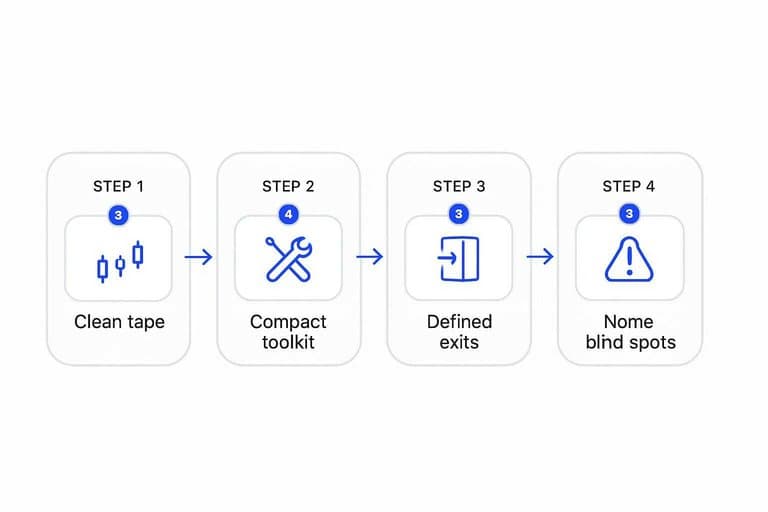
Technicals work best when the tape is clean and the risk is definable. You want enough trading to make signals real, not imaginary.
- Trade liquid names with tight spreads
- Navigate eventful markets with fast repricing
- Ride trends that persist for weeks
- Plan entries around defined risk levels
- Scale out with volatility-based targets
If you can’t define your exit before entry, the chart is just entertainment.
Go-to tools
A compact toolkit beats a cluttered chart. Pick a few tools that answer timing, context, and risk.
Use moving averages for trend and regime, like the 20/50-day combo. Mark support and resistance where price actually reacted, not where you “want” it.
Check relative strength versus a benchmark to avoid fighting the tape. Size risk with ATR, and use volume profile to spot acceptance zones.
If you can’t explain a tool in one sentence, you’re probably curve-fitting.
Blind spots
Charts fail when the next candle is driven by something the chart cannot contain. You get clean lines, then a discontinuity.
- News gaps that skip your stop
- Illiquidity that fakes levels
- Overfit parameters that die live
- False breakouts that reverse fast
- Narrative shocks that rewrite priors
When the regime changes, the “signal” is often just your lag catching up.
Lens 3: Quant screens
Quant screens rank stocks with factor models and backtests. You use them to turn “I like it” into “it scores,” at scale.
A simple value-plus-quality screen can sift 5,000 names overnight. It still bakes in assumptions you may not notice until they fail.
Best use cases
Quant screens shine when you need consistency across a big universe. They also help you stick to rules when your gut wants exceptions.
- Scan broad universes fast
- Enforce a disciplined process
- Harvest known factor premia
- Automate low-cost execution
If you can’t run it monthly, it’s not a screen. It’s a story.
What models miss
Backtests look clean because the mess gets edited out. The “alpha” often depends on a regime you didn’t label.
Value can lag for years, then roar back. A clever factor cocktail can be pure data-snooping, especially with many tweaks. Survivorship bias sneaks in when your dataset forgets dead tickers. And trading costs turn “+3% paper edge” into “flat after slippage.”
If the edge disappears when you add friction, you never had an edge. You had a spreadsheet.
Minimal guardrails
You need a few guardrails to keep screens from drifting into curve-fit theater.
- Validate your data sources and survivorship handling.
- Stress test across regimes, not just one long bull run.
- Include realistic costs: spreads, impact, turnover, taxes.
- Set kill criteria: drawdown, lag window, tracking error.
The goal isn’t a perfect model. It’s a model you can fire before it ruins your process.
For a rigorous framework on this failure mode, see the probability of backtest overfitting.
Lens 4: Narrative
Narratives are the stories investors tell about why a stock should win. They matter because price often reflects expectations more than current results.
Use this lens to spot what the market is already assuming, like “AI will rewrite this industry,” then ask what must be true. The edge comes from testing the story, not repeating it.
Best use cases
Narrative is most useful when fundamentals lag the shift. You’re underwriting a future state, not a trailing quarter.
- Early markets with unclear category leaders
- Platform shifts that reorder distribution
- Brand-driven demand with pricing power
- Inflection stories around product launches
Narrative works best when the story creates measurable milestones, not vibes.
Reality checks
You need a way to falsify the story fast. Otherwise, you’re just paying for a slogan.
- Define the one KPI the story must move.
- List disconfirming evidence you’d take seriously.
- Map the real competition, including substitutes.
- Set time-bound milestones and decision triggers.
If you can’t name a kill switch, it’s not research, it’s fandom.
Blind spots
Narrative investing breaks when the story becomes the thesis and the evidence becomes decoration. You’ll notice it when every datapoint gets interpreted as “proof,” and misses get reframed as “long-term.”
Hype cycles add fuel, and circular “story trades” can trap you in crowded positioning. Base rates get ignored, and dilution gets hand-waved as “strategic,” right up until your per-share math collapses.
Lens 5: Macro
Macro is the “rates, inflation, FX, growth” lens. You use it to sanity-check whether a stock’s tailwinds are real. It fails when you try to trade a CPI print into a single ticker.
Best use cases
Macro works best when the business model is basically a derivative of one big variable.
- Banks with rate- and curve-sensitive NIM
- Commodities tied to spot and inventories
- Exporters with USD translation exposure
- High-duration tech with multiple sensitivity
- Leveraged balance sheets with refinancing risk
If macro is 30% of the P&L driver, it’s a lens. If it’s 5%, it’s a distraction.
Key linkages
Macro linkages are simple until you add real-world messiness like contracts and hedges. A clean mapping still helps you frame what must be true.
Higher discount rates usually compress multiples. A stronger dollar can cut foreign earnings. A steeper curve often helps banks. Higher energy prices can expand or crush margins, depending on pass-through.
Use the mapping to set expectations, then hunt for the exceptions.
For evidence on why curve shifts matter for banks, see the BIS review on net interest margins and yield curve slope.
Blind spots
Macro breaks when the stock’s path depends on details you can’t see in a chart. Even good calls fail when the market already priced them.
- Timing is wrong, even if direction is right
- Hedges and contracts offset the macro move
- Execution dominates the macro backdrop
- “Macro right, stock wrong” on valuation
Macro is the weather. Your stock is the boat.
Lens 6: Sentiment
Sentiment is your read on who’s already in the trade, and who still has to move. You use positioning, flows, and expectations to spot crowdedness, not to predict feelings. Most signals are noisy, so treat them like “weather,” not a map.
Best use cases
Sentiment helps most when the next move depends on surprise, not valuation. You’re looking for “everyone agrees” setups where one catalyst can force repositioning.
- Pre-earnings expectations mispriced
- High short interest squeeze risk
- Capitulation after forced selling
- Extreme fear/greed regime shifts
Trade the gap between positioning and reality, not the mood.
Practical indicators
Use multiple measures because each one lies in a different way. You’re triangulating crowding, not hunting a single magic gauge.
- Put/call ratio extremes
- IV skew and term structure
- Analyst revisions and dispersion
- Insider buys and sells
- Borrow rates and fund flows
When three indicators align, pay attention; that’s often forced flow, not opinion.
Blind spots
Sentiment can stay extreme longer than your patience because constraints keep trades on. A crowded short can persist for months if borrow is stable and the catalyst never lands.
Many signals also lag because they’re reported after positioning shifts, so you’re reading yesterday’s room. The real edge comes from linking sentiment to a plausible catalyst, because “cheap contrarianism” without a trigger is just waiting.
Choosing your lens
Pick the lens that matches your goal and constraints. If you want “sleep-well” holdings, you’ll use different inputs than a fast trade.
One clean way to avoid double-counting is to label what each lens explains, then combine only the non-overlapping parts.
| Your goal | Best primary lens | Key constraint | Don’t double-count with |
|---|---|---|---|
| Long-term compounder | Business quality | Time, patience | Price momentum |
| Cheap with catalyst | Valuation | Catalysts, timing | “Quality” narratives |
| Risk control | Balance sheet | Leverage, liquidity | Macro fear |
| Fast entry/exit | Technicals | Slippage, discipline | “Undervalued” stories |
Pick a Primary Lens, Then Stress-Test the Blind Spots
- Start with your decision: valuation, timing, downside risk, or conviction—then choose one primary lens to lead.
- Add two “counter-lenses” to probe what your primary lens can’t see (e.g., fundamentals + sentiment + macro, or technicals + narrative + fundamentals).
- Run the viability checklist and set guardrails (position size, invalidate conditions, and time horizon) so a single blind spot can’t sink the thesis.
- Use the lens-selection table to keep your process consistent: same questions, same reality checks, and a clear reason for every buy, hold, or exit.
See Leadership, Not Noise
Using fundamentals, technicals, quants, narrative, macro, and sentiment helps you see stocks—but staying objective day to day requires consistent data and context.
Open Swing Trading spotlights potential breakout leaders with daily relative strength ranks, breadth, and sector/theme rotation—so you can build a focused watchlist in minutes. Get 7-day free access with no credit card.
Sources
- The Probability of Backtest Overfitting (SSRN abstract page) — Bailey, Borwein, López de Prado, Zhu — referenced in Minimal guardrails
- BIS Quarterly Review (Dec 2002) — relationship between net interest margin and market interest rates / yield curve slope — referenced in Key linkages