7 Day Trading Mistakes That Blow Up Accounts
A practical troubleshooter for diagnosing and fixing day trading habits that blow up accounts — spot blow-up warning signs, avoid oversizing without edge, set hard stop-loss rules, stop averaging down, break revenge-trading spirals, and prevent late-entry FOMO mistakes.
7 Day Trading Mistakes That Blow Up Accounts
A practical troubleshooter for diagnosing and fixing day trading habits that blow up accounts — spot blow-up warning signs, avoid oversizing without edge, set hard stop-loss rules, stop averaging down, break revenge-trading spirals, and prevent late-entry FOMO mistakes.
If your account swings from “I’ve got this” to “what just happened?” in a few trades, it’s rarely the market—it’s a repeatable mistake you haven’t named yet. The fastest blow-ups usually come with obvious signals: position size creeping up, stops getting “adjusted,” and rules turning optional after a loss.
This troubleshooter helps you catch those patterns early and replace them with simple controls. You’ll learn the warning signs to pause trading, how to size only when you actually have edge, and what to do when FOMO or revenge trading tries to take over.
Blow-Up Warning Signs
You don’t need more trades to diagnose a blow-up. You need a fast read on your equity curve, your risk stats, and your behavior. If you can name the pattern, you can fix the cause before the next click.
Equity Curve Clues
Your P&L curve is a lie detector. It shows which mistake you repeat when pressure hits.
- Sawtooth up, then sharp drops: overtrading after small wins
- Smooth gains, one giant crater: oversized position or no stop
- Flat, then rapid-fire losses: revenge trading after a hit
Treat the curve like a symptom, not your identity, and fix the driver.
Account Health Check
Run these metrics before you place another trade.
- Calculate max drawdown from the last 30 trades.
- Compute average loss in $ and in R.
- Check win rate and compare it to payoff ratio.
- Calculate average R-multiple per trade over the same sample.
- Measure exposure concentration by symbol, sector, or correlated names.
If concentration is high, your “strategy” might just be one crowded bet.
Stop-Trading Triggers
You need hard stop conditions, not vibes, because losses shrink your decision quality. Write them down in one sentence each, like “If I hit -2R, I’m done.”
Pause trading today if you hit your daily loss limit, break a rule you pre-committed to, or feel emotional flooding like rage, panic, or tunnel vision. Your edge doesn’t disappear first. Your discipline does.
Oversizing Without Edge
Oversizing turns a normal losing streak into a margin call, even with a decent setup. You’re not dying from bad trades; you’re dying from math.
- Pick a realistic win rate and payoff, like 45% wins and 1:1 R.
- Assume a common streak, like six losses in a row, because it happens.
- Multiply your risk per trade by the streak to get drawdown.
- Add slippage and gaps, then rerun the drawdown with 1.3× risk.
- If the result hits your max loss limit, your size is the strategy.
Your edge can’t show up if your position size forces you to quit first.
No Hard Stop Loss
Skipping a hard stop turns one bad trade into an account problem. You usually do it for a “good” reason in the moment, like, “Just one more candle.”
Stop Evasion Patterns
Stops get skipped when your brain starts negotiating with price. The story sounds logical, but it’s just delay.
- “It’ll come back” after one more push
- Move the stop “to give it room”
- Average down to “improve the entry”
- Use a “mental stop” you never hit
- Cancel the stop during a spike
If you hear yourself bargaining, you’re already in defense mode, not trade management.
Structure-Based Stops
Your stop should sit where your idea is invalidated, not where the pain feels tolerable.
- Mark the invalidation level from structure, like a swing high or low.
- Add a small buffer past that level to avoid noise tags.
- Set fixed dollar risk for the trade, like $50 or $200.
- Size the position so stop distance matches that dollar risk.
- Place the stop immediately after entry, then leave it alone.
Once size comes from risk, you stop treating the stop like a suggestion.
Execution Safety Net
Even disciplined traders get clipped by fast markets and sloppy clicks. You need guardrails that make the right action the default.
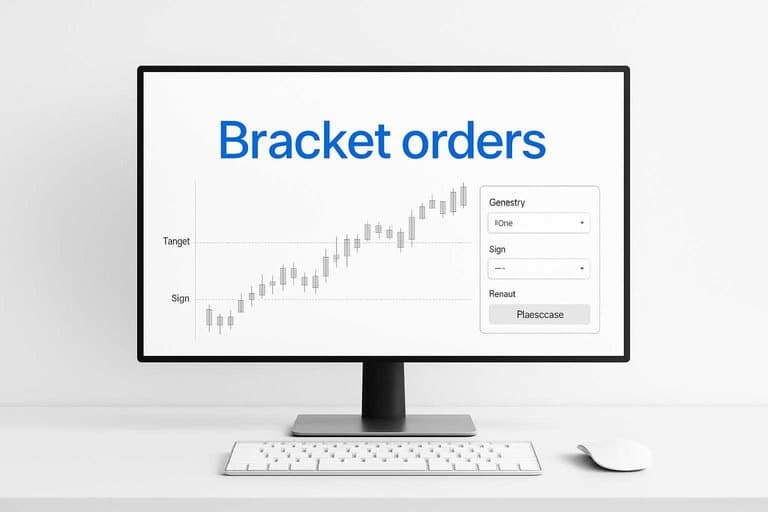
Use bracket orders so your stop and target attach to the entry automatically. Add price alerts near the stop and disable one-click cancel if your platform allows it.
If you can’t accidentally remove your stop, you can’t “accidentally” blow up your day.
For more on why stops/markets may not behave perfectly in fast conditions, see CME’s overview of stop orders with protection.
Averaging Down Losses
You add to a losing trade to “get a better average,” but you’re really buying more risk. It feels like control, yet it’s often a margin call in slow motion.
You can scale only when your plan proves itself, not when price argues with you.
| Situation | Scaling allowed? | Condition | Action |
|---|---|---|---|
| Breakout retest holds | Yes | Stop unchanged | Add on confirmation |
| Trend pullback to level | Yes | Risk stays constant | Add, reduce size |
| Losing, thesis still “feels right” | No | No new signal | Cut or hold size |
| Stop moved wider | No | Risk increases | Exit immediately |
| News spike against you | No | Volatility regime changed | Flatten, reassess |
If your stop moves farther away, you’re not scaling a position. You’re scaling a problem.
Revenge Trading Spiral
A loss can flip your brain from process to payoff. You stop trading your plan and start trading your feelings. One bad fill becomes a personal mission to “get it back.”
Spiral Indicators
You can’t fix revenge trading if you don’t spot the loop early. These cues show up fast, often within minutes of the loss.
- Click faster between tickets and charts
- Increase size without a signal
- Skip your checklist and entries
- Switch markets to find action
- Think “I need it back”
When two or more hit at once, you’re not trading. You’re chasing.
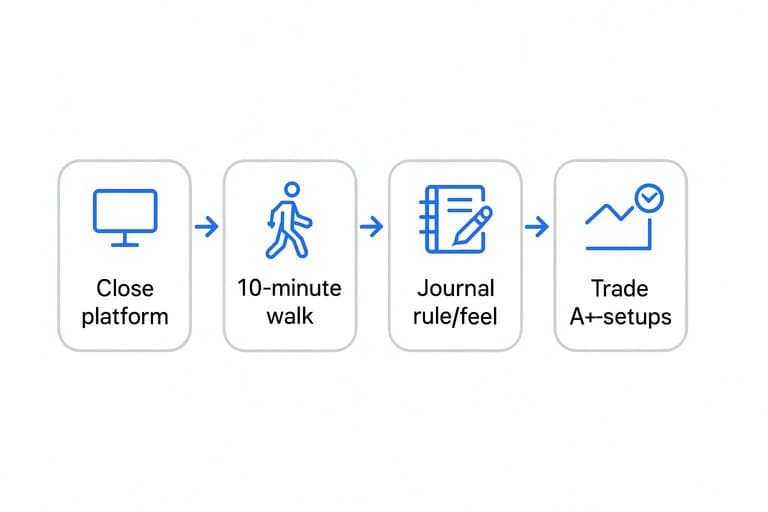
Cooldown Protocol
You need a routine that forces time and friction. Your goal is to break the impulse, not debate it.
- Close the platform and silence alerts.
- Take a 10-minute walk, no phone.
- Journal: “What rule did I ignore, or what did I feel?”
- Reopen only after you can describe your next setup in one sentence.
- Trade only A+ setups, or stop for the day.
The edge isn’t willpower. It’s the circuit breaker you actually use.
Loss-Review Script
You need a clean label for the loss, not a story about it. Use this template right after cooldown, while the details are still fresh.
Write this: “Trade: ____. Plan followed? Yes/No. If Yes: Bad read or normal variance. If No: Rule broken or execution error. One fix for next time: ____.”
Then pick one corrective action:
- Rule-followed loss: reduce size for next 3 trades.
- Execution error: practice entries on replay for 10 minutes.
- Rule broken: add a hard stop, like a daily max-loss.
You’re not trying to feel better. You’re trying to trade differently.
For a broader regulatory view on how quickly day trading can compound risk, FINRA’s day-trading risks and rules are worth reviewing.
Chasing Late Entries
Late entries feel like “I’ll just grab a piece,” but they usually grab you instead. You buy the top of the move or short the bottom, then your stop stays wide while your upside shrinks. That’s how a decent setup turns into a bad trade with good-looking candles.
FOMO Entry Tests
Run this quick check before you click, because your chart will always look “obvious” after it moves.
- Measure distance to invalidation, and convert it into $ risk.
- Calculate remaining R:R to the next target, not your hopes.
- Ask if you would have entered at your planned trigger price.
If any step fails, you’re not trading a setup. You’re paying for emotion.
Pre-Set Triggers
You avoid chasing by deciding your entries while you’re calm, not while price is sprinting.
- Place stop orders at breakout levels you planned.
- Place limit orders at pullback zones you mapped.
- Set alerts one tick before your trigger price.
- Write if-then rules, like “If reclaim VWAP, then buy.”
Your edge is mostly planning. Execution should feel boring.
Accepting Missed Trades
A missed trade is often risk you didn’t have to take. When you chase, you’re volunteering to be last in line.
Treat “missed” as a win, then move it to a “next setup” watchlist with fresh levels and triggers. Your job is to catch the next clean entry, not to redeem the last candle.
Lock In Your Risk Controls Before the Next Trade
- Identify your most common blow-up trigger from this list (oversizing, no hard stop, averaging down, revenge trading, or chasing entries) and write one sentence describing how it shows up in your trades.
- Set one non-negotiable account rule tied to that trigger (e.g., max position size, daily loss limit, mandatory hard stop, or a cooldown after X losses) and make it your “stop-trading trigger.”
- Run the rule for your next 20 trades and track only two metrics: rule compliance (%) and max drawdown. If compliance isn’t near-perfect, fix the process—not the strategy.
Frequently Asked Questions
Does day trading still work in 2026 with algos and high-frequency trading?
Yes—most retail day traders aren’t competing on speed; they win by trading liquid products, using predefined setups, and managing risk tightly. Focus on markets with tight spreads (e.g., SPY/QQQ, major FX pairs, large-cap stocks) and avoid thin names where slippage is the real enemy.
How much money do I need to start day trading without blowing up my account?
A practical starting range is $2,000–$10,000 for futures/FX/crypto or $25,000+ for U.S. stock day trading if you want to avoid PDT constraints. More important than the amount is risking a small, fixed fraction per trade (often 0.25%–1%) so a normal losing streak can’t wipe you out.
What is a realistic win rate and risk-reward ratio for consistent day trading?
Many profitable day traders operate around a 40%–55% win rate with average winners about 1.3R–2.0R and average losers near 1R. Consistency comes from keeping losses small and letting winners reach planned targets, not from trying to win most trades.
How do I measure whether my day trading strategy actually has an edge?
Track at least 50–200 trades in a journal and calculate expectancy (average R per trade), maximum drawdown, and profit factor. If expectancy is positive after fees/slippage and drawdowns are tolerable for your risk limits, you have a tradable edge; if not, you don’t.
Can I day trade successfully with a full-time job and limited screen time?
Yes—most people do better by trading a narrow window (often the first 60–120 minutes of the session) or using set-and-forget bracket orders around preplanned levels. Pick one market, one or two setups, and a fixed routine so you’re not forced into low-quality trades when you’re busy.
Trade Smaller, Select Better
Most account blow-ups start with bad inputs—oversizing, chasing, and trading without context when conditions quietly shift against you.
Open Swing Trading helps you focus on higher-quality setups with daily relative strength, breadth, and sector/theme rotation context—so you’re less likely to force trades. Get 7-day free access with no credit card.
Sources
- Protection Functionality for Market & Stop Orders | CME Group — referenced in Execution Safety Net
- Day Trading | FINRA.org — referenced in Loss-Review Script