
7 Mistakes Spotting Institutional Stocks That Kill Breakouts
A hands-on troubleshooter for diagnosing why “institutional” breakouts fail—verify a real pivot, sanity-check volume vs context, avoid extended entries, demand leading relative strength, and screen base quality and liquidity traps before you buy.
7 Mistakes Spotting Institutional Stocks That Kill Breakouts
A hands-on troubleshooter for diagnosing why “institutional” breakouts fail—verify a real pivot, sanity-check volume vs context, avoid extended entries, demand leading relative strength, and screen base quality and liquidity traps before you buy.
You bought the “perfect” breakout—big volume, clean chart, strong story—and then it just… stalls. Or worse, it snaps back through the pivot and turns your tight risk plan into a slow bleed.
This troubleshooter helps you pinpoint what actually broke: a fake breakout, misleading volume, an entry that was already extended, weak relative strength, a sloppy base, or a liquidity trap. Use the checks and quick fixes to stop guessing and start filtering for breakouts that can truly launch.
Breakout That Won’t Launch
A “failed breakout” is often just a breakout that never met the rules. You triage price, volume, relative strength, and the market first, before blaming a lack of institutions.
Confirm real breakout
A real breakout starts before the pivot, with the base. If the base is loose, the breakout is usually just noise.
You want a clean pivot level, ideally the highest point in the base. Price should clear it with authority, trade above it intraday, and close near the day’s upper range. A close back under the pivot is a red flag, even if it “tagged” the level.
Treat the close like the vote. Intraday is just campaigning.
Volume sanity check
Demand should look obvious on the breakout day, and not just at 10:15 a.m. You’re checking if big buyers are actually leaning in.
- Breakout volume exceeds the 50-day average
- Up-volume beats down-volume, clearly
- Volume expands as price clears pivot
- Little selling on pullbacks
- Late-day buying supports the close
If volume fades into the close, institutions likely weren’t defending the move.
Market headwind scan
A great setup can still fail in a bad tape. You’re checking whether the market is quietly removing the runway.
- Confirm the index trend matches your trade direction.
- Count recent distribution days in major indexes.
- Check whether leading sectors are strengthening or rolling over.
- Verify your stock’s sector isn’t the day’s funding source.
- Reassess if breakouts are failing across your watchlist.
When breakouts fail in clusters, it’s usually the market, not your chart.
Failure symptom map
Some breakouts “work” on paper but fail in behavior. Price pops, then stalls, and the story changes fast.
Watch for reversal candles near the pivot, especially on higher volume. Notice wedging climbs, where price creeps up as volume dries, like a “balloon losing air.” The RS line is your lie detector too: if price breaks out but RS is flat or falling, leadership isn’t there.
If RS won’t confirm, you’re not watching a leader. You’re watching a liquid lottery ticket.
Mistaking “Big Volume”
One volume surge can mean institutions are building a position. Or it can mean tourists stampeded in for a headline.
| Volume surge type | What it looks like | Usual driver | Breakout risk | |—|—|—| | Accumulation | Multiple high-volume up days | Funds scaling in | Lower false breaks | | News spike | One huge day, fades fast | Press release, macro | High failure rate | | Short covering | Big volume, weak close | Forced buy-to-cover | Pops then stalls | | Thin liquidity | Wide spreads, jumpy prints | Few real sellers | Easy to shake out | | Distribution | High volume, flat or down | Large holders selling | Breakout capped |
Treat one-day “big volume” as evidence to investigate, not a buy signal to obey.
Chasing Extended Entries
You don’t lose on great breakouts because your stock “failed.” You lose because you bought it late, then labeled a normal pullback as a breakdown.
If your entry is extended, your stop has to be wider or closer. Either choice poisons the trade.
Extension thresholds
Extension is about odds, not bravery. The farther past the pivot you buy, the more you’re betting on immediate continuation.
A practical way to cap it:
- 0%–3% past pivot: normal zone
- 3%–5% past pivot: only if volatility is low
- 5%–8% past pivot: only with tight risk and fast follow-through
- Above 8%: you’re buying other people’s profit
Use volatility as the tiebreaker:
- Low ATR stock: treat 3% as “getting late”
- High ATR stock: use ~1.0 ATR above pivot as your red line
- Very high ATR: allow up to ~1.5 ATR, but cut size
If your entry sits beyond 1–1.5 ATR from the pivot, you’re no longer trading a breakout. You’re chasing momentum.
You can also anchor this to the classic CAN SLIM discipline to avoid chasing more than 5% past the pivot as a hard guardrail against late entries.
Proper add-on timing
Pyramiding works when you add after you’re right, not while you’re hoping. Your goal is more shares with less average risk.
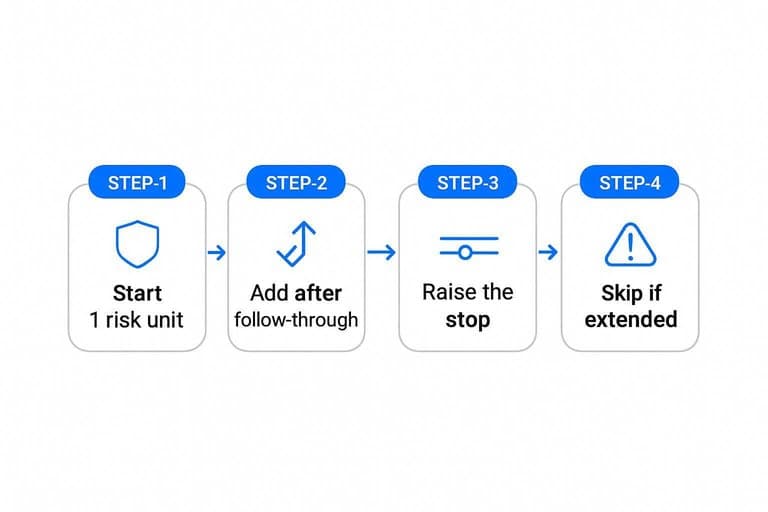
- Start with one risk unit and a stop below the pivot area.
- Add only after a clean follow-through day or tight consolidation.
- Add smaller than the first buy, usually 50% to 70% size.
- Raise the stop to reduce total risk, not to “lock profit.”
- Skip the add if price is extended beyond your ATR limit.
If you can’t add without crowding your stop, you didn’t earn the add-on.
When pullbacks are normal
A good breakout often looks boring right after the pivot. You’re looking for controlled digestion, not a straight line.
- Closes stay tight near highs
- Dips happen on lower volume
- Support holds at the 10-day line
- Support holds at the 21-day line
- Deeper pullbacks respect the 50-day line
If those supports hold, your “scary” pullback is just institutions building the next leg.
Late-entry warning signs
Late entries usually fail fast because there’s no cushion. You buy the emotional part of the move, then meet the first wave of profit-taking.
Watch for tells like a “climax gap” that runs hard at the open, then stalls. Add in an intraday fade, a rapid reversal, or repeated failure to hold VWAP.
When price can’t hold the morning strength, the smart trade is often no trade.
Ignoring Relative Strength
A flat or falling RS line says institutions are buying something else. Your base can look “textbook,” yet the demand is missing.
RS line must lead
You want RS to lead because institutions telegraph leadership before price goes obvious.
- Print RS new highs before price breaks out
- Keep RS slope rising week after week
- Track up weeks closely, not random spikes
- Avoid RS that chops sideways for months
If RS can’t lead in the base, it won’t lead after the breakout.
Hidden RS divergences
RS can rot quietly while price holds up.
- Compare RS versus the sector ETF on weekly and daily.
- Compare RS versus the major index you trade against.
- Compare RS versus the top 3 peers in the group.
- Check 1M, 3M, 6M, and 12M windows.
- Flag any timeframe where RS makes lower highs.
One weak comparison is noise; two or more is rotation.
RS vs price conflict
A breakout on weak RS often fails because buyers are rotating into stronger names. The index can also drag you down even if your chart “clears the line.”
You’ll see it as a clean price push with an RS line that stalls or sinks. That’s the line that gets crossed.
If institutions aren’t choosing your stock versus alternatives, the breakout is just air.
Fix with watchlist rules
Rules beat vibes when RS looks “almost good.”
- Require RS within 5% of a 52-week high before entry.
- Require RS slope up on the weekly for the last 4–8 weeks.
- Require RS to outperform the sector ETF over 3 months.
- Allow one exception: fresh earnings gap on big volume.
Make RS a gate, not a note in your journal.
Buying Weak Base Structures
Institutions don’t buy “bases.” They buy tight risk and rising odds. Your job is to spot the base flaws they skip, then trade the cleaner version.
Base quality checklist
A strong base looks boring on purpose. You want proof of controlled selling and planned support.
- Limit depth to manageable pullbacks
- Require enough weeks to form
- Demand volatility contraction into the right side
- Look for orderly support tests
- Prefer fewer, cleaner lows
When the base tightens late, institutions can size up without moving price.
For classic pattern standards (including tight action requirements), see the IBD chart-pattern notes.
Loose action red flags
Loose price action is a message: big holders are exiting, not building. If it feels like a “casino week,” treat it that way.
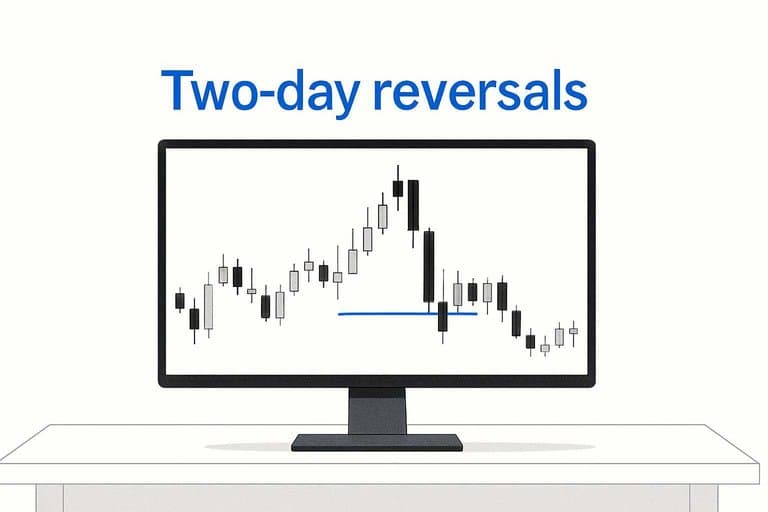
Two-day reversals after a breakout attempt are the classic tell. Wide spreads and choppy weeks also flag distribution, especially on heavier volume.
If the stock can’t stay quiet, it won’t stay owned.
Handle and shakeout errors
Handles and shakeouts are useful only when they tighten risk. Validate them before you call them bullish.
- Confirm the handle forms in the upper half of the base.
- Check volume dries up during the handle.
- Allow a shakeout only near prior support, not mid-air.
- Demand a quick reclaim of the key level.
- Ensure the rebound holds for several sessions.
A shakeout that doesn’t reclaim fast is just a breakdown with better branding.
Pivot placement mistakes
A bad pivot is how you turn a good chart into a bad trade. You “break out,” but your stop sits in no-man’s land.
Choosing a pivot inside the base, or off a random intraday spike, invites false breakouts. You want the level institutions must clear, not the level you hope counts.
Pick pivots that define control, or you’ll keep buying noise and selling fear.
Overlooking Liquidity Traps
A breakout can look institutional on a chart and still be untradeable in real time. Thin floats, wide spreads, and sketchy fills turn “clean” signals into whipsaws.
You’re trying to buy participation, not just a candle.
A fast way to flag liquidity traps before you size up:
| Trap signal | What you’ll see | Why it breaks you | Quick filter |
|---|---|---|---|
| Thin float | Gaps on light volume | Easy to reverse | Prefer larger float |
| Wide spread | 20–80¢ spread | Entry instantly down | Spread under 5–10¢ |
| Erratic fills | Partial fills, slippage | Stops trigger early | Use limit orders |
| Level II mirages | Vanishing bids/asks | Fake support, dumps | Watch time & sales |
| Halt risk | Sudden volatility spike | Reopens against you | Avoid parabolic moves |
If liquidity isn’t boring, your breakout is probably a coin flip.
Run This Pre-Breakout Filter Before Your Next Entry
- Verify the breakout is real: correct pivot, clean close, and no immediate failure symptoms.
- Validate volume in context: compare to the stock’s own averages and the day’s market/sector volume, not just “big.”
- Refuse extended entries: only buy near the pivot/early add-ons; treat late strength as a warning, not confirmation.
- Demand leading relative strength: RS line should lead or at least confirm; add watchlist rules that block RS/price conflicts.
- Grade the base and liquidity: prioritize tight, well-formed structures and avoid thin/whippy names where a few orders can fake demand.
Frequently Asked Questions
How can I tell if a stock is truly an institutional stock or just getting retail hype?
Look for repeated accumulation over weeks (multiple up weeks on above-average volume), improving relative strength vs. the market, and clean price action in a liquid name (tight spreads, consistent daily volume). You can confirm with institutional ownership trends in tools like Nasdaq Institutional Holdings, Whalewisdom, or Bloomberg (if available).
Do institutional stocks still matter in 2026 with ETFs and algorithmic trading dominating volume?
Yes—most breakouts that sustain still require persistent institutional demand, even if the buying is executed through algos and VWAP-style programs. The tell is steady accumulation and strong RS over time, not a single “big volume” day.
What percentage of institutional ownership is “good” for institutional stocks?
Often 35% to 80% institutional ownership is a healthy zone for liquid growth stocks, with the key being an upward trend in ownership rather than the absolute number. Extremely high ownership can reduce future marginal demand, while very low ownership often signals limited sponsorship.
How do I measure institutional accumulation without Level 2 or order flow tools?
Use weekly charts to spot accumulation patterns (up weeks on above-average volume, tight closes near highs) and track Accumulation/Distribution and On-Balance Volume for confirmation. Pair that with relative strength vs. the S&P 500 or your sector ETF to verify demand is persistent.
What should I do if I like the story but the stock doesn’t look like an institutional stock yet?
Put it on a watchlist and wait for a clean base and a high-quality breakout with strong RS and consistent liquidity, rather than forcing an early entry. If you must participate, keep size small and use a predefined stop so you’re not relying on “future institutions” to save the trade.
Find Real Breakout Leaders
Avoiding volume traps, weak bases, and extended entries is easier when you can quickly see relative strength, breadth, and where institutional demand is actually flowing.
Open Swing Trading surfaces potential breakout leaders with daily RS rankings, breadth, sector/theme rotation, and extension scoring—so you can build tighter watchlists in minutes. Get 7-day free access with no credit card.
Sources
- CANSLIM mailing list archive: “Don’t chase it up more than 5% past its pivot” (xmission.com archive) — referenced in Extension thresholds
- IBD Chart Patterns (archived PDF via Paperzz) — referenced in Base quality checklist