9 Swing Trading Mistakes That Cause Late Entries
A practical swing-trading troubleshooter for fixing late entries—spot your late-entry pattern, stop chasing extended breakouts, define hard entry triggers with invalidation, control “confirmation creep,” read market regime correctly, and execute level-first around key support/resistance.
9 Swing Trading Mistakes That Cause Late Entries
A practical swing-trading troubleshooter for fixing late entries—spot your late-entry pattern, stop chasing extended breakouts, define hard entry triggers with invalidation, control “confirmation creep,” read market regime correctly, and execute level-first around key support/resistance.
You see the setup early… then you hesitate. Minutes or days later you buy anyway—right as the move runs out and your stop has to be wider than it should be.
This troubleshooter helps you diagnose exactly why you’re entering late and how to correct it fast. You’ll learn to recognize the late-entry pattern, avoid chasing extended breakouts, turn vague ideas into rule-based triggers, cap confirmation creep, match entries to trend vs chop, and map key levels so your execution happens on time.
Spot the Late-Entry Pattern
A late entry happens when you buy or short after the best risk point has already passed. On a chart, it looks like you enter near the end of an impulsive move, right before price snaps back into balance. If you’ve ever clicked “market buy” on a breakout candle and heard your brain say, “Don’t miss it,” you’ve seen it in real time.
Late entry symptoms
Late entries leave fingerprints you can spot in seconds.
- Chasing an extended candle into resistance or support
- Accepting a poor risk-to-reward at entry
- Seeing an immediate pullback against your position
If you get the pullback right after entry, you weren’t early—you were liquidity.
Quick self-audit
Use these questions to isolate whether timing, selection, or execution is making you late.
- Did I enter after two+ large candles?
- Did I widen my stop to “make it work”?
- Did I skip my planned entry trigger?
- Did I ignore the next obvious level?
- Did I hesitate, then market in?
Your fix depends on which question stings the most.
Why it keeps happening
Late entries repeat when FOMO replaces rules and your trigger is fuzzy. You wait for “confirmation,” then your fill arrives when the edge is already priced in. Add one more delay—notifications, indecision, manual order entry—and you train yourself to buy strength late and sell weakness late.
Write the trigger so a robot could follow it, or your emotions will keep clicking for you.
Chasing Breakouts After Extension
Breakouts feel urgent, so you buy the moment price is obvious. If the move is already extended, you’re paying top dollar for shrinking upside.
- Measure the move from the last base, not from your emotion.
- Check distance to the next resistance, not just the breakout level.
- Place a logical stop under structure, then compute reward-to-risk.
- If R:R is under your floor, skip or wait for a pullback.
- If you still want in, scale smaller and define a tight invalidation.
Extended breakouts don’t fail because you’re “unlucky”; they fail because the math is already against you.
Vague Entry Triggers
“I’ll buy when it looks strong” sounds flexible, but it’s a hesitation machine. You end up waiting for one more green candle, then clicking after the move is mostly done.
Replace vibe-based language with a trigger you can’t argue with, plus a clear invalidation line. When the market hits your condition, you act. Or you pass.
Ambiguous trigger examples
Vague cues feel safe because they don’t force a decision. They also invite endless debate in real time.
- “Big green candle”
- “Momentum is picking up”
- “Trend is up”
- “Looks like buyers stepped in”
- “Breakout vibes”
If you can’t point to a level and rule, you’re trading your mood.
Hard trigger template
You need a trigger that fires, not a story you tell yourself. Write it so a robot could take it.
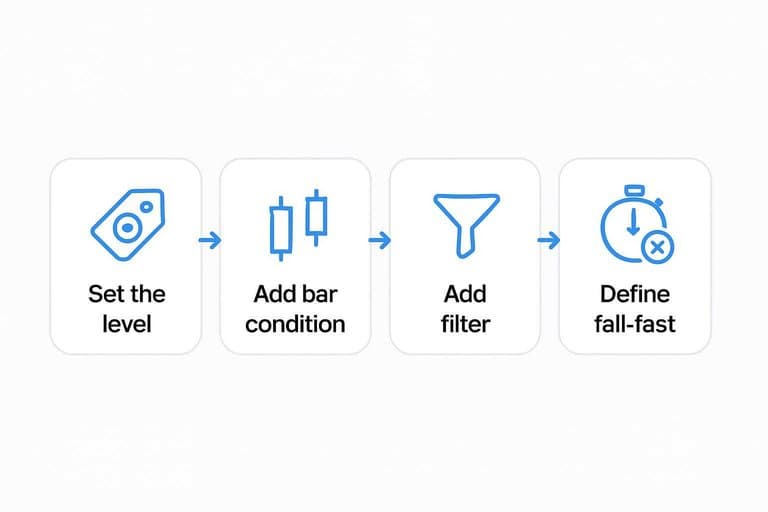
- Set the level: “Buy stop at $X above prior day high.”
- Add bar condition: “Only if a 5-min candle closes above $X.”
- Add filter: “Volume > 1.5× 20-bar or ATR expansion.”
- Set timing: “Enter within 2 bars of the close.”
- Define fail-fast: “No fill by time, cancel order.”
Your edge shows up when your rules do.
Invalidation built-in
A trigger without invalidation turns into “just one more confirmation.” That’s how you chase strength at the worst price.
Pick the price that proves you wrong, not the price that makes you feel better. For a breakout, that might be “below the breakout level” or “below the base low,” and it must be written before you enter.
Once your invalidation is set, hesitation becomes a rule break, not a judgment call.
Waiting for Perfect Confirmation
You can talk yourself into “safety” by stacking indicators until the move is mostly over. That’s how late entries happen: your edge was at the trigger, not after three extra green candles.
Use a minimum confirmation rule tied to your setup, not your mood. Think “one clean trigger,” not “every light green.”
Confirmation creep signs
It starts as caution and ends as a new system mid-trade. Spot it early, or you’ll keep buying the top of your own patience.
- Adding indicators after the setup triggers
- Requiring extra candles to “prove” it
- Moving the trigger level upward
If you do any of these, you’re not confirming—you’re negotiating.
Minimum confirmation rule
You need a rule that makes decisions boring and fast. Two checks. A short clock.
- Define one primary trigger tied to your setup.
- Pick one secondary filter that blocks bad trades.
- Set an entry window, like 1–3 candles after trigger.
- Enter inside the window, or stand down.
Your goal is consistency under pressure, not perfect information.
When confirmation helps
Confirmation is valid when the tape is noisy or the risk is binary. In low-liquidity names, one extra check can stop you from getting trapped in a spread.
It also makes sense near earnings, or in trend transition zones where breakouts often fake. In those cases, “wait for the reclaim” is a rule, not hesitation—and it can help to recognize how FOMO in trading pushes you toward late, over-confirmed entries.
Misreading Market Regime
Late entries often start with the wrong playbook. If you trade breakouts in chop, price “breaks out” ten times a week and you chase the worst one.
Add a quick regime check before you plan entries. It saves you from buying the top of noise.
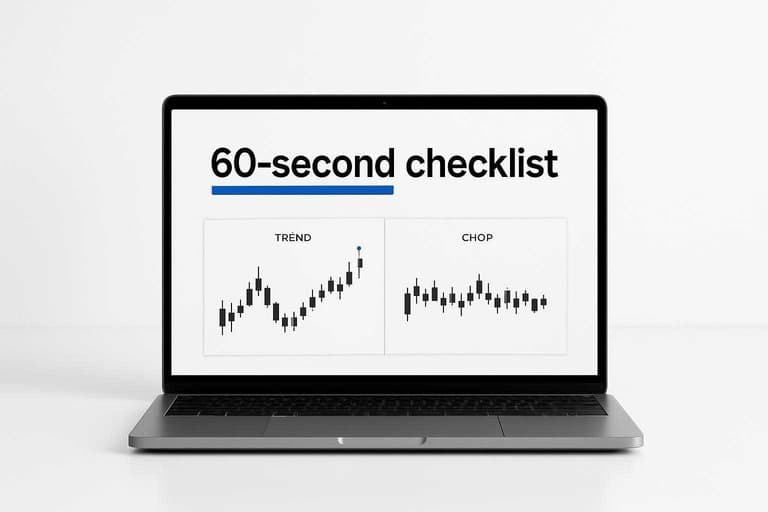
Trend vs chop checklist
Run this 60-second checklist before you mark an entry level.
- Print higher highs and higher lows
- Show moving average sloping up
- Expand ATR during pushes
- Respect clear range boundaries
If you can’t tick three boxes, stop calling it a trend.
Regime-based entry choice
Pick the tactic after you name the regime.
- In trend, take breakouts after tight consolidation.
- In chop, fade moves at range edges.
- In chop, avoid entries in the mid-range.
- If regime is unclear, reduce size or skip.
Your entry timing improves when your tactic stops fighting the market.
One chart to confirm
Use one higher timeframe to keep yourself honest. A 4H or daily view can show a clean range while your 15-minute chart looks “breakout-ready.”
If the higher timeframe is boxed in, treat lower-timeframe spikes as liquidity grabs, not signals.
Ignoring Key Levels
Late entries often happen when you trade the move, not the map. If you ignore support/resistance, VWAP, and prior highs/lows, you buy into supply or short into demand. That’s how a “clean breakout” turns into instant chop.
Levels that matter
You need a short list of levels worth respecting, or you’ll react late.
- Prior day high and low
- Major swing highs and lows
- Unfilled gaps and gap edges
- High-volume nodes and shelves
- Round numbers like 50, 100
If price is near two or more, it’s a decision zone, not a chase zone.
Pre-market mapping routine
Do this before the open, or you’ll do it emotionally mid-trade.
- Mark prior day high/low and pre-market high/low.
- Draw the last two clear swing points on your timeframe.
- Note VWAP and the nearest volume node.
- Set alerts slightly before each level, not on it.
- Define your decision zone: within X% or Y cents of levels.
When your alert hits, you execute a plan, not a feeling.
Level-first execution
Entries work best at levels, with confirmation, not after price has already traveled. Wait for a trigger at your level, like a rejection wick, a reclaim, or a tight consolidation. If the break and retest happens far from the level, you’re paying worse prices into the next zone.
Your edge is the location. The trigger just gives you permission.
Turn the Next Setup Into an On-Time Entry
- Before the open, map the key levels (prior high/low, major S/R, gap levels) and write your regime call: trend or chop.
- Choose one entry style that fits that regime and define a hard trigger plus an invalidation level (what proves you wrong).
- Add a minimum-confirmation rule (e.g., one signal only) and pre-commit: if price is extended past your trigger zone, you pass—no breakout chasing.
- When the alert hits, execute level-first: enter at/near the level, place the stop at invalidation, and record whether you followed the trigger without adding “one more” confirmation.
Frequently Asked Questions
How do I know if my swing trading entry is late compared to the setup plan?
Your swing trading entry is usually late if you enter after the planned trigger bar closes and price has already moved beyond your intended entry zone by more than 25–50% of the setup’s risk (distance to stop). Track “planned entry vs. actual fill” in a journal to spot repeat delays.
What’s the best order type for swing trading to avoid late entries—limit, stop, or market?
Use a stop order for breakout triggers (so you’re in as the level breaks) and a limit order for pullback entries (so you get filled at your price without chasing). Reserve market orders for fast-moving names when slippage is acceptably small relative to your planned risk.
How long should I wait for a swing trading setup to trigger before I cancel it?
Most swing traders cancel the setup if it hasn’t triggered within 3–10 bars on their trading timeframe (e.g., 3–10 daily candles) because the edge decays as the chart structure changes. Add a time-based invalidation rule to prevent “late, frustrated” entries.
Can alerts and automation help prevent late entries in swing trading?
Yes—price alerts at the trigger level plus a prebuilt bracket order (entry, stop, target) often reduces reaction time from minutes to seconds. Tools like TradingView alerts and broker OCO/bracket orders are commonly used for this.
What position size and stop-loss approach reduces the urge to chase in swing trading?
Risk a fixed 0.5%–1.0% of account equity per trade and place the stop at a predefined technical invalidation level, not a “comfort” distance. When size is tied to a fixed dollar risk, you’re less tempted to widen stops or chase a worse entry.
Enter Earlier With Better Context
Late entries often come from chasing extension, using fuzzy triggers, or misreading regime and key levels—problems that start with weak preparation.
Open Swing Trading helps you identify potential breakout leaders sooner with daily relative strength rankings, breadth, and sector/theme rotation context—get 7-day free access with no credit card.
Sources
- Risk-Reward Ratio - Definition, Formula, Example & Trading Insights | TradingMetrics Docs — referenced in Chasing Breakouts After Extension
- FOMO in Trading: Causes, Effects & Data-Driven Solutions | TradesViz — referenced in When confirmation helps