
Advanced Day Stock Trading: Liquidity, Volatility, Regime Shifts
An advanced pillar guide to day stock trading under changing market conditions—build a trading regimes map, read liquidity beyond volume, contextualize volatility, spot regime-shift triggers, execute under stress, match setups to regimes, and run risk as a system with a monitoring dashboard.
Advanced Day Stock Trading: Liquidity, Volatility, Regime Shifts
An advanced pillar guide to day stock trading under changing market conditions—build a trading regimes map, read liquidity beyond volume, contextualize volatility, spot regime-shift triggers, execute under stress, match setups to regimes, and run risk as a system with a monitoring dashboard.
If your best setup “stops working” mid-session, it’s rarely because the pattern failed—it’s because the market regime changed underneath it. Liquidity thins, volatility reshapes, and the same entry signal suddenly produces a different path and fill.
This pillar breaks the day into tradable regimes and shows you how to adapt in real time. You’ll learn what to watch for in depth and spreads, how to size with volatility context, what typically triggers regime shifts, and how to execute and manage risk when conditions get noisy.
Trading Regimes Map
Your edge lives inside microstructure, not inside your opinion. Liquidity, volatility, and flow combine into regimes that change what “good” looks like intraday.
A clean mental model keeps you from forcing the same play into a different game.
Regime primitives
Liquidity, volatility, and flow are your three state variables. They set the rules for entries, exits, and sizing before you even see a chart pattern.
Liquidity controls how much you can do without moving price. Volatility controls how far price can move while you wait. Flow controls whether your fills help or hurt.
Treat them like constraints, not “context,” and your decisions get simpler.
Intraday regime cues
You can read the regime from behavior, not predictions. Watch what the book and tape do when nothing “newsworthy” is happening.
- Spreads widen on small trades
- Top-of-book flickers without follow-through
- Depth pulls before market orders
- Realized vol clusters into bursts
- Reversions weaken into drifts
When three cues align, trade the regime you see, not the one you want.
Regime transitions
Regime shifts rarely announce themselves with a clean signal. They start as micro changes in execution quality, then infect your P&L.
Spreads and depth often move first because market makers reprice risk fast. Correlations and realized volatility can lag because they need time to print. Volatility-of-vol spikes early when participants stop agreeing on “fair.”
Lagging indicators fail because they describe the new regime after it already taxed your fills.
Decision framework
Use an if/then grid so you act on regime evidence. It keeps you from negotiating with the market mid-trade.
| Liquidity | Volatility | Flow | Default tactic |
|---|---|---|---|
| High | Low | Two-sided | Mean-revert, scale |
| High | High | One-sided | Breakouts, trail |
| Low | Low | Stop-start | Reduce size, wait |
| Low | High | Aggressive | Stand down, reassess |
Your job is not to trade every regime. Your job is to trade the ones you can actually execute.
Liquidity Beyond Volume
Printed volume can look huge while the book is still fragile. True liquidity is what you can trade now, at size, without getting punished on price. Fill quality, impact, and queue behavior decide whether your edge is mean reversion, momentum, or standing aside.
Depth vs. resilience
Depth is what you see resting. Resilience is how fast it comes back after someone sweeps it.
A resilient book often shows these traits:
- Depth refills quickly after aggressive buys or sells
- The spread snaps back instead of drifting wider
- Follow-through stalls after the sweep
In that environment, tighter stops and reversion entries make more sense because the book keeps rebuilding.
Spread microdynamics
Spreads widen for different reasons, and the reason changes your order choice.
- Widens on tiny trades, then stays wide
- Widens with fast prints, then flickers
- Widens as depth vanishes, not price moves
- Widens with price gaps and chasing
- Widens near opens, halts, news
If widening comes from toxicity, you pay for impatience with market orders.
Hidden liquidity traps
Hidden liquidity can make the tape look calm while the real queue is unstable. Icebergs, midpoint pegs, and dark prints can absorb flow, until they suddenly stop.
Imagine a stock where midpoint prints keep appearing, so you keep leaning on a tight range. Then the midpoint interest pulls, the visible book was thin, and your next exit hits air.
Treat “stable” pricing with invisible support as borrowed time, not a safety net.
Measuring liquidity live
Use quick proxies you can watch without building a full microstructure model.
- Track spread/price and note sudden step-changes.
- Watch top-of-book depth refill time after small sweeps.
- Compare cancels to adds when price is stationary.
- Log slippage versus size on similar entries and exits.
- Count partial fills and queue stagnation on your limits.
When your proxies disagree, assume liquidity is conditional and size down.
Volatility With Context
Volatility isn’t a single number you plug into a spreadsheet. It’s a regime with a shape, a speed, and a market microstructure behind it.
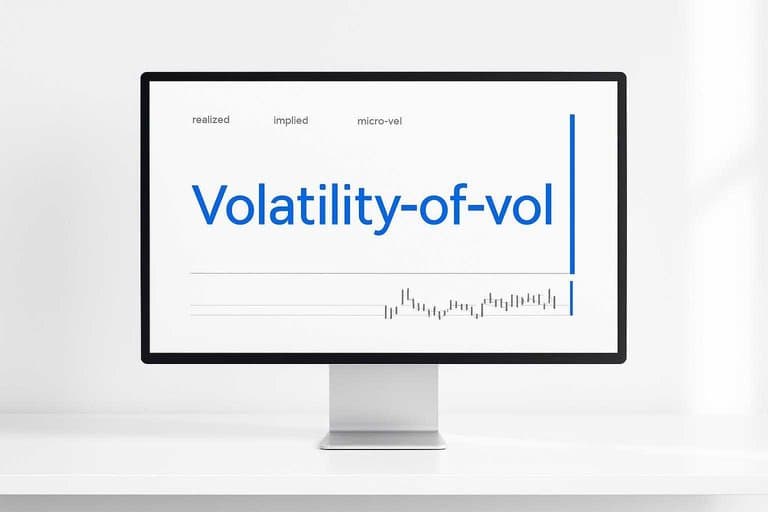
Treat realized vol, implied vol, and micro-vol as three lenses on the same distribution. Your setup choice should change when those lenses disagree.
Volatility-of-vol
Stable volatility lets fixed stops and targets behave. Unstable volatility makes those levels random, because the yardstick keeps moving.
Imagine a morning where the 1-minute range doubles twice in 30 minutes. Your “normal” stop becomes either too tight or pointless.
Use dynamic bands, time stops, or volatility scaling, or you’ll confuse noise with failure.
Tail behavior signals
Fat tails show up as execution pain before they show up in your P&L. You want clues that the next move could be discontinuous.
- Gaps through levels you expected to trade
- Single-bar range expansion on average volume
- Repeated stop-runs near obvious highs/lows
- Wicks that reject, then re-break immediately
- Spreads that widen during “calm” ticks
When you see two or more together, trade smaller or trade simpler.
Range vs trend regimes
High volatility can mean two opposite things: mean reversion fuel or trend ignition. The difference is structure, not excitement.
In ranges, volatility expands but overlaps, and pullbacks retrace deeply. In trends, impulses look clean, and pullbacks are shallow and asymmetric.
Your job is to label the tape fast, because the wrong playbook gets punished immediately.
Volatility sizing rules
Size should come from volatility and liquidity, not conviction.
- Measure ATR or short-window realized vol for your holding period.
- Set max heat per trade, then convert it into a stop distance.
- Compute shares/contracts from heat ÷ stop distance.
- Apply a liquidity cap based on typical spread and depth.
- Reduce size when vol-of-vol rises or tails appear.
If your size ignores impact, your “edge” becomes your fill. (For a classic framework on impact-aware sizing and execution costs, see Optimal Execution of Portfolio Transactions.)
Regime Shift Triggers
Regimes flip when the market’s plumbing changes faster than your playbook. Your edge comes from recognizing the switch early and trading smaller, cleaner, or not at all.
Prediction is optional. Preparation is not.
Scheduled events
These are known clocks that routinely reset liquidity and volatility. You plan tactics and no-trade windows before the tape speeds up.
- Open/close auctions: expect jumps, not continuity
- Macro releases: widen bands, cut size, avoid first prints
- Earnings: treat as new market, not a gap
- Index rebalances: anticipate flow, fade your opinions
- Options expiry: watch pin risk and hedging
Write the rules pre-market, or you’ll write them with P&L.
Flow-driven breaks
Some regime shifts are just one big order expressing itself across venues. You won’t see the intent, but you’ll feel the footprint.
Imagine a large portfolio sell program hitting futures first. Dealers hedge deltas, ETFs adjust baskets, and correlated names move together. Spreads widen, and mean reversion stops working until the flow finishes.
When flow drives, correlations spike because everyone is trading the same hedge.
Structure-driven shifts
Market structure can flip your execution from “tight and continuous” to “gappy and conditional.” You trade the rules, not the chart.
- Halts: reopen prints can invalidate stops
- LULD bands: price snaps, then freezes
- SSR: shorting mechanics change, slippage rises
- Volatility pauses: queues matter more than signals
Your fill probability becomes a variable, so your strategy must become conditional.
Confirmation checklist
You confirm a shift with microstructure, not vibes. Check the tape, then decide whether to press, reduce, or stand down.
- Check spread and quote stability across venues.
- Check top-of-book depth and how fast it replenishes.
- Check realized volatility versus your strategy’s tolerance.
- Check correlation jumps in your watchlist and hedges.
- Check execution quality: slippage, partials, cancel rates.
Re-engage only when execution is predictable again.
Execution Under Stress
Stress execution is where good ideas die. Thin books, fast tapes, and toxic flow punish anything lazy. Your job is simple: reduce adverse selection and control slippage.
Order type selection
Pick the order type that matches the regime, not your preference. The same button is either protection or a donation.
| Order type | Use when | Main edge | Main risk |
|---|---|---|---|
| Limit | Stable spread | Price control | No fill |
| Marketable limit | Fast but liquid | Caps slippage | Partial fills |
| Stop-market | True emergency | Guaranteed exit | Worst fill |
| IOC/FOK | Thin or toxic | Avoid queue | Missed trades |
Treat order types like risk controls, not execution conveniences.
Queue position tactics
Queue position decides whether you get paid or picked off. In stressed markets, being “filled” can be the warning.
Join when you expect flow to come to you, and the level is defended. Improve when you need priority and you can tolerate being the new target. Fade when the book looks like it will disappear, and you’d rather pay up later.
If liquidity is about to pull, the worst place is first in mind and last in line.
Stop placement nuance
Stops fail when they’re obvious and static. Under stop-runs, you need stops that adapt and invalidate.
- Set the stop distance using current volatility, not yesterday’s candle.
- Anchor the stop to structure, not round numbers.
- Add a time stop when the thesis needs speed to work.
- Move the stop only after new structure forms, not mid-noise.
- Recheck after regime shifts, because volatility can reprice instantly.
Your stop should represent a broken thesis, not a briefly swept level.
Scaling mechanics
Scaling reduces regret, but it can leak intent. You want smaller footprints without turning into predictable flow.
- Scale in on confirmation, not on hope.
- Scale out at structure, not at arbitrary fractions.
- Keep clip sizes irregular to avoid signaling.
- Expect partial fills and predefine the next action.
- Reprice only when spreads re-anchor.
If you can’t describe your next order before the fill, you’re already behind.
Setup–Regime Fit
Your setup is a bet on market microstructure. Liquidity and volatility are the hidden assumptions.
When the regime shifts, your “edge” often flips into a liability. Treat regime-fit as the first filter, not a footnote.
Mean reversion fit
Mean reversion needs prices to snap back because trading stays cheap. You want stable depth and predictable fills.
In practice, look for tight spreads, consistent top-of-book size, and low vol-of-vol. Favor names where bids refill after small sweeps.
When one-way flow hits and spreads widen, mean reversion becomes catching a falling knife.
Momentum fit
Momentum needs range expansion without the market “disappearing.” You want follow-through, not just prints.
The sweet spot is expanding range with resilient liquidity: spreads stay reasonable, depth steps down smoothly, and pullbacks hold structure. You can add on higher lows because exits still exist.
If the move is thin-air with liquidity cliffs, you’re trading a vacuum, not momentum.
Breakout filters
Breakouts fail when the pre-break auction is already toxic. Filters keep you out of the loud, low-quality breaks.
- Compression tightens without spread widening
- Pre-break depth holds at key levels
- Retest respects level with absorption
- Post-break spreads stay controlled
- Prints show two-way participation
If flow is toxic, your best breakout trade is often no trade.
Reversal constraints
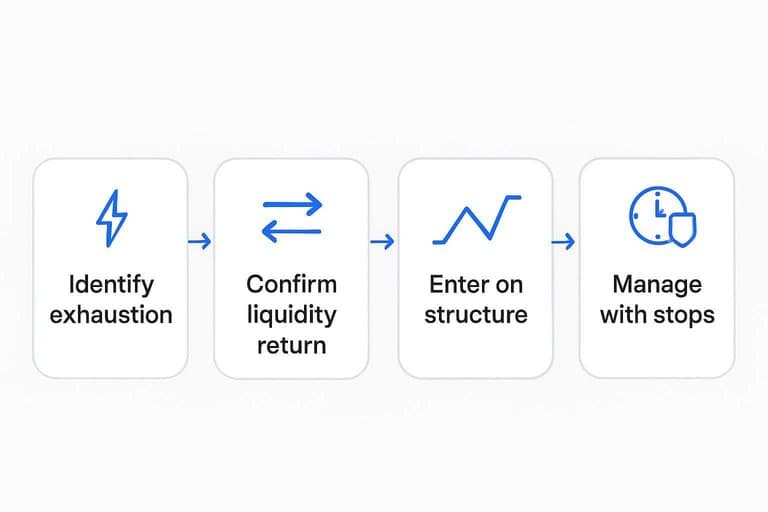
Reversals work when panic ends and liquidity returns. You’re not predicting tops; you’re verifying a turn.
- Identify exhaustion: failed extension and aggressive sweep stalls.
- Confirm liquidity return: spreads tighten and depth refills.
- Enter on structure: break, pullback, then hold.
- Manage with time stop: no bounce, no thesis.
- Manage with vol stop: exit if range re-expands against you.
Your job is to trade the second move, not the first impulse.
Risk as a System
Risk control works best when it behaves like software, not willpower. You’re building one operating model that links per-trade sizing, intraday drawdown, and regime-based exposure, so your worst moments trigger your best constraints. Tools that make regime and leadership context explicit—like Open Swing Trading’s daily breadth and relative strength views—can help you define those constraints ahead of time instead of improvising under pressure.
Imagine a clean breakout strategy on a normal day, then a headline hits and spreads widen. Your per-trade stop still “works,” but your fills and correlations don’t, so the system must automatically pull risk before you debate it. Having a daily, after-close read on market breadth and sector rotation also makes it easier to recognize when “normal day” assumptions have quietly changed.
Exposure throttles
Your size should be a function of regime and execution quality, not confidence. Throttles give you pre-decided ceilings on risk when conditions drift.
- Cap max position size by regime
- Limit max trades per window
- Set max heat across open positions
- Auto-reduce size when slippage worsens
- Pause new entries when spreads widen
When your fills deteriorate, you’re not “unlucky.” You’re in a different game. This is where a simple, consistent daily regime check—breadth, index participation, and whether leadership is expanding or narrowing—helps you justify tightening throttles before the tape forces the lesson.
Correlation and basket risk
Single-name risk quietly becomes factor risk when you stack similar names. You think you’re diversified, but you’re just levered to the same tape.
A momentum long in one high-beta tech name is manageable. Three similar longs often move like one crowded position.
Treat the cluster as one trade, or it will treat you as one account. Practically, that means pairing your chart-based picks with a quick sector/industry strength view so you can see when “three different tickers” are really one theme—something relative strength and sector matrices make obvious before correlation shows up in your P&L.
Kill-switch design
You need hard stops that fire without negotiation. They protect you from the two real blowups: broken conditions and broken behavior.
- Halt new entries when slippage breaches your preset threshold.
- Stop trading after a fixed count of consecutive losses.
- Freeze risk when realized volatility spikes beyond your regime band.
- Exit and disable trading on platform, routing, or data anomalies.
- Require a cooldown and checklist before re-enabling.
If your system can’t say “no,” your P&L will say it for you. A “regime band” is easier to define when you’re tracking objective, repeatable inputs (breadth deterioration, new highs/lows behavior, leadership quality) rather than relying on vibes mid-session. If your process includes volatility-triggered pauses, it also helps to understand the market’s own Limit Up/Limit Down (LULD) plan overview.
Post-trade attribution
You can’t improve what you don’t separate. Attribution isolates strategy edge from execution drag, so fixes land in the right place.
Tag each trade by regime, order type, slippage, and hold time, then review in clusters. A strategy can be right while your entries are late, or your exits are noisy.
Most “strategy problems” are actually process problems with a signature. If you also tag trades with a simple leadership/context label (e.g., RS rank tier at entry, sector strength, breadth state), you can tell whether the issue was selection in a weak tape or execution on a good idea—without needing automated buy/sell signals.
Monitoring Dashboard
You need a small set of live indicators that flag regime shifts before your P&L does. The goal is faster tactical changes: size, holding time, and which setups you even allow.
A simple dashboard works best when each signal has a clear action.
| Live indicator | What it detects | If rising | Tactical adjustment |
|---|---|---|---|
| Market breadth | Participation quality | More names follow | Trade breakouts wider |
| ATR / range expansion | Volatility regime | Moves get larger | Reduce size, widen stops |
| Volume at key levels | Acceptance vs rejection | Levels stick | Hold winners longer |
| Correlation / beta clustering | One-way tape risk | Trades move together | Cut exposure, diversify |
| News/event density | Exogenous shock risk | More surprises | Shorten holds, be picky |
Treat this table like a ruleset, not a report. If two indicators flip, you shift mode immediately.
Trade the Regime, Not the Screenshot
- Start each session by tagging the current regime: structure (trend/range), liquidity quality (spread/depth/resilience), and volatility character (steady vs. vol-of-vol).
- Require a regime cue before taking a setup—then choose the setup family that fits (mean reversion, momentum, breakout, reversal) and apply the matching filters.
- Adjust execution to conditions: when liquidity is fragile, prioritize limit tactics and smaller clips; when volatility expands, widen stops deliberately and reduce size via your sizing rules.
- Run risk like a system: enforce exposure throttles, watch basket correlation, and use a kill-switch plus post-trade attribution so your playbook improves with every regime shift.
Frequently Asked Questions
Is day stock trading still viable in 2026 with tighter spreads, algos, and faster price discovery?
Yes, but the edge usually shifts from predicting direction to exploiting regime-specific execution, risk control, and timing where liquidity and volatility temporarily misprice outcomes. Your results often depend more on avoiding adverse selection and trading only “clean” regimes than on finding more setups.
How do I tell if a stock is truly liquid for day stock trading, not just showing high volume?
Check Level 2/order book depth, spread stability, and whether you can repeatedly enter/exit near your intended price without large queue slippage. Time & Sales patterns (frequent mid/inside prints vs constant sweeping) and your own fill quality logs are often more reliable than volume alone.
What indicators can I use to spot an intraday regime shift early in day stock trading?
Watch for a sudden change in spread and top-of-book depth, volatility expansion/contraction on your execution timeframe, and a shift in how price reacts to market orders (e.g., more follow-through vs snap-backs). Also monitor the stock’s correlation to its sector/benchmark—decoupling often signals a new micro-regime.
Can I use options implied volatility to plan day stock trading entries and exits?
Yes—use implied volatility as a “volatility expectation” baseline, then compare it to realized intraday movement to size risk and choose tactics (scaling, targets, and stop distance). It’s most useful when you track how IV changes around events, not as a standalone buy/sell trigger.
Do I need a swing-trading tool to improve my day stock trading watchlist and regime awareness?
Not required, but a daily, data-driven leadership and breadth view often improves your day-trading stock selection by focusing you on names with institutional attention and cleaner trend context. Platforms like Open Swing Trading can help with premarket preparation via relative strength, breadth, and sector/theme rotation—without replacing your intraday execution plan.
Spot Leaders Before Regimes Shift
All the regime maps, liquidity reads, and volatility context only help if you can surface the right tickers fast and track leadership as conditions change.
Open Swing Trading streamlines stock selection with daily relative strength, breadth, and sector/theme rotation—built for discretionary traders who want better regime awareness without signals. Get 7-day free access with no credit card.
Related Articles
- 6 Day Stock Trading Styles: Use Each When
- Set up a market breadth dashboard in 30 minutes
- Stock Market Data: End-of-Day vs Real-Time for Swing Traders
Sources
- Almgren & Chriss — Optimal Execution of Portfolio Transactions (Dec 2000 working paper PDF) — referenced in Volatility sizing rules
- FINRA — Limit Up/Limit Down (LULD) Plan overview (Reg NMS extraordinary volatility plan) — referenced in Kill-switch design