
Advanced Stocks Open Mechanics for Breakout Entries
An advanced pillar guide to trading breakout entries at the stock market open—decode auction-to-continuous microstructure, upgrade breakout definitions with volatility and gap context, stack pre-open signals, and control slippage and risk with execution playbooks and regime filters.
Advanced Stocks Open Mechanics for Breakout Entries
An advanced pillar guide to trading breakout entries at the stock market open—decode auction-to-continuous microstructure, upgrade breakout definitions with volatility and gap context, stack pre-open signals, and control slippage and risk with execution playbooks and regime filters.
If your best breakouts keep failing in the first five minutes, it’s usually not your chart—it’s the open. The opening auction creates prints, spreads, and liquidity that don’t behave like the rest of the session, and “clean” levels can be mirages when the book resets.
This pillar walks you through how the open actually transitions into continuous trading, how to define breakouts that respect gaps and volatility, and how to execute with slippage-aware orders, false-breakout detection, and open-specific risk rules.
Open Auction Microstructure
The open is an auction, not a “normal” market. Everyone who waited overnight shows up at once, and the tape prints a compromise price.
That’s why “breakout at the open” is often just the auction resolving, not fresh trend demand. Your job is to separate price discovery noise from real continuation.
Order flow sources
Several distinct flows collide at the open, and they don’t share the same time horizon. Each one can fake an early range break.
- Price overnight gaps and macro headlines
- Express MOC/LOC imbalances and index reweights
- Dump retail market orders into wide spreads
- Trigger dealer hedging around options strikes
- Fire systematic opens from VWAP and opening bands
If the move is flow-driven, it can reverse the moment that flow finishes.
Auction to continuous
The opening cross prints a single clearing price, then the market flips into continuous matching. That handoff creates “first-minute” extremes that are often just leftover auction tension.
You’ll commonly see the first continuous prints sweep resting orders, reset spreads, and tag obvious stops. Then liquidity refills and the range looks “broken” in hindsight, even though it was a transition artifact.
Treat the first minute like a gear change, not a signal.
Liquidity mirages
Displayed liquidity at the open lies more than usual. Quotes are posted to anchor the auction, then canceled or widened when continuous trading begins.
Icebergs and hidden orders can absorb what looks like a clean break, while spread resets make market buys print higher without real follow-through. You get a breakout candle, then immediate failure, because the book you traded against no longer exists.
If you can’t explain the liquidity, don’t trust the level.
Opening prints taxonomy
Not every “open” print is the same event, and your chart may label them identically. Knowing the print type tells you what actually matched.
- Opening cross: auction clearing price and size
- First continuous print: post-cross book interaction
- Delayed open: late auction due to imbalance
- Reopen after halt: fresh auction, new reference
- Multi-venue sequence: prints race across tapes
If you misclassify the print, you misread the breakout.
Breakout Definition Upgrades
Naive ORB rules break when the open is noisy, the tape is thin, or the stock gaps like a landmine. You need definitions that adapt to the day’s structure, not “buy +$0.10 over the high.”
Range construction choices
Your opening range is a measurement tool, so choose the one that matches your holding period and liquidity. A 1-minute OR fits scalps, but it also overweights the first chaotic prints.
| Choice | Best for | Main risk | Upgrade |
|---|---|---|---|
| 1m OR | Fast scalps | Outlier prints | Exclude first tick |
| 5m OR | Most day trades | Early chop | Volatility scale |
| 15m OR | Trend days | Late entry | Add VWAP band |
| Anchored VWAP | Reclaims | Mean reversion noise | Use ±sigma bands |
| Volatility range | Cross-name rules | Regime shifts | ATR-based width |
Pick the construction that matches your exit logic, or your “breakout” becomes random.
Volatility normalization
Fixed-cent triggers fail because a $12 stock and a $280 stock don’t breathe the same. Normalize the threshold to the name’s current volatility, not your preference.
Use one of these break filters:
- ATR-based: break = level + k×ATR(14)
- IV-based: break = level + k×(IV×price×sqrt(time))
- Intraday sigma: break = level + k×σ(open-to-now)
- Volume-weighted: require both price and volume expansion
If your trigger doesn’t scale, you’re trading price units instead of risk units.
Gap-aware triggers
Gaps create two different games: continuation and repair. Your trigger should decide which game you’re in before you pay spread and slippage.
- Classify the gap: above prior value area, inside, or below.
- For gap-and-go, require acceptance above the first pullback high.
- For gap-fill, require reclaim of prior day VWAP or value area low.
- Add a no-trade rule if price is stuck inside prior value.
- Trigger only after a clean retest holds for N minutes.
A gap is context, not a green light.
Acceptance vs excursion
A wick above the level is an excursion, not a breakout. A breakout is sustained trade, like “three closes above ORH,” or “two minutes above with rising volume.”
Use acceptance filters such as time-above-level, volume-in-level, or closes-above-level. When you demand acceptance, you stop buying other people’s stop runs.
Pre-Open Signal Stack
Your edge before the bell is signal stacking, not one magic indicator. You’re trying to answer one question: will the first push actually recruit more buyers?
Imbalance interpretation
Opening imbalance can hint at real urgency, or it can be pure MOC/MOO plumbing. Read it to judge who must transact, and how hard.
Watch for:
- Direction vs premarket trend: aligned or fighting it.
- Magnitude vs float/liquidity: big for this name, or routine.
- Stability into the open: tightening, or whipping every update.
- Tape confirmation: bids lifting, or offers refilling.
Treat it as informative when it persists and matches price acceptance above a level. Treat it as noise when it flips fast and price ignores it.
Catalyst quality
Catalysts drive participation, and participation drives follow-through. Rank the headline by how long it stays relevant, and how crowded the trade gets.
- Earnings + raised guide: multi-week repricing
- FDA approval/CRL: binary, sticky reactions
- Macro prints (CPI/NFP): time-boxed, index-led
- “Exploring alternatives”: often fades, headline games
- Conference quotes: real, but usually choppy
Your job is to mark the headline risk windows, then avoid entries inside them.
Relative volume forecast
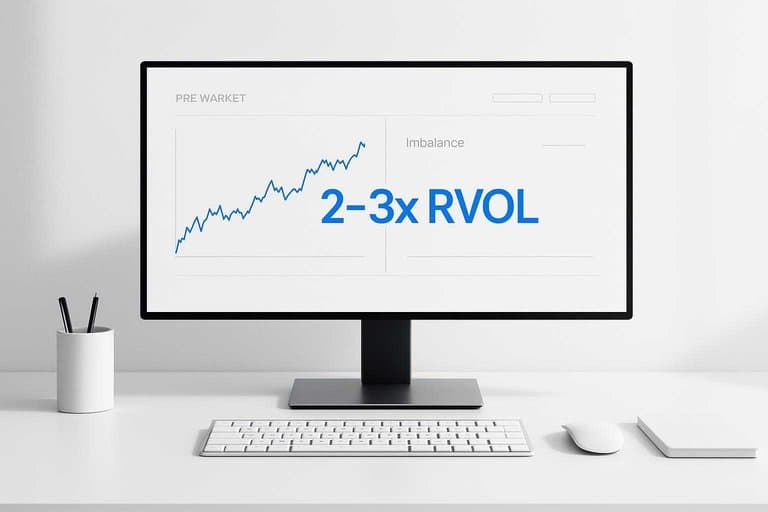
You’re forecasting whether the day will trade like a normal Tuesday or like a “phones ringing” event. Use premarket volume, options, and the closest historical template.
Start with a simple model:
- Premarket volume vs 20-day median at this time.
- Options: call/put imbalance and near-term OI concentration.
- Event template: last 3 earnings days, last CPI day, last FDA day.
If your forecast is 2–3x RVOL, breakouts can run through obvious levels. If it’s sub-1.5x, the first pop often becomes the day’s high.
Level map priority
You need a small level map so your open decisions stay fast. Pick levels that other traders will defend or target.
- Mark prior day high and low.
- Mark premarket high and low.
- Plot VWAP from the open, plus yesterday’s VWAP.
- Add one major pivot or gap edge.
- Circle any liquidity voids on the daily.
If you can’t name your next two targets, you’re not trading a breakout. You’re trading hope.
Liquidity and Slippage Control
You can have the right breakout and still lose at the open. Spread spikes, thin books, and repricing turn “good entries” into bad fills.
Spread regime filters
You’re not filtering for direction. You’re filtering for tradability, because the open changes microstructure minute to minute.
Use thresholds like these before you arm any entry:
- % spread: skip if spread > 0.20% of price (tight names) or > 0.40% (mid names)
- Quoted depth: require ≥ 5–10× your size inside NBBO
- Spread stability: require 3 consecutive quotes within a tight band
- Widening rule: skip if spread widens > 2× in the last 30 seconds
- Flicker rule: skip if NBBO changes > 5 times in 10 seconds
When the spread is widening, your “breakout signal” is often just a liquidity vacuum.
Order type selection
Your order type is your slippage contract with the market. Pick it based on volatility, book thickness, and how much you need a fill.
| Order type | Best when | Main risk | Control lever |
|---|---|---|---|
| Stop-market | Must be in | Gap-through slippage | Smaller size |
| Stop-limit | Need price cap | No fill on spike | Wider limit |
| Limit-on-break | Clean level break | Miss fast reprices | Use buffer |
| Marketable limit | Want fill with cap | Partial fill | Adjust offset |
Default to price-capped orders unless the setup dies without immediacy.
Queue and venue effects
Two traders can place “the same order” and get different fills. Venue rules, queue priority, and NBBO flicker decide who gets hit.
Watch these open-specific mechanics:
- NBBO flicker: quotes update faster than your router can react
- Odd lots: they can move NBBO while hiding real size
- Queue position: early placement beats smart placement, sometimes
- Midpoint pegs: they drift when spreads snap wider
- Auction prints: the first trade can reset every reference
If the tape is jumping but depth is static, you’re fighting queue math, not price.
Slippage budgeting
Decide your maximum adverse fill before you send anything. Otherwise, the open will decide for you.
- Estimate expected slippage in ticks from spread and recent sweep size.
- Set a hard max slip level that invalidates the entry.
- Convert slip into R: add it to entry cost and reduce position size.
- Reject the trade if expected slip cuts R below your minimum.
- Log slip vs plan, then tighten filters on repeat offenders.
When slippage eats the edge, the right move is to not trade the breakout.
False Breakout Detection
False breakouts fail fast, then punish anyone trading on “it should go.” You want evidence of acceptance, not a headline high. Think in auctions: does price stick, does volume follow, and does the tape stay eager.
Three failure signatures
These show up early, and they tell you who’s trapped. Read them as liquidity events, not chart patterns.
- Immediate reclaim: breakout high prints, then snaps back below the level
- Low-volume poke: new high on thin volume, then no follow-through bids
- Trend-day fade: pushes early, then bleeds under opens and prior value
Treat each as trapped demand showing itself, not “bad luck.”
Tape tempo clues
Tape gives you durability signals before candles close. You’re listening for urgency that persists, not a one-minute sprint.
Watch for:
- Speed-up then stall: fast prints, then sudden silence near the breakout
- Passive absorption: offers reload, buyers hit, but price barely lifts
- Thinning bids: bid sizes shrink as price tries to hold the level
If tempo dies at the exact moment it should accelerate, the breakout is already late.
VWAP and value shifts
A real breakout often builds value above VWAP, then uses it as support. A false breakout taps highs but can’t live above VWAP or the developing value area.
Key tells:
- Repeated closes below VWAP after “breakout” prints
- Volume concentrates back inside prior value, not above it
- VWAP flips from support to overhead within minutes
Often the better trigger is the VWAP reclaim with buyers defending, not the first tick through highs.
Halt and reopen traps
Treat halts like hard resets, not pauses. The reopen print is a new auction with new references.
- Mark pre-halt high/low, VWAP, and the halt trigger level.
- Wait for the reopen print, then map the first 30–60 seconds range.
- Only take entries on acceptance beyond that range, not inside it.
- Use the reopen range midpoint as your “no-trade” line.
- Size down, and assume spreads will lie to you.
If you trade halts like normal flow, you’ll confuse a liquidity vacuum for strength.
Risk Architecture for Opens
Open volatility is real information, not noise. Your risk plan has to survive the first spike without giving the trade unlimited room. Think in invalidation rules first, then size to match the worst plausible fill.
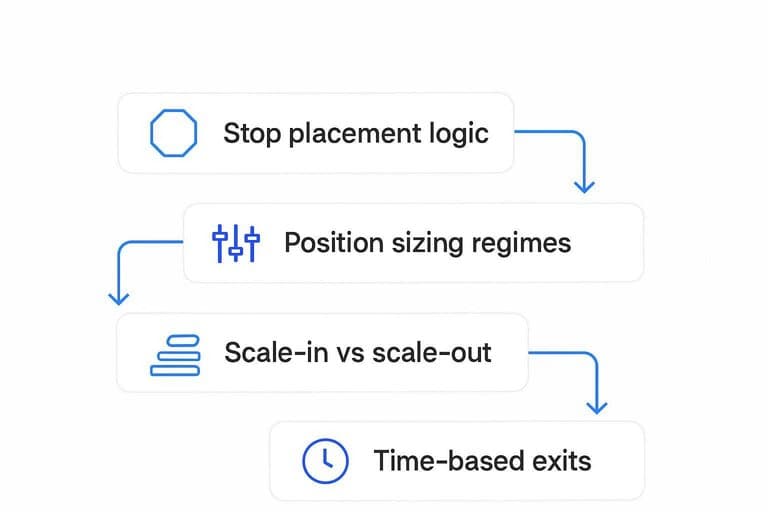
Stop placement logic
Stops at the OR low are easy to see, so they get hunted. You want stops where your thesis is objectively wrong, like “acceptance back inside the range.”
Use a stop that matches your breakout type:
- Acceptance stop: price holds back inside the open range for X seconds.
- VWAP stop: reclaim fails, then trades below VWAP with volume.
- Liquidity-pocket stop: the sweep holds, then loses the pocket fast.
Your stop should trigger on structure, not emotion, or you’ll pay spread for nothing.
Position sizing regimes
Sizing is your shock absorber on the open. When volatility rises, your shares drop, even if your idea is better.
- Volatility-targeted sizing by ATR or 1-minute range
- Max loss per idea, including slippage
- Smaller size when spreads widen or locates tighten
- Step-down size when halts risk increases
- Cap size when opening prints are erratic
If you can’t size it safely, you don’t have a trade, you have a lottery ticket.
Scale-in vs scale-out
Full size at the trigger works when the breakout is clean and liquid. When it isn’t, adding on acceptance usually beats guessing the first tick.
Scale in after proof:
- Starter on the break, add on hold above the level.
- Add when VWAP flips from resistance to support.
- Take partials at liquidity nodes, not random percentages.
Never “average up” without a new signal, or you’ll confuse momentum with hope.
Time-based exits
Use time stops to kill dead opens before they kill your day.
- Define N minutes for follow-through, based on the symbol’s pace.
- Exit if price chops and volume fades before the milestone.
- Exit if the breakout level retests twice without extension.
- Exit if spreads stay wide past your cutoff window.
- Re-enter only on a fresh trigger, not “it should go.”
Capital is a resource; don’t park it in trades that stopped trying.
Execution Playbooks
You don’t need more “setups.” You need fewer patterns you can execute under stress. Treat the open like a regime filter, then run the matching playbook with hard triggers and fail points.
Gap-and-go blueprint
You’re buying strength, not hope, and you need proof the market accepts higher prices. The goal is a clean trigger, a defined fail point, and a planned add zone.
- Trigger long on a break of premarket high with strong tape.
- Confirm acceptance with 1–3 minutes holding above that level.
- Manage the first pullback by buying near VWAP if bids defend.
- Set the fail point below VWAP and the broken level, whichever is lower.
- Add only in the VWAP-to-breakout zone after a higher low forms.
If it can’t hold above premarket high, it’s not “early.” It’s wrong.
Open-drive continuation
Open drives pay you for speed, then punish hesitation. You’re riding the first impulse while refusing the “one more candle” chase.
Look for the first thrust off the open, then use micro pullbacks of one to three candles to re-enter. Trail risk using VWAP slope or a sequence of higher lows, not your feelings. If you missed the first move and price is stretched from VWAP, you pass.
Your edge isn’t predicting continuation. It’s only participating when structure stays intact.
Range-break later
The first minutes are noisy because liquidity is still assembling. Waiting 5–15 minutes often gives you a cleaner level, cleaner risk, and fewer fakeouts.
Mark the opening range high and low, then watch for compression and repeated tests. Take the second breakout attempt, not the first poke, and require volume expansion versus the prior range candles. If the breakout can’t hold for a few minutes, treat it as a scalp or cut it.
You’re paying for confirmation with a slightly worse entry. You’re buying a much better failure rate.
Fade-to-break flip
Failed breakouts often reverse hard because trapped traders become forced sellers. Your job is to flip only after the failure is real, not while it’s still a pullback.
- Identify a breakout that rejects and closes back inside the range.
- Trigger short on a reclaim-fail of the breakout level from below.
- Place your stop just above the failed breakout level or day high.
- Target VWAP or prior value area, then scale on the way down.
- Flip back long only if price reclaims VWAP and holds for minutes.
This is where patience pays twice. You avoid the trap, then trade the unwind.
Regime Filters That Matter
Open breakouts are not “good” or “bad” setups. They’re conditional plays that need the right tape. The goal is simple: decide fast if today supports follow-through, or punishes it.
Index context gates
You’re trading inside an index ecosystem, even on a single-name chart. When SPY/QQQ opens into resistance, your “clean” breakout often becomes a liquidity grab.
Start with three gates:
- Opening trend: higher highs and higher lows, or churn and fades.
- Overnight drift: steady grind versus snapback risk at cash open.
- Breadth: advances/declines and up-volume confirming the direction.
If SPY is under a major level and failing, treat long breakouts as short-lived rentals.
Sector correlation risk
Group momentum can validate your entry, or hide a crowded unwind. You want correlation when it supports range expansion, not when it forces everyone through one door.
- Check sector ETF trend versus your symbol
- Flag sympathy gaps without fresh company news
- Watch crowded “theme” names moving in lockstep
- Note ETF rebalance and quarter-end flow days
- Reduce size when correlation spikes
When the whole group moves as one, your stop is competing with everyone else’s.
Options and gamma effects
Options positioning can flip the open from trend-friendly to mean-reversion fast. A stock pinned near a big strike often rejects breakouts because hedging flows fade extremes.
Use two quick checks: where price sits versus the largest nearby strikes, and whether dealer gamma is likely positive or negative. Positive gamma tends to dampen moves and snap price back; negative gamma can accelerate breakouts and make pullbacks shallow.
If you’re breaking out into a pin, assume chop until proven otherwise.
Event calendar hazards
Scheduled catalysts change what “normal” follow-through looks like.
- Mark hard times: CPI, FOMC, auction, and major Fed speakers.
- Set no-trade windows: 10–15 minutes before, 5–10 minutes after.
- Cut targets and widen invalidation rules if you must trade.
- Avoid fresh breakouts right before the timestamp.
- Resume only after direction and spreads normalize.
Trade the reaction window, not the hope window.
Turn the Open Into a Repeatable Breakout Process
- Start with structure: identify the open auction context (imbalance, likely opening print type, spread regime) before you label any breakout level.
- Define the trade properly: build the range with a consistent method, normalize by volatility, and use gap-aware triggers that distinguish acceptance from brief excursion.
- Execute and manage like an open specialist: choose orders to match liquidity/queue conditions, pre-budget slippage, and apply open-specific stops, sizing, and time exits—then stand down when regime filters (index/sector/gamma/events) say the edge isn’t there.
Frequently Asked Questions
What time is the stocks open for NYSE and Nasdaq, and can I trade before the open?
The U.S. stocks open at 9:30 a.m. ET and closes at 4:00 p.m. ET; most brokers also offer pre-market trading (often 4:00–9:30 a.m. ET) and after-hours (often 4:00–8:00 p.m. ET). Check your broker’s specific session times and order-type rules because access and liquidity vary.
What order type is best for breakout entries at the stocks open: market, limit, or stop order?
For most traders, a limit order (or a stop-limit with a tight, predefined limit) is usually safer at the stocks open because spreads can widen and market orders can slip badly. If you use a stop order, cap the worst-case fill with a limit and size smaller to account for fast repricing.
How can I tell if a move at the stocks open is real institutional buying or just opening noise?
Look for follow-through after the first few minutes: repeated prints near the highs, steady bid support, and volume that stays elevated without sharp “pop-and-drop” reversals. Tools like Time & Sales plus Level II (or footprint/volume-at-price on platforms like TradingView, Thinkorswim, or DAS) help confirm whether buyers are absorbing supply.
Should I trade breakouts right at the stocks open or wait 5–15 minutes?
Waiting 5–15 minutes often improves fill quality and reduces false signals because spreads and volatility typically normalize after the opening auction resolves. If you trade immediately, use smaller size and tighter execution controls because the first minutes have the highest slippage risk.
How do I backtest a stocks open breakout strategy realistically with slippage and spreads?
Use 1-minute (or tick) data and include modeled costs: variable spread, market impact, and realistic fill assumptions for stop/market orders at 9:30 a.m. ET. Most traders get more accurate results by replaying with Level I/II where possible or by adding a time-of-day slippage model that’s worst at the open and improves after the first 10–30 minutes.
Build a Smarter Open Watchlist
Trading the stocks open well is less about one perfect trigger and more about showing up with the right leaders and regime context already mapped.
Open Swing Trading helps you surface breakout candidates with daily relative strength, breadth, and sector/theme rotation so your open execution playbooks start with higher-quality names—get 7-day free access with no credit card.