Advanced Ways to See Stocks Like a Leader List
An advanced pillar guide to building and maintaining a true stock “leader list” — engineer a tradable universe, upgrade relative strength with multi-horizon and volatility-aware ranking, filter for trend quality and flows, and run a disciplined scorecard with refresh cadence and regime awareness.
Advanced Ways to See Stocks Like a Leader List
An advanced pillar guide to building and maintaining a true stock “leader list” — engineer a tradable universe, upgrade relative strength with multi-horizon and volatility-aware ranking, filter for trend quality and flows, and run a disciplined scorecard with refresh cadence and regime awareness.
Most watchlists fail because they’re built like a collection, not a system: too many names, inconsistent standards, and no clear promotion or demotion rules. The result is reacting to headlines while real leaders change under your feet.
This pillar shows you how to see stocks like a leader-list manager. You’ll build a clean universe, rank relative strength the way institutions do, validate trend quality and volume/flow evidence, and keep the roster fresh with a scorecard and regime-aware rules—so your attention stays on the names that actually deserve it.
Leader List Lens
A leader list is a dynamic, rules-based roster that updates with trend, liquidity, and relative strength. You use it to decide what deserves attention today, not to predict what might work someday. Think “promote on proof, demote on decay,” like a portfolio-ready depth chart.
Roster vs watchlist
A watchlist is often a scrapbook. A roster is a system with consequences.
A rule-driven roster has a refresh cadence, like weekly after the close. Names get promoted and demoted based on measurable criteria, not vibes. If a stock loses trend or liquidity, it loses its spot.
Accountability is the feature. Not the friction.
Edge-case failures
Leader lists break in predictable ways when your rules stop matching reality.
- Relying on survivorship-biased backtests
- Keeping stale symbols past their prime
- Overfitting to one market regime
- Ignoring liquidity and spread changes
- Mistaking high beta for leadership
Treat these as alarms, not annoyances.
Mental model
A leader list is a pipeline, not a snapshot. You’re building a loop that learns.
Start with a defined universe, then apply filters for tradability and trend. Score what remains, rank it, and monitor for changes that trigger rebalancing. Feed outcomes back into the rules, and label the regime so you don’t grade trend rules in chop.
Your edge is the loop. The list is just the readout.
Universe Engineering
You don’t pick leaders from “all stocks.” You pick them from a universe that you can actually trade on ugly days. If your universe breaks on halts, churn, or bad prints, your backtest is just fiction.
Liquidity gatekeeping
You need constraints that survive spreads widening at 9:31 and volume vanishing at 3:58. Gate on tradability, not on what looked liquid in hindsight.
- Require median dollar-volume above your slippage threshold
- Cap median spread and spread spikes near the open
- Set a minimum price floor, split-adjusted
- Ignore after-hours prints for liquidity calculations
- Use consolidated quotes, not a single venue
If liquidity fails even once, it will fail when you size up.
Corporate action traps
Corporate actions create “signals” that are just accounting, not behavior. Treat splits, dividends, and symbol changes as data integrity events before you score anything.
Hygiene checks to run before ranking:
- Validate split-adjustment consistency across price, volume, and VWAP.
- Detect dividend-induced gaps and exclude the event window from gap rules.
- Map spinoffs to parent history, or start fresh at the distribution date.
- Resolve symbol and CUSIP changes so history stays continuous.
- Flag abnormal one-day returns tied to action dates, not news.
If you can’t explain a move without the corporate actions calendar, don’t trade it.
Microcap exclusions
Microcaps can look like “leaders” because the tape is easy to bully. You want discovery without stepping into names that can’t absorb your orders.
- Exclude low-float names below your size tolerance
- Exclude high borrow cost or hard-to-borrow symbols
- Exclude frequent volatility halts or long halt histories
- Exclude erratic spreads and sudden quote collapses
- Exclude chronic reverse-split repeat offenders
If the stock needs perfect conditions to trade, it’s not a leader candidate.
Relative Strength Upgrades
Single-period RS is a blunt tool. It spots what moved, not what can keep moving. You want a leader list that survives a pullback and still outruns peers.
Multi-horizon RS
Use several horizons because leadership rotates, but real leaders persist. Weighting also prevents one hot month from hijacking your list.
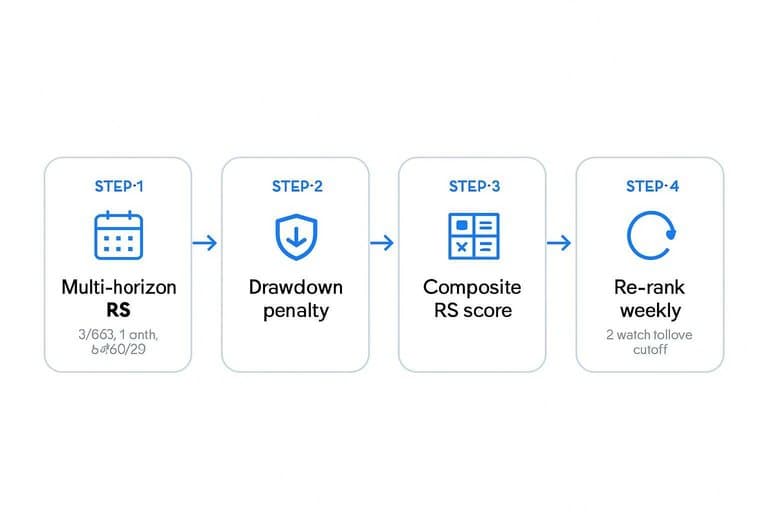
- Compute 3/6/12-month returns and weight them 50/30/20.
- Subtract a max drawdown penalty from each horizon return.
- Add the penalized returns into one composite RS score.
- Re-rank weekly, but require two weeks above your cutoff.
You’ll catch early leaders and filter late-stage blowoffs before they look “obvious.”
For a research-backed framing of these formation windows, see WRDS’s overview of momentum strategies and portfolios.
Volatility normalization
Raw returns flatter high-volatility names. A +20% move means less when the stock routinely swings 6% daily.
Normalize RS with one of these metrics:
- Return / ATR: reward return per typical daily range.
- Return / Vol: reward return per realized volatility.
- Excess return / Vol: reward return over a benchmark per risk.
Set higher cutoffs for noisy names, or they’ll dominate your “leaders” list by randomness alone.
Peer-group ranking
Sector weightings skew index-level RS. Ranking within peers stops mega-cap-heavy groups from crowding out smaller, stronger trends.
- Rank RS scores within each sector, then within each industry.
- Take the top X% per industry to build a candidate set.
- Break ties with volatility-normalized RS across the whole market.
- Final-order the roster using liquidity and spread filters.
That’s how you get true leaders, not just whatever the index owns most.
Trend Quality Filters
You want leaders, not one-day heroes. Trend quality filters keep you out of churn when breakouts look real but act weak.
Structure scoring
Score the shape of the trend because price can be up and still be sloppy.
- Mark higher highs and higher lows
- Check 20/50-day slope upward
- Measure pullback depth versus ATR
- Penalize V-shaped recoveries
- Reward tight closes near highs
If the “breakout” needs a rescue rally, it’s not leadership.
Persistence tests
A leader stays constructive when the tape gets noisy. You’re testing staying power, not perfection.
Look for time-above-average, like 80%+ closes above the 50-day. Cap distribution days, like no more than 2-3 in three weeks.
Treat gap-ups as valid only if they hold the midpoint by the close. For earnings, allow the volatility, but require a tight range within 3-5 sessions.
You’re buying durability, so make the stock prove it can sit on the shelf.
Breadth context
A stock can lead and still fail if the market is breaking underneath it.
- Track advance/decline line direction
- Count new highs versus lows
- Measure sector participation breadth
- Compare leader group strength ranks
- Avoid “one stock” breakouts
If breadth is leaking, you’re gambling on exception, not trend.
Volume and Flows
Institutions leave footprints because they must buy big, over time. Your job is separating real sponsorship from noisy “volume events” that look convincing on a chart.
Accumulation signals
You want evidence of persistent demand, not a one-day spectacle. Look for repeatable signatures that can’t happen without size buyers.
- Up-volume dominates over multiple weeks
- Tight closes on high volume
- Pocket pivots out of tight bases
- Multi-week volume contraction, then breakout
Treat any single signal as a clue, not a verdict.
Flow proxy pitfalls
Flows can imitate sponsorship because they move price without “belief.” ETF rebalances, gamma squeezes, and headline spikes can all print huge volume.
ETF rebalancing is forced buying or selling tied to index rules, not conviction. Gamma squeezes are dealer hedging that can reverse fast.
Filter them with a few checks: confirm follow-through days, watch volume persistence for 2–3 weeks, and compare to peers. If the move fades when the catalyst passes, it was probably flow, not sponsorship.
Ownership constraints
Volume signals matter more when the ownership math makes sense. Use simple guardrails to avoid “crowded trades” that snap back.
- Prefer adequate float for institutional sizing
- Flag high short interest as squeeze-prone
- Track institutional ownership change, not level alone
- Watch for ownership “air pockets” after big runs
Crowdedness turns your upside into someone else’s exit liquidity.
Leader Scorecard
You need a scorecard when you’re screening dozens of stocks fast and consistently. The trick is picking a composite method that matches your risk tolerance and decision style.
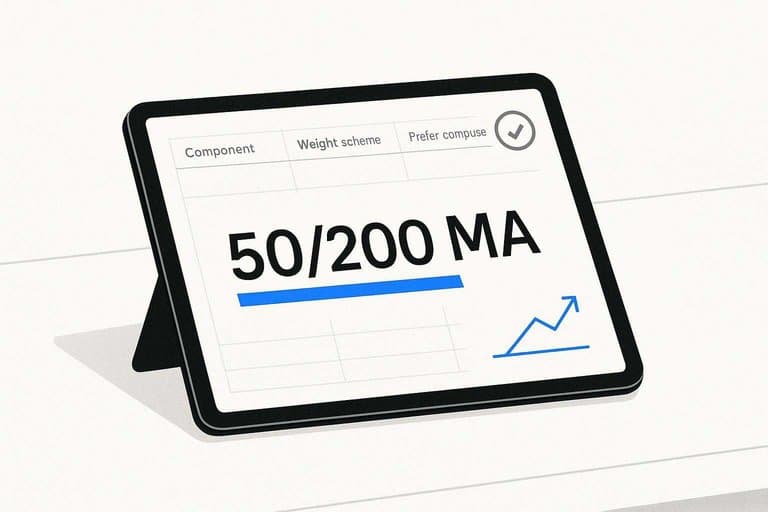
Use this table to map scoring components to weight schemes and composite types.
| Component | What you measure | Weight scheme | Prefer composite |
|---|---|---|---|
| Trend strength | 50/200 MA slope | Fixed % | Additive |
| Relative strength | vs benchmark rank | Percentile | Rank-based |
| Earnings quality | surprises, revisions | Tapered | Multiplicative |
| Liquidity | dollar volume | Hard threshold | Additive |
| Volatility risk | ATR%, beta | Penalty weight | Multiplicative |
Pick additive when you want stable trade-offs, multiplicative when you want “no weak links,” and rank-based when distributions are messy.
Roster Refresh Cadence
Leaders change slower than prices, so your roster needs a clock, not a twitch. Pick a review cadence, hard rules, and a turnover target so you don’t chase every “hot” candle.
A common baseline is weekly adds, daily risk checks, and a quarterly reset of the scoring model. In high-volatility regimes, widen buffers and lengthen confirmation windows before you touch the list.
Promotion rules
You want promotions to be earned, repeatable, and liquid enough to trade. Make the bar explicit so your “leader list” doesn’t become a mood board.
- Require a minimum composite score above your cutline.
- Hold the score above the cutline for a confirmation window.
- Recheck liquidity: dollar volume, spread, and borrow availability.
- Block additions with event-risk flags: earnings, FDA, or major guidance.
If you can’t write the rule, you can’t enforce it under stress.
Demotion rules
Demotions protect your attention and your capital when leadership decays. Use triggers that reflect real degradation, not just red days.
- Demote on relative strength decay over your lookback window.
- Demote on a confirmed trend break on your chosen timeframe.
- Demote on abnormal spread or volume that signals distribution.
- Demote on earnings-gap damage that fails to reclaim key levels.
- Demote when correlation spikes to weak peers or a weak group.
Your list is a filter, not a museum.
Turnover budgeting
Turnover is a resource you can spend, and most people overspend it in chop. Set a churn cap per rebalance, then use buffer zones around the cutline so names don’t flip with tiny score moves.
Add hysteresis: require a higher score to enter than to stay, like “in at 80, out at 72.” That stabilizes the roster while still letting a true breakout force its way in.
If you’re using a volatility regime lens to decide when to widen buffers, S&P DJI’s guide helps interpret the VIX as 30-day implied volatility.
Regime Awareness
Your leader list should change when the market’s rules change. A VIX at 12 and a VIX at 35 are different sports, even if prices look similar.
Build a simple regime map from VIX trend, credit spreads, and market breadth. Then tilt your scoring toward raw relative strength in risk-on, or toward defensiveness and balance-sheet quality in risk-off.
Risk-on vs risk-off
You need a fast read on whether the market is paying for risk or punishing it. If you ignore regime, your list “works” until it doesn’t.
Use a small dashboard:
- VIX level and slope: falling supports risk-on, rising flags risk-off.
- Credit spreads: tightening supports cyclicals, widening punishes leverage.
- Breadth: expanding participation validates leaders, narrowing turns them fragile.
Then change weights, not your whole process. In risk-on, reward clean RS and momentum; in risk-off, reward low drawdown, stable earnings, and liquidity.
Sector rotation logic
Rotation is a regime shift in miniature. Your list should notice before your P&L does.
- Sector RS turns up, then holds.
- Leadership narrows to a few names.
- Cyclicals fade as defensives rise.
- Commodities diverge from equities.
- Rates sensitivity flips from tailwind to headwind.
When two or more line up, cap concentration and let the new sector earn weight.
Crash and melt-up
Tails break normal filters because correlations snap and spreads widen. Your goal is fewer forced decisions, not perfect signals.
In crashes, tighten liquidity and tradability filters, even if it shrinks your universe. In melt-ups, shorten lookbacks and widen entry buffers so you don’t churn on every micro-pullback.
Extreme regimes punish precision. Build slack into the system, then survive long enough to exploit it.
Run the System for 30 Days, Then Tighten the Rules
- Build your universe first: apply liquidity gates, remove corporate-action landmines, and exclude microcaps that distort rankings.
- Rank for leadership: use multi-horizon relative strength, normalize for volatility, and compare within peer groups—not the entire market.
- Confirm quality: require strong structure, persistence, and supportive breadth/flow evidence before a name earns a roster slot.
- Operate the roster: score weekly, promote/demote via pre-set rules, and budget turnover so you’re selective in calm markets and decisive in fast regimes.
Frequently Asked Questions
What’s the best way to see stocks like a leader list without paying for expensive screeners?
You can usually replicate a leader-list workflow with free tools by combining TradingView (watchlists + relative performance), Finviz (liquidity/float/industry filters), and a simple Google Sheet to rank candidates weekly.
How do I see stocks that are about to become leaders before they hit new highs?
Look for multi-week tight consolidations with rising relative performance versus the index and improving volume on up days, then set alerts at key levels so you catch the transition as it happens.
How many stocks should be on a leader list to see stocks clearly without information overload?
Most traders see stocks best with 20–50 names on the core list and a smaller “bench” of 50–150 candidates, so you maintain focus while still tracking new leadership.
How do I measure whether my leader list actually helps me see stocks better than a simple index watchlist?
Track 3 metrics monthly: hit rate (leaders that outperform the benchmark over 4–12 weeks), turnover (adds/drops per month), and average excess return of the list versus SPY/QQQ using a spreadsheet or Portfolio Visualizer.
Can AI help me see stocks like a leader list, and what should I ask it to do?
Yes—use AI to summarize catalysts, map peer groups, and generate a “what changed” brief for list updates, but keep the ranking rules and buy/sell decisions rule-based and verified with price/volume data.
Build Your Leader List
These frameworks work best when your universe, relative strength, flows, and regime read update consistently—without turning stock selection into a nightly spreadsheet grind.
Open Swing Trading delivers daily RS rankings, breadth and sector/theme context, plus leader scorecards so you can spot actionable breakout leaders faster—get 7-day free access.
Sources
- WRDS (Wharton) — Momentum Strategies/Portfolios macro replicating Jegadeesh & Titman (1993) — referenced in Multi-horizon RS
- S&P Dow Jones Indices — VIX introduction / interpretation — referenced in Turnover budgeting