Apply Mark Minervini’s trend template in 10 minutes
A fast, step-by-step guide to applying Mark Minervini’s Trend Template in under 10 minutes—set up the right chart timeframe, validate moving-average structure and slopes, quantify key distances from MAs, and place price within its 52-week range so you can make a clear pass/fail decision and log a watchlist card.
Apply Mark Minervini’s trend template in 10 minutes
A fast, step-by-step guide to applying Mark Minervini’s Trend Template in under 10 minutes—set up the right chart timeframe, validate moving-average structure and slopes, quantify key distances from MAs, and place price within its 52-week range so you can make a clear pass/fail decision and log a watchlist card.
Ever feel like you’re squinting at a chart trying to “see the trend,” only to second-guess it the moment price wobbles? The Trend Template fixes that by turning a fuzzy judgment call into a repeatable, evidence-based screen.
In the next 10 minutes, you’ll set up a clean workspace, confirm the uptrend’s structure with moving averages, measure the distances that matter, and anchor everything to the 52-week range. You’ll finish with a simple checklist and a watchlist card you can reuse every time.
Set up workspace
Open your charting platform and load one ticker only. Set the chart to daily and pull at least 200 trading days of history so the template is judgeable fast. If you can’t see the full trend, you can’t grade it.
Pick chart timeframe
Use daily candles so the template matches how it was designed.
- Set timeframe to 1D candles.
- Load at least 200 trading days of data.
- Switch to a clean linear scale.
- Hide indicators you won’t use.
Speed comes from removing choices, not adding tools.
Add key averages
Plot only the averages the template actually references.
- Add a 50-day SMA.
- Add a 150-day SMA.
- Add a 200-day SMA.
- Use distinct colors and readable thickness.
If you can’t tell lines apart instantly, you’ll hesitate on every rule.
Define pass/fail
Treat the trend template like a one-page checklist, not a debate. Each rule gets a binary “yes” or “no,” like “price above the 150-day” or “200-day rising.” Your goal is a visible decision in seconds, not a perfect narrative.
Binary rules turn chart reading into execution.
Confirm uptrend structure
You’re proving the trend exists before you waste time on “breakout” details. If the moving averages don’t agree, the template fails fast.
Example: a stock can look strong on a 5-day pop, then sit under a flat 200-day.
Check MA stacking
You’re checking alignment because clean stacks signal institutional support. One violation is often enough to skip the chart.
- Price above 50-day MA
- 150-day MA above 200-day MA
- 50-day MA above 150-day MA
- 50-day MA above 200-day MA
- Mark any rule breaks
Treat stacking like a gate. If it fails, you’re done.
Check MA slopes
You want the 150 and 200 to rise for weeks, not days. Rising looks like a steady up-right tilt, not a sideways “shelf.”
On your chart, that means each week’s MA value is generally higher than the prior week. A flat line with tiny wiggles is not rising.
If the long MAs aren’t climbing, you’re fighting gravity.
Spot trend breaks
You’re hunting for cracks because strong trends respect the 50-day. Repeated closes below it usually show distribution.
- Flag any close below the 50-day
- Note how fast price regains the 50-day
- Mark failed rebounds into the 50-day
- Count breaks within the last 8–12 weeks
- Downgrade charts with “chop”
Two or three breaks is a warning. It’s often the top forming.
Measure key distances
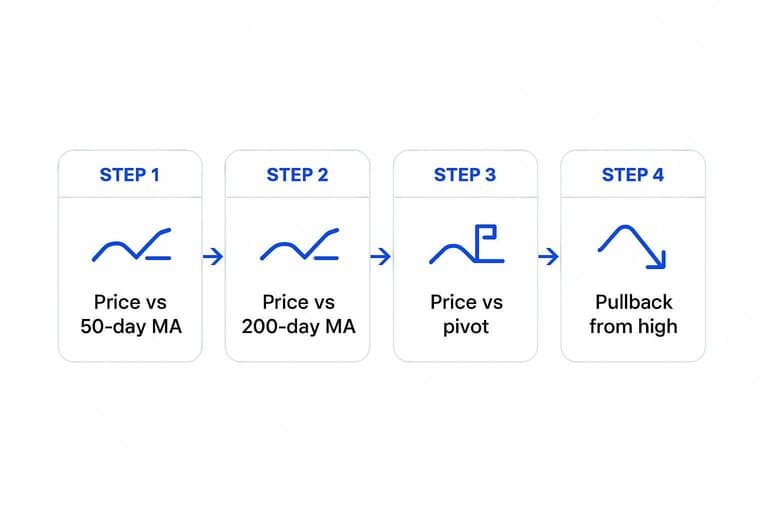
You need fast numbers that answer one question: is price extended or buyable. Use percent distance from key moving averages and recent pivots, like “within 5% of the 50-day.”
Price distances to check quickly:
| Distance metric | How to calculate | Buyable zone | Red flag |
|---|---|---|---|
| Price vs 50-day MA | (P−MA50)/MA50 | 0–5% above | >10% above |
| Price vs 200-day MA | (P−MA200)/MA200 | >0% above | below MA200 |
| 50-day vs 200-day | (MA50−MA200)/MA200 | >0% above | <0% or flat |
| Price vs pivot | (P−Pivot)/Pivot | 0–3% above | >5% above |
| Pullback from high | (High−P)/High | 2–8% down | >15% down |
If two or more metrics scream “extended,” wait for a tight reset near the 10- or 50-day.
Locate 52-week position
Place price inside its 52-week range so you can spot leaders fast. A stock sitting near highs and well above lows usually acts like a winner, not a repair story.
Minervini’s quick check is simple: “strong stocks are near highs.”
Find 52-week low
You’re looking for how far price has lifted from its worst point this year. That distance filters out laggards still fighting gravity.
- Pull daily bars for the last 252 trading days.
- Find the lowest intraday low in that window.
- Compute: (Today’s close / 52-week low) - 1.
- Confirm the result is ≥ 0.30, or 30%.
If you can’t clear 30%, you’re probably shopping in the bargain bin.
Find 52-week high
Now check whether price is still acting like a leader today. Leaders stay close to their best prices, even after pullbacks.
- Pull daily bars for the last 252 trading days.
- Find the highest intraday high in that window.
- Compute distance from high: (52-week high - Today’s close) / 52-week high.
- Confirm the result is ≤ 0.25, or ~25%.
If it’s more than ~25% off highs, institutions may be exiting, not accumulating.
Interpret the range
Near highs and far from lows signals sustained demand, not a one-week pop. It often reflects institutional sponsorship, because big buyers tend to support winners, not underwater names.
If a stock is 35% off its high and only 10% above its low, the market is telling you something. Listen.
Run the 10-minute checklist
Set a timer for 10 minutes and force a binary result. You’re not “analyzing” here; you’re screening, like saying “Template Pass” or “Template Fail.” Think of it as a pre-flight checklist, not a thesis.
Minute-by-minute flow
Move fast and stop at the first hard fail.
- Check MA stack: 50>150>200 and price above 50.
- Check MA slopes: 150 up, 200 up, 50 up.
- Check 52-week rules: above 30% low, within 25% high.
- Check extension: not wildly stretched from 50.
- Assign label: Template Pass or Template Fail. Fail fast beats “almost” every time.
Capture evidence
You need receipts for your future self.
- Screenshot the chart with 50/150/200 MAs visible.
- Mark each rule as PASS/FAIL on the image.
- Add one short note for the first fail reason.
- Save as TICKER_YYYY-MM-DD in one folder. Good records turn “gut feel” into a repeatable process.
Decide next action
When it passes, treat it like a candidate, not a commitment. Add it to your watchlist, then set alerts at obvious levels like the 50-day MA, the last pivot, or the prior high. When it fails, log the first fail reason—“200 flat,” “below 150,” “too extended”—and move on without debate. Your edge comes from consistent execution, not perfect arguments.
Output watchlist card
You need a one-line record per ticker so tomorrow’s scan becomes a decision, not a reread. Keep it consistent so you can compare names fast.
Use this template to capture the trend template result in one pass.
| Ticker | Template score | Key levels | Next action |
|---|---|---|---|
| AAPL | 7/8 | 185 / 192 | Buy on break |
| NVDA | 8/8 | 820 / 860 | Add on pullback |
| TSLA | 5/8 | 165 / 175 | Wait; needs 200SMA |
| LULU | 6/8 | 430 / 455 | Watch; tighten stop |
If you can’t write “next action” in six words, you don’t have a trade.
Put the Template on Autopilot for Your Next Chart
Run the same sequence every time: workspace setup → uptrend structure → distance checks → 52-week position → checklist decision. Save your measurements and screenshots into a single watchlist card so you can revisit the exact evidence later—especially after volatility spikes. If a stock fails any pass/fail rule, tag it “Not Ready” and move on; if it passes cleanly, set an alert near your key levels and track it for a proper entry setup.
Frequently Asked Questions
Is Mark Minervini’s trend template the same as CAN SLIM or IBD rules?
No. Mark Minervini’s trend template overlaps with CAN SLIM on “leading stocks in uptrends,” but it’s a stricter, chart-first filter focused on moving-average structure and 52-week position rather than fundamentals.
Do I need weekly charts to apply Mark Minervini’s trend template, or is daily enough?
Daily charts are usually enough to run the template quickly, then use a weekly chart as a confirmation step for smoother trend context and cleaner support/resistance levels.
What tools can I use to screen for Mark Minervini trend template candidates automatically?
TradingView, MarketSmith, TrendSpider, and Finviz Elite can pre-filter for moving-average conditions and 52-week proximity, then you manually verify the remaining candidates on the chart.
How often should I re-check the Mark Minervini trend template on a watchlist?
Re-check daily after the close, and do a deeper refresh weekly. A stock can fail quickly after a sharp pullback, MA cross, or volatility expansion, so stale passes lose value fast.
What results should I expect after a stock passes Mark Minervini’s trend template?
A “pass” signals trend quality, not guaranteed performance. Most traders then wait for a defined pivot/breakout and manage risk tightly (often 5–8% max loss) because many breakouts still fail in choppy markets.
Build a Minervini-Ready Watchlist
Running Mark Minervini’s trend template quickly is powerful, but the real edge comes from feeding it fresh, leadership-grade candidates every day.
Open Swing Trading surfaces potential breakout leaders with daily RS rankings, breadth, and sector/theme rotation so your 10-minute checklist starts with the right names—get 7-day free access, no credit card.