
Apply William O'Neil Rules in 20 Minutes Daily
A time-boxed daily guide to applying William O’Neil’s rules in just 20 minutes—set up a repeatable workflow, confirm market direction, run a fast CAN SLIM filter, and execute entries/exits with clear risk sizing, alerts, and journaling.
Apply William O'Neil Rules in 20 Minutes Daily
A time-boxed daily guide to applying William O’Neil’s rules in just 20 minutes—set up a repeatable workflow, confirm market direction, run a fast CAN SLIM filter, and execute entries/exits with clear risk sizing, alerts, and journaling.
If your trading day starts with 30 tabs and ends with “I’ll decide later,” you’re not short on information—you’re short on a process. O’Neil-style growth investing works best when the rules are applied consistently, not when you have hours to overthink.
This guide turns the William O’Neil playbook into a 20-minute daily routine. You’ll learn what to check first (market direction), how to screen fast with CAN SLIM, how to validate patterns and pivots, and how to size, place, and manage trades with hard sell rules and a simple journal output.
Daily Setup
You don’t need more screen time. You need a repeatable loop that enforces O’Neil-style selectivity.
Your goal is one tight routine, same order daily, with a clear “done” state. Think: “scan, qualify, plan, risk, log.”
Tools checklist
Keep your stack small so you move fast and stay consistent.
- Open broker + charting platform
- Load a focused watchlist
- Check an earnings calendar
- Skim a fast news feed
- Use a one-page trading journal
If a tool doesn’t change a decision, it’s noise.
Time-box schedule
A timer forces clarity. Twenty minutes is enough if you don’t negotiate with the clock.
- Scan (3 min): Find strong price and volume leaders.
- Qualify (7 min): Validate trend, base, and key levels.
- Plan orders (5 min): Define entry, stop, and add points.
- Risk (3 min): Size the trade to your max loss.
- Log + commit (2 min): Write the plan and walk away.
Speed isn’t the goal. Clean decisions are.
Done criteria
“Done” must be observable, not a feeling. You stop when the outputs exist.
You finish with three qualified candidates, one complete trade plan, and alerts or orders preset. Your journal entry is saved, including the “if-then” that cancels the trade.
When you can’t add clarity, you’re done. Don’t keep scrolling.
Market Direction
You need a fast read on whether the wind is at your back. Use price, volume, and one daily verdict so your picks aren’t fighting the tape.
Example mindset: “Great stock, bad market” is still a bad trade.
Index dashboard
Check one or two indexes and a couple leading ETFs because leadership shifts. You’re looking for trend health, not headlines.
- Pull daily charts for S&P 500 and Nasdaq, plus QQQ or IWM.
- Mark the prior swing high and swing low from the last 2–6 weeks.
- Note: above or below the 21-day and 50-day lines.
- Check if today’s volume is higher or lower than yesterday.
- Record current distribution-day count for each index.
If indexes disagree, trade like the weaker one is right.
Distribution days
A distribution day is institutional selling hiding in plain sight. You tag it when an index closes down on higher volume than the prior day.
Use simple rules: down day, volume up, and the drop is meaningful. Many traders use about 0.2% to 0.3% or more on the index.
To count fast, scan the last 20–25 sessions and tally those days. Then subtract any that get “repaired” by a strong rally day clearing that weakness.
When distribution stacks up, your best setups start failing for no obvious reason.
Green-light rules
You need one label each day so your actions stay consistent. Keep it mechanical, even when your gut wants a story.
- Confirmed Uptrend: index above 50-day, few distribution days.
- Uptrend Under Pressure: distribution days rising, key lines tested.
- Market in Correction: index below 50-day, lows breaking.
- Downgrade fast after heavy selling on volume.
- Upgrade slow after a follow-through style rally.
Your verdict is your position size governor, not a prediction.
Fast CAN SLIM Filter
You don’t need a full CAN SLIM workbook every night. You need a fast screen that kills weak names fast.
Run these checks on your watchlist after the close, then keep only the few that feel “obvious” on the chart and in numbers.
C-A-N quick checks
These are your highest-signal gates. They cut the list hard, before you waste chart time.
- Show EPS growth ≥ 25% last quarter
- Show sales growth ≥ 25% last quarter
- Print a 52-week high or near-high
- Prove a clear “new” catalyst
- Show rising institutional ownership
If two of these look fuzzy, it’s not a candidate. It’s a distraction.
S-L-M tie-breakers
After C-A-N, you’ll still have several decent names. Use S-L-M to find the ones built to move now.
Check supply: tight closes, low-volume pullbacks, and no ugly gap-downs. Compare leadership: stronger relative strength than your other candidates. Confirm the market: your best stock in a bad tape still struggles.
When S-L-M fails, don’t negotiate with it. Wait.
Pass/fail scoring
Keep it mechanical so you don’t “fall in love” with a symbol.
- Give each C-A-N rule a 0 or 1.
- Give each S-L-M check a 0 or 1.
- Total the score, then rank your list.
- Keep only the top three names.
- Re-check them on the weekly chart.
Your job is not finding more stocks. Your job is saying no faster.
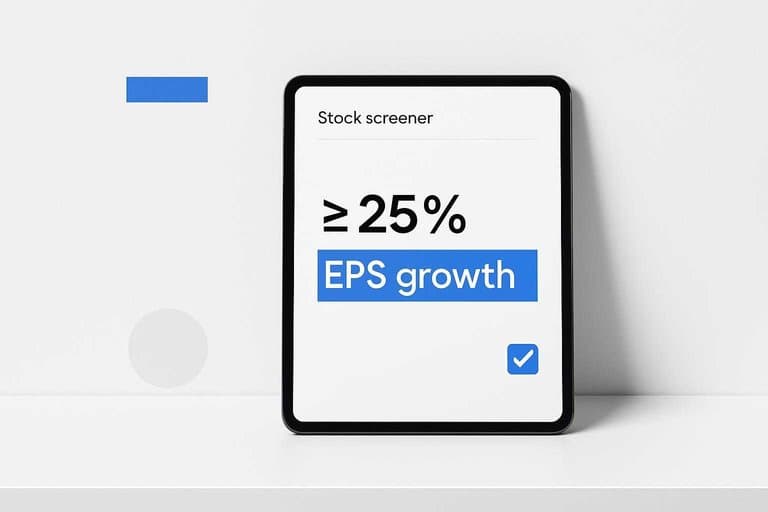
Chart Pattern Snapshot
You’re scanning for one thing: a buyable base with a clear pivot. Do it in under two minutes per chart, or you’ll start “seeing” patterns that aren’t there.
Valid base types
You only need a few base templates to act fast and stay consistent. Use these rules, and reject anything that forces excuses.
- Cup-with-handle: 7+ weeks, 12–33% depth, handle in upper half
- Flat base: 5–6 weeks, ≤15% depth, tight closes near highs
- Double bottom: 7+ weeks, second low undercuts first, then reclaims
- Disqualify: sloppy swings, repeated heavy-volume breaks, no clear right side
- Disqualify: deep base >35%, or “handle” below midpoint
Your edge starts with saying “no” quickly.
Pivot and handle
You’re marking the one price that proves demand is real. Everything else is noise.
- Find the base high and mark the pivot at that price level.
- If it’s a cup, locate the handle in the upper half.
- Confirm handle tightness: small bars, calm closes, no big sell days.
- Write the exact entry: pivot plus a small buffer, like “$52.35 + 0.10”.
- If the “handle” is wide and loose, skip the stock.
A clean pivot gives you a clean decision under pressure.
Volume confirmation
Price shows you the level. Volume tells you if institutions agree.
A “volume dry-up” is when the handle trades quieter than normal, often below the 50-day average. It looks like several days where volume shrinks as price holds tight, like “down 40% vs average.”
“Breakout volume” is the opposite: a decisive push through the pivot on volume clearly above average. Label today’s signal as one of three tags in your notes: “Drying up,” “Neutral,” or “Power coming in.”
When volume and price align, you stop guessing and start executing.
Risk and Position Size
You can like a chart and still blow up your week with sloppy sizing. Convert each candidate into a trade plan you can execute in two minutes, not two emotions.
7–8% sell rule
Set the stop before you buy, not after it hurts. Your job is to define the exact exit price that makes you wrong.
- Pick your entry price, ideally at a proper breakout level.
- Compute 7–8% below entry: Entry × 0.92 to 0.93.
- Check nearby support, like the breakout pivot or 10-week line.
- Set the stop at the tighter level: 7–8% rule or support break.
- Write the exact stop price, like “Stop: $47.85 on close.”
If you can’t name the stop price, you don’t have a trade yet. For the primary-source breakdown, see IBD’s guide on the 7%–8% sell rule.
Position sizing math
Stops are useless without sizing. You size from the stop backward, using a fixed dollar risk.
- Choose account risk per trade, like 0.5% to 1.0%.
- Convert it to dollars: Account × risk%.
- Compute stop distance: Entry − Stop.
- Compute shares: Dollar risk ÷ stop distance.
- Output the plan: “Buy 240 shares, risk $480.”
This is how you stay confident when the stock wobbles, because the risk is already prepaid.
Add-on plan
Add-ons work only when you’re already right. Think “pyramid into strength,” not “average down into hope.”
For pyramiding, use three rules. First, add only after clear progress, like +2% to +3% from your last buy. Second, make each add smaller than the prior buy. Third, recalc a blended stop based on your average cost, while still respecting key support.
Your add-on plan should feel boring. Boring is good. Boring survives.
Order and Alert Execution
You want tomorrow’s trades to run without you watching every tick. Stage orders and alerts today, then let the plan execute while you live your life.
- Identify your trigger price and define it as an if-then rule.
- Place a stop or stop-limit buy above the pivot, with fixed size.
- Add a protective stop loss at 7–8% below your entry.
- Set a profit-taking or add-on alert near 20–25% up.
- Schedule one check-in window, then ignore intraday noise.
Do your thinking tonight, and tomorrow becomes a simple yes-or-no tape read.
Sell Rules Cheatsheet
You need sell triggers that fire without debate, especially in a 20-minute routine. Think “rule, not mood,” like: “If it breaks, I’m out.”
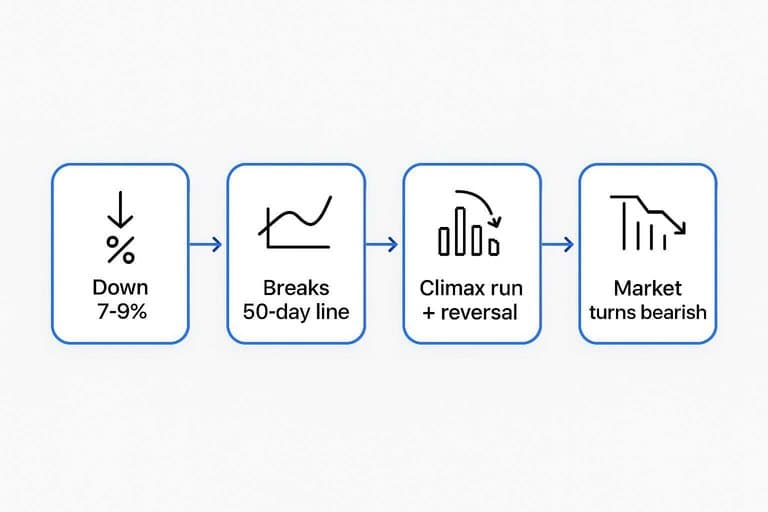
| Sell trigger (O’Neil-style) | What you check fast | Immediate action | Why it matters |
|---|---|---|---|
| Down 7–8% from buy | % loss vs entry | Sell, no exceptions | Protects capital fast |
| Breaks 50-day line | Price vs 50-DMA | Sell or trim hard | Trend likely changed |
| Climax run + reversal | Huge volume, reversal | Take profits quickly | Blow-off often tops |
| Repeated stalling | New highs, weak close | Scale out, raise stops | Demand is fading |
| Market turns bearish | Index breaks support | Tighten, sell laggards | Tides beat stocks |
Print it, or pin it beside your chart. The win is removing “maybe” from your sell button. If you want the canonical ruleset, IBD lays out when to sell stocks (including the 7%–8% rule and profit-taking guidelines).
Daily Journal Output
You don’t improve what you don’t capture. A tight journal turns each day’s trades into data you can audit on weekends.
Write it like you’re briefing “future you” in two minutes. The goal is repeatable decisions, not perfect prose.
One-page template
Keep it to one page so you actually fill it out. Think fields, not paragraphs.
- Market verdict (trend, distribution days, risk-on/off)
- Candidates watched (top 3–5 tickers)
- Entry/stop plan (price, sizing, invalidation)
- Rationale (which O’Neil rules triggered)
- Emotions + context (“felt FOMO after gap-up”)
- Next-day triggers (buy points, sell points, alerts)
When your notes fit one page, your review becomes mechanical instead of emotional.
Screenshot protocol
Screenshots remove hindsight lies. You want proof of what you saw, not what you remember.
- Save a “before” chart at decision time.
- Mark pivot, buy point, and intended entry.
- Draw the stop and write the exact level.
- Note volume and any key moving averages.
- Save an “after” chart at exit or end-of-day.
If you can’t show it on the chart, you didn’t really have a rule.
Weekly review loop
Your weekly review is where the edge compounds. Treat it like a mini post-mortem, not a therapy session.
Pull every trade and tag it as “rule-followed” or “rule-broken,” then total wins, losses, and average loss size. Write the top two rule breaks in plain language, like “bought extended” or “didn’t sell at stop.” Choose one process change to test next week, like “no buys above 5% past pivot” or “hard stop orders only.”
One change per week beats ten intentions per weekend.
20-Minute Walkthrough
You need a repeatable daily loop that turns market data into one actionable plan. Use one sample day and finish with a tight watchlist plus a single trade you can place.
- Check trend: confirm indexes above 21/50-day lines and breadth improving.
- Run your CAN SLIM scan: new highs, strong EPS/sales, high RS, liquidity.
- Filter fast: remove earnings-in-two-days, thin volume, sloppy base structures.
- Build the watchlist: pick 5 names with clean pivots and tight ranges.
- Choose one trade: set buy point, stop, add-on rule, and exit triggers.
Your edge is the routine, not the scan—write the plan, then wait for price to invite you in.
Run the Routine, Then Let the Rules Do the Work
Treat this as a daily checklist, not a research project: confirm the market is in a buyable state, narrow to a small watchlist that passes your CAN SLIM pass/fail, and only act on clean pivots with risk defined before you enter. When you do take a trade, pre-plan the 7–8% sell rule, position size, and any add-on levels so decisions aren’t made mid-volatility. Finish by producing the one-page journal output—because the fastest way to improve is to review the same process every week and tighten the parts that leak discipline.
Frequently Asked Questions
Do William O'Neil rules still work in 2026 markets dominated by ETFs and algorithms?
Yes—most traders still use William O’Neil’s price/volume and breakout principles because they reflect supply and demand. The edge usually comes from disciplined execution (entries, stops, and selling) rather than predicting news or macro moves.
Can I apply William O'Neil rules if I can’t do full fundamental research every day?
Yes—use a weekly fundamentals batch check (earnings growth, sales growth, margins, and ROE) and rely on daily price/volume and base quality for timing. Most traders update the “C” and “A” in CAN SLIM around earnings season and keep daily work focused on execution.
What’s the best toolset to follow William O'Neil without paying for MarketSmith?
A common setup is TradingView (charts, alerts), Finviz or Koyfin (screening), and an earnings calendar like Nasdaq or EarningsWhispers (dates and surprises). The key is having volume overlays, relative strength vs. S&P 500, and one-click alerts at pivots.
How do I measure whether my William O'Neil routine is actually improving results?
Track a simple scorecard: win rate, average gain vs. average loss, and max drawdown, reviewed every 20–30 trades. If your average loss stays near 5–8% and your average winner is 2–3× bigger, the process is working even with modest win rates.
How long does it take to see results using William O'Neil rules with a 20-minute daily routine?
Most people see process improvements in 2–4 weeks (cleaner entries, fewer oversized losses) and clearer performance trends after 30–60 trades. Consistent profitability usually requires at least one full market cycle to experience both favorable and choppy conditions.
Streamline Your CAN SLIM Workflow
Compressing William O’Neil’s rules into 20 minutes only works if your market direction and leadership lists are ready before you open the charts.
Open Swing Trading delivers daily RS rankings, breadth, sector/theme rotation, and extension scoring so you can find breakout leaders faster—get 7-day free access with no credit card.
Sources
- When To Sell Stocks (Investor’s Business Daily) — referenced in 7–8% sell rule, Sell Rules Cheatsheet