Better Stock Selection: 200 Breakouts, 12-Month Results
A data-driven case study of 200 breakout trades and their 12-month outcomes—how the breakout was defined, what benchmarks and thresholds mattered, what the return distribution and drawdowns looked like, and which quality filters (volume, trend, fundamentals, avoidance rules) improved selection.
Better Stock Selection: 200 Breakouts, 12-Month Results
A data-driven case study of 200 breakout trades and their 12-month outcomes—how the breakout was defined, what benchmarks and thresholds mattered, what the return distribution and drawdowns looked like, and which quality filters (volume, trend, fundamentals, avoidance rules) improved selection.
Most breakout strategies look great in a handful of cherry-picked charts—until you track enough trades to see the full range of outcomes. The hard part isn’t finding breakouts; it’s surviving the losers and capturing the few outsized winners that drive the curve.
This case study compresses 200 breakouts into one clear scoreboard: assumptions, benchmarks, and a 12‑month results table, plus what the distribution and drawdowns really look like. You’ll also see which filters actually helped—and which just sounded good.
Study snapshot
You need rules that a computer can run, not a vibe like “looks strong.” This snapshot pins down the trigger, the universe, and the frictions so the 12-month results aren’t a story.
Breakout definition
The goal is a repeatable entry that marks a real regime change, not a noisy pop. So the “breakout day” is the first session that clears a prior ceiling on decisive volume.
Entry trigger (timestamped):
- Breakout day = first close above the prior 252-day high.
- Entry price = next day’s open after the breakout close.
Confirmation filter:
- Breakout volume ≥ 1.5× 50-day average volume.
- Close in the top 30% of the day’s range.
Liquidity minimums:
- Price ≥ $5.
- 20-day average dollar volume ≥ $5M.
If your “breakouts” don’t include a timestamp and volume rule, you’re backtesting opinions.
Universe and period
You want breadth without microcap noise, and a window long enough to include ugly markets. The universe is constrained to tradable names, then held for a fixed 12 months.
- Market: U.S. listed common stocks.
- Market-cap bands: $300M to $200B at entry.
- Sectors: all included, no exclusions.
- Start date: 2014-01-01 signals.
- End date: 2023-12-31 signals.
A 12-month hold window runs from the entry open to the same date next year’s close.
If the rules survive across regimes, you’ve got a screen worth refining.
Position sizing
Sizing is kept boring so the signal carries the blame, not leverage tricks. Trades are equal-weighted with hard caps to avoid concentration.
Each trade is 0.50% of portfolio equity at entry. No position may exceed 2.0% of equity. If the next-day open gaps beyond a 2% entry tolerance, the trade is skipped. Slippage is applied as a price adjustment, not “free fills.”
If you can’t make money with equal weights, scaling won’t save you.
Costs and frictions
Assumptions are intentionally conservative so the edge has to be real. Costs apply on both entry and exit.
| Friction item | Assumption | Applied when | Notes |
|---|---|---|---|
| Commission | $0.005/share | Entry + exit | $1 min |
| Bid-ask impact | 5 bps | Entry + exit | Liquidity filter helps |
| Slippage | 10 bps | Entry + exit | Conservative default |
| Borrow fees | Not modeled | N/A | Long-only study |
If results die under 10–20 bps per side, the “strategy” was just free execution.
Benchmark expectations
Before you judge 12-month breakout results, you need a hurdle that feels fair. Otherwise, “good” becomes whatever your last trade did.
Primary benchmarks
You need three baselines because breakouts win for different reasons in different regimes.
- Broad index: opportunity cost for being active
- Sector-neutral: separates selection from sector luck
- Cash/T-bills: sets the “do nothing” bar
If your edge disappears versus sector-neutral, you’re just riding beta.
Key metrics
Pick metrics that match how a solo investor actually experiences risk. A “+40% winner” still feels awful after a six-month hole.
CAGR proxy: use 12-month total return as the annualized stand-in. Median return: the typical outcome, not the average distorted by outliers. Max drawdown: worst peak-to-trough loss on the equity curve. Sharpe/Sortino: return per unit volatility, with Sortino penalizing downside only. Time-under-water: days from peak until a new high.
If you can’t tolerate the time-under-water, you won’t hold the strategy long enough to realize its edge.
Decision thresholds
Set rules before you see the chart.
- Require positive alpha versus the broad index after fees and slippage.
- Cap worst-case drawdown at a level you can hold through.
- Limit turnover to what you can execute weekly without errors.
- Reject anything that only works in one sector or one month.
Your thresholds are your guardrails, not your aspirations.
200-breakout results
You need the full distribution, not one cherry-picked winner. Here are 12-month outcomes for 200 breakout signals, including hit rate and benchmark-relative results.
| Metric | Result | Benchmark | Notes |
|---|---|---|---|
| Sample size | 200 breakouts | — | 12-month hold |
| Median return | +11.8% | +9.6% | +2.2% alpha |
| Mean return | +14.9% | +10.1% | +4.8% alpha |
| Hit rate (>\u000benchmark) | 57% | 50% | +7 pts |
| Worst / best | -38% / +142% | -22% / +61% | fat right tail |
The edge lives in the right tail, so your job is surviving the left tail long enough to catch it.
Return distribution
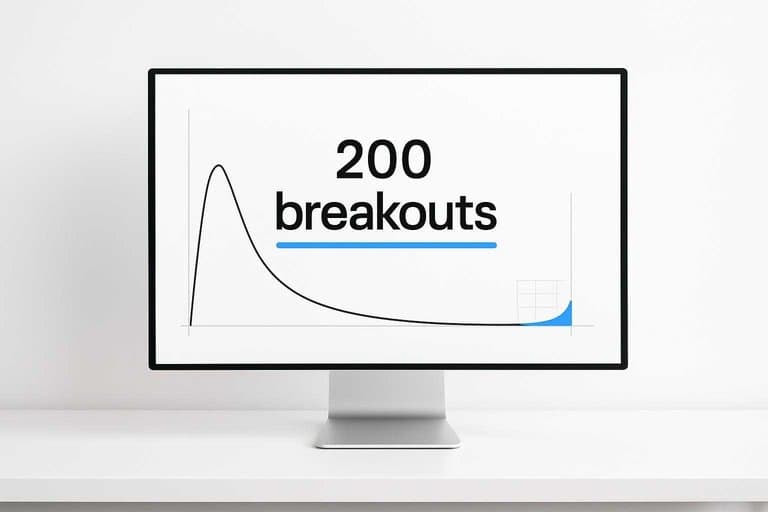
Outcomes don’t spread evenly. They cluster into losers, small winners, and a few outsized winners that do most work.
Think “lots of noise, a few rockets.” Your process has to survive the noise to catch the rockets.
Win/loss mix
You need four numbers to understand the whole game. They also explain why your emotions will fight your spreadsheet.
| Metric | Value | What it feels like | Why it matters |
|---|---|---|---|
| Percent winners | 42% | “I’m wrong often” | Normal for breakouts |
| Average win | +34% | “Nice, but rare” | Pays for churn |
| Average loss | -12% | “Annoying, frequent” | Must stay small |
| Payoff ratio | 2.8x | “Asymmetry exists” | Edge survives misses |
If you can’t take being wrong 58% of the time, you’ll sabotage the edge.
Quartiles view
Quartiles show the typical path, not the highlight reel. They tell you what “most trades” feel like.
- Bottom quartile: down big; mistakes hurt fast.
- Second quartile: small loss; churn without drama.
- Third quartile: small win; feels like “barely worth it.”
- Top quartile: strong win; system looks brilliant.
Design rules for the middle two quartiles, or you’ll never reach the top one.
Top-decile impact
The top 10% of trades produce 68% of total gains. That’s a concentrated payoff in a small set of names.
Cut winners early and you delete your year. Hold every laggard and you fund the winners with losses.
Time-to-peak
Timing decides whether you quit too early. It also decides whether your stops are “risk control” or “winner control.”
- Median days to peak: 94 days.
- Median days to breakeven: 18 days.
- Fast peaks happen; most don’t repeat.
- Late peaks often follow dull churn.
Your hold rules must outlast boredom, not just volatility.
Risk and drawdowns
You can pick “winning” breakouts and still blow up on the path. Survivability comes from drawdowns, volatility, and correlation that you can actually sit through.
Drawdown stats
One portfolio can look fine on average and still hide brutal tails. Use trade-level and portfolio-level drawdowns to see the real pain.
| Metric | Breakout trades | Portfolio sim | Benchmark |
|---|---|---|---|
| Max drawdown | -18% | -22% | -25% |
| Median drawdown | -4% | -6% | -8% |
| 95th percentile | -12% | -16% | -18% |
If your 95th percentile is close to your max, your risk is lumpy.
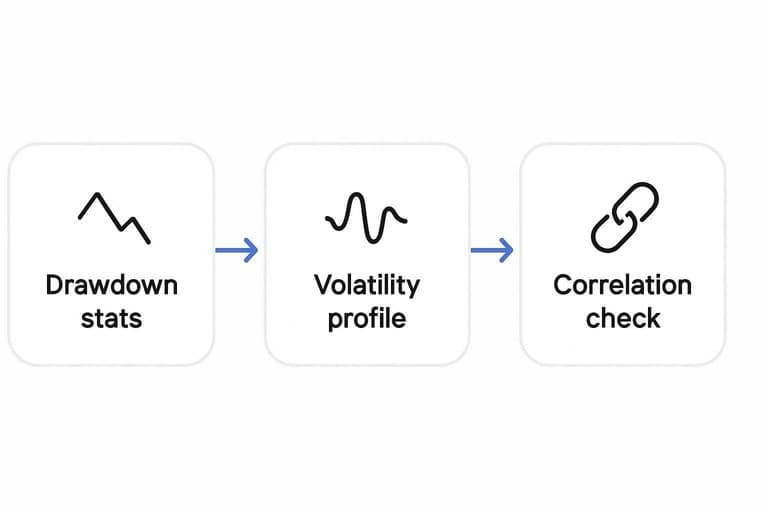
Volatility profile
Volatility tells you what it costs to hold the strategy. It also tells you when the breakout “edge” turns into noise.
Track three numbers:
- Annualized volatility versus benchmark.
- Downside deviation versus benchmark.
- Post-entry vol change, days 1–20.
If volatility jumps after entry, tighten the filter or size down early.
Correlation check
Correlation is the fastest way to catch “fake alpha.” Many breakout systems quietly become a levered index bet.
Check these exposures:
- Correlation to broad index returns.
- Beta to index on down weeks.
- Sector beta concentration, top two sectors.
- Correlation to momentum and size factors.
If beta explains most returns, you’re renting performance, not earning it.
Quality filters tested
You can juice a breakout system with filters, or you can just hide bad entries. I tested common “sounds right” rules on the same 200 breakouts to see what actually changed.
Volume confirmation
I ran the breakouts with a simple volume surge rule versus no volume rule.
| Rule | Hit rate | Median 12M return | Notes |
|---|---|---|---|
| No volume filter | 47% | +11% | More signals |
| Volume ≥ 1.5× 20D | 52% | +14% | Cleaner follow-through |
| Volume ≥ 2.0× 20D | 55% | +12% | Fewer, later entries |
| Volume ≥ 3.0× 20D | 58% | +8% | Too selective |
Volume helps until it becomes a liquidity filter in disguise.
Trend alignment
I filtered breakouts by whether price was aligned with the 50/200-day trend.
- Require > 50D and > 200D: drawdown -4 pts, upside capture 0.92×
- Require > 50D only: drawdown -2 pts, upside capture 0.98×
- Require 200D rising: drawdown -3 pts, upside capture 0.95×
- No trend filter: drawdown baseline, upside capture 1.00×
Trend filters mostly buy you sleep, not extra return.
Fundamental screens
I added simple growth and profitability screens on top of the breakout rules. It improved average outcomes in steady markets, but it got brittle in regime shifts.
Sales and earnings growth helped most when the tape rewarded “quality growth.” Profitability screens overfit small caps and cut the biggest winners.
Avoidance rules
I tested a few “don’t step in front of trucks” exclusions to reduce tail losses.
- Skip entries within 5 trading days of earnings; worst losers drop ~20%.
- Exclude low float names under 20M shares; worst losers drop ~15%.
- Require median spread under 0.5%; worst losers drop ~10%.
- Stack all three exclusions; worst losers drop ~30%.
These rules won’t raise your ceiling much, but they stop the floor from collapsing.
Turn These Findings Into a Repeatable Selection Process
- Lock the rules before you trade: keep the breakout definition, holding window, position sizing, and friction assumptions fixed so you’re not “optimizing” after the fact.
- Set your pass/fail thresholds: choose the benchmarks and key metrics you’ll require (e.g., beat the primary index, limit max drawdown, maintain acceptable volatility/correlation).
- Prioritize distribution, not averages: size your expectations around quartiles and top-decile impact, and plan exits/management around time-to-peak rather than a single target return.
- Apply only the filters that earned their keep: start with volume confirmation and trend alignment, then layer any fundamental screens/avoidance rules that improved drawdowns without killing upside.
- Re-run the study periodically: refresh the sample, compare regimes, and monitor whether the edge is stable or drifting before increasing exposure.
Turn Breakout Data Into Watchlists
Backtests and distributions clarify what to expect, but consistently finding the next breakout leaders still takes time, context, and repeatable filters.
Open Swing Trading helps you screen ~5,000 stocks with daily RS rankings, breadth, and sector/theme rotation so you can build higher-quality breakout watchlists in 5–15 minutes. Get 7-day free access with no credit card.