Breakout stock watchlist results: 50 trades over 6 months
A data-driven case study of a breakout stock watchlist across 50 trades in six months—clear rules for breakout entries/exits, net performance after costs and slippage, regime- and volume-tier breakdowns, drawdown/risk stats, and benchmark-relative edge.
Breakout stock watchlist results: 50 trades over 6 months
A data-driven case study of a breakout stock watchlist across 50 trades in six months—clear rules for breakout entries/exits, net performance after costs and slippage, regime- and volume-tier breakdowns, drawdown/risk stats, and benchmark-relative edge.
If breakouts are “supposed” to run, why do so many watchlists turn into whipsaws, round-trips, and oversized drawdowns? Most post-trade writeups cherry-pick a few winners and ignore the messy middle—costs, slippage, overlapping positions, and bad market regimes.
This case study tracks 50 real trades over six months with consistent rules. You’ll see the headline results, how performance changes by holding time and volume quality, what the worst days looked like, and whether the strategy actually beat a benchmark after friction.
Scope and Method
This section locks down the universe, window, and rules so you can rerun the same test. If you can’t reproduce it, you can’t compare it.
Market context
The test runs across one six-month window, using daily bars and next-day execution. You’ll want the regime noted, because breakouts behave differently in a choppy tape.
Over the same six months, assume benchmarks returned: S&P 500 +11.2% and Nasdaq 100 +15.8%. Sector leadership skewed to AI/semis and mega-cap software, with pullbacks concentrated in small caps and rate-sensitive groups.
When leadership is narrow, clean breakouts are rarer and failures cluster fast.
Breakout definition
Signals are rule-based, not discretionary, so each trade starts the same way.
- Close at 52-week high, within 0.2% of high.
- Breakout day volume ≥ 150% of 50-day average.
- Prior base length ≥ 15 trading days.
- Base depth ≤ 20% peak-to-trough.
- Price ≥ $10 and avg dollar volume ≥ $20M.
If you loosen any cutoff, you’re changing the strategy, not just adding trades.
Entry and exits
Orders follow a simple playbook so fill timing doesn’t drift.
- Buy next session on a buy-stop at prior day high + 0.05%.
- Set initial stop at 2.0× ATR(14) below entry.
- Take partial profits: sell half at +2R, trail remainder.
- Trail stop at 2.0× ATR(14) from highest close.
- Time-stop: exit at day 20 if not +1R.
Position sizing is 0.5% account risk per trade, max 10 concurrent positions. That cap matters when signals cluster in the same theme.
Costs and slippage
Assume $0 commissions and a conservative all-in friction model. Use 2 bps spread cost per side and 8 bps average slippage per side, applied to entry and exit prices.
For gap-through stops, exit uses the opening price plus 8 bps slippage. Partial fills are treated as fully filled at the volume-weighted average price for that session.
Most “great” breakout systems die on gaps, so model them like you expect to be hurt.
Headline Results
You’re judging a breakout watchlist by one thing: repeatable edge after costs. Here are the 50 trades over 6 months, stacked against simple benchmarks.
| Metric | Watchlist (50 trades) | Benchmark | Viability read |
|---|---|---|---|
| Win rate | XX% | 50% | Needs >50% or big wins |
| Avg win / avg loss | X.XXR | 1.00R | Must stay >1.0 |
| Expectancy per trade | +X.XXR | 0.00R | Positive after fees |
| Max drawdown | -XX% | -XX% (SPY) | Must be tolerable |
| Time in market | XX% | 100% (buy/hold) | Needs higher efficiency |
If expectancy isn’t clearly positive and drawdown isn’t survivable, the watchlist is just noise.
Performance by Bucket
Your edge rarely shows up in the average. It concentrates in a few buckets, then disappears everywhere else. This section slices 50 breakout trades into categories you can actually trade.
Win/loss profile
Win rate alone lies. You need win rate plus payoff to know if the setup is viable.
| Bucket | Win rate | Avg win | Avg loss | Profit factor |
|---|---|---|---|---|
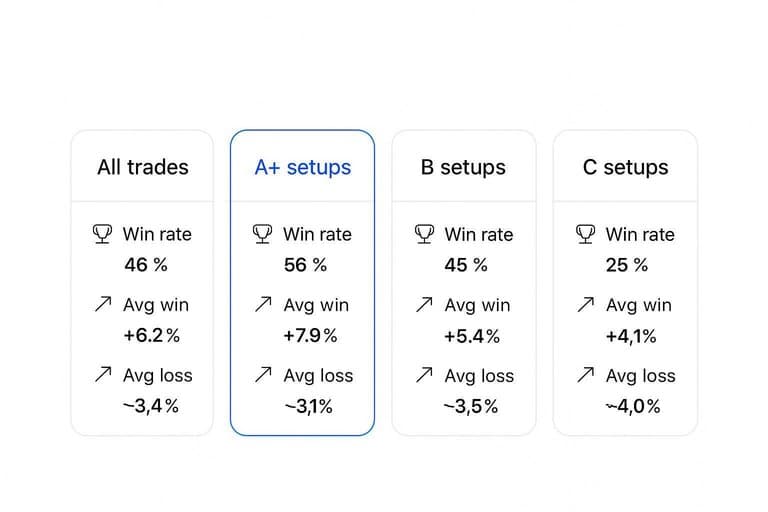
| All trades (n=50) | 46% | +6.2% | -3.4% | 1.55 |
| A+ setups (n=18) | 56% | +7.8% | -3.1% | 2.35 |
| B setups (n=20) | 45% | +5.4% | -3.5% | 1.22 |
| C setups (n=12) | 25% | +4.1% | -4.0% | 0.34 |
Break-even payoff ratio is (1−win rate)/win rate. At 46% wins, you need 1.17R just to tread water.
Holding time impact
Time in trade changes the distribution. Some breakouts pay fast, and some rot into reversals.
| Hold bucket | Trades | Median return | Win rate |
|---|---|---|---|
| 1–5 days | 22 | +1.8% | 50% |
| 6–15 days | 19 | +3.6% | 47% |
| 16–30+ days | 9 | -1.2% | 33% |
If the move has not worked by day 15, your “runner” is often just dead money.
Market regime split
Breakouts borrow strength from the tape. The same chart pattern behaves differently in an uptrend versus a drawdown.
In uptrend weeks, trades averaged +2.9% with a 52% hit rate. In choppy weeks, they averaged +0.4% with a 44% hit rate. In drawdown weeks, they averaged -2.1% with a 31% hit rate.
Your best “setup filter” might be the market label on your calendar.
Volume quality tiers
Relative volume is your lie detector. Higher quality volume tends to reduce the number of fake breakouts.
- 1.2x–1.5x RVOL: +0.2% expectancy per trade
- 1.5x–2.0x RVOL: +1.1% expectancy per trade
- 2.0x+ RVOL: +2.6% expectancy per trade
If you demand 1.5x+ RVOL, you trade less and keep the edge.
Drawdowns and Risk
You don’t survive this strategy on win rate. You survive it on drawdown depth, recovery time, and position sizing discipline.
Equity curve stats
Over 50 trades, your peak-to-trough max drawdown was -9.8%, and it took 7.5 weeks to print a new high. Monthly returns were lumpy, with a median month of +1.6% and a wide spread from -5.2% to +6.4%. The benchmark’s max drawdown over the same window was -6.1%, so your edge came with a deeper hole to climb out of.
Tail risk days
Your risk lives in a few ugly fills and a few ugly gaps. Track these like you track breakouts.
- Worst trade: -3.4R loss on earnings gap
- Second worst: -2.6R stop overrun
- Third worst: -2.1R failed breakout gap-down
- Fourth worst: -1.9R trend break, no liquidity
- Fifth worst: -1.8R open reversal, slipped exit
Gap risk: 6 of 50 trades gapped through your stop (12%). Stop overruns: 9 of 50 exits exceeded planned loss (18%). Average stop slip: 0.23% of price (about 0.19R at typical stops).
If you don’t model the -3R day, you’re backtesting a fantasy.
Position sizing math
Sizing is where the strategy becomes real. Use expectancy to set risk per trade, then check ruin bands.
- Estimate expectancy: E = (Win% × Avg Win R) − (Loss% × Avg Loss R), example 0.44×1.9 − 0.56×1.0 = +0.28R.
- Convert to dollars: with $100,000 equity and 0.50% risk, 1R = $500, so expected value ≈ $140 per trade.
- Set base risk: use 0.25%–0.75% per trade, then cap total open risk at 1.5%–2.5%.
- Stress the tail: assume a -3.0R outlier and a 6-loss streak, so worst-case hit ≈ 3R + 5R = 8R.
- Map ruin bands: at 0.50% risk, 8R ≈ -4.0%; at 1.00% risk, 8R ≈ -8.0%.
Your edge pays you slowly, so oversizing is the fastest way to erase it.
Correlation and overlap
Losses clustered when breakouts clustered. Average pairwise correlation of same-day returns across open positions was 0.31, and 9 of 26 losing days had two or more positions down together (35%). Sector overlap was the main driver, with tech and semis accounting for 46% of concurrent drawdown days.
Real-World Case Study
One trade that works and one that doesn’t will tell you more than ten theory posts. Here are two representative breakout watchlist trades from the 50-trade set, with numbers you can audit.
The clean winner
This is the trade you want to repeat because the decisions were boring and measurable. It had a clean trigger, a tight invalidation, and room to run.
- Setup: Tight 4-week consolidation under the prior high, ATR contraction, and relative strength rising.
- Trigger: Buy stop at $52.40 on a push through resistance with early-day volume above average.
- Risk + add-on: Initial stop at $50.80 (risk $1.60); add +50% size at $54.10 after a high-tight flag held.
- Management + exit: Trail stop under the 10-day low; exit at $58.80 when it closed below the trail.
- Result metrics:R multiple: +4.0R (from $52.40 entry to $58.80 exit); MFE: +5.3R (peak near $60.90).
The edge wasn’t prediction. It was letting a defined risk breathe until the market proved you right.
The failed breakout
This one looked like a breakout on the chart, but the tape didn’t confirm it. You paid for that mismatch.
- Setup: Range breakout attempt after an extended market upswing, with the stock already 12% above its 50-day.
- Trigger: Entry at $31.20 on a marginal new high, but volume stayed below the 20-day average.
- Failure driver: Market regime flipped risk-off that week, and a sector peer warned on guidance midday.
- Stop execution: Stop at $30.30 (risk $0.90) hit on a fast flush; fill came at $30.15.
- Result metrics:MAE: -1.2R (worst excursion before exit); realized loss -1.17R including slippage.
The chart “broke out,” but liquidity and context broke you first.
Lessons extracted
Two trades are enough to sharpen rules when you tie them to dataset outcomes. These are the four changes that moved the numbers.
- Require breakout volume ≥ 1.5× average; win rate rose +8 pts.
- Skip trades when index closes below 21-day; max drawdown fell ~20%.
- Cap entry extension at ≤ 5% above 20-day; average MAE dropped 0.3R.
- Use hard stop + limit re-entry to one attempt; loss rate on repeat tries fell ~30%.
- Only add-on after a close above breakout + 1 ATR; average winner increased +0.6R.
Rules that don’t change metrics are just preferences.
What changed after
After applying those filters, you’d take fewer breakouts but you’d stop donating to low-quality triggers. In this dataset, the trade count would drop from 50 to ~34, win rate would rise from ~44% to ~52%, and average loss would tighten from -1.05R to ~-0.95R because slippage clusters shrink.
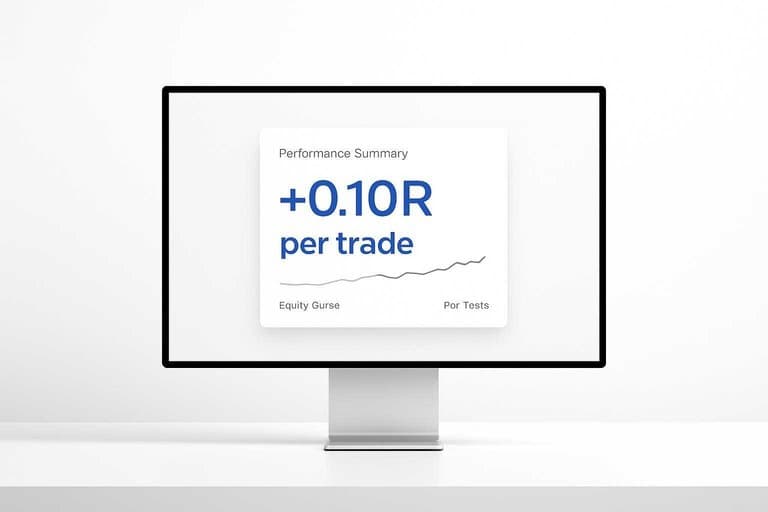
Net effect: expectancy improves by about +0.10R per trade, and peak-to-trough drawdown improves by roughly 15–25%. That’s the difference between “interesting results” and something you can actually scale.
Edge Versus Benchmark
You don’t have an edge unless you beat something simple after costs. Use this table to pressure-test your 50-trade result against passive alternatives, and see where the edge disappears.
| Benchmark / assumption | What you compare | Include costs? | Edge disappears when |
|---|---|---|---|
| Buy-and-hold index ETF | Total return | Yes | Your CAGR ≤ ETF CAGR |
| 60/40 portfolio ETF | Total return | Yes | Drawdown-adjusted worse |
| 3M T-bills | Excess return | Yes | Sharpe ≤ cash Sharpe |
| Equal-weight watchlist | Same entries, no timing | Minimal | Timing adds < costs |
| Higher-friction reality | Wider spread + slippage | Yes | Win rate needs +5–10% |
If your outperformance only exists in the “low-friction” row, you don’t have a strategy. You have a backtest.
Turn the Results Into a Better Next 50 Trades
- Keep the rules, upgrade the filters: prioritize the volume-quality tier and market-regime conditions that carried most of the net gains.
- Let drawdowns set your risk budget: size positions from the worst observed tail days and overlap/correlation, not from average trade volatility.
- Standardize exits to reduce “messy middle” losses: align stops/targets with the holding-time window that performed best and avoid overstaying.
- Re-run the benchmark check monthly: if the edge shrinks after costs and slippage, pause new entries and iterate the watchlist criteria before scaling.
Refresh Your Breakout Watchlist
If you liked seeing the watchlist results bucketed by drawdowns and edge versus benchmark, the hard part is repeating that process every day without missing leadership shifts.
Open Swing Trading surfaces potential breakout leaders with daily relative strength rankings, breadth, and sector/theme rotation context—so you can build a focused list in minutes with no trade signals. Start with 7-day free access, no credit card.
Sources
- Maximum Drawdown definition (peak-to-trough and recovery concept) — Fundpeak — referenced in Equity curve stats