Build a breakout stock watchlist for 5,000 stocks
A practical checklist for building a breakout stock watchlist across 5,000 names—define clean breakout rules, pick the right universe, run liquidity/trend/catalyst scans, and score/rank candidates into a repeatable alerts-and-dashboard workflow.
Build a breakout stock watchlist for 5,000 stocks
A practical checklist for building a breakout stock watchlist across 5,000 names—define clean breakout rules, pick the right universe, run liquidity/trend/catalyst scans, and score/rank candidates into a repeatable alerts-and-dashboard workflow.
If your watchlist keeps ballooning, you’re not watching opportunities—you’re babysitting noise. Most “breakout” lists fail because the rules are fuzzy, the universe is wrong, and the workflow doesn’t tell you what to do next.
This checklist shows you how to build a breakout-ready watchlist from up to 5,000 stocks without guesswork. You’ll set non-negotiable breakout criteria, filter for liquidity and strength, layer in earnings/catalysts, then score, rank, and structure the list so alerts and a simple dashboard keep you focused on the few names that matter.
Define breakout rules
You need rules that survive a 5,000-stock scan without you “seeing” patterns after the fact. Write them like a screener would: numeric, repeatable, and boring. Think “price closed above X with volume Y,” not “looks strong.”
Breakout must-haves
Your scan should only surface breakouts that can actually be bought and managed. If the rule doesn’t protect you from thin liquidity or random spikes, it’s not a rule.
- Close above base high by 0.5%–2.0%
- Volume 150%+ of 50-day average
- Dollar volume $20M+ per day
- Spread under 0.30% at mid
- Market and sector in uptrend
If one fails, you don’t “watch it anyway.” You filter it out.
Base quality checklist
A breakout is only as good as the base behind it. Define what “acceptable” means before you scan.
- Pick a base type: flat base, cup-with-handle, or tight range.
- Require duration: 3–12 weeks for daily-chart bases.
- Cap depth: max 15%–35%, based on volatility.
- Demand tightness: last 5–10 days within 1%–2.5%.
- Set a trigger: buy stop above pivot plus buffer.
Tight bases create clean risk lines. Loose bases create stories.
Common rule traps
Most breakout systems fail from “soft” rules dressed up as discipline. If you can’t code it, you’ll bend it.
Overfit traps show up as phrases like “best-looking in the group” or “volume felt strong.” Another classic miss is context blindness: buying a breakout one day before earnings, or during a market distribution wave.
Your rule should beat your opinions. If it can’t, it’s not a rule.
Choose your universe
Start with fewer, cleaner tickers so your scans fire for real breakouts, not junk prints. Your goal is fill quality: tight spreads, steady volume, and fewer halts.
| Filter | Typical cutoff | Why it helps | Drop if |
|---|---|---|---|
| Avg dollar volume (30D) | $20M+ | Better fills | You trade microcaps |
| Price | $5+ | Fewer manipulations | You accept penny risk |
| Market cap | $300M+ | Less halts | You want high beta |
| Spread (mid %) | <0.15% | Lower slippage | You use limit only |
| Options listed | Yes | More liquidity signals | You never hedge |
If your universe can’t fill cleanly, your “signal” is just a backtest artifact.
Set data and tools
You can’t screen 5,000 stocks with “good enough” data and a few browser tabs. Pick sources and platforms that stay consistent under load, like when you batch alerts or review 200 charts in an hour. If your inputs drift, your watchlist turns into noise.
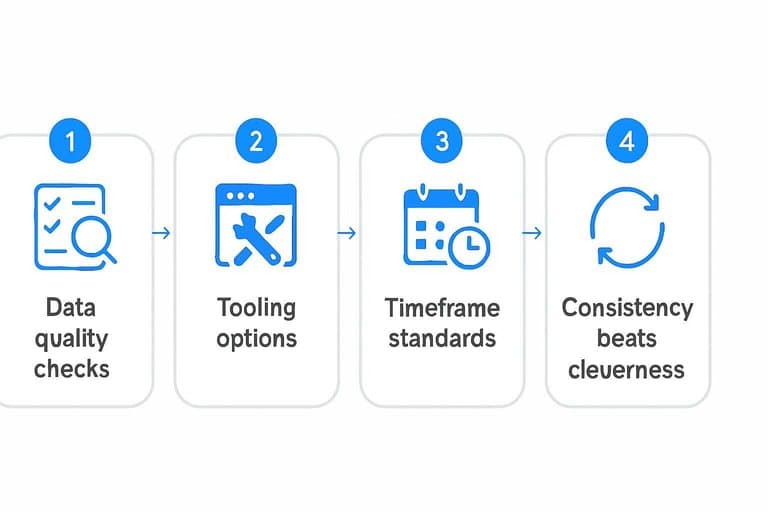
Data quality checks
Bad adjustments and biased histories create fake breakouts, then waste your attention.
- Cross-check splits and dividends against a second vendor for recent 12 months.
- Confirm adjusted and unadjusted OHLC both exist, and you know which you use.
- Ensure delisted symbols remain in history to avoid survivorship bias.
- Compare volume and float fields across sources for the same date.
- Spot-check outliers like 10x volume days against exchange prints or news.
If two sources disagree often, your “signal” is probably vendor math.
Tooling options
You need one stack for screening, one for alerts, and one for fast chart review.
| Option | Best for | Alerting | Scale |
|---|---|---|---|
| TradingView | Visual chart review | Strong | Medium |
| TC2000 | Fast scanning | Strong | High |
| Broker scanner | Tradable filters | Medium | Medium |
| Python + APIs | Custom pipelines | Strong | Very high |
The right choice is the one that still works at 5,000 symbols, every day.
Timeframe standards
Your breakout rules need one clock, or you’ll keep “finding” patterns that vanish on re-check. Use daily bars for scans and weekly bars for trend context, and keep both aligned to the same market session.
Set a default lookback, like 252 trading days daily and 52 weeks weekly, then freeze it for all screens. Treat gaps, halts, and thin sessions as data events, not chart art, and exclude days below a minimum volume threshold.
For more detail on how trading halts and volatility pauses work in practice, see FINRA’s overview of guardrails for market volatility.
Consistency beats cleverness, because your alerts only matter if they repeat tomorrow.
Build the first scan
You need a scan you can run every week without tweaking. It should spit out a short list with “why it passed” attached, so you can audit misses later.
Liquidity first filter
You’re trying to avoid charts you can’t enter, exit, or size. Liquidity rules cut slippage, bad fills, and fake breakouts.
- Set a minimum 20-day average dollar volume, like $10M+.
- Set a price floor, like $5–$10, to avoid junky microcaps.
- Cap the average spread, like under 0.5% of price.
- Require enough movement, like ATR(14) at least 2% of price.
- Exclude thin sessions, like frequent zero-volume opening minutes.
If it fails liquidity, nothing else matters. Don’t negotiate with the tape.
Trend and strength filter
You want stocks already being accumulated, not “maybe turning.” Trend rules keep you aligned with pressure, not opinion.
- Require price above the 50-day moving average.
- Require the 50-day above the 200-day, or rising 200-day.
- Require a relative strength rank, like top 20% vs universe.
- Require higher highs over 3 and 6 months, by close.
- Reject extended names, like 20%+ above the 50-day.
This is how you stop buying hope. You buy proof instead.
Earnings and catalysts
Catalysts change the game because they compress time. A “clean breakout” into earnings can be a coin flip, so you need explicit handling rules.
Tag names with earnings in the next 7–10 trading days as “event risk.” Exclude them if you only trade technicals, or keep them if you trade “earnings run-ups.” Also tag scheduled guidance events, FDA dates, investor days, and major economic exposure, like “big semis before CPI.”
Your watchlist gets calmer when you separate technical setups from headline grenades.
Score and rank
You need a scoring system because 5,000 charts will fool your eyes fast. Points force consistency when two setups look “almost the same.”
Your goal is simple: reward tight, liquid, rising leaders near a real trigger. Everything else gets deprioritized, even if the story sounds good.
Scoring rubric
Use a points table so you can rank fast and argue less.
| Factor | What you measure | Points |
|---|---|---|
| Base tightness | Range contraction | 0–5 |
| Volume signature | Dry-up then surge | 0–5 |
| Relative strength (RS) | RS line near highs | 0–5 |
| Sector momentum | Sector in uptrend | 0–3 |
| Proximity to trigger | Within 0–2% | 0–2 |
If a stock can’t win on structure, it shouldn’t win on vibes.
Tie-break rules
Ties happen when you score honestly, so you need deterministic rules.
- Prefer higher dollar volume liquidity
- Prefer cleaner trend and fewer wicks
- Prefer fewer overhead supply levels
- Prefer clearer stop placement points
When scores match, pick the one you can actually trade and manage.
What not to score
Don’t score anything you can’t define or repeat. “Great story,” “Twitter is excited,” and “CEO on TV” are entertainment, not edge.
Avoid single-day spikes and one-off news candles, since they rarely set durable triggers. Also avoid indicators that double-count, like stacking RSI, stochastics, and MACD as separate “signals.”
If it isn’t additive and testable, it doesn’t belong in your points.
Watchlist structure
You need tiers so you can scan 5,000 names without drowning. Think in actions, not symbols: “buy soon,” “watch,” “ignore.”
- Tier 1: On-deck breakouts (0–30 names)
- Tier 2: Tight setups forming (30–150 names)
- Tier 3: Needs repair or time (150–500 names)
- Tier 4: Watch themes, not tickers
- Tier 5: Trash bin for 30 days
If a stock has no next action, it belongs in a lower tier.
Entry and risk plan
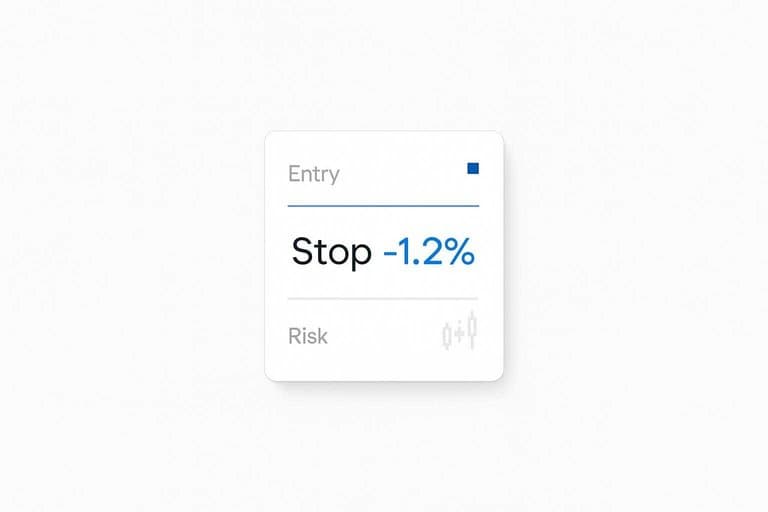
A big watchlist only helps if every name has the same playbook attached. You want a trigger, a stop, and an invalidation level you can read in five seconds, like “Pivot +0.3% / Stop -1.2% / Invalidate below 50DMA.”
Trigger definition
You need a small set of trigger types so 5,000 names don’t become 5,000 opinions.
- Choose one trigger: pivot break, range break, or reclaim level.
- Add a buffer: 0.2–0.5% over level, or 0.1–0.2 ATR.
- Require confirmation: close above, or 5–15 minute hold.
- Pick the order: stop-limit for gaps, stop-market for speed.
- Set invalidation: back inside range, or reclaim fails by close. Good triggers are boring and repeatable, not “felt strong.”
Stops and sizing
Your stop decides your size, not your confidence.
- Place the stop at structure: under pivot low, range low, or key MA.
- Add volatility room: 0.5–1.0 ATR beyond the level.
- Set max risk per trade: 0.25–1.0% of account.
- Size the position: shares = (account × risk%) ÷ (entry − stop).
- Cap size by liquidity: stay under 10% of average daily volume. If you can’t size it safely, it’s not a setup yet.
Risk management don’ts
Rules you break once become rules you break every day. Write these as “never,” not “try not to,” and treat them like circuit breakers. Don’t widen stops, even if it’s “just a little.” Don’t average down into a losing trade. Skip illiquid names with ugly spreads or thin volume. Cap correlated exposure so one theme can’t torch your week. Your edge lives in consistency, and these are the lines that protect it.
Alerts and workflow
Automate the boring parts so you only stare at charts when something changed. A good workflow feels like a trader texting you: “It’s at the line.”
Alert rules
You need alerts that fire before the breakout, at the breakout, and after the breakout fails. Otherwise you get noise, then regret.
- Price crosses trigger + buffer
- Volume spikes vs 50-day average
- RS line makes new high
- “Near trigger” at 1–2% away
- Time reminder: review at close
Build alerts in layers, and you’ll spot intent before the crowd sees price.
Daily review routine
You can run this in 10–20 minutes if you keep decisions binary. Your only job is to re-rank and react.
- Refresh your scans and import new candidates.
- Re-tier names into A, B, and “watch only.”
- Check the next 7–10 days earnings calendar.
- Review triggered alerts and log outcomes.
- Annotate charts with triggers, stops, and invalidation.
Do it at the same time daily, and your alerts become a system, not a surprise.
Weekly maintenance
Once a week, clean the list with rules, not feelings. Prune anything that broke structure, went flat for weeks, or lost relative strength versus its group.
Add fresh leaders from your scans, especially where a sector is rotating into strength. Reset stale setups by redrawing bases and triggers, or demoting them until they rebuild.
Your edge comes from list quality, so protect it like inventory.
Track results dashboard
You need a dashboard that answers one question: does your watchlist generate tradable breakouts. It should also show drift, so you fix rules before you start “explaining” losses.
Track these fields per breakout and review weekly.
| Metric | Definition | Target | Action if failing |
|---|---|---|---|
| Breakout hit rate | % that follow through | 40% | Tighten filters |
| Median R-multiple | Median R per trade | +0.5R | Reduce losers |
| Time-to-fail | Days to stop out | <5 days | Faster exits |
| Watchlist coverage | % liquid names tracked | 80% | Add scan gaps |
| Rule stability | Performance by quarter | Flat to rising | Freeze changes |
If your “rule stability” line breaks, stop optimizing and start auditing your process.
Turn the checklist into a weekly watchlist flywheel
- Lock your rules: Re-read your breakout must-haves and base-quality checklist; update only if you can point to a rule trap you’re fixing.
- Refresh the universe + data: Re-run liquidity and data quality checks so bad prints and illiquid names can’t sneak in.
- Re-scan, then re-rank: Run the same filters, apply your scoring rubric, and use tie-break rules to cap the list at your maximum.
- Execute the workflow: Set alerts, review daily for triggers, maintain weekly, and record outcomes in your results dashboard so the next iteration gets sharper.
Rank Breakout Leaders Daily
Once your breakout rules and workflow are set, the hard part is keeping a 5,000-stock universe ranked, filtered, and alert-ready every day.
Open Swing Trading delivers daily RS rankings, breadth and sector/theme context, and watchlist-ready scoring so you can find emerging leaders faster—get 7-day free access with no credit card.