Build a Quallamaggie watchlist in 20 minutes
A fast, practical guide to building a Quallamaggie-style watchlist in 20 minutes — set your universe and trend filters, run a first scan, score candidates in minutes, mark pivots/alerts, and lock in a daily 5-minute maintenance routine.
Build a Quallamaggie watchlist in 20 minutes
A fast, practical guide to building a Quallamaggie-style watchlist in 20 minutes — set your universe and trend filters, run a first scan, score candidates in minutes, mark pivots/alerts, and lock in a daily 5-minute maintenance routine.
If your watchlist keeps growing but your best setups keep slipping by, the problem isn’t effort—it’s structure. Without clear filters, scoring, and levels, you’ll either chase everything or miss the clean momentum names.
This guide shows you how to build a Quallamaggie-style watchlist in about 20 minutes: define a tight universe, scan for trend and momentum, score candidates fast, and mark actionable pivots, stops, and alerts. You’ll finish with a short list you can manage in five minutes a day.
Setup and filters
You’re building a Quallamaggie-style watchlist for one job: surface leaders you can buy on strength. Time box it to 20 minutes, or you’ll start “researching” instead of filtering.
Your output is a first-pass universe, not a portfolio. Think “names worth stalking,” not “names I must own.”
Define your universe
Start with tradable constraints so every name can actually be executed. Tight inputs beat heroic decision-making later.
- Choose your market: US listed common stocks.
- Set liquidity: $20M+ average daily dollar volume.
- Set price floor: $10+ to avoid junky spreads.
- Remove clutter: exclude ETFs, prefs, and ADRs.
- Keep it fresh: require 252 trading days of data.
If you can’t trade it cleanly, it doesn’t belong in your “A+ setup” funnel.
Trend and momentum rules
Momentum names advertise themselves in the price. Your filters should force leadership, not “maybe it turns around.”
- Within 10% of 52-week high
- Above 50-day moving average
- Above 150-day moving average
- 3-month relative strength vs SPY positive
- 1-month performance in top quartile
When multiple trend tests agree, you’re not predicting strength—you’re selecting it.
Risk and position constraints
Your watchlist should match how you actually trade, not how you fantasize. Define capacity and risk now, so you don’t improvise under pressure.
Cap total positions at 5–12, depending on your attention. Risk 0.25%–1.0% of equity per trade. Use a technical stop, like a prior pivot low or the 20/50-day reclaim level.
The watchlist is only useful if every name has a stop you’d respect.
Catalyst and theme tags
Tags turn scanning into routing. You’ll spot “why now” faster, without adding new rules.
- Earnings soon: within 10 days
- Fresh breakout: new 20-day high
- Sector leader: top 3 sector RS
- News tailwind: upgrade, contract, approval
- Theme bucket: AI, energy, biotech, etc.
Your tags don’t pick trades; they tell you what to check first tomorrow morning.
Run the first scan
Run one clean scan so you get a shortlist you can trust. Your goal is speed plus signal, not a perfect model.
- Set your universe to liquid names only, like “>1M avg volume”.
- Filter for price above key moving averages, like 50DMA and 200DMA.
- Require relative strength, like “RS line new high” or “RSPR > 80”.
- Add a simple consolidation filter, like “within 25% of 52W high”.
- Export results to a sheet with ticker, price, volume, RS score, group.
If your export is over 200 names, tighten liquidity or RS before you review.
Score candidates fast
You don’t need perfect analysis to build a strong Quallamaggie-style watchlist. You need a repeatable filter that turns “maybe” into “yes/no” fast, like scoring NFL prospects on a clipboard.
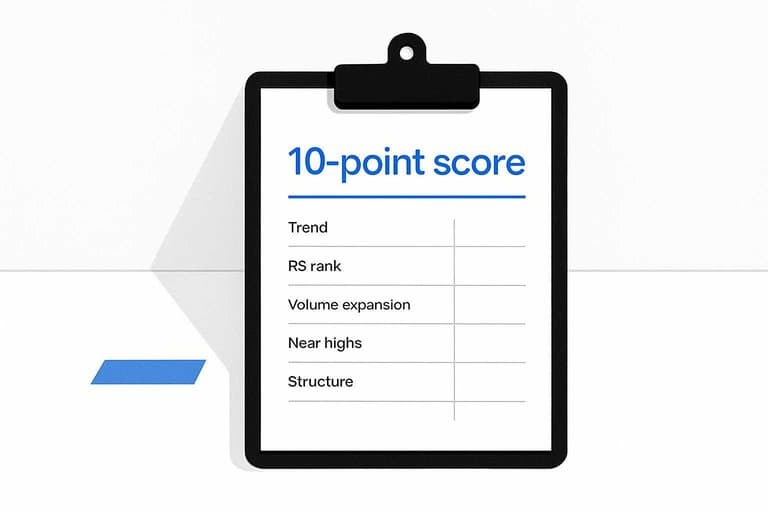
Create a 10-point score
Use five factors so every ticker gets judged the same way, even on a busy day.
| Factor | 0 points | 1 point | 2 points |
|---|---|---|---|
| Trend | Below 50/200 | Above 50 only | Above 50 and 200 |
| RS rank | Below 70 | 70–85 | 86–99 |
| Volume expansion | Dry, fading | One good day | Repeated, controlled |
| Near highs | Far below highs | Mid-range | Within 10% highs |
| Structure | Messy, wide | OK base | Tight, clean |
Your goal is consistency, not precision. That’s how you spot the real leaders early.
Apply the score quickly
Score each ticker once, then move on before you overthink it.
- Pull up the daily chart and RS rank.
- Assign 0–2 points per factor in 30 seconds.
- Write the total score beside the ticker.
- Drop anything below your cutoff immediately.
If you can’t score it quickly, you can’t trade it cleanly.
Add one-line notes
A score tells you “quality,” but your note tells you “plan.” Write a single sentence like, “Uptrend, holding 50DMA; buy through 72.50; invalid below 68.”
That one line becomes your trigger and your exit rule. It also kills wishful thinking.
Choose a target size
Pick a number that fits your review time, not your ambition.
- Sort by score, highest first.
- Keep all names above your “A-list” cutoff.
- Fill remaining slots with the cleanest charts.
- Stop at 20–40 tickers, no exceptions.
A smaller list gets reviewed every day. A huge list gets ignored.
Mark key levels
Key levels turn a “nice chart” into a decision-ready plan. You’re defining where you buy, where you add, and where you’re wrong, like “above $52.40, I’m in.”
Find pivot levels
You need pivots that force action, not debate. Use levels the whole market can see.
- Mark the 20–60 day high that would trigger a breakout.
- Box the tightest 5–15 day range near that high.
- Draw a line at the range high and range low.
- Mark the last obvious swing low before the range.
- Note any gap level that aligns with those lines.
When three clean references stack, that level stops being “yours” and becomes tradable.
Plan stops and adds
You’re mapping risk first, then scaling only if the stock proves you right. Keep it mechanical.
- Place the initial stop below the nearest swing low.
- Use a volatility buffer, not a perfect line.
- Add on a clean break and hold above pivot.
- Add on the first tight flag after breakout.
- Exit on a close back into the base.
Your stop is the price of admission, and adds are earned, not hoped for.
Check liquidity reality
Levels are useless if you can’t execute them without slippage. One quick check saves you from “paper-perfect” trades.
Look at spread at the open and mid-day, scan average daily volume, and compare ATR to your stop distance. If the spread is chunky or the ATR is tiny, your trigger becomes noise.
If it won’t fill cleanly, it doesn’t belong on your watchlist.
Draft alerts
Alerts keep you from babysitting charts and reacting late. You want prompts for entry, invalidation, and strength.
- Set a buy trigger alert slightly above the pivot.
- Set a failure alert slightly below the range low.
- Set a momentum alert at the next obvious resistance.
- Add a “close-based” alert for end-of-day decisions.
- Label alerts with entry, stop, and add notes.
Good alerts don’t predict; they schedule your attention.
Build the watchlist
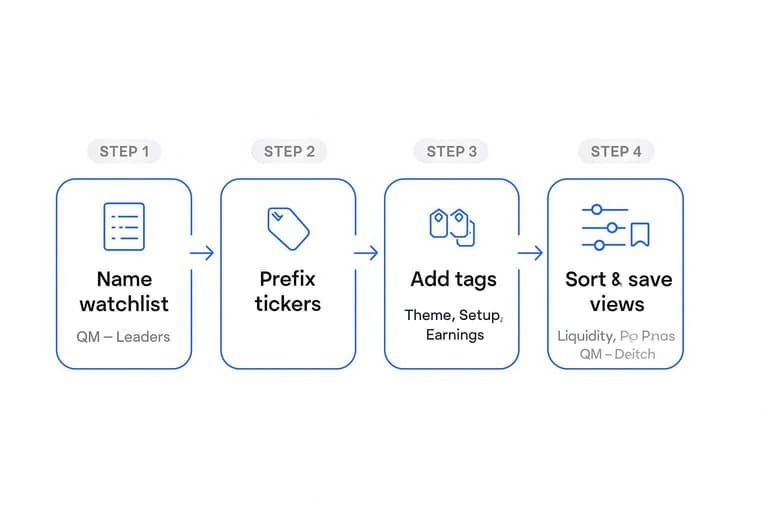
Set up a platform watchlist you can scan fast, every day. Consistent names and tags prevent “what was that again?” moments.
- Create a new watchlist named “QM - Leaders”.
- Add your current candidates, then rename tickers with a prefix like “A1”, “A2”, “B1”.
- Add tags for “Theme”, “Setup”, and “Earnings”, using the same words every time.
- Sort by liquidity first, then by relative strength, then by proximity to pivots.
- Save a second view named “QM - Bench” for former leaders and watchlist rejects.
If your list doesn’t sort the same way daily, your brain will burn cycles you need for execution.
Daily 5-minute routine
A Quallamaggie-style watchlist stays useful when you treat it like a living queue, not a trophy case. You want a fast loop that catches new leaders, trims losers, and keeps triggers obvious, like “tight base near highs.”
Morning quick pass
You’re looking for overnight change that alters your plan. Gaps, volume, and trend shifts tell you what moved from “later” to “now.”
- Check premarket gaps versus yesterday’s range.
- Compare volume trend to the 20-day average.
- Mark price relative to 10/20/50-day moving averages.
- Flag names within 1–2% of your trigger.
- Note any clean “tight near highs” bases.
Your morning job is triage, not analysis.
Midday maintenance
Midday is for quick hygiene while the tape is live. You move winners closer to action and cut anything that broke.
- Move triggered names to an action list
- Drop charts that lost key support
- Remove names with heavy distribution days
- Tighten alerts around clean entries
- Add notes on catalyst or sector
If a chart broke, your watchlist doesn’t need “second chances.”
Evening refresh scan
The close gives you clean data for decisions. You want new leaders in and dead weight out.
- Re-run your leader scans on daily timeframes.
- Add names making new highs on rising volume.
- Tag setups: breakout, pullback, or tight base.
- Remove laggards below the 20/50-day averages.
- Cap each category to prevent list creep.
Your edge comes from selectivity, not coverage.
Weekly reset checklist
Once a week, you audit your process like a system, not a mood. Pull your last week’s trades and screenshots, then ask, “Which tags actually predicted clean moves?” Update your rules, prune repeated mistakes, and tighten definitions like what “extended” or “choppy” really means.
If your watchlist rules don’t evolve, you’ll keep relearning the same lesson with new tickers.
Lock it in and run the routine
- Save your filter preset and run the scan the same way each time (consistency beats “perfect” settings).
- Score quickly, keep only the top tier, and cap the list to a size you can actually review daily.
- Mark pivots, stops, and alert levels immediately so every ticker has an if/then plan.
- Follow the 5-minute routine for a week, then do a weekly reset: prune laggards, refresh themes, and tighten rules based on what produced clean trades.
Frequently Asked Questions
Is a Quallamaggie watchlist the same as a momentum stock watchlist?
Mostly, but a Quallamaggie watchlist is usually stricter about strong relative strength, clean breakouts, and avoiding choppy bases. It’s built to surface leaders that can trend, not just “high volume movers.”
Do I need paid scanners or software to build a qullamaggie watchlist?
No. You can build a solid qullamaggie-style watchlist with free tools like TradingView (basic), Finviz, and your broker’s screener, as long as you can filter for liquidity, trend, and relative strength.
How many tickers should be on a Quallamaggie watchlist at once?
Most traders do best with 20–60 names on the active watchlist and a larger “bench” list (100–300) for ideas. Fewer names improves focus and makes daily review realistic.
How do I measure whether my qullamaggie watchlist is actually improving my results?
Track a simple log: watchlist adds, triggered setups, win rate, average R multiple, and “missed runners” per month. If win rate and average R improve over 8–12 weeks, the watchlist process is working.
How long does it take for a Quallamaggie watchlist to start paying off in real trades?
You usually see better trade quality within 2–4 weeks as you refine what makes the list. Meaningful performance improvement typically shows up over 8–12 weeks of consistent execution and review.
Upgrade Your Leader Scan
A Quallamaggie-style watchlist is only as good as the leadership and regime context behind it—and doing those checks manually every night adds up fast.
Open Swing Trading streamlines your nightly scan with daily RS rankings, breadth, sector/theme rotation, and watchlist workflows built for discretionary breakouts—get 7-day free access with no credit card.