Build a stock and market check in 10 minutes
A 10-minute guide to building a daily stock and market check that keeps you consistent without information overload — set a clear goal, standardize inputs, do a fast market read (index/breadth/volatility), scan stocks with predefined setups, and sanity-check portfolio exposure and risk notes.
Build a stock and market check in 10 minutes
A 10-minute guide to building a daily stock and market check that keeps you consistent without information overload — set a clear goal, standardize inputs, do a fast market read (index/breadth/volatility), scan stocks with predefined setups, and sanity-check portfolio exposure and risk notes.
If your “quick market check” keeps turning into 45 minutes of tabs, headlines, and second-guessing, you don’t need more data—you need a tighter routine.
This guide gives you a repeatable 10-minute workflow: define what you’re actually trying to learn, pull a small set of reliable inputs, write a one-line market stance, scan stocks using prebuilt setups, and finish with a portfolio health check so your next decision is calmer and faster.
Set your goal
“Done” is a 10-minute routine that ends with a stance and a move. You’re not forecasting the year. You’re deciding what to do today, in writing.
Pick time window
Pick one window so your data is comparable day to day.
- Choose one: pre-market, open, or close.
- Set a 10-minute timer you cannot extend.
- Pick a daily start time you can keep.
- Run it on weekdays only, no exceptions.
Consistency beats “perfect timing” every time.
Create a simple template
You need one page you can fill fast, even on busy days.
- Open a note titled “Daily Market Check.”
- Add headings: Market, Watchlist, Portfolio, Actions, Risks.
- Leave 3–5 blank lines under each heading.
- Pin it or favorite it for one-tap access.
If the template is annoying, you’ll skip the routine.
Define success signals
Success is three outputs you can say out loud in one breath. Write them at the top of your template like a checklist. Market trend label: “Uptrend / Range / Downtrend.” Risk level: “Low / Medium / High.” Today’s action list: 1–3 moves, like “raise cash 5%.”
If you can’t name all three, you’re still consuming news, not running a process.
Gather your inputs
Open only the tools you’ll actually use, then close the rest. Speed comes from repetition, not more tabs. Your goal is a daily check you can run even on a busy morning.
Choose data sources
Pick a small set of signals that cover price, participation, and risk. You’re building a dashboard, not a research project.
- Track one index chart you trust
- Add one breadth metric you’ll check daily
- Use one volatility proxy for risk tone
- Open your broker or portfolio view
If you can’t name the four in 10 seconds, you have too many.
Set one watchlist
Create one list you’ll use every day, no exceptions.
- Add your current holdings first.
- Add your top candidates next.
- Add 2–3 market leaders for context.
- Cut anything you won’t trade this month.
- Stop at 10–20 tickers total.
Constraint is the feature here, because it forces real priorities.
Reduce distractions
Turn off the firehose so your brain can see the tape. Keep one reliable calendar for scheduled events, like CPI or Fed days.
Treat everything else as noise, even if it’s trending. That’s the line that gets crossed.
Quick market read
You need a fast read that prevents random trades. Four checks. One stance you can execute.
Think of it as your daily “weather report,” not a forecast.
Check the index
You’re identifying trend and nearby decision levels. Use one index you actually trade around, like SPY or QQQ.
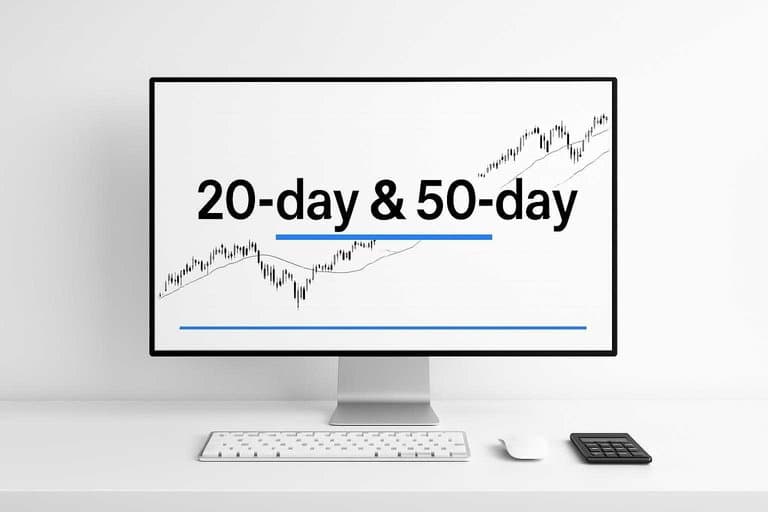
- Mark the 20-day and 50-day moving averages.
- Note price location: above both, between, or below both.
- Mark yesterday’s high and low as trigger levels.
- Label trend: up, sideways, or down using those three signals.
If price is below both MAs and under yesterday’s low, stop arguing with it.
Check breadth
Trend without participation is fragile. Breadth tells you if the move has real backing.
- Pull advancers/decliners for your main exchange, or your watchlist universe.
- If using A/D: label broad when advancers are ~2:1 or better.
- If using % above 50-day: label broad above ~60%, narrow below ~40%.
- Call it broad, mixed, or narrow and write the word down.
When breadth is narrow, your “index rally” is usually just a few names doing the work.
Check volatility
Volatility sets your position size and your patience. Use VIX for markets, or ATR for your primary vehicle.
Call it calm when VIX is falling and below its 20-day average. Call it stressed when VIX is rising and above it. Everything else is normal.
In stressed volatility, demand cleaner entries and smaller bets.
Write market stance
You’re turning inputs into a single operating rule. It should tell you what to do and what to ignore.
- Choose risk-on if index trend is up and breadth is broad.
- Choose risk-off if index trend is down or volatility is stressed.
- Choose neutral if signals conflict or breadth is mixed.
- Write one sentence: “Risk-__ because ___; focus on ___ setups today.”
Your stance is a filter. Let it say “no” most of the time.
Stock-level scan
Your goal is to turn a messy watchlist into three buckets: act now, monitor, no touch. Think “10 names worth attention,” not “200 names worth anxiety.”
Predefine setups
You need a tiny menu of patterns so you stop improvising under pressure. Use the same 2–3 setups every day, like “breakout over range highs.”
Pick 2–3 setups and write one line each:
- Breakout: price clears a clear range high
- Pullback: price tags support in an uptrend
- Continuation: price flags, then resumes trend
If you can’t describe it in one line, you can’t trade it fast.
Run the filter
Run the same three checks on every ticker. You’re scoring reality, not hunting a story.
- Check trend on daily and weekly charts.
- Mark the nearest obvious support and resistance.
- Compare today’s volume to recent average volume.
- Tag A if near a trigger, B if close, C if messy.
When you repeat this daily, your “A” list gets smaller and sharper.
Capture key levels
A-priority names need numbers, not vibes. Write levels so you can act in seconds.
For each A name, record:
- Entry trigger: the exact price that activates the idea
- Invalidation level: the price that proves you wrong
- First target: the next obvious level into strength
If you can’t set invalidation, it’s not an A trade.
Portfolio health check
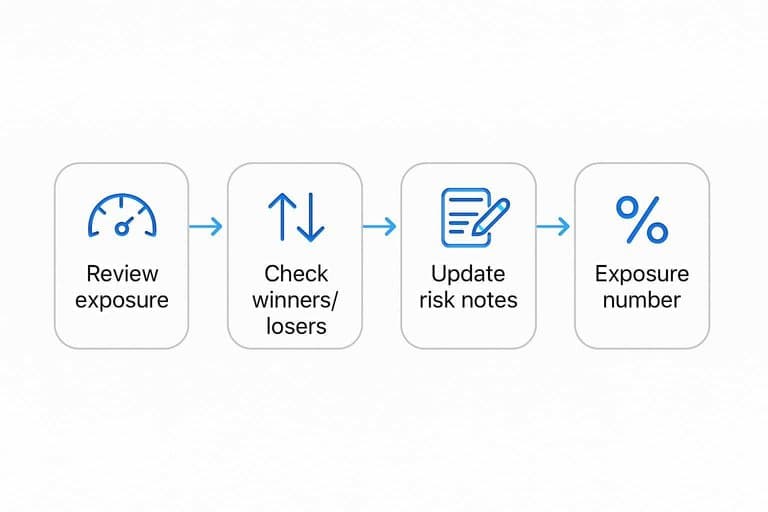
Your market stance is just a guess until it changes what you hold. Convert it into one clear exposure number, like “70% risk-on,” so you can act fast.
Review exposure
You need a fast snapshot of how much risk you’re actually carrying, not how you feel. Use simple rules you can repeat every week.
- Calculate % invested: (stock value ÷ total portfolio) × 100.
- Calculate cash %: (cash ÷ total portfolio) × 100.
- Check sector concentration: largest sector ÷ total portfolio.
- Check single-position size: largest position ÷ total portfolio.
- Compare both to your max rules, then set an “exposure” number.
If any rule is broken, your exposure is already decided for you.
Check winners/losers
Price action tells you where the portfolio is fragile or bloated. Sort positions by distance to your stop and target, then make one decision each.
- Flag “near stop” positions: within ~2–3% of your stop level.
- Flag “near target” positions: within ~3–5% of your target level.
- Flag “extended” positions: far above trend or recent base.
- Decide one action per flag: hold, trim, add, or exit.
- Apply a sizing rule before trading, not after.
The goal is fewer surprises, not more activity.
Update risk notes
Write one sentence that forces clarity, like: “Main risk is tech concentration; I’ll mitigate by trimming to my 20% cap.” Keep it brutally specific.
That line becomes your decision filter for the next trade.
10-minute schedule
You need a minute-by-minute plan so this check never bloats into scrolling. End on actions, not vibes.
| Minute | Do this | Tools | Output |
|---|---|---|---|
| 0–1 | Set intent | Notes app | One-line goal |
| 1–3 | Scan market | Index/ETF page | Market mood |
| 3–6 | Check holdings | Broker watchlist | 1–2 movers |
| 6–8 | Read one source | One newsletter | One takeaway |
| 8–10 | Decide actions | Calendar/tasks | Next steps |
If you can’t write a next step in minute 10, you didn’t really check anything.
Run the 10-Minute Check and Make One Clear Move
- Start with your template and time window so you know what “good” looks like today.
- Pull the same limited inputs, then write a one-line market stance based on index, breadth, and volatility.
- Scan stocks only for predefined setups, capture key levels, and finish by checking portfolio exposure and updating risk notes.
- End by choosing one action: place a planned order, set alerts at your levels, or do nothing—log the reason and move on.
Frequently Asked Questions
Does a 10-minute stock and market check actually work for long-term investing?
Yes—most long-term investors only need a quick daily pulse to manage risk and avoid surprises. Use longer weekly or monthly reviews for allocation changes and deep research.
What tools should I use for a stock and market check if I don’t have Bloomberg or paid data?
A free stack usually works: TradingView (charts/alerts), Yahoo Finance or Google Finance (quotes/news), and your broker app (positions and orders). Add an economic calendar like Investing.com for major events that can move markets.
How do I measure whether my stock and market routine is improving results?
Track two numbers: your portfolio’s 3–6 month performance vs a benchmark (like SPY) and your maximum drawdown over the same period. Also log how many “rule-based” actions you took and whether they reduced losses or improved entries.
Should I do a stock and market check every day, or only on trading days?
Most people do it on trading days only, ideally near the close or after the open when volatility settles. A quick weekend review can catch earnings dates, macro events, and position sizing issues before Monday.
What can I do if I only have 3 minutes for a stock and market check?
Limit it to three checks: index trend (e.g., S&P 500), volatility gauge (VIX or equivalent), and your top 5 positions for breakouts/breakdowns and upcoming catalysts. If any trigger hits, schedule a longer review rather than improvising trades.
Turn Checklists Into Leaders
A fast market-and-stock check is only useful if your inputs stay consistent and your candidate list stays fresh as conditions change.
Open Swing Trading refreshes daily RS rankings, breadth, and sector/theme rotation so your 10-minute routine surfaces actionable breakout leaders—get 7-day free access with no credit card.