Build a Traders Daily Routine: 12 Checks
A practical checklist for building a trader’s daily routine that stays consistent under pressure — define what “done” means, set time blocks and tools, run 12 pre-market-to-close checks, and enforce entry/management rules with clear risk limits.
Build a Traders Daily Routine: 12 Checks
A practical checklist for building a trader’s daily routine that stays consistent under pressure — define what “done” means, set time blocks and tools, run 12 pre-market-to-close checks, and enforce entry/management rules with clear risk limits.
Most trading mistakes aren’t strategy problems—they’re routine problems: you start late, miss context, force setups, or manage emotionally because nothing is standardized.
This checklist turns your day into 12 repeatable checks from pre-market to post-close. You’ll define what “done” looks like, lock in two non-negotiables, and follow simple entry, sizing, and management rules that keep you focused when volatility hits. Use it to reduce decision fatigue and make your execution match your plan.
Routine Blueprint
Your goal is a repeatable daily workflow that cuts mistakes and ends with a clear go/no-go call. Think “one page, same order, every day,” like a pilot checklist before takeoff. When your routine is consistent, your judgment gets to be inconsistent less often.
What “done” means
“Done” means you can point to a single page and say, “This is my plan today.” It includes a watchlist, directional bias, key levels, risk limits, a trade plan, and a written decision to trade or stand down. Example: “Bias: bullish above 5120; max loss: -0.5R; no trades during CPI; stand down if first two setups fail.”
Tools checklist
Use the same tools daily so your routine stays mechanical under stress.
- Charting platform with saved layouts
- Economic calendar with alerts
- Journal template for execution notes
- Position-size calculator for risk control
- News source plus alert system
If one tool is missing, you’re improvising with real money.
Time blocks
Block your day so decisions happen inside a container, not in open-ended chaos.
- Pre-market prep: 20–45 minutes, hard stop before open.
- Session execution: 60–180 minutes, stop after your best window.
- Post-market review: 15–30 minutes, done before dinner.
- Admin reset: 5–10 minutes, set alerts and walk away.
Hard stops prevent “just one more trade” from becoming your strategy.
Two non-negotiables
Protect capital and follow process, even when you feel “certain.” Capital keeps you in the game; process keeps you from turning confidence into damage. On most days, routine beats impulse because impulse only feels smart after the fact.
Pre-Market Checks
Run these checks before you place a single order. You’re building context, hard risk boundaries, and a watchlist that deserves your attention.
1) Sleep and focus
Do a fast self-audit before you open a chart. Trading while foggy turns small mistakes into “I can’t believe I did that” losses.
Rate these from 1–5: sleep, stress, distraction, and urgency to trade. If any score is 2 or lower, cut size by 50% or stand down.
Your edge isn’t just your setup. It’s your decision quality.
2) Calendar scan
Volatility often has a schedule. You want to know when the market can rip through stops for no technical reason.
- Check the economic calendar for high-impact releases and central bank speakers.
- Mark major earnings for your symbols and their sector leaders.
- Set no-trade windows, like 10 minutes before and after each event.
- Note market holidays, early closes, and index rebalances.
You’re not avoiding volatility. You’re choosing when to pay for it.
3) Overnight context
Overnight action sets the tone, even for “day trades.” It tells you whether to fade moves or respect momentum.
- Check S&P, Nasdaq, Dow futures direction
- Note gaps versus prior close
- Scan rates: 2Y and 10Y yield moves
- Check USD strength and major FX pairs
- Watch oil and gold for risk signals
If three markets align, treat it like a regime, not noise.
4) Key levels
Levels are your map for entries, exits, and invalidation. If you don’t write them down, you’ll negotiate with yourself later.
- Mark prior day high, low, close, and pre-market high/low.
- Plot VWAP and yesterday’s VWAP bands if you use them.
- Add weekly high/low and any obvious swing pivots.
- Box clear supply and demand zones from clean impulses.
- Write the levels in plain text beside your watchlist.
A trade without a level is just a feeling with a timestamp.
Session Entry Rules
Your job pre-market is to turn noise into a plan you can execute under pressure. You earn the right to trade only when your plan is specific, testable, and sized for survival.
5) Thesis in one line
Write one sentence that includes direction and the exact level that proves you wrong. Example: “Long above 412.20, wrong below 410.80.” If you can’t name that invalidation level, you’re guessing.
6) Setup qualification
Use a checklist so you trade setups, not moods.
- Match the higher-timeframe trend
- Have a real catalyst, not vibes
- Confirm liquidity at your entry
- Require tradable volatility today
- Define trigger and stop location
If one is missing, you’re not early. You’re just sloppy.
7) Risk and sizing
Decide risk before you see the candle.
- Set a max daily loss and stop trading at it.
- Set max risk per trade in dollars.
- Set a max number of attempts per idea.
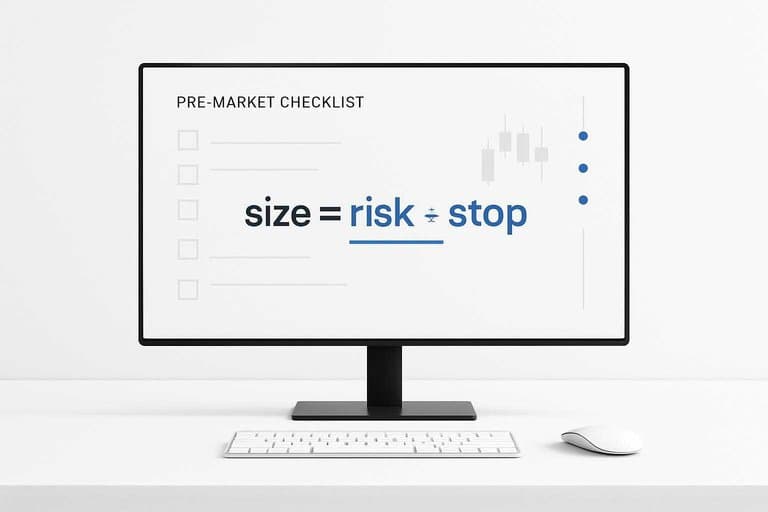
- Compute size = risk ÷ stop distance.
- Cut size if spreads or slippage expand.
Your edge can’t compound if your sizing is allowed to explode.
8) Orders and alerts
Pre-place alerts at your trigger, your stop, and your first decision level. Choose the order type on purpose, like “limit on pullback” or “stop for breakout,” and write your slippage assumption in ticks or cents.
When the alert hits, you should execute, not debate.
Execution Discipline
Live trading punishes improvisation. You need a small routine that keeps risk intact when adrenaline spikes.
Think “do the checklist” before you think “be right.” One sloppy mid-trade decision, like “I’ll just give it more room,” can undo a week.
9) Entry confirmation
Confirm the entry is still valid right before you click. Conditions can degrade in seconds, and your plan must be allowed to cancel.
- Re-check your trigger candle or level; no trigger, no trade.
- Confirm volume and structure match your setup; thin or choppy means pass.
- Check spread and liquidity; if spread widens, cancel.
- Validate risk math again; stop and size still match the plan.
- If any input is worse than planned, cancel and set a fresh alert.
Your edge isn’t the entry button. It’s the willingness to not press it.
10) Trade management
Manage trades with rules, not mood. Your job is to execute exits the same way you execute entries.
- Move stops only on structure, never on pain.
- Take partials at pre-marked levels, not random ticks.
- Use time stops when price stalls past your limit.
- Ban stop widening; tighten or exit instead.
- After a stop-out, no immediate re-entry without a new setup.
If you can’t write the rule, you can’t trust the decision.
11) Drawdown response
Losses are normal, but spirals are optional. You need preset pause rules that trigger automatically, like a circuit breaker.
Example: after two consecutive losses, take a 20-minute cooldown and cut size in half. After a daily loss limit hit, stop trading, even if the next setup looks “perfect.”
Your best recovery tool is stopping early, not trading harder.
12) End-of-session reset
End the session on purpose, not by fading out. A clean reset prevents overnight baggage from becoming tomorrow’s mistake.
- Flatten positions if your plan requires it; no “hope holds.”
- Screenshot entries and exits; mark the decision points.
- Log P/L, rule breaks, and one fix for tomorrow.
- Write carryover notes: key levels, bias, and alerts.
- Shut the platform down for a set window.
You’re building a repeatable machine, not a one-day performance.
12 Checks Tracker
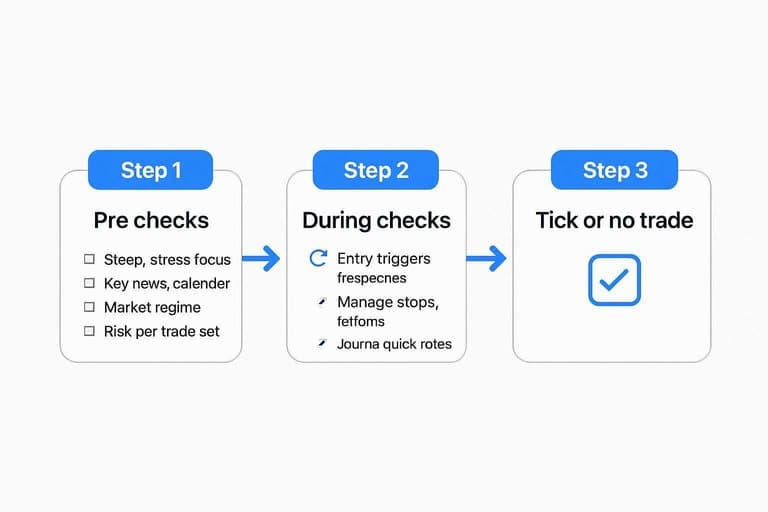
Print this and keep it next to your keyboard. Tick each box before the open, then re-check the “during” items when conditions change.
| # | Check | When | Tick |
|---|---|---|---|
| 1 | Sleep, stress, focus | Pre | ☐ |
| 2 | Key news, calendar | Pre | ☐ |
| 3 | Market regime | Pre | ☐ |
| 4 | Levels, zones marked | Pre | ☐ |
| 5 | Bias and scenarios | Pre | ☐ |
| 6 | Risk per trade set | Pre | ☐ |
| 7 | Max loss cap set | Pre | ☐ |
| 8 | A+ setups defined | Pre | ☐ |
| 9 | Orders, alerts ready | Pre | ☐ |
| 10 | Entry triggers respected | During | ☐ |
| 11 | Manage stops, targets | During | ☐ |
| 12 | Journal quick notes | During | ☐ |
If you can’t tick it, you don’t take the trade.
For a quick pre-open scan, use the CME economic release calendar.
Dos and Don’ts
You want a routine that survives bad days, not one that only works when you feel confident. These are industry-standard behaviors that protect consistency, plus the failures that quietly wreck it.
- Do define risk per trade before entry
- Do log decisions, not just results
- Do trade only your tested setups
- Don’t revenge trade after a loss
- Don’t change rules mid-session
If you can’t write the rule, you can’t enforce it.
Run the 12 Checks, Then Stop Trading
Print the 12 Checks Tracker (or pin it next to your platform) and commit to marking every item before you place risk. Start tomorrow with just two non-negotiables—risk cap and end-of-session reset—then add the rest as habits, not “ideas.” After the close, review which checks you skipped and what it cost you; your routine improves fastest when the tracker becomes your feedback loop.
Simplify Your Daily Stock Selection
A solid traders daily routine is only as effective as the quality of your watchlist and your read on the current market regime.
Open Swing Trading streamlines your 12-check workflow with daily RS rankings, breadth, and sector/theme rotation context—build a focused watchlist in minutes and start with 7-day free access, no credit card.
Sources
- CME Group — Economic Release Calendar — referenced in 12 Checks Tracker