Build an RS-in-Stocks Watchlist in 10 Minutes
A fast-start guide to building an RS-in-stocks watchlist you can maintain weekly—define relative strength (RS), pick a tradable universe and benchmark, choose one RS metric with a clean lookback, use a charting/screener shortcut to pull candidates, and add guardrails for trend, extension, and earnings risk.
Build an RS-in-Stocks Watchlist in 10 Minutes
A fast-start guide to building an RS-in-stocks watchlist you can maintain weekly—define relative strength (RS), pick a tradable universe and benchmark, choose one RS metric with a clean lookback, use a charting/screener shortcut to pull candidates, and add guardrails for trend, extension, and earnings risk.
If your watchlist keeps filling with “good stories” that go nowhere, you’re probably missing the one filter that consistently surfaces leaders: relative strength.
In the next 10 minutes, you’ll set up a simple RS workflow that points you to stocks outperforming a benchmark, without getting lost in indicators. You’ll choose a universe, lock in one RS metric and lookback, grab candidates via a fast charting or screener shortcut, and finish with two guardrails so your list stays tradable—not just interesting.
10-Minute Setup
Relative strength (RS) is a simple idea: “Is this stock beating the market?” You’ll define RS, pick one free data source, and end with a saved watchlist that refreshes every day.
RS, quickly defined
Relative strength is a stock’s price performance versus a benchmark over a fixed lookback window. Example: if your stock is +18% over 3 months and SPY is +6%, it’s showing RS.
Pick one lookback and stick to it, or your list will drift with your mood.
Tools you need
You’re building a repeatable stack, not a perfect system. Keep it free and fast.
- Charting platform with % change
- One benchmark symbol to compare
- One saved watchlist for tickers
- One note field for tags
If you can’t save tickers in one click, you’ll stop doing this.
Benchmark choice
Default to SPY as your benchmark, because it matches “the market” most people mean. Swap benchmarks when your universe changes: QQQ for large-cap growth, IWM for small caps, and sector ETFs like XLK or XLE for sector-only hunting.
Use the benchmark your money actually competes against.
Timing plan
You’ll finish in one pass, with a hard stop.
- Minute 0–1: Open your charting platform and log in.
- Minute 1–3: Set benchmark to SPY and pick one lookback.
- Minute 3–7: Scan your universe and add winners to a watchlist.
- Minute 7–9: Tag each ticker with lookback and date.
- Minute 9–10: Stop and save, even if it feels incomplete.
Your edge is consistency, not extra five minutes of fiddling.
Pick Your Universe
Your RS list is only as good as the stocks you compare. Pick the smallest universe that still matches your strategy, or your rankings turn into noise.
For most traders, start with the S&P 500 or a liquid US stock list. You get faster scans, fewer weird outliers, and cleaner “leaders vs laggards” signals.
Default universe
You want a universe that’s broad enough to find leaders, but small enough to stay fast. The easiest win is using the S&P 500 or a pre-filtered “liquid US stocks” list.
Those lists reduce garbage comparisons, like a mega-cap versus a thin micro-cap. You’ll spend less time debugging odd RS spikes and more time acting on real strength.
Liquidity filter
Thin names can dominate RS rankings for the wrong reasons. Add a simple liquidity gate so your RS numbers reflect tradable reality.
- Average volume: 1M+ shares
- Average dollar volume: $20M+ daily
- Price: $10+
- Spread: tight, consistent
- Options: liquid if needed
If a stock is hard to enter or exit, its RS rank is a trap.
Strategy match
Your universe should match your holding period, or you’ll chase the wrong kind of strength. Keep the mapping simple so you can rebuild the list anytime.
Swing trading works best with liquid large- and mid-caps. Position and trend following can use broader liquid universes, because you care more about persistence than quick moves.
Pick one universe per strategy, and stop negotiating with the filter every week.
Choose RS Metric
Pick one RS calculation you can compute fast and repeat every week. Consistency matters more than perfection when you’re building a watchlist, not a thesis.
Simple RS formula
Use a dead-simple relative strength number you can calculate in a spreadsheet. It keeps you out of the “smart but inconsistent” trap.
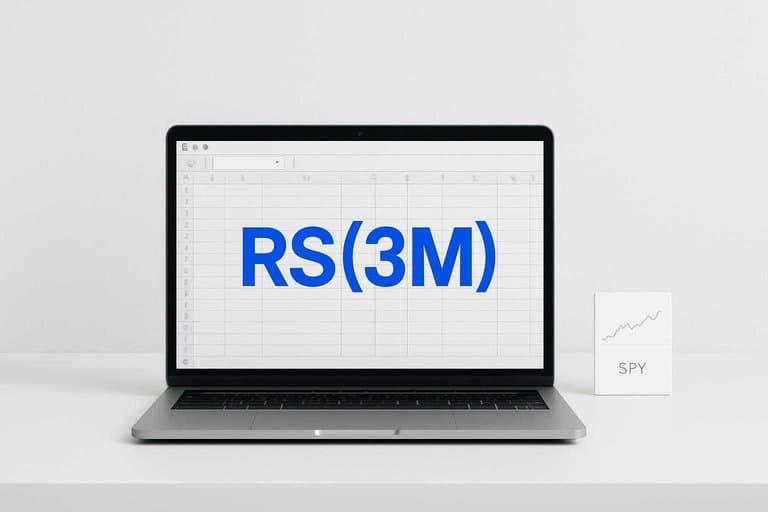
RS(3M) = Return(stock, 3 months) − Return(benchmark, 3 months) Example: Stock +12%, SPY +7% → RS = +5%
You get a clean ranking signal without needing regressions, betas, or excuses.
Lookback presets
Use a few standard lookbacks so your workflow stays predictable. Match the lookback to how long you expect to hold.
| Lookback | Best for holding | Pros | Watch out |
|---|---|---|---|
| 1M | Days to weeks | Fast signal | More noise |
| 3M | Weeks to months | Balanced | Misses sudden turns |
| 6M | Months+ | Durable trend | Slower to react |
Pick the one that matches your decision tempo, not your mood.
One rule only
Lock one lookback for the watchlist and don’t negotiate with yourself. Changing 1M to 3M to 6M midstream is how watchlists turn into slot machines.
Write it down as a rule: “Watchlist RS uses 3M vs SPY.” Then review on schedule, not on impulse.
Stability beats constant reshuffling, because you can finally tell if your process works.
Fast Data Shortcut
You don’t need a spreadsheet model to get usable RS numbers fast. Use one of two shortcuts and you’ll still capture the core signal: “is it beating SPY right now?”
If you can read a chart and export a list, you can build your watchlist today.
Charting RS line
Add a Relative Strength line versus SPY and treat new highs as leadership.
- Open your stock chart and add a “Relative Strength” line.
- Set the benchmark to SPY, not your stock’s sector ETF.
- Look for RS line new highs within the last 4–12 weeks.
- Add those tickers to your RS watchlist immediately.
If the RS line is making highs first, institutions are already voting.
Screener route
Use a screener to rank performance versus SPY and export the leaders.
- Open your platform screener and select “Performance vs Benchmark.”
- Set the benchmark to SPY and the lookback to 3, 6, and 12 months.
- Filter out illiquid names using a volume minimum.
- Export the top 25–50 names into a watchlist.
Your edge is speed here, not precision. If you need a reference point for common screener timeframes and exports, see the FINVIZ screener help.
When to prefer which
Use charts when you have a small universe, like “my 40 favorite names.” Use screeners when you’re scanning hundreds or thousands.
If your workflow takes longer than 10 minutes, you built a hobby, not a watchlist.
Build the Watchlist
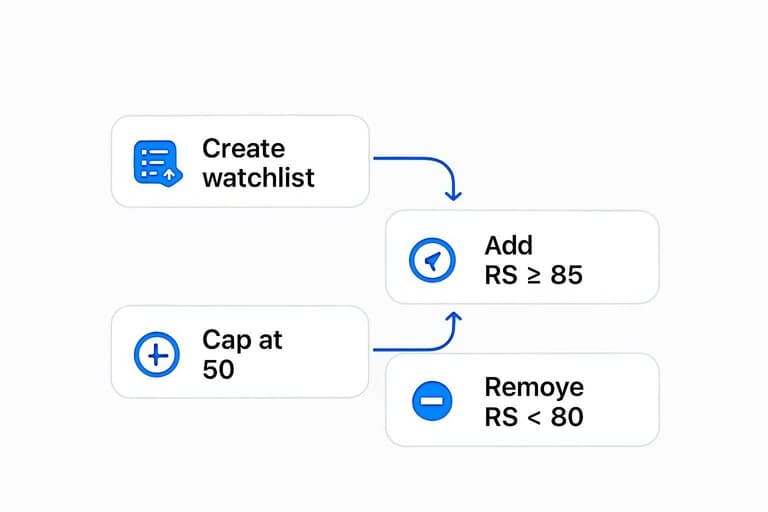
Set up a saved watchlist that stays the same size, so your rankings stay meaningful. Your only job is to keep the list fresh using one rule, not vibes.
- Create a new watchlist named “RS-in-Stocks (50)” in your platform.
- Set the list size to a hard cap of 50 tickers.
- Add any stock with RS Rating ≥ 85 and average volume above your minimum.
- Remove any stock that drops below RS Rating 80 for two sessions.
- Once per week, replace removals with the highest-RS candidates not already listed.
A fixed-size list turns “strong” into a ranking you can act on.
Add Two Guardrails
RS screens find strength fast. They also pull in broken leaders and overcooked charts.
Add two quick checks before anything earns a watchlist slot. Your list stays actionable, not aspirational.
Trend filter
RS without trend is just noise. You want strength in a chart that still behaves.
- Price above the 50-day moving average
- Price above the 200-day moving average
- 50-day moving average rising
- Higher highs and higher lows
- Pullbacks hold prior support
When you enforce this, your RS list becomes a trend list.
Not too extended
Extended stocks can keep running, but your entries get worse. You want names that could set up soon.
- Avoid 10%+ above the 20-day
- Avoid 20%+ above the 50-day
- Prefer tight closes near highs
- Prefer orderly pullbacks on light volume
- Keep room to add safely
If it can’t pull in, you can’t get in.
Earnings landmines
Earnings turns your watchlist into a coin flip. One gap can erase weeks of good RS.
Use a simple rule: don’t add new names within 3–5 trading days of earnings. Wait for the report, then reassess the trend and setup.
You’re building a watchlist, not volunteering for event risk.
Lock It In and Run It Weekly
- Save your RS settings (benchmark, lookback, and your one RS rule) as a preset so you never “re-decide” them.
- Refresh the scan once per week at the same time, then keep only names with RS still rising and price above your trend filter.
- Trim anything too extended and flag upcoming earnings so you know what you’re holding through.
- Promote the top 10–30 names into your primary watchlist and start each trading day by checking those first.
Frequently Asked Questions
Is RS in stocks the same as relative strength index (RSI)?
No. RS in stocks usually means price performance versus a benchmark (like the S&P 500), while RSI is an oscillator that measures momentum on a 0–100 scale.
What’s the best benchmark to use for RS in stocks—SPY, QQQ, or my sector ETF?
Use the benchmark that matches your opportunity set: SPY for broad U.S. stocks, QQQ for growth/tech-heavy universes, and a sector ETF when you trade within one sector to avoid distorted rankings.
How do I measure whether RS in stocks is actually improving before I buy?
Track the RS line or RS ratio trend over the last 4–8 weeks and confirm it’s making higher highs versus the benchmark; most charting platforms can plot this as a comparison or ratio line.
Can I use RS in stocks for ETFs and crypto, or is it only for individual stocks?
Yes. RS works for any tradable asset with reliable price data, as long as you compare it to a relevant benchmark (e.g., BTC vs ETH, or a crypto index) and keep the same lookback window.
How often should I update an RS in stocks watchlist, and when should I remove names?
Update daily or weekly, then remove names that fall below your RS cutoff for 2–3 consecutive updates or break key trend levels (like the 50-day moving average) to keep the list actionable.
Turn RS Into Leaders
Building an RS-in-stocks watchlist is quick—but keeping it fresh and regime-aware every day is where most traders lose time and edge.
Open Swing Trading updates daily RS rankings, breadth, and sector/theme rotation across ~5,000 stocks so you can build tighter breakout watchlists in minutes—get 7-day free access with no credit card.
Sources
- FINVIZ Screener Help — referenced in Screener route