Day Trading for Beginners: How It Really Works
An explainer on how day trading really works from open to close—one-day timeframes, how orders and exits shape results, what liquidity/volatility/volume actually mean, and how to build an edge model with risk rules first.
Day Trading for Beginners: How It Really Works
An explainer on how day trading really works from open to close—one-day timeframes, how orders and exits shape results, what liquidity/volatility/volume actually mean, and how to build an edge model with risk rules first.
If day trading looks like easy money on social media, your first surprise is how much of it is waiting, measuring, and saying no. Most beginners lose because they treat it like prediction instead of a job built on process.
This explainer breaks down what day trading is (and isn’t), how a trade actually gets filled, what moves price in real time, and how “edge” and risk controls determine whether you can survive variance long enough to improve.
What Day Trading Is
Day trading is buying and selling a financial instrument within the same trading day, aiming to capture small price moves. You’re not trying to “own a great company,” you’re trying to manage a short-term trade. The core promise is speed and frequent opportunity; the core risk is that small mistakes compound fast.
One-day timeframe
You open and close positions in one session, then you’re flat by the close. No overnight holds, because after-hours news can gap price past your stop.
Example: a stock closes at $50, earnings hit, and it opens at $44. Your “risk” skipped your exit.
Trading vs investing
They can use the same markets, but the job is different. You’ll feel it in your tools and your calendar.
- Target short-term price moves, not business growth
- Hold minutes to hours, not years
- Use charts and order flow, not just fundamentals
- Feel fees and taxes more, because you trade more
- Spend active screen time, not occasional check-ins
The real job
Day trading is risk management plus execution under uncertainty. You’re paid for following a plan when the next tick could punish you.
A good trader often says, “I don’t need to be right, I need to manage risk.”
Common misconceptions
Most beginner blowups start with a story they want to believe. These are the usual ones.
- Easy income replaces a job fast
- Signals guarantee wins with no context
- More trades always means more profit
- Leverage is free money
How a Trade Works
A single trade has a lifecycle: idea, entry, management, exit, and review. Each stage forces a decision, and each decision has a cost. Commissions are obvious, but spread and slippage are usually bigger.
Setup and thesis
A setup is a repeatable pattern plus a reason it should work. Think “breakout from a tight range” plus “buyers keep absorbing sellers.”
Keep your story separate from testable conditions. Narrative is “AI is hot.” Conditions are “price above VWAP, higher lows, volume expanding.”
Your job is to trade the conditions, not defend the story.
Order types basics
Order types decide how you enter and what you pay for speed. Each one protects you from one risk, while adding another.
- Market: guarantees entry; risks bad fills in fast moves.
- Limit: controls price; risks no fill as price runs.
- Stop: triggers on momentum; risks slippage on the trigger.
- Stop-limit: controls worst price; risks missing the trade entirely.
Pick the order that matches your failure mode: bad price, or no trade.
For a clear primer on these mechanics, see CME Group’s guide to market, limit, stop, and stop-limit orders.
The spread and slippage
The bid is what buyers pay, the ask is what sellers want, and the gap is the spread. You “pay the spread” when you buy at the ask and could only sell at the bid.
Slippage is the difference between your expected price and your actual fill. In fast markets, your screen shows “paper prices,” but your order hits whatever liquidity exists.
If fills surprise you, your strategy is trading the market’s speed, not its direction.
Exits define outcomes
You don’t know if a trade is good until you see the exit plan. Exits turn a chart idea into actual risk and return.
- Stop-loss: caps damage; risks getting tagged by noise.
- Profit target: locks gains; risks cutting winners short.
- Trailing stop: rides trends; risks giving back open profit.
- Time stop: prevents stagnation; risks exiting before the move.
Your entry gets you in, but your exits decide what you get paid.
The Market’s Moving Parts
Day trading isn’t random. It’s a reaction to a few mechanics that decide what you can trade and how cleanly you can trade it.
Know these moving parts, and your charts start making sense.
Liquidity explained
Liquidity is how easily you can buy or sell without moving price. You feel it in the spread and your fill quality, not in theory.
In a liquid stock, you might hit the ask and get filled instantly. In an illiquid one, you pay a wider spread and get partial fills.
“Easy to enter” only matters if it’s also easy to exit when you’re wrong.
Volatility and range
Volatility is the day’s breathing room. It changes your risk math fast.
- Expect bigger swings per minute
- Use wider stops to survive noise
- Reduce position size to keep risk constant
- Trade fewer shares or contracts
If your stop stays small in a big-range market, you’re donating to chop.
Volume as participation
Volume is participation you can measure. It’s the difference between a “real move” and a lonely candle.
Healthy flow looks like steady prints at multiple prices, with bids and offers refilling. Thin markets jump, stall, then gap on small orders.
If volume disappears, your strategy turns into a slippage test.
Catalysts and schedules
Most big intraday moves have a clock behind them. You don’t predict news, but you can respect the schedule.
- Earnings reports and guidance
- Economic releases like CPI and jobs
- Fed decisions and pressers
- Opening and closing auctions
- Sector headlines and upgrades
If you ignore the calendar, you’ll keep “randomly” getting steamrolled at 8:30 and 2:00.
Your Edge Model
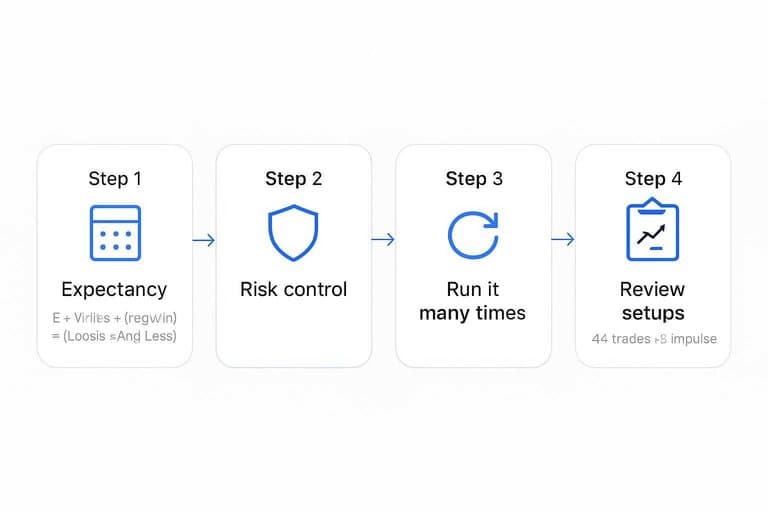
Edge is a small statistical advantage you can repeat, not a magic pattern you “feel.” You pair that advantage with tight risk control, then run it many times like a casino runs hands.
Expectancy formula
Expectancy is what you average per trade when you repeat the same rules. It uses win rate, average win, and average loss, because accuracy and payoff trade off.
A simple form looks like this: E = (Win% × Avg Win) − (Loss% × Avg Loss). Example: 40% wins × $300 − 60% losses × $150 = $120 − $90 = +$30 per trade.
A “high win rate” system can still lose if the average loss dwarfs the average win. That’s the line that gets crossed.
Variance is normal
Losing streaks are part of the deal, even with positive expectancy. You need reasons, not excuses.
- Randomness clusters losses together
- Market regime shifts break your setup
- Small samples lie to you
- Execution errors mimic “bad luck”
If you can’t survive a streak, you don’t have an edge. You have a story.
Process over outcomes
One trade is noise, even when it pays. Judge yourself on rule-following and what your data says, not today’s P&L.
Track “A+ trades” versus “impulse trades,” then review expectancy by setup and market condition. A green day from broken rules is still a failure.
You don’t control outcomes. You control decisions. That’s where edge lives.
Two common edges
Beginner-friendly edges are simple, testable, and repeatable. They also have obvious failure modes.
- Trend continuation: breaks in choppy ranges
- Trend continuation: fails after exhaustion spikes
- Mean reversion: breaks in strong trends
- Mean reversion: fails on news volatility
Pick one, define when it’s “off,” and stop trading when that condition appears.
For evidence on why more activity can still hurt results, see Barber et al. (2009) on how much individual investors lose by trading.
Risk Rules First
Risk rules are your guardrails when your brain gets loud. You’re not trying to “be right.” You’re trying to stay in the game after a nasty candle.
Define max loss
Pick two numbers: a per-trade max loss and a per-day max loss. Think “-$50 per trade” and “-$150 per day,” not “I’ll see how it feels.”
Per-trade loss stops one idea from becoming a rescue mission. Per-day loss stops a bad morning from turning into “one more trade” until the account is wrecked.
If you can’t name your max loss, the market will name it for you.
Position sizing steps
You size the position from the stop, not from hope.
- Choose your stop distance in dollars or cents.
- Pick your risk dollars for this trade.
- Compute size: shares = risk ÷ stop distance.
- Adjust down for thin liquidity and wider spreads.
- Cut size again if volatility is expanding fast.
Your size is the only lever you fully control. Use it first.
Leverage and margin
Leverage makes a small move feel huge, in both directions. A 1% drop can become a 4% hit if you’re 4x levered.
Margin calls happen when losses shrink your equity below the broker’s requirement. Then you sell what you can, when you must, usually at the worst time.
Under-leverage until your process is boring and repeatable. Then earn the right to scale.
Risk red flags
Risk blows up when your behavior changes under stress. Watch for these signals early.
- Revenge trade after a loss
- Double down to “get back”
- Move stops farther away
- Trade illiquid, wide-spread names
- Ignore major news times
When two show up, you’re done for the session. Protect tomorrow’s trades.
Start Like a Professional, Not a Gambler
- Write your risk rule first: a daily max loss and a per-trade max loss you will not exceed.
- Trade only one simple setup for a week and record entries, exits, and whether slippage/spread changed the plan.
- Review results using expectancy (win rate, average win, average loss) and accept variance as normal.
- Scale only after consistency: increase size slowly, keep the same risk limits, and stop trading when you hit your red flags.
Frequently Asked Questions
How much money do I need to start day trading in 2026?
Most beginners can start practicing with a paper trading account for $0, and many brokers allow live day trading with $100–$1,000. If you’re in the U.S. and day trade stocks frequently, the Pattern Day Trader rule usually requires $25,000+ in a margin account.
Is day trading still profitable with AI and algorithmic trading dominating the markets?
Yes, some traders are profitable, but the bar is higher because many opportunities are competed away quickly. Beginners usually do better focusing on highly liquid markets and repeatable setups with strict risk limits rather than trying to outsmart institutional algos.
How long does it take to learn day trading and see consistent results?
Most people need 3–6 months to learn basics and build a routine, and 6–18 months to reach consistency if they journal trades and follow a strict process. Expect uneven results early while you test strategies and reduce mistakes.
What’s the best market for beginners: stocks, forex, options, or futures day trading?
For most beginners, liquid large-cap stocks or major ETFs are the simplest place to start because pricing is transparent and position sizes are easy to control. Options and futures add leverage and complexity, so small errors can become large losses faster.
How do I track day trading performance the right way (beyond win rate)?
Track expectancy (average win × win rate minus average loss × loss rate), max drawdown, and profit factor using a trade journal or tools like TraderSync or Edgewonk. Review results by setup and time of day to find what’s actually working.
Build Your Trading Watchlist
Once you understand how trades work, the real bottleneck is finding quality setups and staying aligned with market breadth, sectors, and your risk rules—every day.
Open Swing Trading streamlines discretionary stock selection with daily relative strength rankings, breadth, and sector/theme rotation context—get 7-day free access with no credit card.
Sources
- CME Group Education — Futures Order Types — referenced in Order types basics
- Oxford Academic (Review of Financial Studies) — Barber, Lee, Liu & Odean (2009) “Just How Much Do Individual Investors Lose by Trading?” — referenced in Two common edges