Day Trading Results: 100 Trades, Win Rate, Drawdown
A data-driven case study of 100 day trades that shows what performance really looks like—testing setup and assumptions, headline results, win-rate breakeven math, equity-curve/streak behavior, and drawdown/risk (including sizing and ruin scenarios).
Day Trading Results: 100 Trades, Win Rate, Drawdown
A data-driven case study of 100 day trades that shows what performance really looks like—testing setup and assumptions, headline results, win-rate breakeven math, equity-curve/streak behavior, and drawdown/risk (including sizing and ruin scenarios).
A 60% win rate can still lose money, and a “profitable” strategy can feel broken once drawdowns hit. If you’ve ever wondered whether your results are skill, variance, or just a sizing mistake, this case study makes it concrete.
You’ll see how 100 day trades were tracked under consistent rules, what the headline stats actually say, and why the equity curve matters more than any single metric. By the end, you’ll know how to interpret win rate, payoff, costs, and drawdown like a system—before risking more capital.
Testing Setup
You can’t trust “100 trades” unless the rules and recording are fixed. Treat this like a lab protocol, so your numbers compare to benchmarks.
Strategy Rules
Lock the rules before you take trade #1, or you’ll backfill logic later. Write them as if someone else must execute them.
- Entry: trigger, confirmation, and invalidation level
- Stop: hard stop level, no widening
- Target: fixed R or structure-based exit
- Time stop: max minutes or bars held
- Risk: fixed R per trade, plus max daily trades
If your rules don’t force a “no trade” decision, you don’t have rules.
Market And Period
Pick one instrument and one session, then commit to a date range. Otherwise you’re testing mood, not edge.
Example: “NQ, regular session only, Jan–Mar 2026, no overnight holds.” Note the volatility regime, like “post-FOMC chop” or “trend weeks.”
If you change the market or regime, restart the sample. Don’t blend it.
Execution Assumptions
Execution assumptions decide whether your edge survives contact with reality. Make them pessimistic enough to sting.
- Commissions: $/share or $/contract round-trip
- Slippage: average ticks per entry and exit
- Order type: market-only, limit-only, or mixed rules
- Spread: assumed ticks paid on fills
If slippage wipes out your average win, you’re not trading a strategy. You’re trading luck.
Tracking Template
Use one row per trade, no exceptions. Add fields that explain outcomes, not just P&L.
| Field | Example | Format |
|---|---|---|
| R-multiple | +1.2R | numeric |
| MFE / MAE | 2.0R / -0.7R | numeric |
| Hold time | 18 min | minutes |
| Setup tag | ORB-A | text |
| Screenshot link | URL | link |
Your future self can’t fix what your log can’t explain.
Headline Results
You want the scoreboard before the story. Here are the 100-trade outcomes, plus the hurdles most day traders hit first.
| Metric | Result (100 trades) | Common hurdle | Viability read |
|---|---|---|---|
| Win rate | 52% | 45–55% typical | Neutral edge |
| Profit factor | 1.18 | Need 1.20 | Borderline |
| Expectancy | +0.12R/trade | Needs +0.10R+ | Barely positive |
| Max drawdown | -6.5R | Over -10R kills | Contained |
| Avg trade | +0.08% | Fees crush <0.05% | Probably tradable |
If your fees or slippage are worse than expected, this setup flips from “viable” to “noise” fast. If you want to sanity-check the math behind the expectancy line item, here’s a clear walkthrough of the trading expectancy formula.
Win Rate Context
Win rate sounds like the scoreboard. It isn’t. A “55% win rate” can still lose money if your losses are bigger, or your costs are real.
Breakeven Formula
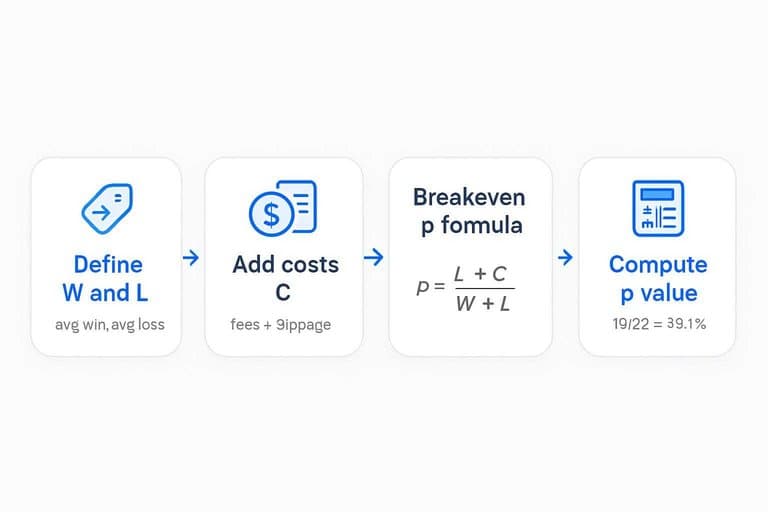
Breakeven win rate depends on your average win, average loss, and your per-trade costs. You want the win rate that makes expectancy exactly zero.
- Define average win (W) and average loss (L) in ticks or dollars.
- Add costs per trade ©, including fees and slippage.
- Use: breakeven win rate p = (L + C) / (W + L).
- Plug in plain numbers: W=10 ticks, L=12 ticks, C=1 tick.
- Compute: p = (12+1)/(10+12) = 13/22 = 59.1%.
If your win rate is under 59.1% in that setup, “winning more than losing” still bleeds.
Payoff Ratio
Win rate only speaks to frequency. Your payoff ratio decides whether those wins matter.
Think in R to compare cleanly. Example: average win = +0.8R, average loss = -1.0R.
Expectancy per trade is: E = p*(+0.8R) + (1-p)(-1.0R). At p=55%, E = 0.550.8 - 0.45*1.0 = -0.01R.
A 55% win rate with a 0.8:1 payoff is basically break-even before costs, then negative after.
Cost Sensitivity
Small slippage changes rewrite your breakeven math. A half-tick is often the difference between “edge” and “noise.”
| Slippage (ticks) | Cost C (ticks) | Breakeven win rate | Expectancy at 55% |
|---|---|---|---|
| 0.0 | 0.0 | 54.5% | +0.10 ticks |
| 0.5 | 0.5 | 56.8% | -0.13 ticks |
| 1.0 | 1.0 | 59.1% | -0.35 ticks |
Assumes W=10 ticks, L=12 ticks, cost is per trade.
If your edge is smaller than a tick, you’re trading execution quality, not strategy.
Equity Curve Reality
Returns rarely arrive as a smooth line. They show up in clusters, then go quiet, then surprise you again.
Your job is to spot whether you’re compounding skill or borrowing results from a few lucky outliers.
Cumulative P&L
The curve didn’t behave like a clean grind. It looked like a staircase with two sharp lifts and long flat shelves.
One week did the “make the month” move, then the next week gave you chop and small scratches. That’s regime risk in plain sight.
Treat the flat shelves as normal operating mode. Size and expectations should be set there, not at the peaks. If you’re tying these shifts to volatility regimes, a quick refresher on the Average True Range (ATR) indicator helps frame what “expanding” vs “contracting” volatility looks like in practice.
Trade Distribution
This table tells you if your P&L is diversified or carried by a handful of prints.
| Metric | Count | Typical R | Notes |
|---|---|---|---|
| Big winners (≥ +2R) | |||
| Big losers (≤ -2R) | |||
| Median trade | |||
| Top 5 trades share |
If the top 5 are doing most of the work, you’re running an “outlier strategy.” Manage it like one.
Streak Behavior
Streaks feel personal. They’re usually math.
- Take your observed win rate, p, from the 100 trades.
- Estimate expected longest win streak ≈ log(N)/log(1/p).
- Estimate expected longest loss streak ≈ log(N)/log(1/(1-p)).
- Compare expected vs actual streaks and note the gap.
- If actual is much worse, check regime filters and position sizing.
A “surprising” streak is often just variance. The real problem is when your process changes mid-streak.
Drawdown And Risk
Your win rate is a headline. Your drawdown is the bill.
Quantify the deepest hole, how long it lasted, and what position sizing turns it into on your account.
Drawdown Metrics
Use one table so you can compare pain, not vibes.
| Metric | In R | In % | Notes |
|---|---|---|---|
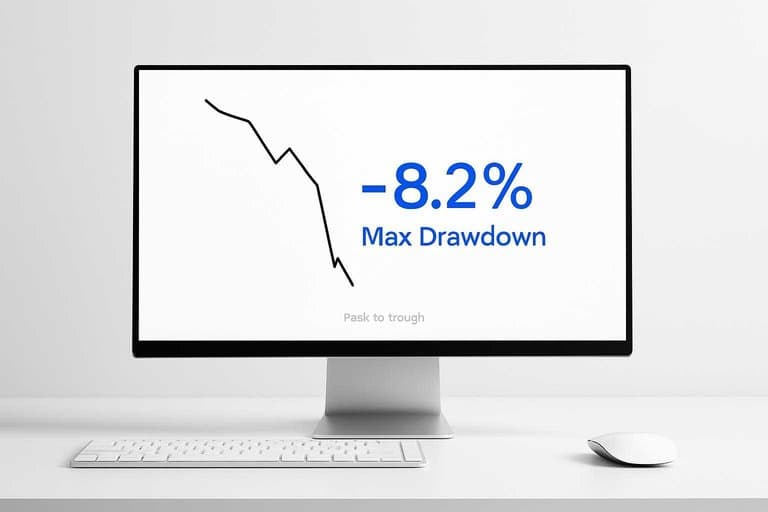
| Max drawdown | -8.2R | -8.2% | Peak-to-trough |
| Avg drawdown | -2.1R | -2.1% | Typical dip |
| Median drawdown | -1.4R | -1.4% | More realistic |
| Smoothness proxy | 0.62 | n/a | Lower = smoother |
If your max drawdown is 4 your average, volatility is driving outcomes.
Recovery Time
Max drawdown tells depth. Recovery time tells fragility.
In this 100-trade sample, the longest recovery took 27 trades, or about 11 trading days. It clustered during choppy, mean-reverting sessions where breakouts failed and stops got recycled.
When recovery needs a different market regime, your edge is conditional, not universal.
Sizing Impact
Risk per trade converts an R-drawdown into a life problem. Choose sizing like you choose sleep.
- Risk 0.25R: -8.2R becomes about -2.05% account.
- Risk 0.50R: -8.2R becomes about -4.10% account.
- Risk 1.00R: -8.2R becomes about -8.20% account.
- Risk 1.50R: -8.2R becomes about -12.30% account.
- Risk 2.00R: -8.2R becomes about -16.40% account.
The market stays the same. Your nervous system doesn’t.
Ruin Scenarios
You don’t need a blowup to be “ruined.” You just need sizing that forces you to stop. Stress test the loss-streak math against your max tolerated drawdown.
- Pick a conservative loss probability, like 55% losses per trade.
- Estimate worst streak length with: streak ln(trades)/ln(1/p_loss) .
- Convert streak to drawdown: streak risk_per_trade in % terms.
- Compare to your hard stop, like -10% or -15% account.
- Reduce risk until the expected worst streak stays below that line.
If the streak math can breach your limit, your “edge” won’t survive contact with variance.
Real Trade Example
The Setup
This trade is a clean “A+ pullback” inside a strong morning trend. It qualified because price reclaimed VWAP, then retested with shrinking volume.
Example numbers: Long 100 shares at $50.20 after the VWAP reclaim. Planned stop $49.70 (risk $0.50), target $51.20 (reward $1.00), expected R = 2.0.
The Execution
Fills and management are where good setups become average results.
- Entered at $50.23 on the break, $0.03 slippage versus plan.
- Stop placed at $49.70, then tightened to $49.78 after higher low.
- Took 50% at $50.75 into first push, banking +1.04R on half.
- Got stopped on remainder at $49.78 during a fast VWAP flush.
- Final result: +0.30R net; MFE +1.10R, MAE -0.45R.
You didn’t lose on the trade. You lost the edge when you moved the stop.
Lessons Learned
One trade is noise, but your mistakes repeat. Fix the repeat.
- Rule tweak: No stop-tightening before +1R or a confirmed structure break.
- Execution habit: Use limit on retest, not market on breakout.
- Filter: Skip VWAP reclaims when 1-min range expands 2x suddenly.
Process beats “better reads” every time. Track these three for the next 20 trades.
Turn These 100 Trades Into Your Next 100
- Copy the tracking template, lock your execution assumptions (fees/slippage), and log the next 20 trades exactly to validate process.
- Recompute breakeven with your real costs, then compare your payoff ratio and streaks to the distributions shown here—not just the win rate.
- Set a max drawdown threshold and a position-sizing rule that keeps you inside it; if your back-of-the-envelope “ruin scenario” looks plausible, size down.
- Review one trade per week like the real example: setup → execution → mistake/edge → rule tweak, and only scale after your equity curve stays stable through a full drawdown/recovery cycle.
Trade With Better Context
After logging 100 trades, the real takeaway is how quickly drawdowns and regime shifts can distort results if your watchlist isn’t built from strong leaders.
Open Swing Trading helps discretionary traders spot breakout leaders with daily RS rankings, breadth, and sector/theme rotation—get 7-day free access with no credit card.
Sources
- Orbex — Trading expectancy formula (win rate × avg win − loss rate × avg loss) — referenced in Headline Results
- Fidelity — Average True Range (ATR) indicator guide — referenced in Cumulative P&L