Day Trading vs Swing Trading: A Decision Framework
A decision-focused comparison of day trading vs swing trading that helps you choose the right approach—time/lifestyle fit, capital and cost structure, risk and drawdown expectations, strategy edge requirements, and execution/liquidity realities.
Day Trading vs Swing Trading: A Decision Framework
A decision-focused comparison of day trading vs swing trading that helps you choose the right approach—time/lifestyle fit, capital and cost structure, risk and drawdown expectations, strategy edge requirements, and execution/liquidity realities.
Trying to pick between day trading and swing trading often turns into vague advice: “day trading is stressful” or “swing trading is easier.” That doesn’t help when your schedule, capital, and tolerance for drawdowns are very real constraints.
This framework lets you decide based on the factors that actually move results: how much screen time you can sustain, what costs you’ll face, where losses typically come from, which strategies fit your tools and skills, and how taxes and account rules can tilt the math in one direction.
Decision Snapshot
Day trading and swing trading solve different problems. One prioritizes speed and tight control; the other prioritizes patience and broader moves.
Use this framework to pick the style that matches your schedule, your temperament, and your actual edge. The wrong match feels like “forcing trades” every week.
Core definitions
Day trading means you open and close positions within the same market day. You’re usually working on 1–15 minute charts, reacting to intraday volatility.
Swing trading means you hold positions for several days to a few weeks. You’re usually working on 4-hour to daily charts, targeting multi-day trends.
Common instruments overlap—stocks, ETFs, futures, and major FX pairs—but the constraints don’t. Your holding time sets your lifestyle.
Fast comparison
The differences show up in your calendar and your psychology. Pick the friction you can live with.
- Hold minutes to hours vs days to weeks
- Trade daily focus vs scheduled check-ins
- Take many setups vs take fewer, higher-conviction setups
- Manage fast stress vs manage slow uncertainty
- Pay more spreads/fees vs pay more slippage/gaps
Your best style is the one you can repeat without negotiating with yourself.
Framework overview
Start with constraints, not opinions.
- Define your goal: income now, or growth over time.
- Map your schedule: can you watch live, or only review twice daily.
- Stress-test risk tolerance: fast losses or overnight gaps.
- Identify your edge: momentum, mean reversion, or catalysts.
- Price the costs: spreads, fees, taxes, and borrow.
- Check execution limits: platform, liquidity, fills, and rules.
Once constraints are clear, the “right” style usually picks you.
Common misconceptions
More trades don’t guarantee more profit. More trades only guarantee more chances to pay spread, fees, and mistakes.
Swing trading isn’t automatically safer. Overnight gaps, earnings, and news can turn “small risk” into a jump cut.
Day trading isn’t pure gambling, but it becomes gambling without a tested plan. The line is whether you can define entries, exits, and size before you click.
Time and Lifestyle Fit
Your calendar decides your trading style faster than your opinions do. Pick the approach that matches your available hours, attention, and tolerance for routine.
Screen time demands
Day trading rewards constant monitoring because prices can move in minutes on a headline or sudden order flow. Swing trading tolerates distance because your edge comes from larger moves and end-of-day structure.
Day trading usually means being present for specific session windows, like the open, midday lull, or close. Swing trading is more like periodic check-ins, plus a focused end-of-day review for entries, exits, and risk.
If your best trading hours are fragmented, swing trading fits your life instead of fighting it.
Work schedule compatibility
Your job shape matters more than your motivation on Monday morning. Match the style to when you can reliably think, not just when you’re awake.
- 9–5 job: favors swing trading, end-of-day planning
- Shift work: favors swing trades, flexible check-ins
- Caregivers: favors swing trades, fewer forced windows
- Students: favors day trades, defined session blocks
- Flexible remote roles: favors either, if interruptions are controlled
If you can’t protect uninterrupted blocks, day trading turns into “hope trading” fast.
Stress and stamina
Day trading compresses decisions into a tight window, which amplifies decision fatigue and impulse clicks. The common trigger is speed: you feel late, you chase, you widen risk.
Swing trading removes the minute-to-minute pressure but adds overnight uncertainty, like gaps on earnings or macro news. The stress shifts from “act now” to “sit still,” and many traders overmanage positions to regain control.
Choose the stress you can manage consistently, not the one that sounds easier today.
Automation potential
You can automate the guardrails even if you can’t automate your judgment. Use tools to reduce missed steps and emotional decisions.
- Alerts: price, level, and volatility triggers
- Bracket orders: stop, target, and OCO exits
- Scans: premarket and end-of-day filters
- Journaling: auto-import fills and screenshots
- Checklists: pre-trade risk and thesis prompts
Automate the repetitive parts so your discretion is reserved for the hard calls.
For a clear definition of the style and expectations, see Schwab’s overview of swing trading strategies.
Capital and Costs
Your account size and your costs decide what trades are even worth taking. Day trading leans on frequent execution, so frictions compound fast.
Small differences in leverage rules, commissions, and spreads can flip your expected value. A “good setup” can still be a bad trade after fees.
Account size changes which style feels constrained versus flexible. That constraint is the real strategy filter.
Day trading and swing trading absorb costs differently, so compare them side by side.
| Factor | Day Trading | Swing Trading | What it changes |
|---|---|---|---|
| Typical account pressure | High | Medium | Trade selection scope |
| Margin/leverage usefulness | High, regulated | Moderate, situational | Position sizing speed |
| Commission sensitivity | Very high | Low to medium | Breakeven distance |
| Spread/slippage impact | High | Medium | Entry quality matters |
| Overnight fees/borrow costs | Low to none | Can be meaningful | Hold-time penalty |
If your costs are unclear, your edge is imaginary.

Risk Profile Differences
Day trading and swing trading don’t “feel” risky in the same places. One bleeds from intraday noise and execution, the other from time and overnight uncertainty.
Your job is to size trades so a normal bad outcome is survivable. Then you cap losses so an abnormal one can’t end you.
Where losses come from
Day trading losses usually come fast, often in seconds, and execution quality matters more than you expect. A clean setup can still fail because price snaps back or fills worse than your stop.
Swing trading losses come from time exposure. Overnight gaps, macro headlines, and multi-day drift against you can invalidate a thesis before you can react.
If you hate surprises, day trading punishes speed; swing trading punishes sleep.
Risk controls toolkit
Use controls that match your style’s failure modes. Build them into rules, not moods.
- Set a max daily loss limit
- Size positions by stop distance
- Choose stops: hard, mental, or time-based
- Cut leverage when volatility expands
- Avoid illiquid names and wide spreads
Your best risk tool is the one you can follow on your worst day.
Drawdown expectations
Variance is the tax you pay for being in the game, and both styles pay it differently. A 45–55% win rate can still produce 6–10 losses in a row, even with a real edge.
Day trading often targets smaller average wins, so costs and slip turn discipline into a math problem. Swing trading may win bigger, but drawdowns can deepen during correlated selloffs.
If your average win is small, your rules must be brutally tight.
Psychological risk
Most blowups are behavioral, not analytical. Your plan breaks when your nervous system takes over.
- Revenge trade after a loss
- Overtrade to “make it back”
- Hold losers and “hope”
- Chase moves from FOMO
- Freeze and miss exits
Fix the behavior loop first; the strategy comes second.
Edge and Strategy Fit
Your edge lives in a timeframe, not in a label like “day trader” or “swing trader.” Match the market behavior you exploit—momentum, mean reversion, news, or trend-following—to the holding period that makes it visible and tradable.
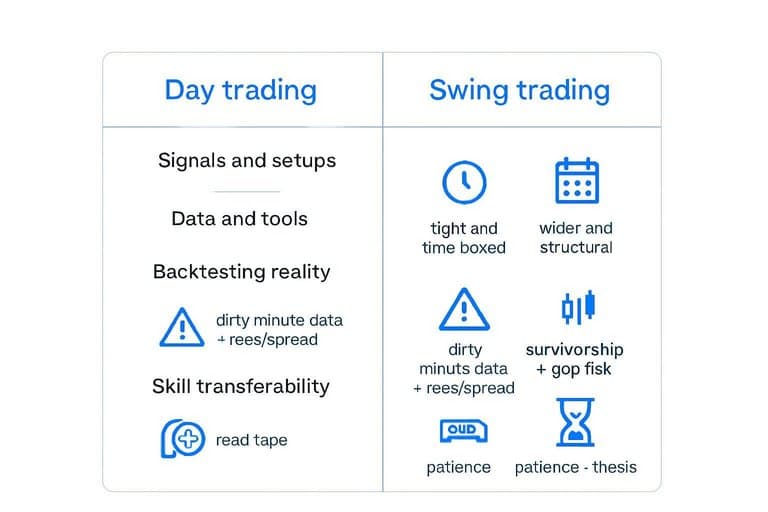
Signals and setups
Day trading setups usually monetize fast information and intraday liquidity, so the signals are tight and time-boxed. Swing trading setups usually monetize multi-day positioning, so the signals are wider and more structural.
Day trade examples: opening range breakouts, VWAP reclaims, and failed breakdowns at prior day low. Swing examples: pullbacks into daily support, multi-day trend continuation, and base breakouts on rising volume. News fits both, but day traders trade the reaction window, while swing traders trade the post-news trend.
If your best trades need “one more day,” you’re fighting day trading’s clock.
Data and tools
Your tool stack should match how quickly your edge appears and disappears. Faster edges need faster reads.
- Use Level 2 for liquidity and spoof risk.
- Use time-and-sales for real-time execution clues.
- Use intraday volume profiles for day trading context.
- Use daily/weekly charts for swing structure and trends.
- Use earnings and news calendars for event risk.
If you need Level 2 to “feel safe,” you’re probably trading too fast for your system.
Backtesting reality
Intraday backtests fail quietly when your minute or tick data is dirty, missing, or mis-synced. They also get wrecked by ignored costs, like fees, spread, and partial fills.
Swing backtests look cleaner, but they hide survivorship bias, index reconstitutions, and gap risk that skips your stops. A “simple” daily system can still blow up around earnings because the open prints through your level.
Backtest the friction first, because that’s where most edges die.
Skill transferability
Some skills travel well across timeframes, because they’re about decision quality. Others are style-specific, because they’re about sensing tempo.
- Journal trades with screenshots and reasons.
- Size risk with fixed rules and max loss.
- Follow a checklist and trade plan.
- Read tape and microstructure for day trading.
- Build patience and thesis management for swings.
You can switch styles, but you can’t skip the skill tax.
Execution and Liquidity
Speed makes small frictions loud. The more often you trade, the more microstructure becomes your real opponent. A “perfect” setup that fills badly is just a bad trade with nicer charts.
Order mechanics
Order type decides where you lose first: price, certainty, or control. Day traders pay this tax more often, while swing traders pay it in bigger gaps.
Market orders buy speed and sell price. Limit orders buy price and sell certainty. Stops add automation, but they also add surprises.
Stop-limit is the classic trap. Your stop triggers, your limit doesn’t fill, and price keeps running. That’s how you get “right idea, no position.”
Bracket orders help because they force discipline at the broker level. Entry, stop, and target live together. But the truth stays the same: fills determine outcomes, not your intent.
The SEC’s primer on order types and execution risks is a useful reference (especially on stop-limit behavior).
Liquidity checklist
You can screen for liquidity before you ever place a trade. Do it upfront, or pay for it later.
- Check spread in normal conditions
- Check average volume across days
- Check intraday volatility and spikes
- Check halt risk and news sensitivity
- Check time-of-day liquidity dips
If the spread widens when you need out, your “risk” was never the stop.
Market events exposure
Catalysts change the game because they change the auction. Day trading can avoid most of them by going flat. Swing trading must either size down or accept gap risk.
Earnings are a binary volatility event. Day traders often step aside or trade the post-earnings reaction. Swing traders either hold for the thesis or exit before the coin flip.
CPI and Fed days compress and then explode liquidity. Day traders plan around the release minute and the reversal waves. Swing traders treat it like an overnight risk, even if it’s intraday.
Overnight news is the swing trader’s hidden stop. Stops don’t protect you in gaps, and limit orders can be skipped. Plan exits before the close, or own the headline risk.
Taxes and Constraints
Taxes and rules can decide your style before you place a trade. The same strategy can look “profitable” pre-tax and mediocre after compliance, settlement, and restrictions. Your jurisdiction and account type do a lot of silent steering.
Tax implications
Day trading usually produces short-term gains taxed at higher ordinary rates, while swing trading can sometimes reach long-term treatment if you hold long enough. Wash-sale rules can disallow losses if you repurchase “substantially identical” shares too soon, and frequent traders rack up a brutal recordkeeping load across lots, fees, and corporate actions.
If you’re active, a tax pro can save you from expensive “I didn’t know” surprises.
Regulatory frictions
Rules and broker policies often punish high-frequency behavior, even when your edge is real.
- Trigger PDT limits under $25k equity
- Face higher margin requirements
- Hit pattern-based risk controls
- Struggle with short locate availability
- Lose features to platform restrictions
If one constraint blocks execution, your strategy isn’t a strategy.
Account structure
A cash account forces you to respect settlement, so rapid in-and-out trading can create “free-riding” violations and idle buying power. Margin accounts add leverage and faster reuse of capital, but you pay with interest, stricter risk controls, and tougher liquidation rules when volatility spikes.
Retirement accounts often limit margin and shorting, and options permissions can be narrower, so your playbook may need a redesign, not a tweak.
Choose Your Trading Lane—and Commit for 30 Sessions
- Pick the style that matches your non-negotiables first: available screen time, acceptable drawdown, and required liquidity.
- Build a one-page plan with your setup(s), risk limits (per trade/day/week), and the exact markets/hours you’ll trade.
- Paper trade or trade minimal size for 30 sessions, tracking execution quality, costs, and rule adherence.
- Review the log, adjust only one variable at a time, and either scale gradually or switch styles based on evidence—not mood.
Frequently Asked Questions
Is day trading more profitable than swing trading for most retail traders?
Usually no—most retail traders struggle with day trading because costs (spreads, commissions, slippage) and decision frequency compound quickly. Swing trading often gives more time to plan entries/exits and can be easier to execute consistently.
How much time does it take to get good at day trading?
Most traders need 3 to 6 months of focused practice to build basic execution and risk control, and 12+ months to prove consistent results across market conditions. Track performance with a trading journal and review weekly stats (win rate, average R, max drawdown).
What’s the best market for beginners to start day trading—stocks, forex, or futures?
For most beginners, liquid large-cap stocks or a single highly liquid futures contract are the simplest because pricing and fills are more transparent and spreads are typically tighter. Forex can add complexity from broker pricing models and variable spreads, especially around news.
What is the best day trading timeframe—1-minute, 5-minute, or 15-minute charts?
Most day traders do best with 5-minute or 15-minute charts for decision-making and use a higher timeframe (1-hour/daily) for context. The 1-minute chart is usually too noisy and increases overtrading unless you have a proven, rules-based setup.
Can I practice day trading without risking real money?
Yes—use a broker simulator or paper trading for 4 to 8 weeks to validate a rules-based strategy and execution process. Switch to small size only after you can follow your rules and keep losses within a defined daily limit for several consecutive weeks.
Shift From Noise to Leaders
If day trading’s pace, costs, or constraints don’t match your decision framework, you can still stay active by focusing on end-of-day, data-backed opportunities.
Open Swing Trading helps discretionary traders surface potential breakout leaders with daily relative strength, breadth, and sector/theme rotation context—so stock selection and regime awareness take minutes, not hours. Get 7-day free access with no credit card.