
Episodic pivot explained for breakout swing traders
An explainer for breakout swing traders on how an episodic pivot forms and how to trade it—episode vs. trend, the microstructure engine (imbalance/liquidity/volatility), measurable confirmation signals, and practical entry/risk management across the pivot lifecycle.
Episodic pivot explained for breakout swing traders
An explainer for breakout swing traders on how an episodic pivot forms and how to trade it—episode vs. trend, the microstructure engine (imbalance/liquidity/volatility), measurable confirmation signals, and practical entry/risk management across the pivot lifecycle.
Most breakouts fail because you’re treating every new high like the start of a trend. In reality, the biggest swing moves come from episodes—short, violent repricings where liquidity thins, expectations reset, and price discovers a new range.
This explainer shows you what an episodic pivot actually is, what causes it, and how to confirm it with signals you can measure. You’ll also get a clean swing-trading playbook: base identification, triggers, risk placement, sizing, and management from shock to exhaustion.
What It Really Is
An episodic pivot is a sudden, news-driven regime shift that forces fast repricing and then a real trend. Think “earnings blew up expectations” or “FDA decision hit” and price resets in hours, not weeks.
You’re not forecasting. You’re recognizing a new auction with new participants and new urgency.
Episode vs trend
An episode is a one-time catalyst that instantly changes the consensus price. A trend is what follows when the market keeps adjusting to that new reality.
An episode shows up as gaps, outsized candles, and time-compressed movement. Normal drift shows up as overlapping bars and “grind higher” price action.
Urgency is the tell. If price moves without giving you a clean pullback, a regime just flipped.
Why breakouts matter
Institutions can’t “scale in slowly” after a true surprise. They have to reweight, hedge, and rebalance while everyone else is doing the same.
That creates a persistent order-flow imbalance, not a tidy two-day pop. Breakouts work here because the market is searching for a new price zone, fast.
You’re riding forced behavior. That’s a different edge than spotting a nice chart pattern.
Core ingredients
You need a minimal setup, not a perfect story.
- Catalyst that changes expectations
- Surprise versus consensus positioning
- Liquidity vacuum around key levels
- Volume expansion versus normal
- Range expansion versus ATR
Miss two of these and you’re probably trading noise, not a pivot.
Working definition
Use a definition you can screen and execute. If you can’t measure it, you’ll rationalize it.
An episodic pivot is a catalyst-driven move that produces a sharp range/ATR expansion, a high volume percentile, and a meaningful gap. It also pushes price to new highs or new lows relative to the prior base.
Treat it like a regime change checklist. When it passes, stop arguing and start planning entries.
Market Microstructure Engine
A catalyst only matters if it changes who must trade right now. Microstructure is the plumbing that turns “news” into one-way urgency.
Order imbalance
When aggressive market orders hit, they don’t “find” a fair price. They take whatever is posted, sweeping multiple levels and chewing through resting liquidity.
As the book thins, market makers widen spreads and refresh smaller, because inventory risk just jumped. Price doesn’t climb smoothly; it gaps through limit clusters, then prints where the next real size sits.
The tell is simple: speed plus air pockets, not a clean staircase.
Liquidity vacuum
During uncertainty, passive traders stop being brave. They cancel limits, reduce size, or move quotes away from touch.
Depth collapses, so each incremental buy or sell moves price more than “normal.” A single sweep that used to move 10 ticks now moves 40, because there’s nothing to absorb it.
That’s how a small imbalance becomes a big candle.
Volatility feedback
Once price starts running, other flows pile on for mechanical reasons. The move recruits forced buyers and forced sellers.
- Stop orders convert to markets
- Margin calls force liquidation
- Vol-target funds cut exposure
- Risk-parity deleverages on vol
- Gamma hedging accelerates flow
If you see three or more firing together, the move is being engine-driven, not opinion-driven.
Why it persists
Institutions don’t finish in one print. They slice orders across hours or days, because impact and mandates matter.
Benchmark constraints also trap them: “We need exposure by month-end” or “track the index on close.” So the initial spike creates a new urgency, then the execution schedule keeps leaning on price.
The breakout holds when the slow money is still mid-order.
What Causes Pivots
Pivots don’t come from “news.” They come from a gap between what was priced and what just became true. A tiny headline can flip trend if it breaks the tape’s expectations, like guidance moving from “flat” to “down 10%.”
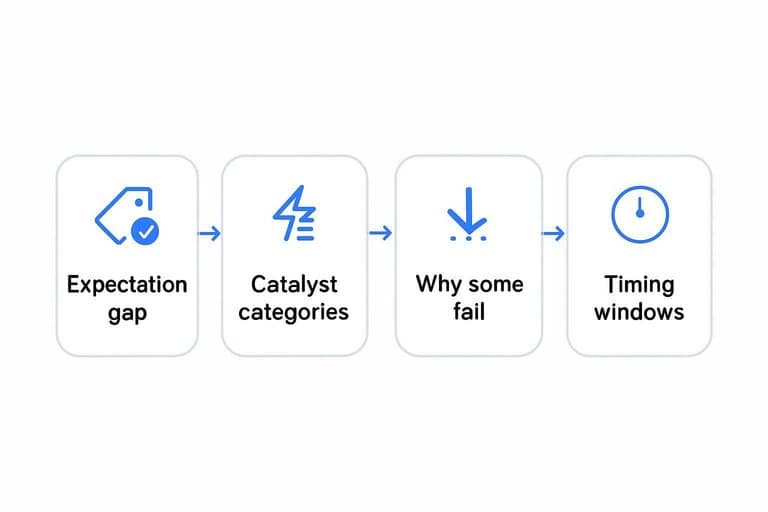
Expectation gap
Markets price consensus, not your thesis. That consensus lives in estimates, forward guidance ranges, and the tone behind “visibility is improving.” When the print or guidance deviates, valuation re-anchors fast because future cash-flow assumptions just changed. That gap is the fuel, and the chart is the smoke.
Catalyst categories
Most episodic pivots start with a discrete trigger that forces repricing.
- Earnings and guidance resets
- FDA rulings and trial data
- Litigation rulings and settlements
- Macro prints and rate decisions
- Upgrades, downgrades, and target changes If you can’t name the catalyst class, you’re probably chasing noise.
Why some fail
Some catalysts are already in the price because everyone positioned for them. Others fail because liquidity is too deep, so the order flow gets absorbed. The worst ones move on headlines but die without sponsorship, like a gap that fades as institutions sell into strength. You want surprise plus sustained demand, not surprise alone.
Timing windows
Pivots cluster in predictable time windows when information hits and liquidity shifts.
- Overnight gaps on fresh information
- Open auction reversals and trend starts
- Post-earnings days 1–3 continuation
- Macro release minutes and repricing Your edge improves when you hunt the windows, not the whole day.
Signals You Can Measure
You need measurable signals because “it felt strong” is how you confuse noise for a pivot. Treat an episodic pivot like a repricing event, not a nicer-looking candle.
Range expansion
ATR expansion and wide-range bars show urgency, not normal auction behavior. When true range expands fast, price is being re-valued, not negotiated.
Look for ATR(14) rising 30–60% within 5–10 sessions and at least one wide-range bar in the pivot direction. A wide-range bar should be materially larger than recent bars, often 1.5–2.0× the 20-day average true range, and it should close in the top (or bottom) third. Bonus points if gaps hold and the next day doesn’t immediately fill.
If range expands without follow-through closes, you’re watching volatility, not repricing.
Volume signature
Volume is your lie detector because pivots usually need participation. You’re looking for evidence of real demand, not just thin air.
- Compare volume to 20-day average: 1.5–3.0×
- Track up/down volume: heavy volume on up days
- Confirm dollar volume: liquidity steps up, not down
- Watch volume-at-price: shifts to higher nodes
If volume expands but dollar volume stays weak, your “breakout” is just a small-cap echo.
Price structure shift
A pivot changes where price can trade, not just how fast it moves. You want an objective level event, then proof the stock can digest it.
Start with a reclaim or break of a multi-week level that capped price, like a 4–12 week range high or a well-tested moving average cluster. Add confirmation via a fresh 52-week high or low, since that resets supply and demand memory. Then demand tight consolidation after the impulse, like a 3–10 day narrow range that holds above the breakout level.
No consolidation, no absorption, no edge.
Relative strength
Relative strength keeps you out of the “it’s up, but everything’s up” trap. Sponsorship shows up as outperformance, not just green candles.
- Compare returns vs sector ETF over 1–4 weeks
- Compare returns vs market index over 1–4 weeks
- Confirm RS line prints new highs
If RS lags during the move, your pivot is probably beta wearing a costume.
The Pivot Lifecycle
An episodic pivot usually runs in a repeatable sequence: shock, absorption, continuation, then exhaustion. The key is that pullbacks change character after the pivot because the market has accepted a new reference price.
Shock phase
A pivot starts with a gap or hard impulse that snaps price away from the old range. Spreads widen, prints get messy, and you’ll see “air pockets” where price skips levels.
Price is searching for new fair value, so liquidity thins and extremes overshoot. You often get long wicks, fast reversals, and mixed tape because both sides are reacting late.
Your job here is survival, not precision entries.
Absorption phase
Once the shock stops, pullbacks usually turn shallow because passive demand starts showing up. You’ll see dips bought quickly, with less retracement even when volume stays elevated.
VWAP often acts like a reclaim line, and prior highs become magnets as trapped shorts defend and late longs chase. Pullbacks tag those references, then snap back, because participants anchor to them.
When pullbacks stop reaching “obvious” levels, you’re watching acceptance happen in real time.
Continuation phase
After absorption, trends get mechanical because positioning and systematic buyers take over.
Exhaustion phase
Eventually, continuation turns into distribution, and the clues show up before the headline reversal. You’ll see big volume that stops producing progress, plus fresh highs that fail quickly.
Churn expands, the stock starts lagging its peers, and breakouts need more effort for less distance. The tape feels heavy, like every push meets a wall.
When relative strength cracks, your next pullback is more likely to break than bounce.
Entry Logic For Swing
You’re turning a “looks good” breakout into a repeatable entry decision. The goal is simple: enter where structure is tight, risk is defined, and adds are earned.
Identify the base
A swing base is a post-shock pause where price stops expanding and starts behaving. You want tightening ranges, quieter volume, and support holding above a level that mattered before the move.
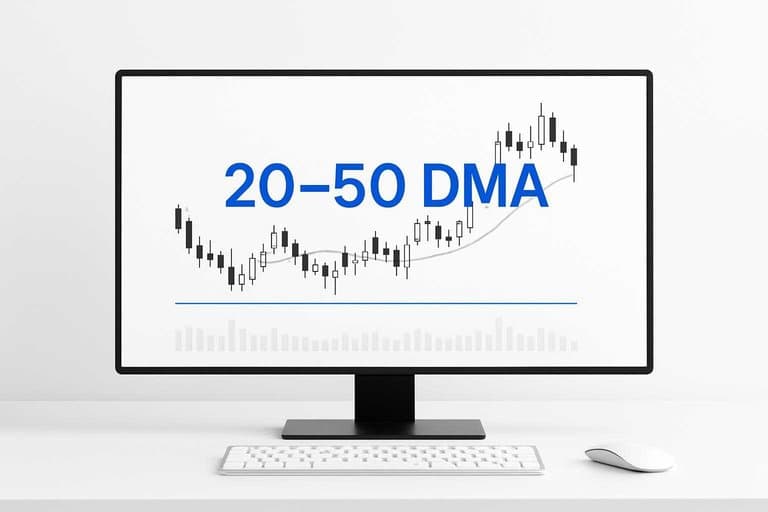
Look for a consolidation that respects the 20–50 DMA zone, a prior breakout level, or the gap midpoint. If candles shrink and wicks get rejected at the same prices, you’re seeing volatility compress into a decision point.
Your edge starts when the chart stops being loud.
Trigger criteria
You need triggers you can spot in seconds, not narratives you can defend for hours.
- Breaks above base highs on volume
- Reclaims the gap pivot and holds
- Breaks a tight range after contraction
- Buys first pullback at defined support
If none trigger cleanly, you’re early, not “disciplined.”
Risk placement
Stops belong where your thesis dies, not where your feelings calm down. Put risk at the first clear invalidation: the base low, the reclaimed gap pivot, or a VWAP loss that flips the tape.
Arbitrary percentages ignore structure and punish tight bases. If price loses the level that made the entry valid, you want out fast.
Define the line that gets crossed, then size to it.
Position sizing
Sizing is where good charts turn into survivable trades.
- Use ATR to estimate normal noise
- Use stop distance to set dollar risk
- Check liquidity and expected slippage
- Cap correlation exposure across positions
If your portfolio heat is rising, your next “A+” setup is still a pass.
Risk And Trade Management
Episodic pivots don’t just move price. They reshape volatility, liquidity, and how failures show up on your chart.
Your job is to trade the new regime, not the old one you wish you had.
Managing volatility
Right after a catalyst, ATR often expands faster than your stop logic adjusts. If you keep the same dollar stop or leverage, you’ll get chopped by “normal” post-news swings.
Use volatility-aware guardrails:
- Set initial stops at 2–3× ATR(14) from entry, then tighten after compression.
- Add a time stop if the move stalls, like 3–7 bars post-breakout.
- Reduce size when ATR spikes, then scale back as ranges normalize.
Treat the first expansion as a different product than the base you bought.
Add-on rules
Adds work when they’re earned by structure, not hope. Your first entry buys the pivot; adds buy confirmation.
- Add on breakout retest that holds VWAP or the pivot level.
- Add on tight flag break with contracting volume.
- Add on RS line acceleration versus your benchmark.
- Cap at 2 adds total per position.
- Space adds by at least 0.5–1.0× ATR.
If you can’t name the trigger, you’re averaging up blind.
Exit logic
Episodic pivots tend to front-load gains, then rotate into digestion. Scaling out into strength pays you while the tape is still cooperating.
Use a two-part exit: sell some into extension, then hold a smaller core until character breaks. Character change looks like a failed breakout reclaiming the range, an RS line rolling over, or heavy distribution days that erase progress.
You’re not selling because it’s “up a lot.” You’re selling because the auction changed.
Common failure modes
Episodic pivots fail differently than slow breakouts. The traps are fast, emotional, and often headline-driven.
- Low-float squeezes that reverse in minutes.
- One-day wonders that gap, spike, and fade.
- Late entries after the easy range is gone.
- Dilution risk from secondaries or convertibles.
- Macro reversal risk that kills risk-on flows.
Label the failure mode early, then your exit becomes obvious.
Pivot vs Other Setups
You’ll confuse yourself fast if you treat an episodic pivot like a generic “breakout.” The edge comes from a regime change, not a line on your chart.
| Setup type | Core trigger | Best market backdrop | Typical failure mode |
|---|---|---|---|
| Episodic pivot | New info rerates | Baseline → new trend | Event fades fast |
| Standard breakout | Range highs break | Tight consolidation | Chop, false breaks |
| Mean reversion | Stretch from value | Sideways, stable vol | Trend keeps trending |
| Momentum burst | Sudden price thrust | News-less, thin tape | Reverts within days |
If you can’t name the “new info,” you’re probably trading a breakout, not a pivot.
Turn “Breakout” Into a Repeatable Episodic Pivot Playbook
- Label the context: Is this an episode (fast repricing) or a slow trend? If it’s episodic, expect expansion and follow-through windows.
- Confirm the engine: Look for evidence of imbalance + thinning liquidity (range expansion, strong closes, tight pullback bids) rather than a single wick.
- Require measurable signals: Volume/turnover signature, structure shift (base → higher highs/lows), and relative strength versus its peers/benchmark.
- Execute like a swing trader: Enter on the trigger, place risk where the pivot thesis breaks (back into base/failed breakout), size for volatility, and add only after absorption confirms.
- Manage by phase: Press during continuation, scale/trim into extension, and exit on exhaustion cues (failed pushes, volatility spike without progress, RS rollover).
Frequently Asked Questions
Is an episodic pivot the same as an earnings gap or a news breakout?
Not usually. An episodic pivot can start with a gap or headline, but it’s defined by a regime shift that sustains repricing over days to weeks—not just a one-day reaction.
Do episodic pivots still work in 2026 with algos and crowded momentum trading?
Yes, most still work because they’re driven by expectation gaps and forced repositioning. The edge usually comes from faster confirmation and tighter invalidation rather than predicting the catalyst.
How long does an episodic pivot typically last for a swing trade?
Most episodic pivot trends give tradable follow-through for about 2 to 20 trading days. The strongest names can extend to 4–8+ weeks when the catalyst resets forward guidance or the macro backdrop.
Can I trade an episodic pivot without buying the breakout day (e.g., on the first pullback)?
Yes—many swing traders enter on the first orderly pullback after the pivot day, using the pivot-day low or a key moving average as the line-in-the-sand. This often improves R-multiple versus chasing the initial expansion.
What tools help me find episodic pivots quickly without watching the tape all day?
Use real-time news + abnormal volume/volatility scanners like Benzinga Pro or Dow Jones Newswire alongside Trade Ideas, Finviz Elite, or TrendSpider alerts. Pair that with TradingView/Thinkorswim alerts on volume multiples and ATR expansion to surface candidates early.
Find Tomorrow’s Pivot Leaders
Episodic pivots are easiest to trade when you consistently surface fresh leadership and confirm it with breadth, sector rotation, and measurable signals.
Open Swing Trading helps you shortlist breakout leaders fast with daily RS rankings, breadth and rotation context, and actionable watchlist workflows—get 7-day free access with no credit card.