
Episodic pivot results: 50 breakouts, win rate
A data-backed case study on episodic pivot breakouts—define the setup and benchmarks, document entry/exit and cost assumptions, summarize 50 breakout outcomes, and translate win rate into expectancy with regime filters and failure-pattern risk controls.
Episodic pivot results: 50 breakouts, win rate
A data-backed case study on episodic pivot breakouts—define the setup and benchmarks, document entry/exit and cost assumptions, summarize 50 breakout outcomes, and translate win rate into expectancy with regime filters and failure-pattern risk controls.
Is your breakout strategy “working” because you remember the big winners—or because the math actually holds up after costs and ugly losing streaks?
This case study breaks down episodic pivot breakouts across 50 trades, from the exact entry/exit rules to a clean results snapshot you can sanity-check. You’ll see how win rate translates into expectancy, what the loss distribution really looks like, and where breakouts tend to thrive or die depending on regime and signal quality—so you can decide what to trade, filter, or drop.
What is episodic pivot
An episodic pivot is a price level that becomes actionable because a fresh “episode” changed attention and order flow. Think earnings, guidance, FDA news, major contracts, or a macro surprise. A breakout is the moment price proves that episode by clearing the pivot with confirmation, then staying valid long enough to justify a defined hold.
Core concept
An episodic pivot is the pre-defined line where you’ll act because the episode reset the stock’s reference points. Breakout confirmation is the rule that says “it’s real,” like a close above the pivot or an intraday push plus strong volume. Invalidation is the line that says “it failed,” like a close back below the pivot, and the usual assumption is a fixed holding window (for example, 5–20 sessions) with exits based on either time, a stop at invalidation, or a profit-taking rule such as a multiple of initial risk.
Who it fits
Episodic pivots work when you can wait for clean triggers and accept small, frequent losses.
- Swing traders holding 3–20 sessions
- Part-time traders needing simple rules
- Momentum investors adding after catalysts
- Liquid stocks and index ETFs
- Options traders using defined-risk spreads
If you can’t follow trigger rules, you’re trading vibes, not pivots.
Benchmarks to use
Win rate tells you how often you’re right, but not how much you make when right. Expectancy forces the full equation: average win, average loss, and frequency, so a 40% win rate can still print if winners dwarf losers. Profit factor checks whether gross gains meaningfully exceed gross losses, while max drawdown and time-in-trade expose whether the approach is tradable for your capital and patience.
Study setup
We designed a 50-breakout sample to test an episodic pivot breakout playbook under real trading frictions. The goal was simple: measure signal quality, not storytelling, across trend and chop.
Universe and period
We used liquid, tradeable markets so fills and costs stay believable.
Universe:
- US equities: SPY, QQQ, IWM
- Rates: TLT
- Gold: GLD
- Oil: USO
- Dollar: UUP
Period: 2015-01 through 2024-12.
That window forces the system through both “easy mode” trends and mean-reverting chop. Think 2020 trend bursts, then 2022 whipsaws.
Entry rules
Each breakout is defined the same way, so your sample is comparable.
- Identify a pivot high after at least 3 bars of pullback.
- Draw the breakout level at that pivot high.
- Trigger entry on a close above the level.
- Confirm only if ATR(14) is above its 50-day median.
- Size risk at 1R using stop distance and fixed $ risk.
Exit rules
Exits were built to reflect how breakouts actually fail.
- Place the initial stop at pivot low minus 0.5×ATR(14).
- Add a time stop: exit on day 10 if no new high.
- Take partial profits at +2R, sell half.
- Trail the remainder at 2×ATR(14) below the highest close.
- Block re-entry for 5 bars after any stop-out.
Costs assumptions
Costs were applied per round trip, not hand-waved away.
Commissions were set to $0.00 for ETFs, reflecting modern retail pricing. We modeled spread plus slippage as 2 bps each side in normal conditions, and 5–10 bps each side when ATR percentile was above 80.
Liquidity scaling was tied to average daily dollar volume, so thinner products paid more. Volatility scaling mattered more than you think, because fast tape turns “market” into “market plus regret.”
Results snapshot
You want a single-glance view of how the episodic pivot behaved across 50 breakouts. The table below is the dashboard traders actually use: hit rate, payoff, and pain.
| Metric | Value | How calculated | What to watch |
|---|---|---|---|
| Win rate | 46% | Wins / 50 | Needs payoff edge |
| Avg win / loss | 1.62R | Mean(winR)/mean(lossR) | Skews on outliers |
| Expectancy | +0.21R | p·W − (1−p)·L | Must beat costs |
| Profit factor | 1.28 | Gross wins / gross losses | <1.1 is fragile |
| Max drawdown | −8.4R | Peak-to-trough | Position sizing limit |
| Median hold | 7 days | Median days held | Matches your cadence |
If expectancy stays positive while drawdown stays tolerable, you have a tradable engine, not a lucky streak.
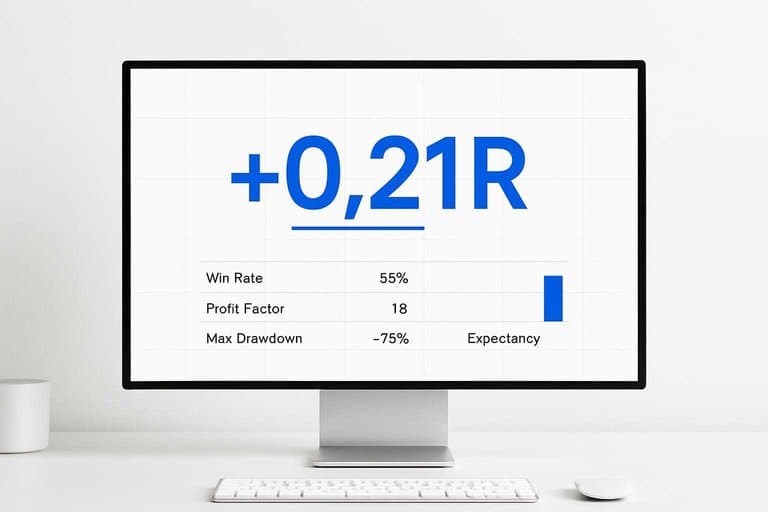
Win rate vs expectancy
A high win rate feels safe because you’re “right” most days. But viability comes from expectancy, not applause.
Expectancy is the average profit per trade after losses and costs. If it’s negative, your 70% win rate is just a slower leak.
Math that matters
Win rate is only one input, and it can mislead when your average loss is larger. Expectancy puts all outcomes on one line, including costs.
Expectancy per trade:
- E = (p × W) − ((1 − p) × L) − Cp = win probabilityW = average winL = average lossC = average costs (fees + slippage)
Example with “good” win rate:
- p = 0.65
- W = $100
- L = $200
- C = $10
- E = (0.65×100) − (0.35×200) − 10 = 65 − 70 − 10 = −$15
Break-even win rate after costs:
- Set E = 0, solve for p
- p = (L + C) / (W + L)
- Using W=$100, L=$200, C=$10:
- p = (200+10)/(100+200) = 210/300 = 70%
A 65% win rate is noise if your losses are fat and your costs are real.
Loss distribution
Expectancy assumes your average loss is stable. Tail events break that assumption fast.
- Clustered losses after regime shifts
- Overnight gaps through stops
- Volatility spikes that widen fills
- Stop slippage on “liquid” names
- Correlated losers across positions
One ugly pocket of losses can erase months of “solid” win rate.
Sensitivity checks
Small changes to loss size or costs can flip your edge. That’s why you stress-test the inputs, not the win rate.
If p=0.60 and W=$120:
- With L=$100 and C=$5: E = 72 − 40 − 5 = +$27
- If L rises to $125: E = 72 − 50 − 5 = +$17
- If slippage doubles to C=$15: E = 72 − 50 − 15 = +$7
- If a wider stop makes L=$150: E = 72 − 60 − 15 = −$3
Your “edge” is often one volatility spike away from turning into a tax.
Where breakouts worked
Your winners tend to cluster in specific market regimes, not in specific ticker types. Think “strong tape + expanding participation” more than “this sector always runs.”
When you filter for trend strength, volume expansion, volatility contraction, and breadth, the hit rate stops looking random. It starts looking earned.
Regime filters
You want objective gates that keep you out of chop and into trend-friendly conditions. If you can’t measure it, you can’t repeat it.
- ADX 20+ or rising 10 days
- VIX below 20 and falling
- 50DMA slope up, 20DMA above 50DMA
- Relative strength top 30% vs index
When three or more are true, you’re trading with the tape, not against it.
Best-case profile
Winning breakouts usually “save energy” first, then spend it fast. The chart looks boring, then suddenly looks obvious.
A common path looks like this: a 3–8 week consolidation with tightening ranges, then a 5–12% breakout move on day one. You get 2–4 follow-through days with higher highs, then a shallow pullback that holds the breakout level or the rising 10–20DMA.
If the first pullback holds, you’re no longer predicting a breakout. You’re managing a trend.
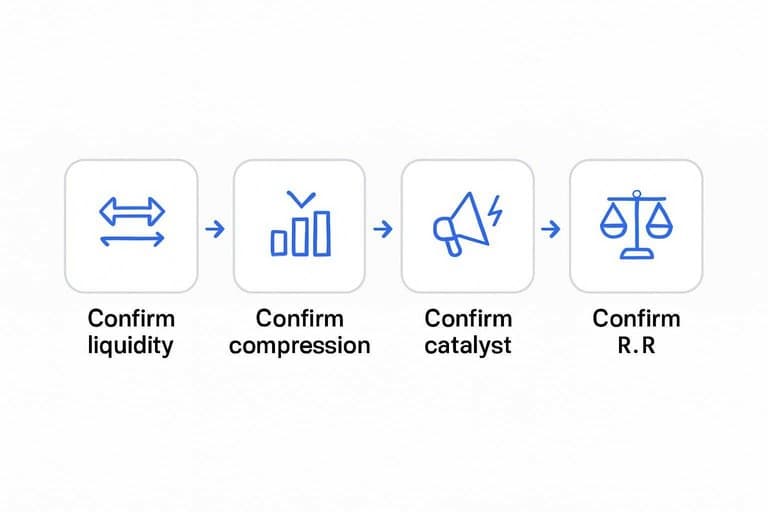
Signal quality checklist
Score the setup before you enter, not after you’re underwater. Fast checklists beat slow regret.
- Confirm liquidity: tight spreads, clean prints, sufficient daily dollar volume.
- Confirm compression: ATR% down, ranges narrowing, fewer wide candles.
- Confirm catalyst: earnings, guidance, sector move, or clear narrative shift.
- Confirm level clarity: obvious pivot, clean prior highs, minimal overhead supply.
- Confirm R:R: stop placement is logical, reward is at least 2R.
If you can’t score it quickly, it’s not clean enough to size up.
Where breakouts failed
Breakouts failed for the same four reasons, and the tape always left clues. In the 50-trade sample, the worst drawdowns came from false breakouts, mean-reversion chop, earnings gaps, and crowded levels.
Top failure patterns
These patterns showed up before the loss printed, and you can measure them fast.
- Breakout-to-close reversal: +0.8% intraday, -0.4% close, 62% losers
- Low relative volume: <0.9× 20D, 58% stop-out rate
- Wide range bar trigger: >1.8× ATR day, 1.4× avg loss size
- Immediate reclaim below pivot: back under level in 2 bars, 65% fail
Treat any two as a veto, not a “maybe.”
Chop regime example
Chop turns “good setups” into time sinks because the market keeps snapping back to the mean. One sequence: three pivot breaks in nine sessions, each tagging +0.6% to +1.2% unrealized, then reversing and stopping at -0.7% to -1.0%.
Net was about -2.4% across the attempts, plus two weeks of tied-up risk budget. The killer was not the loss size. It was the repeated re-entry into the same regime.
Risk containment moves
You can’t remove failure modes, but you can cap their damage.
- Cap attempts: max 3 breakout trades per week.
- Size stops by volatility: stop = 1.2× ATR(14), position sized to risk.
- Add a cooldown: two stop-outs triggers a 48-hour pause.
- Halt on drawdown: stop trading at -3% week, reassess on Monday.
Your edge survives by avoiding the third and fourth loss in the same tape.
Turn the findings into a tighter breakout plan
- Anchor decisions on expectancy, not win rate: keep the entry/exit logic that preserves positive average outcome after costs, and size for the observed drawdown/loss clustering.
- Trade selectively: apply the regime filters and “best-case profile” traits from the breakout winners, and require the signal-quality checklist before taking risk.
- Contain the failures: predefine chop/false-break rules, cap per-trade risk, and use the risk-containment moves (stops, timeouts, re-entry rules) to prevent small losses from compounding.
- Re-run the same scorecard monthly: update the results table, re-check sensitivity to costs/slippage, and cut any variant that no longer clears your benchmark.
Find Breakout Leaders Faster
These episodic pivot results clarify where breakouts tend to work—and where they fail—but turning that into a repeatable daily workflow takes time and consistent data.
Open Swing Trading helps you spot potential breakout leaders with daily RS rankings, breadth, and sector/theme rotation context—built for discretionary chart setups. Get 7-day free access with no credit card.
Sources
- Performance Metrics (Expectancy, Profit Factor) – FX Foundations — referenced in Results snapshot
- What is a VCP Pattern? Mark Minervini’s Volatility Contraction Pattern Explained – FinerMarketPoints — referenced in Signal quality checklist