
Episodic pivot vs earnings gap: which leads
A practical comparison of episodic pivots versus earnings gaps to see which indicator leads — clarify what each measures, how timing and reliability differ, where false signals come from, and how to apply trade rules by horizon and market regime.
Episodic pivot vs earnings gap: which leads
A practical comparison of episodic pivots versus earnings gaps to see which indicator leads — clarify what each measures, how timing and reliability differ, where false signals come from, and how to apply trade rules by horizon and market regime.
You spot a clean intraday pivot and wonder: is the move “real,” or will the next earnings gap rewrite the trend overnight? Most traders get burned not because the signal is wrong, but because they’re using it in the wrong time window.
This comparison shows you when episodic pivots tend to lead, when earnings gaps dominate price discovery, and how to choose a setup with fewer false signals. You’ll leave with simple playbooks, regime-based expectations, and a scenario scorecard you can apply immediately.
What Each Measures
An episodic pivot measures whether a company’s story just changed. An earnings gap measures whether the market repriced that story overnight.
Both use price and volume, but they lean on different inputs. Traders track pivots to catch new trend regimes, and gaps to gauge immediate consensus and positioning.
Episodic pivot
An episodic pivot is a discrete event that changes expectations for months, not days. You track it because it often marks the start of a new trend.
Typical catalysts include a blowout quarter with raised guide, a major product launch, an acquisition, or a regulatory win. On the tape, you’ll usually see a sharp price expansion, heavy volume, and a narrative shift like “they’re no longer a one-product company.”
Treat it like regime change, not a “nice beat.”
Earnings gap
An earnings gap is the price discontinuity created when earnings news hits outside regular hours. You track it because it reveals instant repricing and forced repositioning.
Traders usually label gaps by direction and context: gap-up, gap-down, continuation gap, or exhaustion gap. Sizing is commonly measured versus the prior close, the prior day’s range, or ATR, and it often prints in the overnight session before the regular session confirms or fades it.
The open is the referendum, but the gap is the headline vote.
Quick identification
Use this checklist to separate a real pivot from a one-night reprice.
- Confirm a specific catalyst, not vague “strong demand”
- Measure gap size versus ATR or prior range
- Check volume surge versus 20-day average
- Watch VWAP reclaim and hold, or reject fast
- Require day-1 range hold into the close
When VWAP and the day-1 range hold, institutions are usually defending the move.
Signal Timing
Both signals are about who learns first. One comes from management tone shifts, the other from printed numbers and guidance.
A simple example: a CEO says “demand stabilized” weeks before the quarter closes. Price can move before the report even lands.
Lead-lag mechanics
Episodic pivots can show up before the fundamental data is public because they ride on narrative change. You often see it in quotes like “we’re exiting the experiment” or “profitability is the priority,” then positioning slowly follows.
Earnings gaps usually arrive after the firm forces new information into the open. The gap is the market repricing the report, the guidance, and the credibility in one shot.
If you want lead time, follow words and behavior changes, not the earnings PDF.
Best early tell
Episodic pivot is the earliest actionable signal because it can move before consensus updates models. You can act while the story is still forming, not after it prints.
Earnings gaps are faster confirmation, not earlier information.
Trade the pivot for timing. Use the gap for validation.
When it flips
Earnings gaps lead when the report forces a discontinuous reprice, not a gradual rethink.
- Surprise is massive versus expectations
- Pre-positioning is light and complacent
- Guidance change is clean and directional
- Prior narrative is already exhausted
- Liquidity is thin at the open
In those setups, the gap is the first honest price, not a reaction.
Reliability Rate
Episodic pivots and earnings gaps both look decisive. Only one reliably survives the first 1–5 sessions without giving it back. Think “who keeps control after the headline fades.”
Sustain criteria
You need a clean definition of “sustain,” or every chart becomes a victory lap. Use price, volume, and context, not vibes.
- Hold the gap or pivot level for 1–5 sessions
- Print higher highs and higher lows
- Show expanding volume on up days
- Avoid heavy upper wicks near highs
- Get sector confirmation, not isolation
If two of these fail early, you’re watching a fade, not a lead.
Common failure modes
Most “leaders” don’t fail randomly. They fail in repeatable ways tied to follow-through and liquidity.
- Pivot reverses after one strong day, then stalls
- Pivot breaks support on light volume, then accelerates down
- Earnings gap fills quickly on mean-reversion flows
- Earnings gap fades when liquidity was thin at the open
- Either signal fails when the sector is rolling over
Spot the failure mode early and you can flip from “trend” to “trade” fast.
Winner call
Earnings gaps are usually the more reliable leader for 1–5 sessions because they reprice information, not just positioning. They win most consistently when the gap holds the opening range, volume is 2x+ normal, and the sector is also breaking out.
If the gap doesn’t hold day-one lows, treat it as a scalp, not a campaign.
False Signal Risk
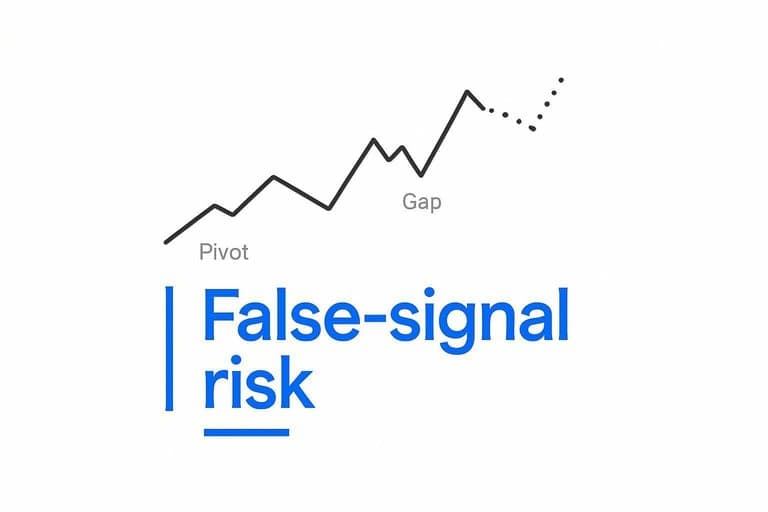
Both episodic pivots and earnings gaps can look like clean regime changes. They also produce clean-looking traps. Your job is to spot when price is moving without durable participants.
Pivot traps
Pivots trap you when the story moves faster than positioning. One strong headline can print a perfect breakout, then vanish by lunch.
Headline churn is the classic one-day wonder. Narrative overreach is next, when “AI turnaround” becomes a whole thesis from one quote. The nastiest version is supply: insiders selling, or a secondary that caps the move.
Treat pivots as probation until volume holds through a second catalyst.
Gap traps
Gaps trap you when the market reprices, then immediately negotiates the new level. The open looks decisive, but the next two sessions tell the truth.
Guidance walk-backs create the cleanest fake. You get “beat and raise,” then a clarifying comment softens it. Options pinning can glue price near a strike into expiry. Liquidity-driven fills happen when the book is thin, then refilled. Post-earnings drift is slower, when investors sell the news over days.
If the gap can’t hold the first pullback, it wasn’t repricing.
Which is riskier
Episodic pivots usually carry higher false-signal risk, because the catalyst is fuzzier and supply can appear without warning. Earnings gaps are noisy, but they start from audited numbers and a scheduled reset.
Reduce both by waiting for day-two confirmation and checking for obvious supply.
Trade Setup Rules
You want setups you can run the same way every week, not one-off hero trades. The point is to anchor entries and exits to levels you can name out loud: “retest,” “reclaim,” “VWAP.”
Pivot playbook
A pivot trade is a level trade, so you win by being boring and consistent.
- Mark the pivot level from the prior swing high/low.
- Wait for price to retest the level after the initial break.
- Enter on a reclaim and close back above the level.
- Place your stop just below the pivot level or reclaim candle low.
- Scale in only if price prints higher lows above the pivot.
Your edge is the retest; no retest, no trade.
Gap playbook
Gaps feel obvious, but the first hour decides if the move is real or just noise.
- Classify the gap: earnings gap, sympathy gap, or news-driven gap.
- Define the first-hour range high/low and note opening VWAP slope.
- Enter only if price holds above the range low (or breaks range high).
- Set the stop at the gap midpoint or the day’s low, whichever is tighter.
- Trail risk under VWAP once price is extended from the open.
If VWAP fails early, you’re trading a headline, not a setup.
Cleaner framework
The pivot playbook is cleaner because the level, retest, and stop are usually unambiguous. Earnings gaps force more judgment on “type of gap” and intraday context, which makes rule-following slip fast.
Time Horizon Fit
Your horizon decides the lead signal. Episodic pivots behave like fast feedback, while earnings gaps behave like slow commitments.
Pick the one that matches how long you can sit through noise without flinching.
Intraday winner
For 1–2 day holds, episodic pivot leads. Liquidity and volatility make pivots show up early, like a clean “VWAP reclaim then higher low.”
Earnings gaps often start with spread, halts, and whippy reprices that punish tight risk. That’s the line that gets crossed.
Trade the pivot, then use the gap as context.
Swing winner
For 1–4 week swings, earnings gap leads. A real gap prints a new reference range, and that structure holds up under retests.
You get clear retreat levels, like “gap fill,” “mid-gap,” and “opening range low.” That gives you entries and exits without guessing.
If it can’t defend the gap zone, your swing thesis is already broken.
Position winner
For multi-month trends, earnings gap leads by a mile. Big gaps often mark a fundamental re-rating, like margins resetting or guidance stepping up.
Episodic pivots can stack, but they rarely change valuation alone. The gap is where institutions reprice risk, then build positions over weeks.
Track post-gap accumulation, because that’s your confirmation of a new regime.
Market Regime Effects
In different regimes, your edge comes from different problems getting priced first. Bull runs reward persistence, bears punish leverage, and chop taxes impatience.
Bull markets
Breakouts tend to stick in bull markets because flows reinforce winners and dips get bought. Momentum also amplifies post-event drift, so the episodic pivot usually triggers earlier than an earnings-gap follow-through.
Winner: episodic pivot.
Bear markets
Bear markets are about liquidity first, narrative second, and gaps often mark forced repricing. Fast mean-reversion also fades “new highs” signals, so episodic pivots get trapped while earnings gaps stay information-dense.
Winner: earnings gap.
Choppy markets
Chop creates whipsaws, so you need filters that block low-quality triggers.
- Require ATR above a minimum threshold
- Demand relative strength vs benchmark
- Prefer higher float, tighter spreads
- Trade only high-quality events
Treat chop as a filtering problem, not a forecasting problem.
Side-by-Side Scorecard
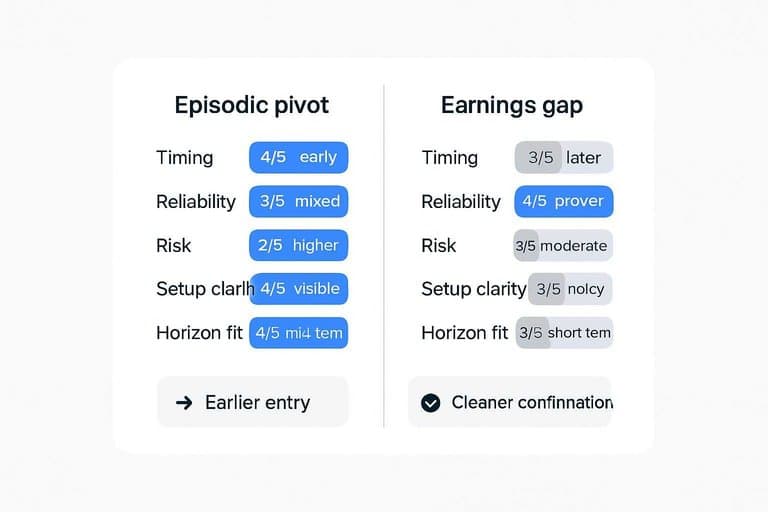
You need a fast way to decide which signal should drive your next move. Score both on the same dimensions, then follow the higher total.
| Signal | Timing | Reliability | Risk | Setup clarity | Horizon fit |
|---|---|---|---|---|---|
| Episodic pivot | 4/5 early | 3/5 mixed | 2/5 higher | 4/5 visible | 4/5 mid-term |
| Earnings gap | 3/5 later | 4/5 proven | 3/5 moderate | 3/5 noisy | 3/5 short-term |
Trade the episodic pivot when you want earlier entry and can manage whipsaws; default to the earnings gap when you want cleaner confirmation.
Choose By Scenario
Use this table when you need a fast default, not a perfect forecast. Think: “Fed shock week” versus “quiet grind into earnings.”
| Scenario | Better signal | Why it leads | What to watch |
|---|---|---|---|
| Macro shock, new regime | Episodic pivot | Narrative resets fast | Rates, VIX, flows |
| Earnings week, single-name focus | Earnings gap | Price re-prices facts | Guide, margins, tape |
| Index chop, sector rotation | Episodic pivot | Rotation is story-driven | Breadth, leaders, ETFs |
| Post-earnings drift, low vol | Earnings gap | Gap anchors positioning | VWAP, options pin |
| Crowded theme unwind | Episodic pivot | Crowds exit on headlines | Short interest, skews |
When the “why” changes, follow pivots; when the “what” changes, follow gaps.
Final Recommendation
Most readers should lead with the earnings gap, because it’s measurable and hard to fake. Think “guided $2.00, printed $2.60” versus a vague “new AI initiative.”
- Lead with earnings gap for position sizing and timing
- Use episodic pivots to source ideas, not confirm them
- Prefer pivots only when earnings are structurally delayed
- Downweight both signals when guidance is unreliable
- Re-check after one quarter, then either add or walk
Trade what shows up in the numbers, then let the story earn the right to matter.
Pick Your Lead Signal, Then Trade It the Same Way Every Time
- If you need the earliest, tradable clue inside the session, prioritize the episodic pivot—but require follow-through (structure + volume/volatility confirmation) before sizing up.
- If you need the market’s highest-conviction re-pricing event, prioritize the earnings gap—but only after it proves acceptance (holds key gap levels and doesn’t fade back into the prior range).
- Don’t mix horizons: pivot rules for intraday/swing execution, gap rules for swing/position alignment.
- Use the scorecards to decide which leads in your scenario, then commit to one playbook for the entire trade to reduce “signal flipping” and whipsaw exits.
Frequently Asked Questions
Is an episodic pivot the same thing as a pivot point or classic technical pivot levels?
No. An episodic pivot is an event-driven inflection tied to a discrete catalyst and rapid repricing, while classic pivot points are mechanically calculated support/resistance levels based on prior price ranges.
What indicators or tools help confirm an episodic pivot in real time?
Use relative volume (RVOL), volume-at-price/anchored VWAP, and options signals like rising implied volatility or unusual call/put volume to confirm that the move is catalyst-backed and being accepted by the market.
What’s the best timeframe to chart an episodic pivot—5-minute, hourly, or daily?
Most traders spot the pivot on intraday charts (5–30 minute) and validate it on the daily close; the cleanest read usually comes from combining intraday structure with the daily trend context.
How do I backtest an episodic pivot strategy without curve-fitting?
Predefine a repeatable pivot label (catalyst + RVOL threshold + break of a prior range), test across at least 3–5 years and multiple tickers, and report out-of-sample results with walk-forward validation.
Does an episodic pivot still matter in 2026 with AI-driven markets and faster news pricing?
Yes. News is priced faster, but episodic pivots still show up as liquidity and positioning shifts; the edge often comes from confirming acceptance (volume/VWAP/structure) rather than being first to the headline.
Spot Leaders Before They Gap
Episodic pivots can show up before the obvious earnings move, but only if you can separate real rotation from noisy, one-off spikes consistently.
Open Swing Trading helps you validate episodic pivots with daily RS rankings, breadth, and sector/theme context—use the 7-day free access with no credit card to tighten your watchlist in minutes.
Sources
- Post–earnings-announcement drift (PEAD) – Wikipedia (overview + key canonical citations) — referenced in Gap traps