High Stocks vs Low Stocks for Breakouts
A clear comparison of high-priced vs low-priced stocks for breakout trades — use a breakout decision map, assess liquidity and slippage, match volatility to your setup, and choose structures, risk models, and tools (shares/options) that fit your execution.
High Stocks vs Low Stocks for Breakouts
A clear comparison of high-priced vs low-priced stocks for breakout trades — use a breakout decision map, assess liquidity and slippage, match volatility to your setup, and choose structures, risk models, and tools (shares/options) that fit your execution.
Breakouts look simple on a chart—until the stock you picked turns a clean level into a wick, a gap, or a halt you can’t control. One of the biggest hidden variables is price: “high” and “low” stocks behave very differently when momentum hits.
This comparison helps you choose the right battleground for your breakout style. You’ll learn how price impacts spreads and fills, how volatility changes false-break risk, what clean structure looks like, how sizing and stops really work, and when options help—or just add another way to get chopped up.
Breakout Decision Map
You’re not picking “cheap” versus “expensive.” You’re picking a trading environment with different fills, risks, and payoff shapes.
Define the price bucket first, then match it to your breakout style and execution limits.
What “High” Means
For this guide, “high-priced” starts around $20 and gets meaningfully different above $100. That’s where a “$0.20 slip” becomes noise, but a “$2 slip” becomes a tax.
Practical bands:
- $5–$20: lower-priced listed
- $20–$100: core listed
- $100+: high-priced leaders
If you’re on a small account or can’t trade fractional shares, $100+ can force tiny size and odd risk math. Your broker rules matter as much as the chart.
What “Low” Means
“Low-priced” usually means $1–$5, and “penny” is often under $1. Below that, you’re more likely to run into OTC tickers, wider spreads, and sketchier prints.
Listed low-priced names can still be real businesses. But price alone is not quality, or safety, or even “value.” One reverse split and your “$0.80 stock” becomes “$8” overnight.
Breakout Basics
Breakouts work when structure and participation line up. You want the same simple ingredients, regardless of price.
Breakout Basics
You’re looking for repeatable conditions, not a one-off rocket. The checklist stays boring on purpose.
- Sufficient liquidity for your size
- Tight base with drying volume
- Clear catalyst or narrative shift
- Volume expansion on the break
- Clean levels with few wicks
If two are missing, you’re not trading a breakout. You’re trading hope.
How We Judge Winners
Price changes the mechanics of execution. So we grade “high” versus “low” on what actually hits your P&L.
How We Judge Winners
You don’t need more opinions. You need a scoring rubric you can apply in 30 seconds.
- Slippage and spread cost
- Liquidity and depth
- Volatility and range stability
- Options availability and pricing
- Shortability, gaps, and risk control
The winner is the one you can exit cleanly when you’re wrong.
Quick Takeaway
High-priced, liquid leaders tend to win on reliability: tighter spreads, cleaner levels, better options, and fewer “gotcha” gaps. Low-priced names tend to win on explosive percent moves, but they charge you in slippage, halts, and exits that feel like “no bids.”
Pick high-priced when you want repeatability. Pick low-priced when you accept chaos as the entry fee.
Liquidity and Slippage
On breakout day, you’re buying when everyone else is buying. Liquidity decides whether you get filled cleanly or pay up in slippage. Think “in and out” versus “stuck and squeezed.”
Spreads and Depth
High-priced stocks usually trade with tighter spreads and thicker books. Low-priced breakouts often show a one-cent spread that’s deceptively wide, because it’s a big percent.
If you want tight spreads and real depth, high stocks win.
Market Impact
Your order moves price when it’s large relative to available liquidity. That’s the hidden tax on breakout entries and panicky exits.
- Smaller float relative to demand
- Lower average daily volume
- First 15 minutes volatility
- News-driven volume spikes
High stocks usually win because they absorb size without jumping levels.
Execution Tactics
You need rules that protect you from both slippage and FOMO. Use different tools depending on whether liquidity is thick or thin.
- For high stocks, use stops for triggers and limits for entries.
- For low stocks, prefer stop-limits with a tight max slippage cap.
- Scale in with two to three small adds, not one full-size hit.
- If you miss the breakout, wait for the first pullback, not the next candle.
- On exits, place limits into strength, not market sells into air pockets.
Build the process first, because thin names punish improvisation.
Winner: Tradability
High stocks are the winner for tradability on breakout day. You get more consistent fills, less spread tax, and less surprise impact.
Low stocks can compete when volume is unusually high, float isn’t tiny, and the tape stays orderly.
Volatility and Range
Breakouts live or die on range control. Your job is to find expansion that follows through, not noise that snaps back.
ATR vs Percent Moves
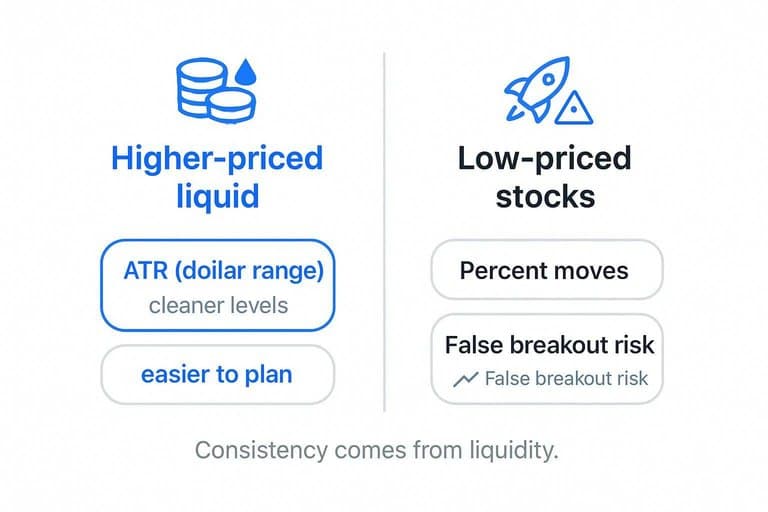
Low-priced stocks often print big percent moves because a few cents is a lot of percentage. A $2 name moving $0.20 is 10%, while a $200 name needs $20. High-priced stocks can still move plenty, but the dollar ranges often respect levels cleaner.
That matters for breakouts. Percent volatility creates drama, but dollar-based ATR in liquid, higher-priced names is easier to plan around.
Trade the range you can size and survive.
False Breakout Risk
Whipsaws usually come from structure, not your charting tool. Spot the usual culprits before you pay tuition.
- Trade thin liquidity near key levels
- Get trapped by halts and reopen gaps
- Enter through wide, jumpy spreads
- Chase pump headlines with no follow-through
- Ignore level overhead from bagholders
Winner for fewer fakeouts: higher-priced, more liquid stocks.
Matching Setup to Stock
Pick the stock that matches your breakout style. Use a quick filter, then commit.
- Check base tightness relative to ATR.
- Measure the prior run for exhaustion risk.
- Compare current relative volume to its norm.
- Note distance to the key level you’ll trade.
- Rate catalyst strength: real news vs “rumor”.
When the setup fits the tape, execution feels boring. That’s ideal.
Winner: Consistency
For dependable continuation, higher-priced liquid stocks win because ranges and fills are cleaner. Low-priced stocks win when you want momentum spikes and you’re willing to absorb chop.
Consistency comes from liquidity, not bravado.
Chart Structure Quality
High stocks usually print cleaner structure because institutions keep defending obvious levels like “the 20-day” or VWAP. Low stocks can still base well, but their levels get run more often by spreads, liquidity gaps, and single prints. If you care about repeatable breakouts, structure cleanliness is the edge you can actually see.
Level Respect
High stocks tend to respect prior pivots, anchored VWAP, and key moving averages because bigger players need orderly execution. You’ll often see tight reactions at the 10/20/50-day, plus clean retests of breakout lines and pre-market VWAP after news.
Low stocks can respect levels too, but they more often “tag and fade” through them on thin liquidity. Think wicks through a pivot, then a close back inside.
Winner: high stocks for level respect, because the market can actually trade there without slipping.
Base Types That Work
Both groups form classic bases, but the ones that hold up differ because liquidity changes how price digests supply.
- High stocks: flags on the 20-day
- High stocks: cups with tight handles
- High stocks: multi-week consolidations
- Low stocks: IPO bases with volume floors
- Low stocks: squeeze coils into catalysts
High stocks win overall because their bases “stay intact” under pressure, not just in screenshots.
Catalyst Interaction
Catalysts are where structure either becomes tradable or gets erased. High stocks usually create clean post-earnings levels, like a gap-day low, a first pullback to VWAP, or a tight three-day shelf.
Low stocks often gap so far and so fast that prior resistance becomes irrelevant. The new “levels” are sometimes just halts, wide candles, and air pockets.
Winner: high stocks, because the catalyst tends to leave behind usable reference points.
Winner: Pattern Clarity
Winner: high stocks, because their support, resistance, and base boundaries stay readable across timeframes. You get fewer fake breaks and more honest retests.
Low stocks can be equally clean when volume is steady for weeks and the float is actively traded, like a post-IPO base building above VWAP.
That’s when a “cheap stock” starts behaving like a real market.
Position Sizing and Risk
Risk control is where breakouts stop being a chart pattern and become a business. Your stop, your size, and your daily loss cap decide whether one bad trade hurts or haunts.
Stop Placement Reality
Low-priced breakouts often look “tight-stop friendly,” but the tape disagrees. Spreads, sudden wicks, and percentage volatility force wider stops than your eyes expect.
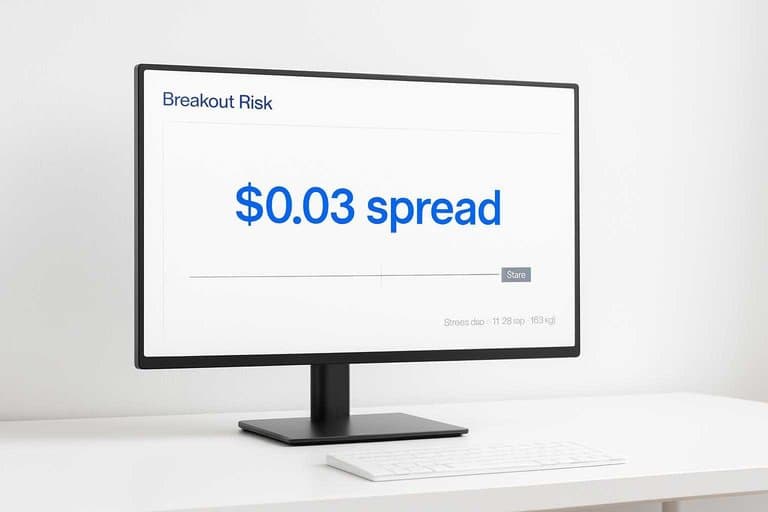
A $2 stock with a $0.03 spread and random $0.10 spikes can chew through a “clean” $0.05 stop. A $120 stock might show a $0.02 spread and smoother $1.50 ATR, so your stop can sit at a real invalidation level.
High-priced stocks win for stop precision, because microstructure noise is a smaller fraction of price.
Sizing Constraints
Your sizing isn’t just math. It’s what your broker, rules, and the market will allow.
- Account size limits meaningful share counts
- PDT rules restrict frequent day trades
- Leverage caps reduce buying power
- Margin requirements change overnight
- Share availability blocks shorts or locates
High-priced stocks usually win, because fills and borrow constraints add less sizing friction.
If sizing feels “fiddly,” your edge is already paying a tax.
A Simple Risk Model
You need one repeatable loop that turns a chart idea into a dollar-bounded bet.
- Choose invalidation on structure, not vibes.
- Set dollar risk per trade, like $100 or 0.5%.
- Compute shares: shares = $risk ÷ stop distance.
- Plan partials at predefined levels, then trail the rest.
- Set max daily loss, then stop trading when hit.
Your chart is optional; your loss cap isn’t.
Winner: Risk Control
High-priced stocks win for controllable downside, because stops map cleaner to true invalidation. You get tighter execution, less spread tax, and fewer random stop-outs.
Low-priced breakouts can be managed safely when you accept wider stops, reduce size, and trade only high-liquidity names. If you can’t get consistent fills inside the spread, you’re not trading risk, you’re trading hope.
Gaps, Halts, and News
Gap Behavior
High-priced leaders usually gap with institutions behind them, so continuation is more common than a full fade. Low-priced names gap on chatter, thin floats, or “strategic alternatives,” so they often spike, stall, then retrace fast.
Winner for stability: high stocks, because the gap is more often a reprice than a squeeze.
Halt Mechanics
Halts turn execution into damage control, and the damage is worse when the tape is thin. Low-priced breakouts live on thin books, so every reopen is a coin flip.
- Reopen spreads widen, and your fill gets ugly
- Stops skip levels, and risk doubles instantly
- Liquidity vanishes, and slippage becomes the trade
- Market orders misbehave, and limits get ignored
- Short halts stack, and momentum flips fast
Winner: high stocks, because reopening auctions are deeper and less chaotic.
News Quality Filter
Most “breakout news” is just a volatility trigger, so you need a fast grading loop.
- Check the source: SEC filing beats a screenshot.
- Judge materiality: revenue, margins, or contracts, not “partnership discussions.”
- Look for guidance: numbers and timelines, not vibes.
- Scan dilution risk: ATM, convert, or shelf on deck.
- Map sympathy: sector leaders moving, not just your ticker.
Trade the catalyst that survives step four.
Winner: Event Safety
High stocks are safer around news because liquidity absorbs surprise, and narratives are harder to fake. Your risk is still real, but the market structure is less predatory.
Low-priced names offer the best asymmetric shot when the catalyst is verifiable and the float is tight, like a clean FDA headline or a signed contract in an 8-K. That’s when a small defined loss can buy a multi-day repricing.
Options and Leverage
Options Access
Options only help breakouts when you can get in and out cleanly. Higher-priced, liquid names usually have weekly expirations, tight spreads, and real size at the bid and ask.
You’ll see it in chains like “$0.05 wide, 1,000 up” versus “$0.30 wide, 10 up.” High stocks win for options flexibility because execution stays predictable when the tape speeds up.
When Shares Beat Options
Options are a tool, not a requirement, and sometimes they’re the wrong tool. Use shares when the structure makes options slow, expensive, or unavailable.
- Trade premarket or after-hours breakouts
- Navigate halts and reopen volatility
- Avoid wide IV and crushing premiums
- Handle names with no viable chain
- Manage hard-to-borrow constraints
If the chain is broken, trade the stock. Speed matters more than clever leverage.
Winner: Tooling
If you actively use options, high stocks are the winner because they give you more strikes, tighter markets, and cleaner hedges. If you need premarket access, expect halts, or trade thin runners, stick to shares.
Pick the instrument that matches the microstructure, not the story.
Choose your breakout arena and standardize your rules
- Start with tradability: if spreads widen, depth is thin, or you can’t scale out, default away from low-float/low-priced names.
- Match the stock’s range to your plan: trade high-priced names for smoother, more consistent moves; trade low-priced names only when you’re intentionally targeting expansion and can tolerate more fakeouts.
- Demand clean structure: prioritize levels that get respected, well-defined bases, and catalysts that support (not replace) the pattern.
- Size from the stop, not the ticker: set a realistic stop, calculate shares from fixed $ risk, and cap size when liquidity or gap risk makes the stop meaningless.
- Decide your tool: use shares when fills matter most; use options only when liquidity is strong and the contract structure won’t turn a good breakout into a bad execution.
Frequently Asked Questions
Are high stocks better for breakout trading in 2026 with tighter spreads and faster execution?
Often yes, because many high-priced leaders still attract deeper institutional liquidity and cleaner order flow. The bigger edge usually comes from the stock’s volume and sponsorship, not the price tag alone.
What price is considered a “high stock” for breakouts, and does it change by market?
Most traders call anything above about $100 a high stock, with $200+ being “very high,” but the better filter is average daily dollar volume (often $50M+). In small caps, $30–$50 can already trade like a “high stock” due to thinner floats.
How do I scan for high stocks breaking out today?
Use a scanner like TradingView, Finviz Elite, or TrendSpider with filters for price (e.g., >$100), relative volume (e.g., >1.5x), and “52-week high” or “consolidation breakout.” Confirm with a quick check of average daily volume (often 500k–1M+ shares) and a tight pre-breakout range.
What indicators work best for confirming breakouts in high stocks?
Relative volume (RVOL), anchored VWAP, and a 20/50-day moving average stack are commonly effective for confirmation. A breakout that holds above the breakout level and VWAP on the first pullback is often a stronger signal than indicators alone.
How long should I expect a breakout in high stocks to take to play out?
Many breakout moves show their intent within 1–3 sessions, with continuation or failure often clear by day 5. For swing breakouts, traders frequently plan for a 2–6 week trend leg if the stock holds key moving averages and makes higher highs.
Find High-Stock Breakout Leaders
Applying the decision map across liquidity, volatility, structure, and news risk is doable—but scanning thousands of names consistently is where most traders lose time and edge.
Open Swing Trading surfaces high-stock breakout candidates with daily RS rankings, breadth, and sector/theme rotation context—use your own chart setups and start with 7-day free access.
Sources
- FINRA — Margin Requirements (retired NASD Rule 2520; includes Pattern Day Trader minimum equity requirement language) — referenced in Sizing Constraints