How High Stocks Change Breakout Volatility Mechanics
An explainer on why “high-priced” stocks break out differently—and often more violently—than lower-priced names, covering breakout definitions and archetypes, percent-vs-dollar denominators (ATR scaling and move convexity), microstructure amplifiers (spread/depth, lots, stops), and options-driven feedback loops (dealer hedging, gamma zones, charm/vanna) plus a volatility pattern map table.
How High Stocks Change Breakout Volatility Mechanics
An explainer on why “high-priced” stocks break out differently—and often more violently—than lower-priced names, covering breakout definitions and archetypes, percent-vs-dollar denominators (ATR scaling and move convexity), microstructure amplifiers (spread/depth, lots, stops), and options-driven feedback loops (dealer hedging, gamma zones, charm/vanna) plus a volatility pattern map table.
A $5 breakout and a $500 breakout can look identical on a chart—until you trade them. The same “2% push through resistance” can produce very different whipsaws, fills, and follow-through, especially when liquidity, position sizing, and options hedging start to matter.
This explainer shows you how high stock prices change breakout volatility mechanics from the ground up. You’ll learn what truly counts as a breakout, why denominators (percent, dollars, ATR) reshape behavior, where microstructure adds acceleration, and how options positioning can turn a clean move into pinball.
Breakout Volatility Setup
High-priced breakouts are still “range breaks,” but the tape behaves differently at $50 versus $500. A $2 push can be noise in one name and a headline move in another. That price level changes what you call a clean trigger, and what you can realistically trade.
What counts as breakout
A breakout is a range escape with a tradable trigger, not just a “new high” print. Think “above the box and staying there,” not “tagged the level.”
Range: a compressed zone with repeated rejections. Trigger: a specific level that must clear, often with speed. Follow-through: continuation without immediate full retrace. Failure: reclaim back into the range, then acceptance.
A “new high” can happen inside a wide, sloppy range. A range escape is when the market stops respecting the boundary.
Why price level matters
Price level changes microstructure, so the same breakout pattern prints different volatility. Spreads, ticks, and typical bar size don’t scale neatly with your chart.
A $1 move is 2% on a $50 stock. It’s 0.2% on a $500 stock. The same $0.10 spread is 0.20% versus 0.02%. Stops and targets need percent logic, not dollar logic.
Trade the percentage reality, or you’ll overtrade “movement” that is mostly optics.
Two breakout archetypes
Most breakouts in high-priced names fall into two repeatable behaviors. Each one produces a different volatility signature.
- Liquidity-grab then trend: fast sweep, hard snapback, then directional push
- Slow squeeze then expansion: tight drift, drying volume, then wide-range ignition
- Liquidity-grab then trend: higher initial volatility, cleaner second entry
- Slow squeeze then expansion: lower pre-break volatility, bigger post-break range
Name the archetype early, because your entry timing and stop width depend on it.
Denominators Drive Behavior
Volatility isn’t just “movement.” It’s movement divided by something: price, tick size, contract unit, or position size. Change the denominator and the same $1 wiggle feels like a different market.
Percent vs dollars
A $1 move is a numerator. Your brain trades the denominator.
At $20, a $1 swing is 5%. At $400, it’s 0.25%.
So your “breakout volatility” can look calmer at high prices even when the tape is just as jumpy.
ATR scaling effects
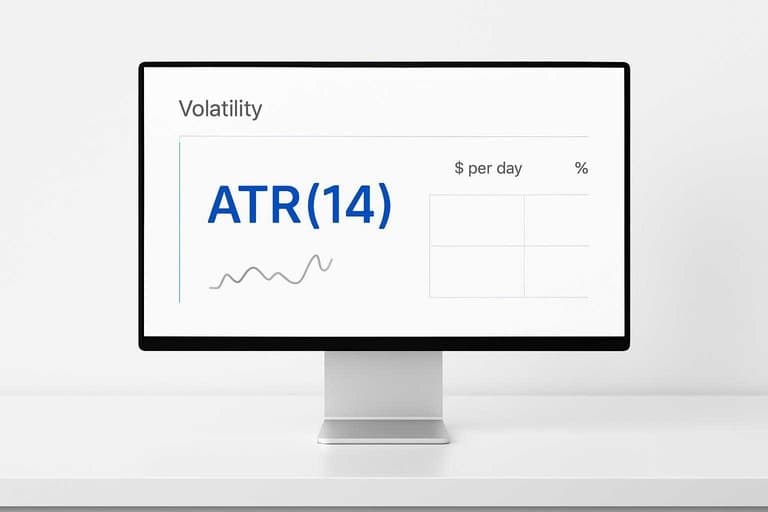
ATR answers “how many dollars per day,” which is a different question than “how many percent.” Mix those up and you’ll mis-rank breakouts.
- ATR(14) rises with price and range dollars
- ATR% falls when price rises faster
- True range spikes on gaps, not drift
- Cross-asset comparisons break without normalization
Pick the unit first, or your volatility screen lies.
Gamma of price moves
Markets don’t move in continuous math. They move in ticks, prints, and rounding.
A one-tick change is fixed in dollars, but it shrinks in percent as price rises. Yet your execution cost, spread, and minimum stop distance still respect ticks.
That mismatch creates nonlinear sensitivity: breakouts can look “smooth” in % terms while still being mechanically chunky.
Microstructure Amplifiers
High nominal prices don’t just “feel” different. They change how the order book transmits pressure into prints, especially during breakouts. The same intent can create bigger gaps, sharper wicks, and faster volatility regimes.
Spread and depth
A $300 stock can show a 5–20¢ spread and still look “tight” in percentage terms. In dollars, that’s real friction, and it raises the minimum jump size you’ll see on the tape.
When depth is thin near the touch, a marketable order clears one level, then the next. Prints look jumpy because price must hop across discrete quote levels, not glide. Breakouts then appear as fast stair-steps, not smooth ramps.
If your entries depend on clean triggers, spread-driven granularity is the hidden tax. (See the SEC’s overview of minimum quoting increments for the tick-size mechanics behind this.)
Lot-size constraints
High price shrinks your share count, and that changes execution shape. Your “same dollar risk” becomes a different microstructure event.
- Buy fewer shares per $10k notional
- Trigger more odd-lots at the top
- Receive more partial fills on sweeps
- Move the quote with smaller size
- Pay more slippage per share
If fills start fragmenting, you’re trading the matching engine, not the chart.
Stop clustering dynamics
Stops concentrate where humans and systems agree on “obvious” levels. Round numbers, prior highs, and whole-dollar pivots become magnets in high-priced names.
Once price tags that level, sweep orders can remove several resting layers at once. The book thins, prints gap, and volatility arrives in bursts instead of a steady climb. That’s why high-price breakouts often look like a snap, then a pause.
If you see sudden air pockets, you’re watching stop inventory get converted into momentum.
Options Pinball Effects
High-priced stocks tend to have dense option open interest at clean, round strikes. That makes dealer hedging flows big enough to matter, especially during breakouts. You’ll feel it as either a “magnet and snap” move or a slow grind that won’t die.
Dealer hedging loop
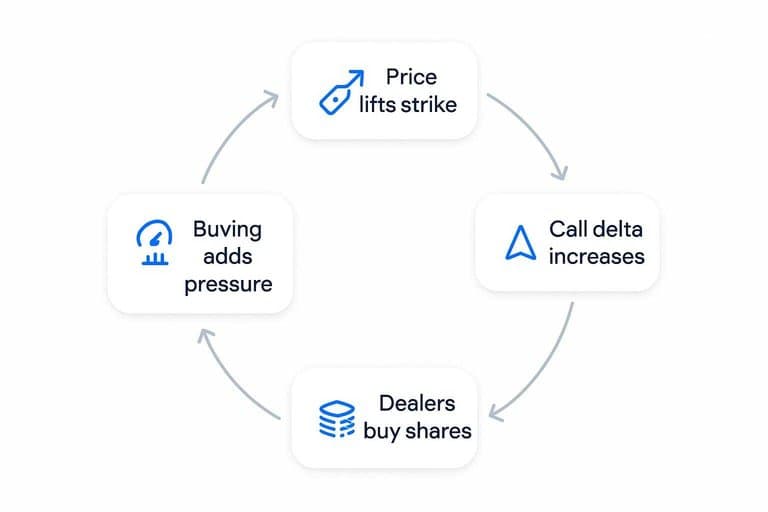
In high-price names, a breakout can become a hedging feedback loop. When customers buy calls, dealers often get short those calls and hedge by buying shares as delta rises.
During an upside break:
- Price lifts through a strike.
- Call delta increases.
- Dealers buy more shares to stay hedged.
- Their buying adds pressure.
That’s how a clean breakout turns into a sudden acceleration, not “organic momentum.”
Gamma zones list
You can usually spot the regime by how price behaves near big strikes. Watch the tape, not the theory.
- Positive gamma: price snaps back to strikes.
- Positive gamma: ranges compress after spikes.
- Negative gamma: price runs away from strikes.
- Negative gamma: ranges expand into the close.
- Negative gamma: dips get sold faster.
If you see range expansion after crossing a major strike, dealers may be chasing, not damping.
Charm and vanna
Delta doesn’t change only with price. It also shifts with time decay (charm) and implied volatility (vanna), which can dominate late in the day.
Near a breakout level, charm can quietly reduce delta as expiration approaches. Dealers may sell shares into strength just to keep the hedge flat.
Vanna can flip the script when implied volatility drops on a breakout. Call deltas can fall as vol collapses, forcing dealers to unwind buying and triggering a sharp reversal.
If the move “dies for no reason” at 3:30, check time and vol before blaming sentiment.
Volatility Pattern Map
High-priced stocks often break out differently because each tick is larger and liquidity is more selective. Use this map to diagnose what you’re seeing on the tape and in the candles.
High-priced breakouts tend to repeat a few recognizable outcome patterns. The mechanism column tells you what’s actually driving the move.
| Breakout outcome | What it looks like | Internal mechanism | What to do next |
|---|---|---|---|
| Clean continuation | Tight pullbacks | Shallow supply, steady demand | Add on retests |
| Pop then fade | Big wick, close weak | Liquidity sweep, trapped chasers | Wait for reclaim |
| Grind-up breakout | Small candles, persists | Passive bids, thin offers | Size smaller, hold longer |
| Violent squeeze | Fast range expansion | Dealer hedging, forced covers | Use wide stops |
| Breakout stall | Flat top, no follow | Absorption at key level | Stand aside, reassess |
When the “look” and the mechanism line up, your trade management gets boring in a good way.
Use the Denominator First, Then Check the Feedback Loops
- Start by translating the breakout into multiple denominators: percent move, dollar move, and ATR multiples—then note which one makes the move look “large,” because that’s usually the one that drives behavior.
- Sanity-check microstructure: spreads, displayed depth, and lot/position-size constraints tell you whether the move is likely to gap, wick, or grind.
- Finally, look for options feedback: identify nearby gamma zones and whether dealer hedging, charm, or vanna could reinforce or fight the breakout.
- Use the volatility pattern map to classify what you’re seeing (trend, squeeze, whip, pin), then match risk controls to the pattern rather than the headline price level.
Frequently Asked Questions
What counts as a “high stock” in breakout trading—$100, $500, or $1,000+?
In practice, “high stocks” usually means names priced $200+ where tick size, share affordability, and options liquidity start to noticeably change breakout behavior. Many traders treat $500+ as the threshold where these effects become consistently pronounced.
Do high stocks break out more reliably than low-priced stocks?
Not usually—high stocks often produce cleaner levels but more complex follow-through because liquidity and hedging flows can dominate the move. Reliability improves when volume expansion and market-wide momentum confirm the breakout.
How can I compare breakout volatility between high stocks and lower-priced stocks without getting misled by the price level?
Use normalized metrics like ATR% (ATR divided by price), realized volatility, and dollar-volume rather than raw point moves. For intraday, compare move size in basis points and spread as a percent of price to put both on the same scale.
Should I size positions differently for high stocks during breakouts?
Yes—most traders risk-manage in dollars and size by stop distance (e.g., ATR-based) so a $20 move in a $800 stock doesn’t unintentionally become oversized risk. A common approach is fixed % account risk per trade (like 0.25%–1%) divided by the planned stop in dollars.
How long do breakout moves in high stocks typically take to play out—minutes, days, or weeks?
Intraday breakouts often resolve within 30–120 minutes around key liquidity windows (open, close), while swing breakouts usually show confirmation or failure within 3–10 trading days. If a breakout hasn’t expanded range/volume within that window, it often turns into a range instead of trending.
Find Better Breakout Leaders
High-float stocks can mute or reshape breakout volatility, so the real edge comes from spotting leadership and regime context before the move starts.
Open Swing Trading helps you scan ~5,000 stocks with daily RS rankings, breadth, and sector/theme rotation so you can build tighter breakout watchlists—get 7-day free access with no credit card.
Sources
- SEC — FAQ re: Rule 612 (Minimum Pricing Increment) of Regulation NMS (Sub-Penny Rule) — referenced in Spread and depth