Institutional Ownership vs Price Action: Which Defines Institutional Stocks?
A clear comparison of institutional ownership vs price action for identifying institutional stocks—how to read ownership filings and revision cycles, spot “institutional footprints” in charts and volume, weigh pros/cons in a head-to-head table, and apply a hybrid framework with a practical checklist.
Institutional Ownership vs Price Action: Which Defines Institutional Stocks?
A clear comparison of institutional ownership vs price action for identifying institutional stocks—how to read ownership filings and revision cycles, spot “institutional footprints” in charts and volume, weigh pros/cons in a head-to-head table, and apply a hybrid framework with a practical checklist.
A stock can show 80% institutional ownership and still trade like dead money—while another breaks out on heavy volume before any filing data catches up. So which lens actually defines an “institutional stock” for you?
In this comparison, you’ll see what ownership data can and can’t tell you, what price action reveals about real-time demand, and how to resolve conflicts when the signals disagree. You’ll walk away with a hybrid decision framework and a simple rubric to screen, validate, and act with fewer false positives.
Define the Two Lenses
“Institutional stock” can mean two different things, depending on your lens. You can define it by reported ownership, or by how the stock trades day to day. The choice matters, because each lens answers a different question: “Who holds it?” versus “Who is actively supporting it?”
A common misconception is that one lens is “true” and the other is “noise.” In practice, they’re complementary signals with different failure modes, and your job is to pick the one that fits your time horizon.
What “Institutional” Means
Institutional usually means banks, mutual funds, pensions, endowments, hedge funds, and insurance firms. They don’t just buy; they shape liquidity, control float, and set the marginal price in many names. When a few large holders control a meaningful chunk of the float, the stock behaves differently.
For traders, “institutional” often implies tighter spreads, cleaner trends, and repeatable volume patterns. For long-term investors, it can imply governance pressure and capital stability, or crowded risk when everyone owns it. The label matters because it changes your expectations for volatility, execution, and downside when the bid disappears.
Ownership Data Basics
Ownership data is useful, but it’s not a live feed. It’s a lagging map with blind spots, and you need to know where it lies.
- Treat 13F filings as delayed snapshots
- Watch fund mandates and style drift
- Expect index adds to force buying
- Account for survivorship and coverage gaps
- Separate voting power from economic exposure
If you trade the tape, stale ownership can be a comfort blanket, not a signal.
Price Action Basics
Price action is the market’s continuous vote, not a quarterly report. It shows trend, volatility, volume pressure, and relative strength versus a benchmark. It also reveals accumulation and distribution, even when filings are quiet.
Institutions often can’t hide their footprint when they build or unwind size. Price can lead fundamentals and filings because the market sniffs out change before it’s disclosed. If you see persistent strength on heavy volume, someone is doing work.
Core Question Framed
You’re deciding which evidence you’ll treat as primary when you call a stock “institutional.” Make that decision explicitly, or you’ll flip-flop when trades get uncomfortable.
- Define your horizon: weeks, months, or years.
- Pick your primary proof: ownership records or price/volume behavior.
- Choose your “fail state”: stale filings or noisy tape.
- Set your confirmation rule: require both, or allow either.
- Write the trigger that changes your mind.
The real edge comes from knowing which signal you’ll trust when they disagree.
Institutional Ownership Approach
Ownership data answers a specific question: who’s on the cap table, and how committed are they. It’s how you separate “held by everyone” from “owned with intent,” like seeing Fidelity Contrafund versus a pile of benchmark funds. Use it to infer sponsorship, not to predict next week’s candle.
Useful Ownership Signals
Ownership metrics matter because they reveal sponsorship quality, not just popularity. You’re looking for repeatable accumulation and credible holders, not a one-off headline stake.
- Track institutional % and its direction
- Measure top-holder concentration and stability
- Rank holder quality by mandate and turnover
- Watch new positions versus position trims
- Prefer a stable long-only base
High-quality sponsorship is boring and sticky, and that’s the edge.
When Ownership Misleads
Ownership can look “strong” while real demand is weak, because the plumbing lies. A stock can show big holders yet behave like nobody cares, especially around index events.
Common failure modes you should assume are in play:
- Stale 13F snapshots that miss fast selling
- Closet indexers that never act decisively
- ETF and benchmark flows that aren’t conviction
- Dark pool routing that hides true intent
- Derivatives exposure that never appears as shares
- Window dressing that fades after quarter-end
If the “buyers” can vanish without a thesis, you don’t have sponsorship. You have labeling.
Timeliness and Revisions
Reporting lag is the tax you pay for ownership clarity. You can still use filings, but you need rules that dampen false precision.
- Use a 2–3 quarter lookback, not one report.
- Compare consecutive quarters for persistence, not point-in-time size.
- Sanity-check implied flow using volume and price impact.
- Treat single-holder changes as noise until confirmed next quarter.
- Flag “new stakes” near quarter-end as provisional.
Your job is to detect trends in sponsorship, not to front-run paperwork.
Best Use Cases
Ownership shines when you’re making decisions where “who owns it” changes outcomes. It’s especially useful when your timeline is months, not days, and when governance matters.
Use it for:
- Long-horizon conviction and thesis durability
- Activism and governance risk mapping
- Liquidity planning for real position sizing
- Spotting crowdedness before it unwinds
When time is on your side, cap-table structure becomes a real signal.
Price Action Approach
Price action is your fastest read on who’s in control and how committed they are. When institutions build positions, the chart changes character, even before filings show it.
But charts also lie by omission. You’re seeing the tape, not the motives, so you need pattern discipline.
Institutional Footprints
Some price behaviors only show up when big money keeps buying without blowing out the price. You’re looking for repeatable, boring strength, not a one-day miracle.
- Break out on heavy volume
- Hold tight ranges after strength
- Pull back constructively on light volume
- Keep rising RS line
- Show persistent bid support
If you see three or more together, you’re likely tracking real accumulation.
False Positives
Charts can print “institutional-looking” moves for reasons that have nothing to do with steady demand. The trap is mistaking volatility for sponsorship.
A news spike can create a clean breakout that fails the next day. Low-float squeezes can look like accumulation, but it’s just forced buying. Buybacks can prop the bid without new outside demand. Mean-reversion chop can fake “support” that’s really indecision. Microcaps can be walked up, then rug-pulled.
If the move depends on a headline or a thin float, treat the chart like a stage set.
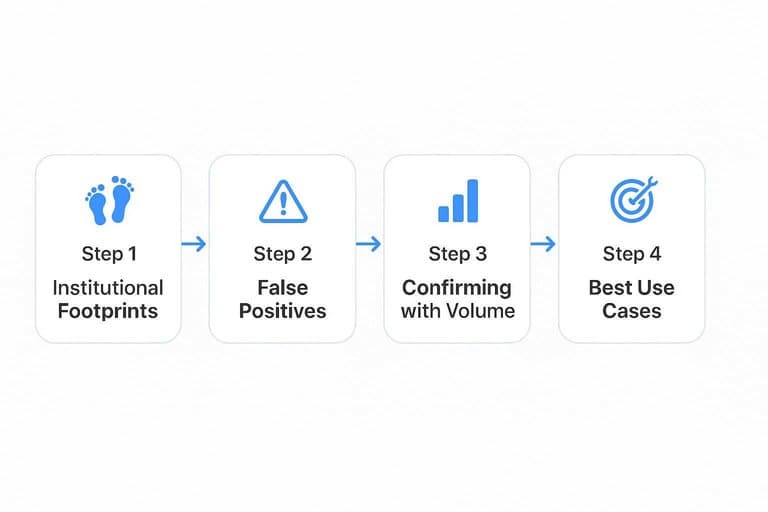
Confirming with Volume
Use volume as your lie detector, because institutions leave size behind. You don’t need perfection, just enough confirmation to avoid obvious traps.
- Compare today’s volume to the 50-day average, not yesterday.
- Check whether up days carry more volume than down days.
- Count recent distribution days, especially near highs.
- Compare the stock’s performance to its sector ETF, not the index.
When price and volume agree, you can size up with less guesswork.
Best Use Cases
Price action works best when you need decisions before the paperwork arrives. It gives you earlier signals, cleaner entries, and defined exits when the story gets messy.
It also adapts fast when regimes change, like when leadership rotates from growth to value. Your chart will reflect that shift long before ownership data settles.
Use it to act, then use ownership data to stay honest.
Head-to-Head Comparison
You can define an “institutional stock” two ways: by who owns it, or how it trades. Both work, but they answer different questions at different speeds.
Here’s how they compare across the decisions you actually make.
| Factor | Institutional ownership (13F, filings) | Price action (tape, volume) | Best use |
|---|---|---|---|
| Timeliness | Slow, lagged | Real-time, fast | Entry timing |
| Reliability | High, but stale | Medium, can fake | Confirmation |
| Signal-to-noise | Clean, filtered | Noisy, messy | Early clues |
| Costs | Data fees, tools | Free to low | Daily workflow |
| Data access | Harder, gated | Easy, ubiquitous | Broad scanning |
| Ideal profile | Fundamental, patient | Trader, tactical | Matching style |
If you need “who’s in,” use ownership. If you need “what’s happening now,” read the tape.
Hybrid Decision Framework
You need one framework that uses both ownership and price action, without counting the same fact twice. The job is decision-making under conflict, not perfect classification.
Pick Your Goal
Choose the lens before you choose the signals. Screening needs speed, while entry timing needs precision, and those are different tools.
If you’re building a long-term position, credible holders matter more than today’s candle. If you’re avoiding crowded trades, ownership concentration and recent inflows are the real “don’t touch” alarm.

Sequence the Checks
Run the same order every time, so you don’t rationalize trades after the fact.
- Check liquidity and float, so you can actually exit.
- Check price and volume health, so the chart isn’t broken.
- Check ownership quality, so the buyers are real.
- Check catalyst and earnings context, so you know the regime.
- Set a risk plan, so the trade has a stop.
This sequence keeps “story” from outranking tradability.
Conflict Resolution Rules
Signals will disagree, and you need default rules before money is on the line.
- Strong price, weak ownership: trade it shorter, size down, demand tight risk.
- Strong ownership, weak price: wait for a base, then buy the first clean breakout.
- Strong price, no ownership data: treat it as momentum, not “institutional.”
- Strong ownership, distribution volume: assume rotation, and avoid “dip buys.”
- Both strong, but crowded: require pullback entries, not breakouts.
Your edge comes from how you act in conflicts, not when everything aligns.
Minimum Evidence Threshold
Use a two-of-three rule to avoid single-signal traps. You want trend or relative strength, accumulation-type volume, and credible ownership trends.
One signal can override the others in rare cases. A decisive earnings gap with heavy volume can override ownership, and a top-tier holder building a position can override a flat chart.
Investor Type Recommendations
Long-Term Investors
You’re underwriting a business, not a three-week tape. So start with who owns it and whether they tend to stay.
Look for stable, high-quality holders like long-only funds and patient insiders. Then require an entry you can live with, like a clean base, a reclaim of the 200-day, or a tight pullback after a breakout.
Ownership keeps you out of the flaky names, and price structure tells you when to actually deploy capital.
Swing/Position Traders
You get paid on movement, not on “great holders.” So lead with price action, relative strength, and volume that proves real demand.
Favor names making higher highs with rising RS, or breaking out of multi-week bases on above-average volume. Then sanity-check ownership to avoid thin floats, forced rebalances, and “every fund owns it” meltups.
Price tells you what’s happening now, and ownership helps you dodge the blowups.
Quant and DIY Screeners
If you screen systematically, you need signals that are measurable and tradable. Mix slower ownership data with faster price and volatility filters.
- Use 13F ownership change, lagged one quarter
- Filter by 6–12 month momentum
- Cap volatility with ATR or beta bands
- Require liquidity via dollar volume
- Flag concentration risk by top holders
Your edge dies fast if your data is stale, biased, or illegally sourced.
Overall Recommendation
Most readers should define “institutional” primarily by price action. It’s the only lens that updates every day and reflects real-time sponsorship.
Use ownership as a secondary qualifier and risk filter. It helps you avoid illiquidity, extreme concentration, and the “crowded exit door” problem.
Trade what you can see, then verify what you can’t.
Rubric and Checklist
You need a repeatable scorecard, not vibes, because institutional names can look “strong” right before they fail. Use this to separate real accumulation from temporary liquidity events.
One table. Fixed weights. Hard gates.
| Check | What to measure | Weight | Pass / Fail gate |
|---|---|---|---|
| Institutional demand (flow) | 3–4q net adds | 25% | Fail if net selling |
| Price action (trend) | 20/50/200D alignment | 25% | Fail if below 200D |
| Relative strength | vs index, 3–6m | 15% | Fail if lagging |
| Volume confirmation | up-volume dominance | 10% | Fail if drying up |
| Liquidity + float | ADV, float size | 10% | Fail if thin tape |
| Fundamentals sanity | rev/earnings inflect | 10% | Fail if collapsing |
| Event risk | earnings, lockups | 5% | Fail if binary |
Decision rule:
- Buy: No fails, and score ≥ 80.
- Watchlist: No fails, and score 60–79.
- Avoid: Any fail, or score < 60.
The gatekeepers matter more than the total, because one hard fail can erase five soft wins.
Use Both Lenses to Make a Decision You Can Defend
Treat institutional ownership as the “who might be involved” layer and price action as the “is it acting like it now” proof. Start with your goal (long-term quality vs timed entry), require a minimum evidence threshold from your primary lens, then use the other lens to confirm—or to veto when signals conflict. When ownership is high but the chart is deteriorating, assume distribution or staleness; when price action is strong but ownership is unclear, assume early accumulation and demand stricter volume/relative strength confirmation. Apply the rubric and checklist consistently, and you’ll classify institutional stocks by behavior and evidence—not by a single lagging metric.
Frequently Asked Questions
Does high institutional ownership automatically make a stock an institutional stock?
No. High ownership can be a legacy position or index/ETF-driven exposure, so most traders also look for confirmation in price/volume behavior (e.g., breakouts holding above key levels with strong relative strength).
What percentage of institutional ownership is considered “good” for institutional stocks?
Many investors use 30%–70% as a practical “sponsored but not crowded” range, with the most useful signal being an upward trend in ownership over 2–4 quarters rather than a single snapshot number.
How can I tell if institutional buying is happening in real time without waiting for 13F filings?
Watch for abnormal volume (often 2x+ the 50-day average) paired with strong closes and improving relative strength versus the market/sector; tools like TradingView, MarketSurge, and volume/RS indicators help flag it daily.
Are ETFs and index funds inflating institutional ownership numbers for institutional stocks?
Yes. Passive funds can boost institutional ownership without “active conviction,” so it’s smart to separate passive holders from active managers and focus on concentration, new positions, and ownership changes across quarters.
What results should I expect from focusing on institutional stocks—higher returns or lower risk?
Usually you get better liquidity and fewer extreme gaps, but not guaranteed outperformance; a realistic goal is improving your hit rate on breakouts and reducing false signals by confirming demand with both sponsorship and price action.
Spot Institutional Leaders Earlier
Balancing ownership data with price action is powerful, but keeping that hybrid checklist current across thousands of stocks is the real challenge.
Open Swing Trading streamlines the process with daily relative strength rankings, breadth, and sector/theme rotation context so you can surface breakout leaders faster—get 7-day free access.