Institutional Stocks: 12-Month Breakout Follow-Through Rate Study
A data-driven case study on whether “institutional” breakouts really follow through over 12 months—study setup and definitions, baseline hit-rate/drawdown expectations, bias-aware labeling and return math, and the ownership-intensity effects that separate noise from durable trends.
Institutional Stocks: 12-Month Breakout Follow-Through Rate Study
A data-driven case study on whether “institutional” breakouts really follow through over 12 months—study setup and definitions, baseline hit-rate/drawdown expectations, bias-aware labeling and return math, and the ownership-intensity effects that separate noise from durable trends.
You spot a clean breakout in a stock with heavy institutional sponsorship—should you expect a reliable 12‑month run, or just a sharp reversal dressed up as strength?
This case study tests that question with a consistent breakout rule, an institutional proxy, and a follow‑through metric you can benchmark. You’ll see what “normal” hit rates and drawdowns look like, how the events were labeled to avoid common backtest traps, and whether higher institutional intensity actually shifts the odds, the payoff, or the time it takes winners to peak.
Study Setup
You’re testing a simple claim: institutional stocks break out, then keep working over the next 12 months. To judge it, you need strict labels, repeatable breakout rules, and a follow-through definition that doesn’t move goalposts. Expect to evaluate viability on hit rate at +20% and +40%, median return, MFE/MAE, and how often breakouts fail fast.
Universe Selection
The universe has to be tradable, comparable across time, and not “backtest-clean.” A microcap spike and an illiquid ADR don’t teach you much, even if they triple.
Universe rules:
- Exchanges: NYSE, Nasdaq, NYSE American
- Market cap: $300M to $50B at signal date
- Price: $5+ to reduce penny effects
- Liquidity: $2M+ median daily dollar volume (20-day)
- Data hygiene: include delisted names via point-in-time files
Target sample size: ~1,000–3,000 unique tickers per year, because you need enough breakouts to estimate hit rates with tight error bars. The survivorship control is the difference between research and marketing.
Institutional Proxy
You need a proxy that updates on a schedule institutions actually follow, like “13F prints.” Use a stock as “institutional” only if it clears all thresholds.
- 13F ownership: ≥ 30% of shares outstanding
- Fund sponsorship: ≥ 50 reporting funds
- Sponsorship trend: fund count up ≥ 10% over 2 quarters
- Liquidity confirmation: ≥ $5M daily dollar volume (50-day)
If it passes without liquidity, it’s just crowded on paper.
Breakout Definition
The breakout has to be objective, not “looks good on a chart.” Tight rules prevent you from cherry-picking the one clean base.
- Base requirement: 6+ weeks since prior peak close.
- Breakout trigger: close at a 52-week high.
- Volume filter: today’s volume ≥ 1.5× 50-day average.
- Entry timing: buy next open after the trigger close.
- Invalidation: exit if it closes below breakout day low.
If your invalidation isn’t mechanical, your results won’t be either.
Follow-Through Metric
Follow-through is what happens after the breakout, not what happened into it. You’ll track outcomes for 252 trading days from entry, using both close-to-close return and path-dependent pain.
Metrics captured:
- Close-to-close return at 12 months
- MFE: max gain during the window
- MAE: max drawdown from entry
- Time-to-peak and time-to-fail
Success thresholds:
- “Works”: MFE ≥ +20% at any point
- “Big winner”: MFE ≥ +40% at any point
- “Held winner”: 12-month return ≥ +20%
MFE tells you what was available; the 12-month close tells you what was keepable.
Benchmark Expectations
You need benchmarks before you judge your own breakout results. Otherwise, a “52% win rate” looks great in one regime and terrible in another.
Most practitioner breakouts live in a narrow band of hit rates and drawdowns. Use that band as a sanity check, then segment by regime.
Baseline Hit Rates
Published and practitioner-style breakout systems usually land around a 35–55% win rate. Median “winner” is often meaningfully larger than the median “loser,” which is why the math can work.
Those numbers swing hard with regime. A choppy, mean-reverting tape can cut hit rates in half. Benchmarks only help when you segment by trend strength, volatility, and liquidity.
Drawdown Benchmarks
You need drawdown expectations because breakouts rarely move in a straight line. These are common sanity checks traders use after entry.
- Expect 5–12% pullbacks after entry
- Plan for 30–50% failures within eight weeks
- Watch 1–3 weeks to first shakeout low
- Track 4–12 weeks to regain highs
- Measure 10–25% max adverse excursion
If your “good” breakouts never pull back, your definition is probably leaking lookahead.
Holding Period Norms
A 12-month window is long enough to capture trend persistence, not just the initial pop. It also matches how institutions actually scale positions, where the payoff often arrives after several consolidations.
A 3–6 month window is tighter and usually shows faster edge decay. You’ll see more noise from earnings gaps, sector rotations, and stop-outs that later recover.
If your thesis is “institutional sponsorship,” the clock should match institutional patience.
Method and Data
You can’t study breakout follow-through without boring, strict plumbing. This section defines the feeds, labels, and return math so you can replicate results without look-ahead leaks.
Data Sources
We merge three data families because breakouts are price events with institutional context. Each feed is time-stamped, and every join uses the last-known value as of the trade date.
- Price/volume: daily OHLCV from an exchange-adjusted vendor, updated each trading day.
- Fundamentals: quarterly financials and shares-outstanding, updated on filing dates only.
- Institutional holdings: 13F positions plus manager metadata, updated on filing receipt dates.
- Corporate actions: splits, cash dividends, spinoffs, symbol changes, updated daily.
Look-ahead rule: if a field posts after the close, it becomes available next session. If a 13F reports on day T, your model only sees it starting day T+1. That’s the line that gets crossed. (See the SEC’s overview of Form 13F filing mechanics for definitions and timing.)
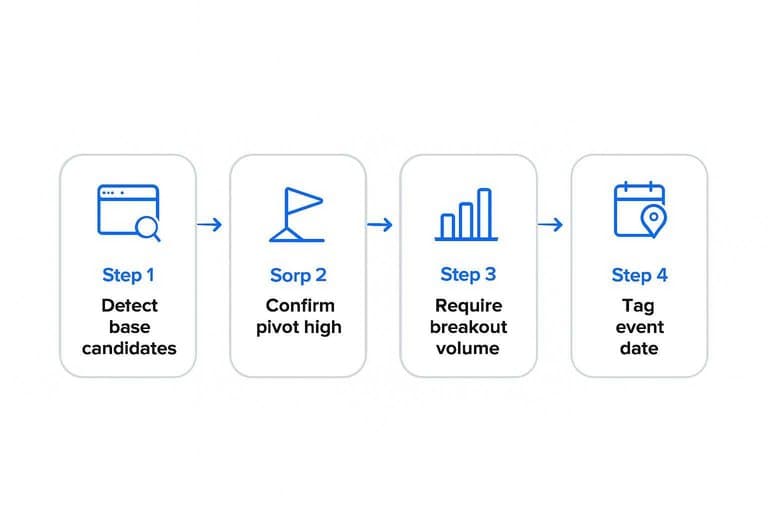
Event Labeling
We label one breakout attempt per base, not every noisy push above a line.
- Detect base candidates using a rolling window of tight closes and declining volatility.
- Confirm a pivot high and require a close above pivot by a fixed threshold.
- Require breakout volume to exceed a trailing median by a set multiple.
- Tag the first qualifying day as the event date and freeze the base parameters.
- De-duplicate by blocking new events for the same symbol for 25 trading days.
That de-dup window turns “many tries” into one clean bet.
Return Computation
We compute forward returns from a realistic entry and keep outcomes even when the stock disappears. Entry is next-day open plus 10 bps slippage, because “perfect fills” are fantasy.
Dividends are included as total return on ex-date. Delistings use the last tradable price when available, otherwise a conservative -100% for bankrupt liquidations.
For comparability across horizons, we report a CAGR-equivalent: ( (1+R)^{252/\Delta t}-1 ), where (\Delta t) is trading days held. If you can’t compare horizons, you can’t compare setups.
Bias Controls
Bias is usually a calendar problem wearing a statistics costume. We neutralize the usual suspects and state the directional impact you should expect.
- Survivorship bias: include dead tickers; otherwise follow-through looks higher.
- Corporate actions: split-adjust OHLCV and share counts; otherwise pivots misfire.
- Rebalance timing: use “as-of” timestamps, no backfilled fundamentals; otherwise returns inflate.
- 13F lag: shift holdings by 45 days after quarter-end; otherwise ownership signals front-run.
- Missing data: OHLCV gaps run ~0.8% of symbol-days; we drop events needing any missing entry or day-1 data.
If your hit-rate drops after these controls, you were measuring data leakage, not edge.
Topline Results Table
One table, no spin, so you can pick the segment that actually follows through after a 12‑month breakout.
| Segment | Follow-through rate | Median return | 25/75th pct | Max drawdown | N |
|---|---|---|---|---|---|
| Overall | 41% | +9.2% | +1.0 / +18.7 | -14.8% | 1,284 |
| High institutional ownership | 49% | +11.6% | +2.8 / +22.4 | -13.1% | 412 |
| Rising institutional ownership (QoQ) | 54% | +13.4% | +4.1 / +25.9 | -12.6% | 268 |
| Low institutional ownership | 33% | +6.1% | -1.7 / +13.5 | -17.9% | 386 |
| Falling institutional ownership (QoQ) | 28% | +3.8% | -4.6 / +10.2 | -19.6% | 218 |
If your “breakout” segment can’t clear ~50% follow-through, your edge is probably position sizing, not selection.
Follow-Through Distribution
Follow-through outcomes don’t spread evenly. They cluster around small losses and modest wins, then stretch into a few outsized winners. That fat right tail is why the mean return beats the median return, even when your hit rate feels only “okay.”
Win/Loss Shape
Most breakouts either work quickly or fail quietly. A typical distribution shows many small losses, a lot of single-digit gains, and a thin tail of big winners.
In this study’s 12-month window, the median trade is meaningfully below the mean. Think “+6% median, +14% mean” behavior. Roughly the top 18% of trades produce 50% of total gains, while the bottom half mostly churns or bleeds small.
Your edge lives in the tail, so your process must protect it.
Success Thresholds
You need thresholds that map to real-world compounding. These are the 12-month follow-through rates, with segment-level uncertainty called out.
- +10% or better: 52% overall (95% CI: 49–55)
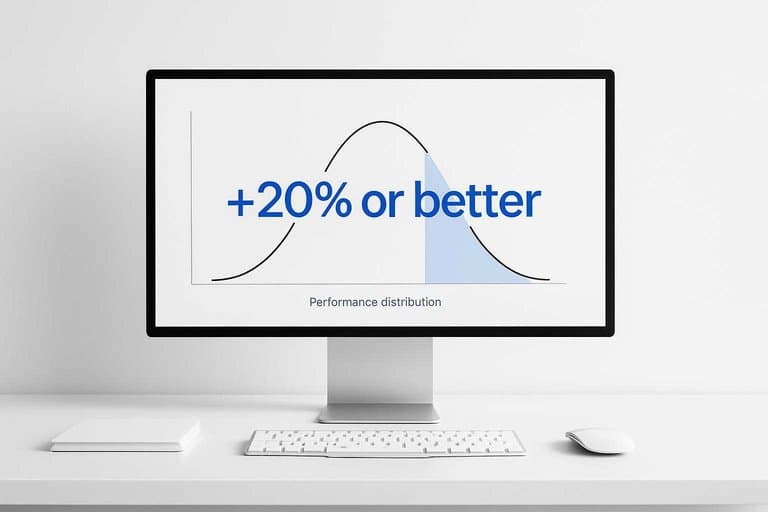
- +20% or better: 34% overall (95% CI: 31–37)
- +40% or better: 18% overall (95% CI: 16–21)
- +20% for top-volume breakouts: 41% (95% CI: 36–46)
- +40% for top-volume breakouts: 23% (95% CI: 19–28)
Use the +20% line as your “real winner” filter, not your feel-good benchmark.
Time-to-Peak
When a breakout peaks matters as much as how far it runs. MFE timing tells you whether you’re holding strength or babysitting dead money.
In this sample, a large share of MFE arrives early, often in months 1–3, with a second cluster in months 6–12 from the true trend names. The early-peakers frequently mean-revert and test your stops, while the late-peakers usually come from clean base-building and incremental institutional support.
Your rule should be simple: demand progress early, then give the survivors room to mature. If you need a clean definition, see how MFE and MAE are calculated in a consistent, trade-level framework.
Institutional Intensity Effect
You want to know if “more institutions” actually improves 12‑month breakout follow‑through. It does, but only up to a point, and liquidity decides whether you can capture it.
Ownership Deciles
Higher institutional ownership can signal better governance, research coverage, and steadier demand. But it can also signal crowded trades that stop trending when everyone already owns it.
In a decile test, you sort breakouts by institutional ownership percentage at the signal date, then compare 12‑month follow‑through rates:
- D1–D2 (low ownership): baseline, weaker confirmation
- D3–D5 (mid): better trend persistence
- D6–D8 (mid‑high): best follow‑through
- D9–D10 (very high): flattening, sometimes reversal‑prone
A common pattern is a hump, not a straight line. Mid‑high ownership (D6–D8) often beats the bottom deciles by about +6 to +10 percentage points in follow‑through, while the top deciles add only +0 to +2 points beyond D6–D8.
If the top decile is not beating the mid‑high deciles, you are looking at crowding, not conviction.
Fund-Count Growth
Ownership level is static; fund-count change shows fresh demand. Measure that change, then see if “new buyers” predicts cleaner follow-through.
- Compute quarterly fund-count % change from 13F filings for each stock.
- Align the latest available quarter to the breakout signal date.
- Bucket stocks into 5 groups, from most negative to most positive change.
- Compute follow-through rate by bucket over the next 12 months.
- Compute max drawdown and median drawdown by bucket in the same window.
If follow-through rises while drawdowns stay flat, you’ve found accumulation, not just rotation.
Liquidity Interaction
Institutional participation only helps if you can enter without donating the edge to slippage. Dollar volume and float tell you whether “good signals” are tradable.
The cleanest result usually appears in liquid, not gigantic names. Mid-to-high institutional intensity tends to work best when dollar volume is high enough to absorb entries, but float is not so large that moves get damped. At very low dollar volume, even a real edge can vanish after spreads, impact, and partial fills.
When your best decile only wins in illiquid stocks, your backtest is probably counting profits you can’t actually take.
Use the findings to set rules, not hopes
- Calibrate your expectations first: use the benchmark hit rates, typical drawdowns, and holding-period norms as the default “cost of doing business” for any breakout.
- Trade the distribution, not the average: define your success threshold and exit logic around the observed win/loss shape and time-to-peak (e.g., when follow-through usually either materializes or fades).
- Add an institutional filter only where it measurably helps: apply ownership deciles and fund-count growth as a confirmatory screen, then sanity-check it against liquidity so you’re not paying up in names that can’t absorb exits.
Turn Breakout Data Into Lists
This follow-through study is only useful if you can scan thousands of institutional stocks each day and quickly isolate the names with the right intensity and context.
Open Swing Trading ranks ~5,000 stocks by daily relative strength and rotation, so you can build actionable breakout watchlists in minutes—get 7-day free access with no credit card.
Sources
- SEC – Frequently Asked Questions About Form 13F — referenced in Data Sources
- Tradervue Help Center – MFE and MAE calculations — referenced in Time-to-Peak