Institutional Stocks Explained for Breakout Beginners
An explainer on institutional stocks for breakout beginners—learn who institutions are, how accumulation and bases set up breakouts, which volume/price clues signal demand, and how to use a simple checklist while avoiding common traps.
Institutional Stocks Explained for Breakout Beginners
An explainer on institutional stocks for breakout beginners—learn who institutions are, how accumulation and bases set up breakouts, which volume/price clues signal demand, and how to use a simple checklist while avoiding common traps.
If you’ve ever watched a stock explode out of nowhere, it probably wasn’t random—it was money moving. The hard part as a beginner is knowing whether you’re seeing real institutional demand or just noise that fades the next day.
This explainer gives you a clean breakout mental model, the specific price/volume clues institutions tend to leave behind, and an easy checklist to vet setups. You’ll also learn the most common beginner traps so you can protect your capital while you build pattern recognition.
Institutional Stock Basics
Institutional stocks are names where big, professional pools of money drive a meaningful share of daily action. Think of a fund building a position in a liquid leader, not a lone trader hitting “buy” on a whim.
They behave differently because institutions must move size without moving price too fast. That constraint shapes volume, volatility, and the slow “grind” you often see before a breakout.
Who counts as institutional
Institutions are professional investors managing other people’s money, so their decisions are slower and their trades are larger.
- Mutual funds managing diversified portfolios
- Pension funds matching long liabilities
- Hedge funds running concentrated bets
- Insurance companies investing premium float
When you see repeated large volume in a stable name, that’s often their footprint.
Why size changes price
A big buyer can’t just place one giant order without spiking the price. They need liquidity, patience, and execution tactics that spread demand over time.
In practice, they split orders into smaller pieces, route across venues, and keep buying on dips for days or weeks. That process can create support levels, persistent volume, and “it won’t go down” price behavior.
Your edge is recognizing the accumulation phase before the obvious breakout.
Not a special ticker
“Institutional stock” isn’t a formal label like NYSE vs. Nasdaq. It’s a description of ownership and attention.
A stock becomes “institutional” when funds hold a lot of it, can trade it efficiently, and care about it enough to keep defending positions. The same ticker can shift in and out of that spotlight over time.
Treat it like a behavior pattern, not a category you’ll find on an exchange page.
What beginners can do
Start with safety and observation, not prediction.
- Focus on liquid leaders with consistent daily volume.
- Avoid thin floats and low-volume small caps.
- Watch price and volume for two weeks before trading.
If you can’t read the footprints, you’re not ready to follow the steps.
The Breakout Mental Model
Institutions can’t buy a meaningful position in one clean print. They accumulate over time, price action tightens, and the eventual breakout releases stored demand like a coiled spring. Think: weeks of quiet bids, then one day the stock says, “I’m done waiting.”
Accumulation vs distribution
Accumulation is sustained buying that gets hidden inside a sideways base. Distribution is sustained selling that shows up as failed pushes and heavier down days.
In accumulation, dips get bought quickly and volatility shrinks. In distribution, rallies get sold into and peaks start to flatten. Same chart shape at first. Different intent.
Your job is to spot who keeps “showing up” when price tests the edges.
Base as agreement zone
A base is an agreement zone where buyers and sellers temporarily balance. It matters because big money needs time to transact without moving price too far.
You’ll often see tighter closes, repeated support tests, and fewer wide-range days. Volume can drift lower, then pop on specific up days. The base becomes a reference point: “fair value,” until it isn’t.
When agreement ends, the move tends to be fast.
Breakout as imbalance
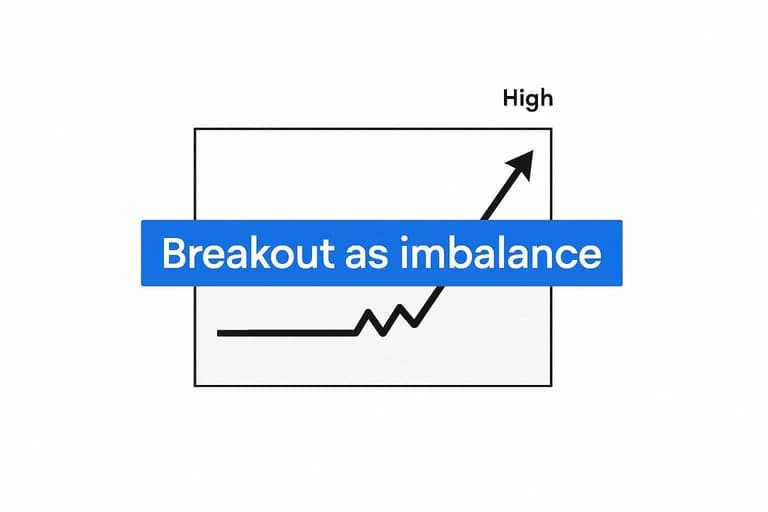
A breakout is price escaping a range with real participation. It often reflects urgency from large players who can’t wait for pullbacks.
- Closes above the range high
- Expands range and volatility
- Rises on higher volume
- Holds gains into the close
- Pulls back shallow, if at all
If participation is missing, you’re watching hope, not demand.
Failure as information
A failed breakout is supply showing up where demand was supposed to overwhelm it. It usually means buyers weren’t big enough, weren’t early enough, or got crowded.
You’ll see a push above the range, then a quick fade back inside. Sometimes it undercuts support and keeps sliding. That’s not “bad luck.” It’s the market telling you your thesis lacked fuel.
Treat failures like diagnostics, not prophecies.
How Institutions Leave Clues
Institutions can’t buy a breakout stock quietly. Their size leaves footprints in price and volume, even if you never see the buyer.
You’re looking for behavior that says “accumulation,” not a perfect indicator.
Volume and range
Volume and daily range show you who’s in control and how urgent they are. You want strong demand on advances, then calm selling on pullbacks.
- High-volume up days, closing strong
- Low-volume pullbacks, drifting down
- Wide range on breakouts, then stabilizing
- Tight ranges on quiet days, near highs
- Big volume on gains, not on dips
If volume expands on up moves and dries up on dips, bigger money is likely supporting price. For a beginner-friendly definition of this, see Fidelity’s guide to accumulation/distribution.
Tight closes matter
A close near the high after an intraday dip often signals support. Sellers pushed, buyers absorbed, and price finished strong.
Think “they bought the dip and defended the close.” That’s controlled selling pressure, not panic.
When that repeats a few times, you’re seeing a stock being accumulated, not just traded.
Relative strength lens
Relative strength is how your stock performs versus the market or its sector. If the market is flat and your stock grinds up, that’s a tell.
Institutions prefer leaders because leadership attracts more capital. Strong relative strength often becomes a self-reinforcing loop.
Your job is to focus on what’s being bought, not what “should” bounce.
Support and resistance
Marking key levels keeps you from guessing during fast moves.
- Draw a line at prior swing highs.
- Mark the top of the most recent base.
- Circle areas with three or more bounces.
- Note gaps where price moved fast.
- Recheck levels on higher timeframes.
If price respects a level repeatedly, that level is now a decision point for big money.
A Beginner’s Stock Checklist
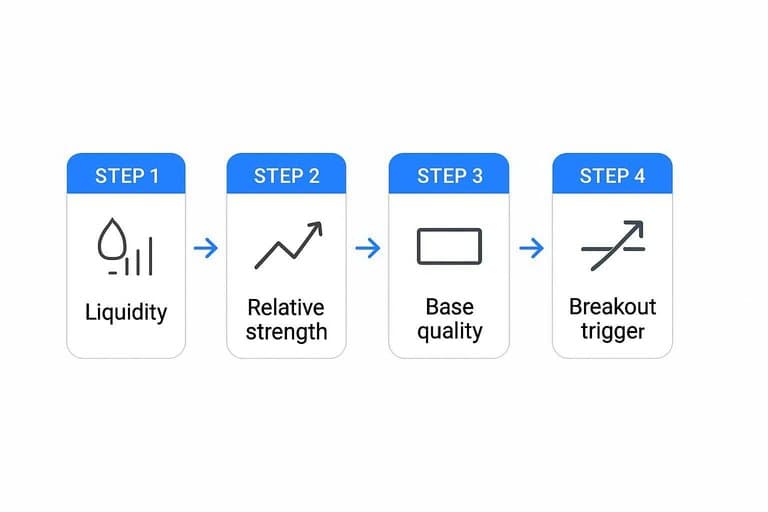
You need a repeatable filter that finds institutional-style breakouts without turning into a fragile rulebook. Use this checklist to qualify candidates, then let price action make the final call.
| Checklist item | What “good” looks like | Quick check | Common trap | |—|—|—| | Liquidity | Tight spreads, deep volume | Avg volume rising | Illiquid “storybook” chart | | Relative strength | Outperforming your watchlist | RS line near highs | Buying laggards “cheap” | | Base quality | Calm pullbacks, clean range | 6–12 weeks tight | Choppy, wide swings | | Breakout trigger | Clear pivot, obvious level | Breaks on volume | Front-running early | | Risk plan | Defined stop, small loss | Stop below support | No stop “to be safe” |
If three boxes are fuzzy, skip it and keep scanning.
Common Beginner Traps
You’re trying to ride “institutional” breakouts, but most losses come from the same few sloppy habits. Think of every trap as a filter you can add before you click buy.
- Buying the first green candle instead of the reclaim
- Calling any volume spike “institutional” without context
- Ignoring the daily level and trading a random intraday pop
- Chasing extended price instead of planning the pullback entry
- Using a wide stop because you didn’t define invalidation
Build a pre-trade checklist that blocks these by default, or you’ll keep paying tuition.
Put the Model to Work on Your Next Chart
- Start with the mental model: look for a clear base (agreement zone), then wait for evidence of imbalance (breakout) rather than guessing early.
- Confirm with clues: expanding volume and range, tight closes near highs, and relative strength versus the market/peers.
- Use the checklist to qualify the setup and define risk (near support/resistance), then cross-check the traps list before you place the trade.
- Treat failures as data: if the breakout reverses quickly, note what was missing and refine your criteria instead of chasing the next candle.
Frequently Asked Questions
Are institutional stocks the same as “smart money” stocks?
Mostly, but not always. “Institutional stocks” typically means names with strong ownership and liquidity for funds, while “smart money” can also include insiders, hedge funds, and other informed buyers.
Do I need Level 2 data to trade institutional stocks breakouts?
No. Most beginners can trade institutional stock breakouts using daily price/volume, basic moving averages, and volume tools in platforms like TradingView or Thinkorswim.
How can I check institutional ownership for a stock?
Use sources like Nasdaq Institutional Holdings, Fintel, WhaleWisdom, or your broker’s fundamentals tab to review % institutional ownership and recent 13F activity.
How long does it usually take for an institutional stock breakout to play out?
Most breakouts show their “tell” within 1 to 3 weeks after the breakout, while bigger winners often trend for 2 to 6 months if the market and sector stay supportive.
What can I do if I don’t have a large account—can I still trade institutional stocks?
Yes. Focus on liquid institutional stocks or ETFs with tight spreads and use position sizing and stop-loss rules so your dollar risk per trade stays small (often 0.5% to 1% of your account).
Turn Clues Into Watchlists
Spotting institutional footprints and avoiding beginner traps is easier than turning that insight into a repeatable, breakout-ready routine every day.
Open Swing Trading streamlines institutional-stock selection with daily RS rankings, breadth, and sector/theme rotation context—so you can build a focused watchlist in minutes. Get 7-day free access with no credit card.
Sources
- Fidelity — Accumulation/Distribution technical indicator guide — referenced in Volume and range