Mark Minervini explained for discretionary swing traders
A clear explainer of Mark Minervini’s swing-trading approach—use the market-first lens, the VCP (Volatility Contraction Pattern), relative strength selection, asymmetric entries with tight risk, and sell rules that cut losses fast while letting leaders run.
Mark Minervini explained for discretionary swing traders
A clear explainer of Mark Minervini’s swing-trading approach—use the market-first lens, the VCP (Volatility Contraction Pattern), relative strength selection, asymmetric entries with tight risk, and sell rules that cut losses fast while letting leaders run.
If your swing trades feel like coin flips, it’s usually because your process doesn’t force asymmetry—you’re risking too much to make too little, in the wrong market, on the wrong kind of stock.
Minervini’s framework is a discretionary system that’s still rules-driven: filter for the right environment, target true leaders, wait for contraction-and-volume clues, and define the pivot, stop, and sell plan before you click buy. This explainer translates the method into decisions you can apply immediately.
Who Minervini Is
Mark Minervini is a discretionary swing trader who treats rules like guardrails, not guesses. If you want “when X happens, do Y,” his work fits.
Discretion, not guessing
Discretionary swing trading is structured decision-making, using price and volume as evidence. You still use rules, but you apply them to what the chart is doing, not what you hope it will do.
Think: “No breakout, no buy,” even if the story sounds great. That’s discretion with discipline.
Core promise
Minervini’s promise is simple: ride the strongest uptrends, then cut risk fast when you’re wrong. You aim for asymmetric trades, where small losses fund a few big winners.
It shows up as tight entries, tight stops, and zero tolerance for “I’ll give it room.” That’s how you stay in the game long enough to catch the real runs.
Key vocabulary
You need a shared language to execute, not just agree.
- VCP: volatility contraction pattern before a breakout.
- Pivot: the breakout trigger price.
- Tightness: narrow closes, low volatility.
- RS: relative strength versus a benchmark.
- Base: consolidation area that resets supply.
- Selling into strength: scaling out during rapid price extension.
If you can define these quickly, you can act quickly.
The One Mental Model
Minervini’s core model is simple: only buy strength after constructive consolidation. You wait for a stock to “behave well,” then you buy as it proves itself.
Your job is risk first. Size and stops make sure one trade can’t hurt you, even when you’re wrong.
Three-stage filter
You need a pipeline, not a watchlist dump. The order is Market → Stock → Setup, because a “perfect pattern” in a bad tape still fails.
Start with market direction and breadth, then demand a leading stock, then require a clean trigger. If any stage is “no,” you stop right there.
That’s how you avoid forcing trades that were dead on arrival.
Trend plus contraction
Minervini wants an uptrend that pauses without breaking character. Contraction matters because it shows sellers are getting exhausted.
You’ll see smaller pullbacks, tighter closes, and fewer wide red bars as supply dries up. When demand returns, price can move fast because there’s less overhead inventory.
That’s the asymmetric part: you risk a little at the edge, and you can catch a fast repricing.
Asymmetry checklist
You’re looking for conditions where risk is obvious and upside is open. Skew comes from structure, not hope.
- Tight ranges near highs
- Rising lows on pullbacks
- Volume drying up
- Strong relative strength
- Nearby invalidation level
If you can’t point to the invalidation line, you’re not managing risk—you’re guessing.
Market First Lens
Minervini’s first filter is the tape, not your watchlist. You want the market giving you easy follow-through, not forcing hero trades. Think “wind at your back,” like breakouts that move without drama.
When to press
You press when the broad market is making it easy to be right. In these conditions, your best setups get immediate traction.
- Major indexes above 50/200-day averages
- Advance/decline lines trending up
- Breakouts hold and extend
- Few failed bases and breakdowns
- Leaders show tight action
Your edge expands when the market pays you quickly for being early.
When to protect
You protect when the market starts punishing strength and rewarding weakness. That’s when “one bad day” turns into a week of repairs.
- Distribution days stacking up
- Breakouts fail within days
- Heavy gaps down in leaders
- Breadth deteriorates fast
- Defensive sectors lead
In red-light tape, survival is the trade that keeps you funded for the next green light.

Default behavior
When you’re unsure, act like you’re wrong. Cut exposure, demand cleaner setups, and keep stops tight.
Cash is a position, and it’s the only one with zero volatility.
Stock Selection Stack
Minervini’s “leaders only” rule is a filter, not a vibe. You’re stacking simple checks so you stop debating random tickers. Think: fewer candidates, cleaner execution, smaller dumb losses.
Relative strength idea
Relative strength is just “this stock is outperforming the market.” If the S&P chops and your name holds near highs, that’s leadership behavior.
Leaders tend to keep leading in strong tapes because institutions already own them and add on strength. You don’t need fancy RS ratings to start. Compare the stock’s 3–6 month trend to SPY, and ask: “Which line is rising faster?”
When the tape turns risk-on, leaders are already positioned to sprint.
Fundamental tailwinds
You’re not doing deep value work here. You’re checking for business momentum that can justify more buyers paying up.
- Earnings growth accelerating quarter-to-quarter
- Sales growth staying strong and steady
- ROE staying high versus peers
- Margins expanding or holding highs
- Story backed by numbers
If you can’t point to one clear engine, you’re probably renting a chart.
Liquidity and risk
Great setups fail in illiquid names because you can’t get in or out cleanly. Liquidity is a risk control, not a convenience.
Use guardrails you can check in seconds: average daily volume, typical spread, and whether your order would “move” the tape. If a normal stop-out costs you extra slippage, your risk math is fake.
Match position size to liquidity, or trade something else.
VCP Setup Anatomy
You’re trying to spot a base that tightens, not just a stock that went sideways. A clean VCP looks like price “exhales” in smaller waves, then hits a decision point.
Base structure
A VCP starts with a prior uptrend, because leaders pause to refuel rather than reverse. Then a base forms, and each selloff should contract in depth and duration, like a spring compressing.
Constructive bases usually show: early wide swings, then 2–4 tighter pullbacks, with price staying above key moving averages. Sloppy bases show: deep breaks, frequent undercutting, and random whipsaws that shred structure.
If the contractions don’t get tighter, you’re not watching a VCP. You’re watching noise.
Volume behavior
Volume tells you if sellers are getting bored, or getting serious. You want the tape to calm down as the pattern matures.
- Drying volume on pullbacks
- Heavier volume on up days
- Muted trade near the pivot
- Fewer high-volume reversals
- No persistent distribution weeks
When volume stays loud into the pivot, expect chop. Not liftoff.
Pivot and trigger
The pivot is the line that gets crossed, because it defines where supply last won. It’s usually the high of the tightest contraction, or the base’s key resistance level.
Your trigger is price clearing that pivot with conviction, meaning it pushes through and holds, not just wicks above it. Volume should be acceptable for the stock and market context, but the real tell is clean progress after the break.
Treat the pivot like a yes-or-no question. Your job is to wait for the answer.
For a clear breakdown of the classic pattern mechanics, see this overview of the Volatility Contraction Pattern (VCP).
Entry and Positioning
You’re not buying “a great chart.” You’re buying a specific trigger with a defined loss if you’re wrong.
Minervini-style execution is about speed and clarity: enter on strength, keep risk tight, and get out fast when the setup breaks.
Entry styles
Different entries change your win rate, your average loss, and how fast you know you’re wrong. Pick the one that matches the chart’s tightness and your tolerance for shakeouts.
- Pivot breakout: buy through the pivot on volume
- Early entry: buy tightness near support before the pivot
- Add-on: buy more as it clears the pivot cleanly
- Re-entry: buy back after a tight reset
Early entries improve reward but raise failure risk. If you can’t place a tight stop, you don’t have an “early entry.”
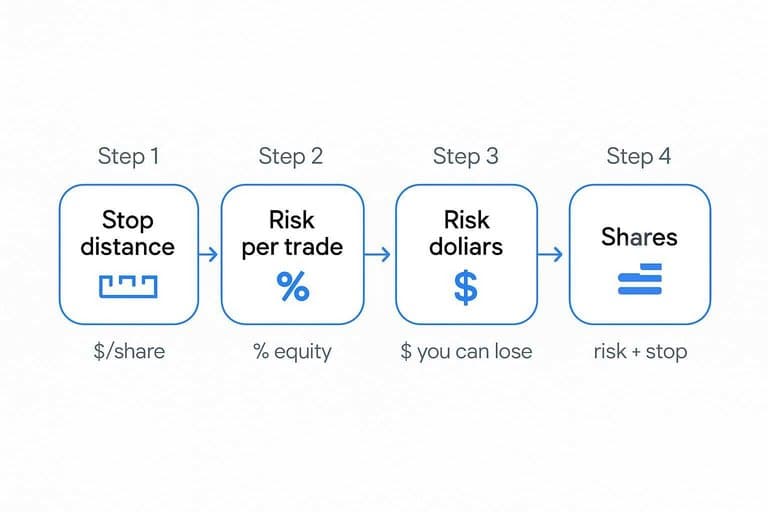
Sizing framework
Your size is a math output, not a mood.
- Define your stop distance in dollars per share.
- Choose your risk per trade as a percent of equity.
- Convert that risk into dollars you can lose.
- Divide risk dollars by stop distance to get shares.
- Cut risk or shares when chop increases.
If you don’t reduce size in chop, the market reduces your account for you.
Where the stop goes
Put the stop where the trade idea is invalid, not where your pain tolerance ends. A common anchor is just below the pivot, the most recent tight support, or the last “line in the sand” low.
If a stock breaks that level, the breakout thesis is damaged, so you want out fast. Arbitrary wide stops turn a swing trade into a slow-motion hope trade.
Sell Rules That Matter
Selling is where Minervini’s edge becomes real. Your job is simple: cut risk fast, then press advantage when you’re right.
Think like a casino. You cap the downside per bet, then you let the few big wins pay for everything.
Fast loss exits
You need rules that fire without debate, because hesitation turns scratches into damage.
- Place your stop before entry, then obey it.
- If the stop hits intraday, exit on the close or next liquidity window.
- If a breakout fails within 1–3 days, exit faster than your stop.
- Never average down; reduce size or exit instead.
Small losses buy you the right to keep swinging.
Profit-taking logic
You’re not “selling early.” You’re converting paper gains into staying power.
- Sell into strength on sharp expansion days.
- Scale out in pieces, not all at once.
- Take profit on climactic gaps or blow-off volume.
- Trail stops under key supports, not random percentages.
- Sell partials near prior resistance or round-number magnets.
Profits are inventory; move them when the market is paying retail.
Let winners work
Big winners need room, so you switch from “defend” to “manage.” Stay in while price respects your key moving average, holds above the prior breakout level, and prints higher highs without repeated heavy reversals.
A clean trend often looks boring: tight closes, shallow pullbacks, and support that keeps holding. That’s your cue to sit on your hands.
Your sell trigger becomes character change, not impatience.
Common Failure Modes
You can follow Minervini’s words and still trade like a gambler. The mistakes usually come from skipping constraints, then calling it “discretion.”
Use this table as a quick pre-trade guardrail.
| Failure mode | What it looks like | Guardrail | Quick check |
|---|---|---|---|
| Loose “trend” definition | Choppy base, weak slope | Require 50/200 up | Both rising weekly? |
| Buying too early | Entry inside base | Only buy pivot break | Above pivot on volume? |
| Ignoring volume quality | Green days on light volume | Demand accumulation days | More up-volume weeks? |
| Over-positioning | One idea becomes portfolio | Cap risk per trade | 1R loss tolerable? |
| Averaging down | “Improving cost basis” | Add only above entry | Added at strength? |
If you need a story to justify the trade, you already broke the rules.
Turn the Method Into a Repeatable Weekly Routine
- Start with the market: decide whether you’re in “press” mode or “protect” mode, and size your activity accordingly.
- Build a tight watchlist of liquid leaders with clear relative strength and supportive fundamentals; then wait for clean VCP structure and constructive volume.
- Define the trade before entry: pick your trigger (pivot reclaim/breakout), place the stop at the logical invalidation point, and size so the loss is small and acceptable.
- Execute and manage: take fast loss exits without debate, lock in gains when the stock proves itself, and keep the rest for the possibility of an outsized winner—then review failure modes to refine the next cycle.
Frequently Asked Questions
Is Mark Minervini’s approach still relevant for swing traders in 2026?
Yes—because it’s built on recurring market behaviors: leadership, tight consolidation, and disciplined risk control. The tools and platforms change, but the edge comes from cutting losses fast and pressing strength when markets reward it.
Do I need Minervini’s Trend Template to trade the Mark Minervini style?
No—the Trend Template is a checklist, not a requirement. Most traders can replicate the intent by confirming the stock is in a clear uptrend (price above rising 50/200-day averages) and making new highs before entering.
Can I trade Mark Minervini setups on ETFs or only individual growth stocks?
You can use the same breakout-and-tightness concepts on liquid sector ETFs, but individual leaders usually offer cleaner volatility contraction and stronger upside. If you choose ETFs, prioritize high liquidity and strong relative strength versus the market.
How do I measure “relative strength” for Mark Minervini without expensive software?
Use a simple ratio line (stock price divided by SPY or your benchmark) on TradingView, StockCharts, or Thinkorswim and look for an upward-sloping line into the setup. You can also compare 3–6 month performance versus the index and focus on the top performers.
How long does it take to see results trading Mark Minervini-style swing setups?
Usually you’ll know if the process is working within 20–50 trades, because the win/loss distribution and drawdowns become clear. In calendar time, that’s often 2–6 months depending on market conditions and how many quality setups appear.
Find Leaders, Not Noise
Minervini’s edge comes down to consistent market context and disciplined stock selection, but doing that daily across thousands of names is a time sink.
Open Swing Trading streamlines Minervini-style leader hunting with daily RS rankings, breadth, and sector/theme rotation tools—use it as an educational research layer with 7-day free access.
Sources
- RizeTrade — Volatility Contraction Pattern (VCP) — referenced in Pivot and trigger