Mark Minervini vs CAN SLIM for breakouts
A side-by-side comparison of Mark Minervini and CAN SLIM breakout trading—learn who each method fits, how their filters and setup signals differ, what entries/exits and risk rules they emphasize, and how to choose a playbook that matches your goals and temperament.
Mark Minervini vs CAN SLIM for breakouts
A side-by-side comparison of Mark Minervini and CAN SLIM breakout trading—learn who each method fits, how their filters and setup signals differ, what entries/exits and risk rules they emphasize, and how to choose a playbook that matches your goals and temperament.
Two traders can buy the same “breakout” and get opposite results—because they’re not trading the same definition of a breakout. Minervini wants tight, high-velocity price action; CAN SLIM wants institutional-grade fundamentals plus chart confirmation.
This comparison helps you stop mixing rules and start executing one coherent plan. You’ll see how each method screens candidates, grades base quality, times entries, manages risk and shakeouts, and rides winners—then use a simple decision table to pick the approach that best fits your market, timeframe, and personality.
Two breakout playbooks
Minervini and CAN SLIM are both breakout systems, not just stock-picking styles. They tell you when to buy strength, where you’re wrong, and when to press.
A “breakout” is the moment price escapes a base into open air, and you decide to pay up or pass. Your real choice is simple: trade a tighter, more tactical pattern playbook, or run a broader checklist that blends business quality with chart action.
Who each fits
Minervini fits the trader who wants precision and clear invalidation, even if it means fewer trades. CAN SLIM fits the investor who can hold through noise, because the story is partly fundamental.
Minervini tends to match you if you:
- Watch charts daily and act fast
- Prefer tight risk and tight setups
- Accept being picky and often in cash
CAN SLIM tends to match you if you:
- Research earnings, sales, and leaders
- Hold for weeks to months
- Tolerate pullbacks inside an uptrend
Pick the system that matches your calendar, not your ego.
Core philosophy
Minervini is about price/volume tightness plus relative strength, then strike at the inflection. CAN SLIM is about finding the right company and the right chart at the same time.
Minervini (VCP/SEPA) bets on:
- Tight contractions before expansion
- RS leadership before the breakout
- Clean risk points and fast exits
CAN SLIM bets on:
- Earnings and sales acceleration
- Institutional sponsorship and leadership
- Technical entry aligned with fundamentals
One playbook starts with the tape. The other starts with the business.
Breakout definition
Both systems buy strength, but they validate it differently.
- Minervini: clears pivot from tight VCP, minimal overhead supply
- Minervini: breakout rides strong RS line, in a healthy market
- Minervini: volume confirms, but tightness matters more
- CAN SLIM: clears proper base pivot, ideally on big volume
- CAN SLIM: breakout aligns with strong earnings and sponsorship
If you can’t define your breakout, you’re not trading a system. You’re trading hope.
Selection criteria
Both Minervini and CAN SLIM hunt breakouts, but they weight the inputs differently. Minervini starts with price behavior and risk control, while CAN SLIM starts with earnings power and leadership.
Minervini filters
Minervini is a chart-first gatekeeper, because clean structure keeps your risk tight. You’re trying to buy strength you can define, not hope you can justify.
- RS line near highs
- Tight, orderly bases
- Trend template alignment
- Adequate liquidity and spread
- Volatility contraction into pivot
If you can’t box the risk, you’re not selecting a breakout. You’re selecting a story.
CAN SLIM filters
CAN SLIM is fundamentals-first with a leadership overlay, because big winners usually earn their way up. The chart matters, but earnings fuel the move.
- Current EPS up sharply
- Annual EPS growth strong
- New product or catalyst
- Supply tight, demand rising
- Leader in strong group
When the numbers and the group line up, institutions can keep buying for months. That’s the real edge.
When filters clash
Charts can look perfect while fundamentals lag, and fundamentals can scream while price goes nowhere. Treat it like a mismatch in timing, not a debate about “right.”
If the chart is A+ but the numbers are thin, size down, demand cleaner sponsorship, and use a hard stop. If the fundamentals are elite but the base is sloppy, wait for a tighter setup or buy only on confirmed strength, not anticipation.
Your job is simple: don’t force alignment. Let price prove the thesis, or pass.
Setup quality signals
Minervini and CAN SLIM both grade a setup before the breakout. They just weight different evidence.
Minervini asks, “Is risk tight and pressure building?” CAN SLIM asks, “Is growth real and institutions are buying?” Pick the filter that matches your market and temperament.
Use Minervini when
You want a setup you can kill fast when it fails. You also want “clean” price action you can define in advance.
- Trading choppy indexes and false breakouts
- Demanding tight risk and quick invalidation
- Preferring clean pivots and obvious support
- Reading VCPs, tight closes, and range contraction
- Avoiding earnings roulette before the move
Your edge here is precision, not prediction.
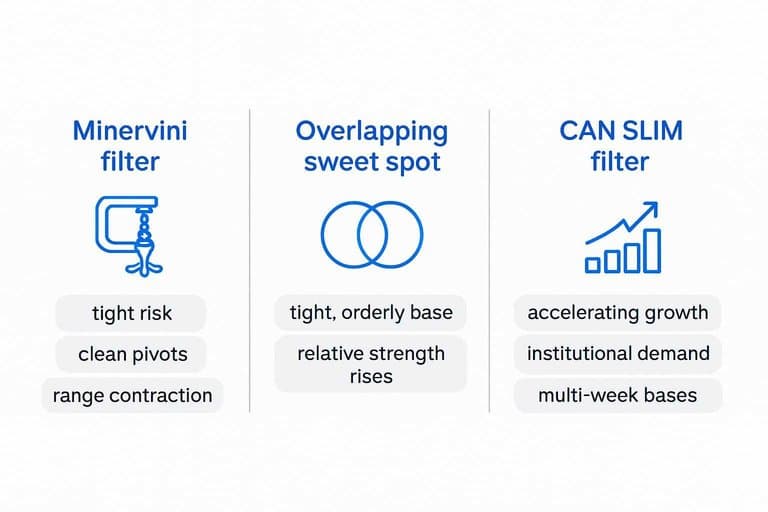
Use CAN SLIM when
You want leaders with a clear fundamental engine. You also want signs that big funds are already involved.
- Buying earnings-led leaders with accelerating growth
- Leaning into strong themes and industry groups
- Tracking institutional demand via volume and sponsorship
- Holding through multi-week bases and shakeouts
- Accepting wider stops to stay in the move
Your edge here is strength with sponsorship, not perfect entry.
Overlapping sweet spot
The ideal overlap is a true leader building a tight, orderly base while relative strength rises. Think “A+ numbers” plus “no drama” price action.
When you get both, you can press the breakout and still define risk like a technician.
Entry triggers compared
You need an entry trigger you can repeat under pressure. A clean table beats a vague rule like “buy the breakout.”
Both systems focus on breakouts, but they disagree on what qualifies as a proper pivot. That small difference changes where you place orders and how often you get faked out.
| Rule area | Mark Minervini (SEPA/VCP) | CAN SLIM (O’Neil) | What you do at entry |
|---|---|---|---|
| Pivot type | Tight VCP pivot | Cup-with-handle pivot | Define pivot before session |
| Buy range | Small, often tight | 5% above pivot | Pre-set max buy price |
| Volume requirement | Surge on breakout | 40–50% above average | Skip if volume is light |
| Price action requirement | Tight closes near highs | Clear breakout through pivot | Buy only on clean cross |
| Market timing check | Trend, risk-on tape | Market uptrend confirmed | No buys in downtrends |
Pick one trigger format and standardize it. That’s how you stop “almost” setups from stealing your best risk.
Risk management styles
Both systems win by cutting losers fast, but they cut them differently. Minervini treats a breakout like a test with a clear fail point, while CAN SLIM uses a broader “don’t let it get away from you” rule.
Initial stop logic
Minervini sets the stop where the breakout is proven wrong, usually just under a tight area like the pivot, the 10-day, or the most recent support shelf. CAN SLIM often starts with the classic 7–8% max loss from the buy point, then tightens it using pivot lows or key moving averages when the base is clean.
Minervini’s stop is an invalidation stop: “If it breaks here, I’m out.” CAN SLIM’s stop is a damage cap: “If I’m down 8%, I was wrong.”
Use Minervini stops when your entry is precise; use CAN SLIM stops when the base is looser or volatility is higher.
Position sizing
Minervini sizing stays small until the stock proves itself, because the stop is tight and the failure rate is real.
- Start smaller with tight stops
- Add only after progress
- Reduce size in choppy tape
- Use pyramids on strength
- Keep risk per trade constant
Use larger size only after you’ve earned it with clean price action.
Handling shakeouts
Shakeouts happen because breakout levels are obvious, and obvious levels get hunted.
- Mark the prior low and pivot before entry.
- If it undercuts, wait for a reclaim on volume.
- Re-enter only if it retakes the pivot or key MA.
- Reset the stop below the shakeout low.
- If it fails again, exit and move on.
Your edge is re-entry discipline, not “getting back” at the stock.
Managing winners
Both systems care less about the breakout and more about what happens after it. Your job is to stay in the move without donating the bulk back during the first real shakeout.
Minervini exits
Minervini rides winners by demanding “tightness” and leadership, then exiting when the character breaks. You hold through normal volatility, but you sell fast when the stock stops acting like an A+ leader.
Key triggers:
- Climax runs: a steep, emotional acceleration after extended upside.
- Late-stage base failure: a mature name breaking down after multiple bases.
- Loss of tightness: wider swings, sloppy closes, broken pivots.
- RS deterioration: leadership fades versus the market and peers.
The tell is behavioral, not mathematical. When the stock’s “tight” look disappears, you’re already late.
CAN SLIM exits
CAN SLIM rides trends with rules that force you to lock gains and respect institutional selling. You take profits into strength, then use time-based holds to avoid getting shaken out early.
Core rules:
- Take 20–25% profits, especially after a clean breakout run.
- Hold 8 weeks if up 20% within about 3 weeks.
- Watch the 10-week line for support and sells.
- Track distribution days as “big money leaving” signals.
The edge is consistency. You’re not guessing the top; you’re obeying the tape when institutions unload.
Add-on entries
Adding to winners is how you turn a good breakout into a great trade, but only when the stock is proving itself. The safer the add, the closer it is to strength, not hope.
- Buy a secondary pivot in a tight, constructive pause.
- Buy the first pullback to the breakout area on light volume.
- Add at new highs after a tight flag or mini-base.
- Add after reclaiming key moving averages with power.
- Add only when RS line makes new highs.
If your add requires “patience,” it’s not an add. It’s a new risk.
Strengths and tradeoffs
You’re choosing between two breakout playbooks that reward different skills. One leans on tape-read precision, the other on structured fundamentals.
| Dimension | Minervini (SEPA/VCP) | CAN SLIM |
|---|---|---|
| Complexity | High, many filters | Medium, clear checklist |
| Signal frequency | Lower, selective | Higher, broader universe |
| Whipsaw risk | Lower, tighter setups | Medium, more false starts |
| Research load | Medium, chart work | High, earnings + themes |
| Learning curve | Steep, pattern nuance | Moderate, rules-based |
Pick the one that matches your time budget, not your optimism.

Common failure modes
Breakouts fail for boring reasons: context, liquidity, and timing. Each system has its own way of creating false positives, especially when you force a pattern to fit.
Minervini pitfalls
Minervini-style breakouts reward precision, but precision can turn into fragility. These are the spots where your “perfect” setup breaks first.
- Overfitting every chart into a VCP
- Using stops tighter than normal volatility
- Ignoring earnings dates and guidance risk
- Trading low-liquidity names with wide spreads
If the trade only works with ideal fills and no surprises, it’s not a setup. It’s a wish.
CAN SLIM pitfalls
CAN SLIM works when you buy right and sell fast when wrong. The failures usually come from paying up or rationalizing obvious damage.
- Buying extended above the pivot
- Chasing news after the first gap
- Accepting sloppy bases and loose action
- Holding through clean support breaks
Your edge isn’t the story. It’s the discipline to treat “no” like a full position.
Pre-trade checklist
Run this before every breakout to cut low-quality entries. Fast filters beat post-trade regret.
- Confirm the market trend supports breakouts.
- Check RS is strong and improving versus the index.
- Demand volume expansion at the pivot, not just “decent” volume.
- Prefer mature, tight bases over fresh, choppy structures.
- Verify risk/reward works using real support, not hopeful lines.
When you can’t explain the risk in one sentence, you’re not ready to buy.
Choose your method
Use this table to pick a breakout method that matches your time, stomach, and tools.
| Your situation | Market regime | Best fit | Why it wins | |—|—|—| | 30–60 min/day | Choppy, rotational | Minervini (SEPA) | Fewer trades, tighter filters | | 2–3 hrs/day | Trending, broad | CAN SLIM | More setups, earlier entries | | Low volatility tolerance | High VIX, whipsaws | Minervini (SEPA) | Waits for clean pivots | | Loves fundamentals + stories | Stable uptrend | CAN SLIM | Earnings + sponsorship edge | | Loves tape + relative strength | Late-stage leaders | Minervini (SEPA) | Strength-on-strength focus |
If you can only pick one, pick the one you’ll execute every week, not admire every weekend.
Pick one playbook—and trade it end-to-end
Use this comparison to choose Minervini or CAN SLIM as your primary “source of truth” for selection, entry, and exits—hybrids fail when the filters, triggers, and sell rules contradict each other. Standardize your risk first (position size and initial stop), then paper-trade 20–30 examples to see which approach matches your temperament and the current tape. Once you commit, track a simple journal: setup grade, entry type, stop distance, add-ons, and exit reason—so your next adjustment is data-driven, not emotional.
Frequently Asked Questions
Is Mark Minervini’s VCP pattern the same thing as a CAN SLIM cup-with-handle breakout?
No. They both target tight consolidations before a breakout, but VCP focuses on volatility contraction and tightening ranges, while cup-with-handle has specific shape and duration expectations.
Do I need fundamental analysis to use Mark Minervini, or can I trade it purely on charts?
You can apply Minervini-style breakouts with mostly technicals, but most traders improve odds by adding basic filters like strong recent earnings and sales growth plus relative strength.
What scan settings work best for finding Mark Minervini breakout candidates?
Start with RS/relative strength near 52-week highs, price above the 50- and 200-day moving averages, and liquidity filters (often $20+ price and 500k–1M+ average daily volume) to avoid thin names.
How do I measure “relative strength” for Mark Minervini—RS rating, RS line, or performance vs the S&P 500?
Most use the RS line versus the S&P 500 to spot true leadership, then confirm with a quantitative metric like an RS Rating (e.g., 85–90+) or 3–12 month performance ranks.
How long does it usually take to learn Mark Minervini’s approach well enough to trade live?
Most traders need 4–8 weeks to learn the rules and build scans, then 2–3 months of paper trading and review to execute consistently before sizing up with real risk.
Build Your Breakout Watchlist
Minervini and CAN SLIM both work best when your stock selection and market-regime read are consistent enough to act quickly without forcing setups.
Open Swing Trading streamlines breakout leader research with daily RS ranks, breadth, and sector/theme context—use the 7-day free access to tighten your watchlist in 5–15 minutes a day.