Market breadth dashboard vs sector rotation for breakouts
A clear comparison of market breadth dashboards versus sector rotation for trading breakouts—define breadth and rotation, judge signal quality and timing triggers, weigh tools/complexity, and match risk management and regimes to the right approach.
Market breadth dashboard vs sector rotation for breakouts
A clear comparison of market breadth dashboards versus sector rotation for trading breakouts—define breadth and rotation, judge signal quality and timing triggers, weigh tools/complexity, and match risk management and regimes to the right approach.
Breakouts fail most often for one reason: the move isn’t being supported by the rest of the market. You spot a clean chart, take the entry, and then watch it roll over as liquidity rotates somewhere else.
This comparison shows you when a market breadth dashboard gives you the edge and when sector rotation does. You’ll learn how each approach filters false breakouts, how to time entries and exits with a confirmation stack, what data and workflows you actually need, and how to choose based on your trading horizon and risk constraints.
Table of Contents
- Decision snapshotWhat breadth meansWhat rotation meansBreakout goalsWhen each shines
- Signal qualityFalse-breakout filtersEarly vs lateWhipsaw riskWinner verdict
- Timing and triggersEntry triggersExit triggersConfirmation stack
- Tools and complexityData requirementsPlatform readinessScreening workflowWinner verdict
- Risk management fitStop placementConcentration riskRegime shifts
- Performance by regime
- Common failure modes
- Best choice matrixIf you swing-tradeIf you day-tradeIf you position-tradeFinal recommendation
- Pick your primary lens, then stack confirmations
- Frequently Asked Questions
- Turn Breadth Into Breakouts
Decision snapshot
You’re choosing between two lenses for breakouts: breadth dashboards that measure participation, and sector rotation that finds leadership. One asks, “Is the whole market supporting this move?” The other asks, “Which groups are strong enough to carry it?”
What breadth means
A market breadth dashboard tracks how many stocks are actually joining the move, not just the index. You use it to avoid buying breakouts when participation is thin and fragile.
Common breadth inputs:
- Advance/decline lines and A/D volume
- New highs vs new lows
- % above 20/50/200-day MAs
- Up/down volume breadth and upside volume ratios
- Thrust signals (e.g., “breadth thrust” spikes)
If the index is breaking out but breadth is flat, you’re betting on a few names.
What rotation means
Sector rotation treats the market as competing groups and asks where money is concentrating. You use it to focus breakouts in the leaders, even when the overall tape is mixed.
Typical rotation tools:
- Sector and industry relative strength ranks
- Leader/laggard quadrant maps (RS vs momentum)
- ETF and futures flow proxies
- Momentum regime reads (risk-on vs defensives)
- Industry group confirmation (semi vs software, banks vs brokers)
When leadership is narrow, rotation can keep you out of “index mirages.”
Breakout goals
You’re using either method to improve breakout quality, not to predict headlines. The goals are practical and measurable.
- Increase follow-through after entry
- Reduce false breakouts and reversals
- Enter earlier without guessing
- Keep rules consistent across markets
- Scale decisions across many tickers
Pick the lens that tightens your entry rules, not the one with prettier charts.
When each shines
The right choice depends on whether the move needs broad participation or just strong leadership.
| Market condition | Breadth dashboard fits | Sector rotation fits |
|---|---|---|
| Broad risk-on surge | Strong confirmation | Find best leaders |
| Narrow leadership | Warns “thin tape” | Targets the winners |
| Trend day breakout | Confirms participation | Adds precision entries |
| Choppy range | Flags low odds | Finds pockets working |
If your breakouts fail in ranges, breadth is the smoke alarm; rotation is the fire escape.
Signal quality
You’re choosing between two confirmation engines: “is the whole market coming along?” versus “is leadership rotating into the right places?”. Signal quality is about fewer fake breakouts and more follow-through when price clears a level.
False-breakout filters
Breadth confirmation asks a blunt question: do more stocks advance when the index breaks out. Sector rotation asks a fuzzier one: is the leading group strong enough to pull the tape.
Breadth is the clearer filter when you use participation thresholds, like “55%+ above the 50-day” or a clean thrust in advancers. Sector leadership can look convincing while the rest of the market stays thin, which is where breakouts die quietly.
If participation isn’t expanding, you’re usually watching a breakout on borrowed time.
For a concrete breadth-divergence example, see how narrowing market breadth raises risk even as the index holds up.
Early vs late
Both can confirm a breakout, but they fire on different clocks.
- Breadth thrusts lead, but need strong momentum.
- Participation expansion leads, but needs broad buying.
- Sector RS turns lead, but can front-run price.
- Sector leadership confirmation lags, after flows show.
The faster trigger is sector RS turns, but it’s faster because it’s less certain.
Whipsaw risk
Breadth whipsaws come from mean reversion, especially after sharp down days or oversold bounces that fade. You’ll see “one-day breadth fireworks” that don’t persist, then the breakout fails.
Rotation whipsaws come from churn, where money hops between groups without lifting the index. A sector can “win the week” and still fail to carry the breakout past supply.
Lower whipsaw risk usually goes to breadth, because persistence is measurable and hard to fake.
Winner verdict
For signal quality, the market breadth dashboard wins on reliability. It filters false breakouts better because it demands broad participation, not just a hot pocket of leadership.
Sector rotation still works when the market is narrow by design, like early-cycle leadership, AI-style theme tapes, or defensive risk-off regimes. Use it then, but treat it like a tactical tell, not a structural confirmation.
If you want fewer false positives, make the breakout earn breadth.
Timing and triggers
Breakouts fail less when your triggers are mechanical, not interpretive. You want rules you can run every day, like “above 55%” or “below last week’s low.” Repeatability beats a clever thesis.
Entry triggers
Use triggers you can mark on a chart without debate.
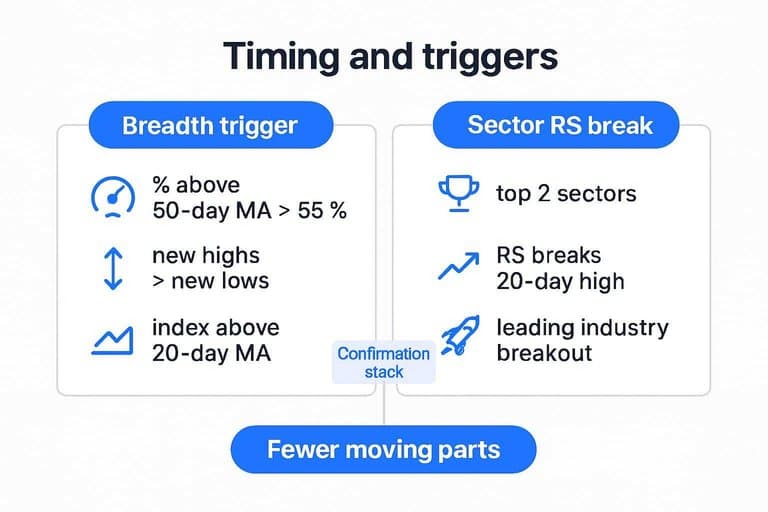
- Buy when % above 50-day MA crosses above 55%.
- Require 2 closes above 55%, not one.
- Confirm new 52-week highs exceed new lows by 2:1.
- Enter on the first pullback that holds the breakout level.
Sector-rotation entry:
- Identify the top 2 sectors by 3-month relative strength.
- Wait for sector RS to break a 20-day high.
- Buy the leading industry on a price breakout.
- Skip if the broad index breadth is below 50%.
The breadth trigger is cleaner because one dashboard threshold beats a chain of rankings.
Exit triggers
Exits should fire fast, even when you “still like it.”
- Reduce when % above 50-day MA falls back below 50%.
- Exit when new lows exceed new highs for 2 sessions.
- Exit if the index undercuts its 20-day low on a close.
- Re-enter only after breadth resets above 55%.
Sector-rotation exit:
- Exit when sector RS closes below its 20-day low.
- Exit when price loses the breakout level for 2 closes.
- Rotate when a new sector takes the RS lead.
- Stand down if leaders diverge from the index.
Breadth deterioration is more objective because it ignores your attachment to any “leader.”
Confirmation stack
Keep confirmation minimal, or you will optimize yourself into hesitation.
Breadth stack: one breadth threshold plus one participation check, like “% above 50-day MA > 55%” and “new highs > new lows.” Add a simple price filter, like “index above 20-day MA,” then act.
Sector-rotation stack: sector RS trend plus industry RS trend plus the stock’s breakout, usually with a market regime filter. It works, but it adds two extra links that can disagree.
Fewer moving parts makes breadth easier to execute when the tape gets fast.
Tools and complexity
A market breadth dashboard feels like a “control panel.” Sector rotation feels like a “leaderboard.” Both can find breakouts, but they tax you differently in data, setup, and habit.
Data requirements
Breadth tools need fewer price series, but they need the right internals. Rotation tools need lots of clean relative-strength lines across sectors and industries.
- Advancers/decliners per exchange
- Up/down volume per exchange
- New highs/lows per exchange
- Sector ETF prices for RS
- Industry group prices for RS
If you can’t source reliable internals, rotation is the simpler stack.
Platform readiness
Most charting platforms ship with basic breadth indicators, like A/D lines and new highs-lows. But “exchange-grade” breadth often needs a paid data feed or custom symbols.
Sector and industry relative strength is usually easier. You can compute RS from standard ETFs and watchlists. That’s native on TradingView, Thinkorswim, and most brokers.
Screening workflow
You need a routine you’ll actually run at 8:30 a.m. The two approaches differ most at the “who do I even look at” step.
- Breadth dashboard: Check breadth regime, then pick long or stay flat.
- Breadth dashboard: Scan breakouts only in favored direction.
- Breadth dashboard: Trigger on your pattern, then recheck breadth.
- Rotation: Rank sectors and industries by RS trend.
- Rotation: Scan breakouts inside the top groups and trigger.
Rotation is faster because it hands you a shortlist before you open a chart.
Winner verdict
For most traders, sector rotation wins on simplicity. It runs on plain price data, works on almost any platform, and produces a clean “start here” list.
Breadth dashboards earn their complexity when you trade many names, size aggressively, or swing through corrections. That’s when “risk-on vs risk-off” is the real signal, not the breakout candle.
Risk management fit
A breakout system lives or dies on risk control, not entry precision. Your tool should make sizing, stops, and concentration rules obvious when things get weird.
Stop placement
Technical stops are clean: swing low, ATR band, prior range, done. Breadth dashboards add a second brake, like “risk-off if advance/decline breaks down” or “new lows expand,” while sector rotation often defaults to relative stops versus the benchmark or sector peers.
Breadth-based filters tend to be portfolio-level and binary: reduce exposure, tighten stops, or stop adding when participation thins. Sector-relative stops can keep you in a name that’s “winning its sector” while the whole market rolls over.
The more robust default is technical stops plus a breadth risk-off filter, because it protects you from market-wide air pockets.
Concentration risk
Concentration sneaks in when your signal source is also your portfolio map. Here are the common traps.
- Chasing one hot sector’s top three names
- Overweighting mega-caps that dominate indexes
- Mistaking relative strength for diversification
- Adding “different tickers,” same macro factor
- Ignoring breadth while leaders keep climbing
Breadth-first breakouts usually spread risk earlier, because participation forces variety.
Regime shifts
Regime shifts show up as either participation breaking or leadership rotating. A breadth dashboard flags the first one fast, with signals like fewer stocks above key averages, fewer new highs, and a surge in new lows.
Sector rotation can catch a different shift: money moving from growth to defensives, or cyclicals to staples. But it can look “healthy” during early damage, because something is always leading.
Breadth is the quicker warning system, because it detects the floor dropping out under the whole market.
To quantify the “fewer new highs / more new lows” idea, the High-Low Index indicator is a common breadth gauge.
Performance by regime
Different market regimes reward different signals, even when both target breakouts. Your dashboard should switch emphasis when the tape changes.
| Regime | Breadth dashboard edge | Sector rotation edge | Best pick |
|---|---|---|---|
| Risk-on, broad rally | Confirms participation | Avoids lagging sectors | Breadth dashboard |
| Risk-on, narrow leadership | Flags weak internals | Concentrates in leaders | Sector rotation |
| Range-bound, choppy | Filters false breakouts | Gets whipsawed often | Breadth dashboard |
| Risk-off, rolling selloff | Triggers fast defense | Late if leaders crack | Breadth dashboard |
| Post-panic rebound | Times re-expansion | Catches early leaders | Tie, time-dependent |
Pick breadth for protection and confirmation; pick rotation when leadership is the signal.
Common failure modes
Both tools lie in predictable ways, especially near breakouts when positioning is crowded. Know the traps, add simple filters, and decide which method survives bad inputs better.
- Breadth spikes on short-covering; require 2–3 day follow-through
- Breadth looks “strong” from mega-caps; use equal-weight and advance/decline
- Breadth breaks on rebalances or expiries; ignore event-week prints
- Rotation “leaders” are mean-reversion bounces; demand higher highs on relative strength
- Rotation hides index-level weakness; pair with index trend and volatility filter
Breadth is more failure-tolerant because it measures participation, not just which bucket is winning.
Best choice matrix
Pick between a market breadth dashboard and sector rotation based on what you’re trying to catch, how long you hold, and how much noise you can tolerate. Breadth tells you if breakouts have “air support” across the tape, while rotation tells you where leadership is migrating. Your default should match your holding window, then borrow the other tool as a filter.
If you swing-trade
For 2–10 day breakouts, sector rotation wins because leadership shifts show up before broad participation does. You’re hunting the hot group where money is flowing, not waiting for the whole market to agree.
Use rotation to pick the pond, then pick the fish:
- Rank sectors by relative strength vs index
- Focus on top 2–3 improving sectors
- Trade breakouts in liquid names inside them
- Keep breadth as a risk-on filter
Caveat: rotation can whip on macro headlines, so avoid chasing a one-day leadership spike. Treat breadth like the circuit breaker, not the steering wheel.
If you day-trade
For intraday breakouts, sector rotation wins because it points you to the only stocks moving with intent right now. Breadth is too slow at this horizon and gets distorted by open and close flows.
Run a tight scan loop:
- Identify the strongest sector ETF on the day
- Trade stocks aligned with that sector’s move
- Confirm volume and range expansion
- Ignore weak sectors even with “good” charts
Caveat: rotation can be fake during index rebalances or options-driven squeezes. If the sector leader is illiquid, step aside.
If you position-trade
For weeks-to-months breakouts, a market breadth dashboard wins because durable trends need broad participation. When advance-decline, new highs, and participation expand together, breakouts fail less.
Use breadth to avoid false regimes:
- Prefer rising advance-decline lines
- Favor expanding new highs vs new lows
- Watch participation across caps and industries
- Add rotation only to choose strongest themes
Caveat: breadth can lag at major turns, especially after sharp selloffs. Early leaders can run before breadth “confirms,” so scale in.
Final recommendation
Use a market breadth dashboard as your default when:
- You trade multi-week breakouts
- You want fewer false starts
- Your universe is broad indexes
- Your temperament prefers confirmation
Pair sector rotation when:
- You trade 0–10 day breakouts
- You need clear leadership targets
- Your universe is liquid stocks and ETFs
- Your temperament can handle churn
If you must pick one, start with breadth for regime, then add rotation for selection. That’s the difference between trading “a chart” and trading a market.
Pick your primary lens, then stack confirmations
If your goal is cleaner breakout participation, choose one primary lens: use breadth dashboards to validate that risk-on participation is broad, and use sector rotation to aim your capital at where relative strength is concentrating. Then stack confirmations—market/sector trend, setup quality, and a pre-defined trigger/stop—so you’re not relying on a single signal. Keep it consistent for a full regime cycle and review the failure modes you hit most (whipsaws, late entries, concentration) before you add more indicators. The best approach is the one you can execute every day without increasing complexity faster than your edge.
Frequently Asked Questions
Turn Breadth Into Breakouts
A market breadth dashboard is only useful if it consistently guides your watchlist when regimes shift and breakouts start failing. The right workflow turns those readings into faster, cleaner setups.
Open Swing Trading combines daily breadth snapshots with volatility-adjusted relative strength, sector/theme context, and ATR extension scoring so you can spot breakout leaders faster—get 7-day free access with no credit card.