Market Daily vs Weekly Review for Swing Traders
A side-by-side comparison of daily vs weekly market reviews for swing traders—choose the right cadence using decision criteria, time commitment, signal quality, risk management fit, execution/alerts setup, psychology impacts, and performance tracking.
Market Daily vs Weekly Review for Swing Traders
A side-by-side comparison of daily vs weekly market reviews for swing traders—choose the right cadence using decision criteria, time commitment, signal quality, risk management fit, execution/alerts setup, psychology impacts, and performance tracking.
If your swing trades keep turning into impulse trades, your review cadence might be the real culprit. Too much checking creates noise and overtrading; too little leaves you late to key levels and risk events.
This comparison helps you pick a daily or weekly review routine that matches your time, strategy, and temperament. You’ll see how each cadence affects signal clarity, stop placement and gap risk, alert and order prep workflows, and the discipline needed to hold winners without stressing every candle.
Decision Snapshot
Swing trading lives in the middle: you need timely risk checks without living on a five‑minute chart. Your review cadence is the system that turns “I’ll manage it later” into “orders are set and risk is known.” Think of it as choosing between a daily cockpit scan and a weekly flight plan.
Best For Whom
Pick a cadence that fits how often you can act, not how often you can worry.
- Busy professionals: weekly plan, daily 5‑minute check
- Active swing traders: daily reviews, weekly big-picture reset
- New traders: weekly structure, limited daily tweaks
- Multi-timeframe traders: weekly bias, daily execution
Choose the cadence you can repeat on your worst week, not your best.
Bottom-Line Winners
Use this to decide fast, then commit for 4–6 weeks.
| Criterion | Daily Review | Weekly Review | Winner |
|---|---|---|---|
| Time cost | Higher | Lower | Weekly |
| Signal quality | More noise | Cleaner | Weekly |
| Risk control | Faster response | Slower response | Daily |
| Psychology | More temptation | More patience | Weekly |
| Performance tracking | More data | Less detail | Daily |
If risk is your edge, go daily; if discipline is your edge, go weekly.
When To Switch
Switching cadence is a risk-management move, not a productivity hack. You change when your environment or behavior changes.
Move daily → weekly when volatility compresses, your watchlist shrinks, you’re over-trading, or life gets packed. Move weekly → daily when ranges expand, your watchlist grows, you miss exits, or you catch yourself saying “I’ll check tonight.”
Treat cadence like position size: adjust it when conditions change, then stick to it.
Time Commitment
Daily reviews feel “quick” until you count the bookends: pre-market scans and post-close notes. Weekly reviews take longer per sitting, but you pay that cost once.
Here’s the time math most swing traders actually live with.
| Approach | Pre-market time | Post-close time | Total commitment |
|---|---|---|---|
| Daily review | 10–20 min/day | 10–20 min/day | 100–200 min/week |
| Weekly review | 0–10 min/week | 45–90 min/weekend | 45–100 min/week |
| Weekly + light daily check | 2–5 min/day | 45–90 min/weekend | 55–125 min/week |
For most swing traders, weekly wins because it protects your weekdays from constant decision pressure.
Signal Quality
Daily reviews show you everything, including the junk. Weekly reviews hide the wiggles and keep the structure, which is what most swing setups need. For cleaner swing decisions, weekly cadence wins.
Noise Versus Clarity
Daily review catches micro-moves, because every gap, wick, and intraday reversal looks “actionable.” That’s great for spotting early shifts, but it also turns normal chop into fake signals.
Weekly review compresses five days into one candle and forces context. Most whipsaws disappear, and the remaining levels tend to matter.
If you want cleaner swing setups, weekly is the winner because it filters temptation.
Entry Timing
Daily and weekly cadences “see” the same pattern, but they time it differently. Your goal is precision without overtrading.
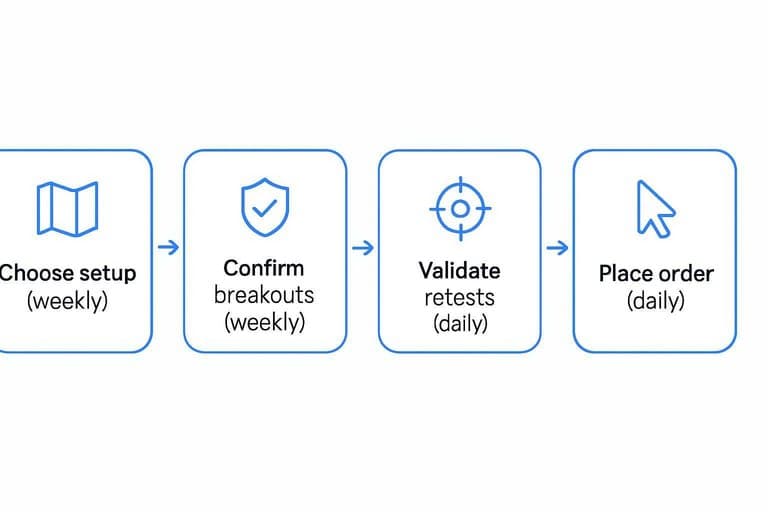
- Spot pullbacks earlier on daily
- Confirm breakouts cleaner on weekly
- Validate retests tighter on daily
- Avoid chop better on weekly
Use weekly to choose the setup, then daily to place the order.
Multi-Timeframe Fit
Use the weekly as your market map and the daily as your steering wheel. The weekly defines trend, key levels, and what “normal” volatility looks like.
Then use daily for execution cues like a higher low, a tight consolidation, or a retest that holds. You’ll trade less, but your trades will fit the bigger move.
Weekly is the better primary anchor because it keeps you trading the move, not the mood.
For a proven framework, see the Elder Triple Screen System approach to higher-timeframe confirmation and lower-timeframe entries.
Risk Management Fit
Daily and weekly reviews push you toward different risk habits. You’re choosing between tighter feedback loops and cleaner structure, like “ATR stop” versus “weekly low.” The better fit is the one that prevents one bad idea from becoming a portfolio problem.
Stop Placement
Stops are where cadence shows up in dollars. Daily review tends to anchor to ATR and recent swings, while weekly review leans on obvious structure.
| Review cadence | Common stop reference | Stop-out tendency | Risk creep tendency |
|---|---|---|---|
| Daily | 1–2x ATR | More noise stop-outs | Lower per-trade |
| Weekly | Weekly low/high | Fewer noise stop-outs | Wider stops |
| Hybrid | Weekly level + ATR buffer | Lower stop-outs | Moderate width |
Weekly structure stops reduce stop-outs, but only if you size down to keep dollars fixed.
Gap And News Risk
Surprises don’t care about your cadence. Each rhythm has blind spots you need to pre-wire.
- Daily review misses overnight repricing after earnings guides.
- Daily review misses weekend gaps that jump your stop.
- Weekly review misses midweek macro shocks and trend breaks.
- Weekly review misses creeping correlation risk across positions.
- Both miss halts and liquidity air-pockets.
Daily handles surprises better, because you see damage sooner and can de-risk faster.
Drawdown Control
Drawdown control is about how quickly you admit “I’m wrong” in practice. A daily review supports a daily kill-switch, like cutting exposure when a position violates a level or your portfolio hits a preset loss.
A weekly review often delays thesis checks until the next close, which can turn a manageable leak into a broken pipe.
Daily review wins for faster damage control, because time is your only non-refundable input.
Execution And Alerts
Daily reviews feel “hands-on,” but they also create more moving parts. Weekly reviews reduce decisions, so your orders and alerts do the work.
For practical execution, weekly wins because fewer refresh cycles means fewer chances to improvise.
Order Prep Workflow
Daily planning helps you react fast, but it forces constant re-validation of levels and size. Weekly planning is slower, yet it’s cleaner because the same plan runs for days.
- Mark weekly levels: prior week high/low, key pivot, major gap.
- Define triggers: break-and-hold, pullback tag, or failed break.
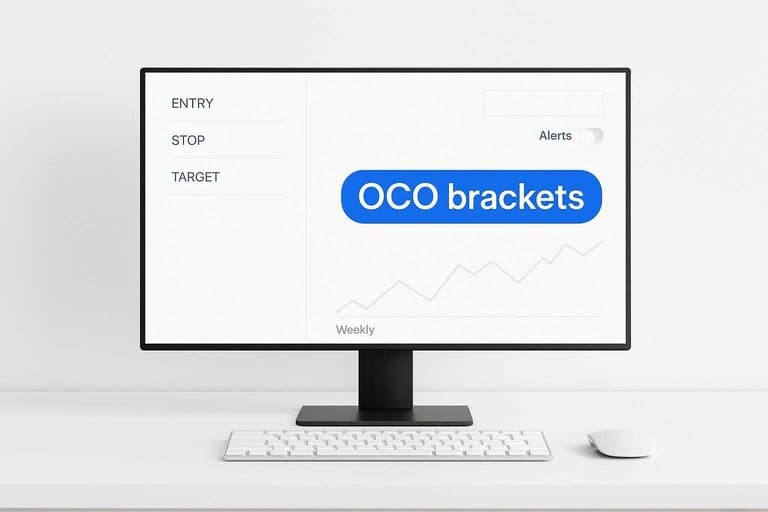
- Place orders: entries, stops, and first target as OCO brackets.
- Add contingencies: earnings freeze, news spike rule, max slippage rule.
- Schedule one midweek check: cancel, adjust, or let it ride.
Weekly is simpler to execute because the plan survives normal noise.
Alert Strategy
Alerts replace screen time, so you only touch trades when conditions actually change. You want fewer, higher-signal alerts as your cadence slows.
- Daily cadence: level break, then 1x ATR follow-through.
- Daily cadence: premarket gap beyond your stop.
- Weekly cadence: weekly close above or below a level.
- Weekly cadence: 1.5–2x ATR move from entry.
- Weekly cadence: earnings date minus five trading days.
If you’re firing more than five alerts per ticker, you built a monitoring job.
If you need a refresher on mechanics, TradingView has a solid primer on getting started with technical alerts.
Platform Setup
Your setup should make the next decision obvious, like “buy above 52.40” or “exit on weekly close below 49.10.” Daily cadence needs more clutter because you’re managing micro-structure.
Weekly minimal layout: one weekly chart with levels, one daily chart for entries, and a watchlist capped at 15 names. Daily minimal layout: daily plus 1-hour chart, more alerts, and a smaller watchlist to avoid overload.
Weekly wins for setup simplicity because your chart stays stable all week.
Psychology And Discipline
Daily and weekly reviews shape your behavior more than your charting tools do. The question is simple: do you want more chances to interfere, or more chances to follow your plan.
For most swing traders, weekly review wins for consistency because it reduces impulse decisions.
Overtrading Pressure
Daily reviews create more touchpoints, which quietly invites “just one small tweak.” More screens mean more perceived signals, and overtrading sneaks in as “being proactive.”
Weekly reviews reduce decision frequency, so fewer urges get acted on. You still monitor risk, but you stop manufacturing trades from noise.
Weekly suits most swing temperaments because it starves FOMO before it gets fed.
Confidence In Holds
Micromanagement looks like caution, but it behaves like fear. Weekly review supports holding winners by limiting your chances to sabotage them.
- You move stops because “it feels heavy.”
- You check P&L more than levels.
- You take profit to “lock something.”
- You re-enter right after exiting.
- You change the plan mid-candle.
If these show up, weekly review improves adherence by removing your hands from the wheel.
Stress Load
Daily cadence increases cognitive load because you keep reopening decisions you already made. That repetition creates decision fatigue, and fatigue makes you chase, cut, and tinker.
Weekly cadence lowers stress by batching decisions into a single, deliberate session. You spend your attention on structure, not stimulation.
Weekly is the lower-stress winner, and stress is where discipline breaks first.
Performance Tracking
Track performance so your strategy improves, not just your P&L. The right review cadence changes how fast you find repeatable mistakes.
| Review cadence | Journaling frequency | Review metrics | Learning loop speed |
|---|---|---|---|
| Daily | Per trade | Execution quality | Fast |
| Daily | End-of-day | Process adherence | Fast |
| Weekly | Batch entries | System expectancy | Medium |
| Weekly | Weekly summary | Risk and exposure | Medium |
| Hybrid | Daily notes + weekly | Both sets | Fastest |
Daily wins for faster improvement because you correct behavior before it compounds.
Pick Your Cadence, Then Lock It In for 30 Trades
- Choose a default: go weekly if your edge is trend/structure and you want fewer, higher-conviction decisions; go daily if your edge depends on timely entries, active risk reduction, or frequent setups.
- Define the “switch triggers” upfront (e.g., new job/time constraints, rising overtrading, missed entries, or repeated gap/news surprises) so you change cadence for a reason—not emotions.
- Run the routine for 30 trades while tracking expectancy, max drawdown, and rule violations; keep the cadence that improves results and reduces decision stress.
- Use alerts to bridge the gap: even with weekly reviews, set level/volatility/news alerts so the market pulls you in only when action is required.
Frequently Asked Questions
Does a market daily review still matter in 2026 if I use news alerts and screeners?
Yes—most swing traders still need a market daily to check trend, sector leadership, and key levels that alerts miss. Use alerts for speed, but use a daily review to prevent trading against the broader tape.
Do I need a market daily review on weekends too, or is a weekly market review enough?
Most traders skip the daily review on weekends and do one deeper weekly review instead. If you trade Monday open often, spend 10–15 minutes Sunday night mapping levels and catalysts.
What should be in a market daily checklist for swing trading (so it doesn’t turn into two hours)?
Keep it to 5 items: market trend (index/volatility), leading sectors, your watchlist setups, key levels/invalidations, and tomorrow’s catalysts/earnings. Cap it at 15–25 minutes and stop once orders/alerts are set.
How do I measure whether my market daily routine is improving results?
Track 3 metrics for 4–6 weeks: win rate, average R multiple, and rule violations/impulse trades. If R improves and violations drop while trade count stays stable, your daily process is working.
Can I replace a market daily review with AI tools like TradingView alerts, Finviz, or a news aggregator?
You can automate data gathering with TradingView/Finviz/news feeds, but you still need a short daily decision step to interpret context and update levels. Most traders use AI/alerts to summarize, then confirm bias and plans manually.
Upgrade Your Daily Market Review
Daily vs weekly reviews come down to time and signal quality—especially when you need regime context without turning analysis into an all-night routine.
Open Swing Trading streamlines your daily workflow with RS leadership, breadth, and sector/theme rotation context so you can build a focused watchlist in minutes—get 7-day free access, no credit card.
Sources
- Elder Triple Screen System — overview / confirmation plan (DailyForex) — referenced in Multi-Timeframe Fit
- Getting started with technical alerts (TradingView Support) — referenced in Alert Strategy