Market update stocks feel random? Debug your inputs
A practical troubleshooter for when stock market moves feel random—clarify timeframe and signal vs noise, audit data feeds for quality/latency gaps, rebuild a rates-first market map, and set expectation/ breakpoint rules to regain decision clarity.
Market update stocks feel random? Debug your inputs
A practical troubleshooter for when stock market moves feel random—clarify timeframe and signal vs noise, audit data feeds for quality/latency gaps, rebuild a rates-first market map, and set expectation/ breakpoint rules to regain decision clarity.
If stock moves feel random, it’s usually not because markets “stopped making sense”—it’s because one of your inputs is misaligned. A timeframe mismatch, a delayed data feed, or an outdated mental map can turn normal volatility into pure confusion.
This troubleshooter helps you debug the process, not predict the next candle. You’ll audit what you’re seeing, rebuild the drivers that actually matter (often starting with rates), and set expectations and thesis breakpoints so updates feel actionable instead of noisy.
Define the “random” feeling
Markets feel random when your inputs don’t match your decisions. You’re seeing real signals, but through missing context: time horizon, risk tolerance, noisy data, and conflicting narratives.
Treat the feeling like a bug report. If you can name the mismatch, you can reduce the chaos fast.
Timeframe mismatch
Randomness often shows up when you mix intraday headlines with long-term goals. A midday selloff can be irrelevant to a six-month thesis, yet it still hijacks your attention.
Try this: define your decision window in plain words. “I rebalance monthly,” or “I’m trading this week,” or “I’m holding until the thesis breaks.”
Once the window is clear, most “chaos” becomes background noise.
Noise vs signal cues
Most market updates blend useful data with attention bait. You need quick filters, not more tabs.
- Social feeds optimizing for outrage
- Single earnings beats without guidance
- Hot sector chatter without valuation
- Vague “risk-on” talk without drivers
- Chart screenshots without timeframe
If the source won’t state the horizon, it’s probably selling adrenaline.
Three quick clarifiers
Answer three questions before you consume another update.
- What’s my horizon for this decision?
- What’s my thesis in one sentence?
- What input would change my action?
If you can’t answer #3, you’re not researching. You’re grazing.
Audit your data feeds
When stocks feel random, your inputs are usually noisy, late, or incomplete. Start by listing every feed you rely on, then rank them by how they fail under pressure.
Source quality check
Trustworthy sources are closest to the event and hardest to fake. Unreliable sources are easy to share, hard to verify, and perfect for trading you into confusion.
Primary beats secondary when precision matters: SEC filings, official press releases, and full earnings-call transcripts. Reputable newswires help when you need fast, attributed facts, with corrections and timestamps. Anonymous posts, cropped screenshots, and “heard from a friend” notes belong in quarantine until confirmed by a primary document.
Build your process around sources that can be audited, not vibes that can’t.
Latency and revisions
A clean chart can still be a dirty timeline. If your numbers are stale or later revised, price moves will look like magic tricks.
Delayed quotes can hide the real sequence of trades, especially around open, close, and fast headlines. After-hours prints can reflect thin liquidity, late blocks, or corrections that didn’t hit your feed in real time. Economic releases also get revised, so your “surprise” may vanish once the prior month gets restated.
If you can’t align timestamps, you’re not analyzing the move—you’re narrating it.
Coverage gaps list
Most “unexplainable” moves become explainable when you add the missing lenses. A basic stock-only view ignores the cross-asset levers that reprice risk.
- Rates level and curve shifts
- FX moves versus revenue exposure
- Credit spreads and funding stress
- Commodity proxies for input costs
- Positioning and sector index weights
Fix the blind spots first; predictions get easier when your map stops omitting roads.
Rebuild the market map
Markets feel random when you track headlines instead of inputs. Build a small causal map from macro to rates to earnings to positioning.
Once you can name the drivers, you can write scenarios instead of stories.
Top-down drivers
Start with the few levers that move many assets at once. Keep the list short, or you will overfit every candle.
- Inflation expectations and pricing power
- Growth surprises versus consensus
- Central bank reaction function
- Liquidity and funding conditions
- Geopolitical risk and risk premia
When three levers turn together, “random” usually means “you missed a link.”
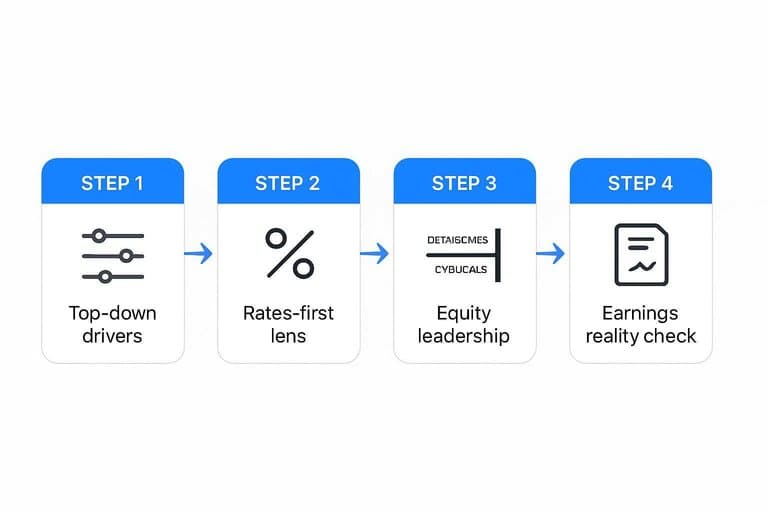
Rates-first lens
Equities often trade like a duration asset. Read the tape through rates first, then check if earnings confirms it.
- Check real yields first; higher real yields pressure long-duration equities.
- Read curve shape; steepening can mean growth, or inflation, or both.
- Scan term premium; rising premium can hit multiples without new data.
- Compare rates move to equity leadership; defensives versus cyclicals tells you why.
- Decide if rates dominate; it usually does around CPI, jobs, and central banks.
If the rates story is coherent and leadership agrees, stop hunting for a headline villain.
Earnings reality check
Earnings are two things at once: cash flows and expectations. Guidance shifts the path, margins change the slope, and discount rates set the math.
A beat can still be bearish when forward guidance is cautious, estimates drift down, or the discount rate jumps. Watch revisions, not just prints. That’s where “good news, down stock” usually lives.
Debug price confusion
When stocks feel random, it’s usually your inputs, not the market. Read the chart and tape like a system: regime first, then microstructure, then events. You’re separating trend, mean reversion, and gap-driven repricing. It also helps to ground your read in a consistent, end-of-day view of what’s actually leading (and what isn’t) so you’re not projecting “randomness” onto a market that’s simply rotating—something a research layer like Open Swing Trading’s daily relative strength, breadth, and sector context can make easier to sanity-check alongside your charts.
Regime ID steps
Classifying the regime stops you from forcing trend tools onto chop. It also tells you whether “noise” is just volatility doing its job.
- Mark the last swing highs and lows, then label higher-highs or lower-lows.
- Measure daily range versus recent average to tag volatility as high or low.
- Check whether reversals happen near a stable midline or drift away from it.
- Note which moves align with scheduled releases, auctions, or central bank days.
- Decide: trend, chop, or event-driven, then choose one playbook.
If you want an additional objective check on “trend vs. chop,” add a quick breadth/leadership scan: are new highs expanding, are RS leaders holding up, and is strength concentrated in a few names or spreading across groups? A daily market-breadth snapshot and relative strength rankings can reinforce (or challenge) what you’re labeling from price alone.
Once you name the regime, half the “randomness” disappears because your expectations finally match reality.
Microstructure pitfalls
Charts can lie when the plumbing matters more than the pattern. These are the usual traps when price behaves “weird” around obvious levels.
- Thin liquidity exaggerates moves and fakes breakouts.
- Stop runs print beyond levels, then snap back fast.
- Options pinning pulls price toward crowded strikes.
- Rebalancing flows create one-way pressure near closes.
- Headline algos spike and reverse on keyword hits.
One practical way to reduce false “pattern narratives” is to focus your attention on names showing sustained relative strength versus the broader universe—thin, news-whipped movers often won’t persistently rank as leaders once the dust settles.
If the tape looks jumpy and discontinuous, treat your “level” as a zone, not a line.
When to ignore charts
Some days technicals are a secondary input because price is being reset by information. Your job is to know when the chart is describing the past, not forecasting the next hour.
Deprioritize chart signals during earnings releases, major macro prints like CPI, and central bank decision windows. Do the same after sudden policy headlines, geopolitical escalations, or unexpected guidance changes. Also step back when spreads widen, depth thins, or your fills show obvious slippage.
Even if you’re stepping aside intraday, it can still be useful to do a calm end-of-day reset: check whether the shock actually changed leadership, breadth, or sector/industry strength (versus just creating a temporary volatility event). That kind of post-close review is often where data-driven RS and breadth tools add clarity without turning into “signals.”
On those days, trade the calendar and liquidity first, or don’t trade at all.
Fix your expectations
Daily moves feel random when your mental baseline is wrong. Reset it with one consistent reference, then judge surprises against that.
Use one baseline to separate normal noise from real signal.
| Input you assume | Baseline to use | What “normal” looks like | What to do next |
|---|---|---|---|
| Expected return | Your long-run plan | Small, uneven gains | Recheck horizon, not headlines |
| Volatility | Your risk budget | Big swings happen | Size positions for swings |
| Downside risk | Your max drawdown | Drops are routine | Predefine exit or hedge |
| News impact | Your scenario set | Most news fades | Track thesis, not stories |
| Timing skill | Your process edge | Many flat periods | Measure over cycles |
If your “normal” column surprises you, your issue is calibration, not randomness. (For a concrete benchmark, see the VIX methodology for how implied volatility is defined.)
Spot thesis breakpoints
Market updates feel random when your thesis has no failure conditions. You end up reacting to headlines instead of checking inputs against a plan.
Define what breaks your view before you read the next update. Then the news becomes a test, not a trigger.
Predefine invalidations
Write your thesis so it can be wrong, fast. You want triggers tied to observable inputs, not your mood.
- State your thesis in one sentence, including the time horizon.
- List 2–3 key drivers you expect to move fundamentals.
- For each driver, pick one observable input you can track consistently.
- Write two invalidation triggers using “If X happens, I’m wrong.”
- Pre-commit an action per trigger: exit, trim, hedge, or re-underwrite.
If you can’t name the inputs, you don’t have a thesis. You have a vibe.
Catalyst calendar
Track the events that change inputs, not the ones that change emotions. Put them on a calendar so you stop “discovering” them mid-move.
- Earnings dates and investor calls
- Guidance updates and pre-announcements
- Key macro releases you follow
- Fed meetings and minutes
- Index rebalances and option expiries
Most “random” price action is scheduled. The surprise is usually your attention, not the market’s.
Post-update checklist
After an update, you’re not asking “Is this good or bad?” You’re asking “Did this hit my triggers?”
Compare the new information to your observable inputs first. Then adjust your probabilities, and choose one action: hold, trim, add, hedge, or do nothing. If nothing changed, do nothing.
The edge is consistency. Your process should move faster than your feelings.
Turn the next market update into a controlled test
- Restate the question in one timeframe. “What should happen over the next day/week/quarter if my thesis is right?”
- Verify the inputs. Check source quality, timestamps/latency, revisions, and what’s missing (coverage gaps) before interpreting price.
- Rebuild the driver chain. Start with rates and liquidity, then layer macro/sector, then earnings—write the “if X, then Y” links.
- Classify the regime and ignore the wrong tools. In trendless or event-driven regimes, de-weight chart patterns and focus on catalysts and positioning.
- Log the breakpoint. Define what would invalidate the thesis, note the next catalyst date, and run a quick post-update checklist to decide: hold, adjust, or exit.
Frequently Asked Questions
What should a daily market update include so stock moves don’t feel random?
A useful market update stocks routine usually covers three buckets: macro/rates (what changed), earnings/news (what actually hit), and positioning/breadth (how traders were already leaning). If one bucket is missing, price action often looks “random” because you’re seeing effects without the cause.
How do I tell if a “random” stock move is just normal volatility or real information?
Compare the move to the stock’s recent average range (e.g., ATR) and check whether the move came with a catalyst (earnings, guidance, macro data) or a broad index/sector impulse. Big moves inside normal range with no new info are often noise; abnormal range plus a clear catalyst is often information.
Which indicators help explain market update stocks headlines without overfitting?
Start with a small, stable set: index trend + volatility (e.g., VIX), yields/credit spreads, market breadth (advance/decline, new highs/lows), and sector relative strength. Too many indicators usually creates conflicting signals that feel like randomness rather than clarity.
How can I track sector rotation and breadth quickly when following market update stocks every day?
Use a consistent dashboard: sector/industry relative strength vs the index, a breadth snapshot (A/D line, % above key moving averages, new highs/lows), and a short list of leading stocks making constructive bases. Tools like Open Swing Trading can speed this up with daily RS rankings, breadth, and sector/theme views so you can focus on decision-making, not data wrangling.
What’s a good way to summarize a market update for my watchlist without chasing headlines?
Write a one-paragraph “regime note” (risk-on/off, rates direction, leadership sectors) plus 3–5 if/then scenarios tied to your watchlist (e.g., “if yields rise, prefer X sector; if breadth improves, add breakouts”). This keeps your actions anchored to conditions rather than reacting to each new headline.
Rebuild Your Market Inputs
If stocks feel random, it’s usually a sign your data, context, or expectations are out of sync with the current regime—so the same charts stop making sense.
Open Swing Trading gives you daily relative strength rankings, breadth, and sector/theme rotation context across ~5,000 stocks so you can spot leaders and thesis breakpoints faster—get 7-day free access with no credit card.
Related Articles
- Stock Market Data: End-of-Day vs Real-Time for Swing Traders
- Set up a market breadth dashboard in 30 minutes
- Sector rotation analysis vs relative strength for breakouts
Sources
- Treasury Term Premia | Federal Reserve Bank of New York — referenced in Rates-first lens
- Cboe Volatility Index® (VIX®) Methodology (PDF) | Cboe Global Markets — referenced in Fix your expectations