Open Stocks Explained: Open Price, Gaps, Range
A pillar guide to understanding the stock market open and how to trade around it—open price formation, gap types and causes, opening range breakouts vs fades, and range/volatility cues you can use for better entries and risk sizing.
Open Stocks Explained: Open Price, Gaps, Range
A pillar guide to understanding the stock market open and how to trade around it—open price formation, gap types and causes, opening range breakouts vs fades, and range/volatility cues you can use for better entries and risk sizing.
If you’ve ever watched a stock print wildly at 9:30 and thought, “Why is the open never the price I expected?”, you’re not alone. The first minutes can compress overnight news, hidden liquidity, and order imbalances into one chaotic burst.
This guide breaks that chaos into a repeatable framework. You’ll learn how the open price is actually set, what different gaps usually signal (and when “gap fill” logic fails), how to use the opening range to plan trades, and how to translate range and volatility into position size and risk.
Opening Snapshot
The market open is the first moment your chart turns from “yesterday” into “today.” Those first prints concentrate overnight news, queued orders, and fresh positioning into one visible price, and traders treat it like the session’s tone-setter.
In practice, the open often brings the day’s highest liquidity and some of its messiest volatility. That mix is why the open can “feel” decisive, even when it’s just the market clearing a backlog.
What is open?
The “open” is the start of regular trading hours when the first executable trades print for the session. It can mean the first trade you see, or the official open price set by an opening auction, and those are not always identical.
Many venues run an opening auction that matches buy and sell orders into a single clearing price. Some feeds show the first continuous trade, while the “official open” is the auction result, and the timestamps can differ by venue and data provider.
If your data disagrees, check the auction print first. That’s usually the anchor institutions used.
Why open matters
The open compresses a lot of information into a few minutes, so your expectations can skew fast. You care because it changes both what price means and how easy it is to trade.
- Resets price discovery after overnight news
- Concentrates liquidity as queued orders execute
- Reveals positioning via gaps and fast repricing
- Produces early volatility from order imbalances
Trade the open like a special regime, not “just another minute.” That’s how you avoid getting chopped.
Core terms map
Use one mental model: the open is the day’s first reference point, and everything else measures distance from it. A gap is the jump from yesterday’s close to today’s open, while the opening range is the first defined slice of intraday action.
The day’s range is simply high-to-low, and an intraday trend is how price behaves relative to the open and that opening range. Example: “Gap up, holds opening range, then trends higher” is a very different day than “Gap up, fails opening range, then mean-reverts.”
Once you can name the sequence, you can plan the trade. Words become rules.
Open Price Mechanics
The open price is not a guess. It is a negotiated clearing point where queued orders meet fresh marketable flow.
On most primary listings, an opening auction collects orders, computes an indicative match price, then prints one official open. That single print can still look different across brokers, feeds, and charts.
Auction basics
The opening auction is designed to turn chaos into one tradable price. It does that by measuring supply versus demand and then clearing as much as possible.
An exchange typically runs the auction like this:
- Imbalance: shares to buy versus shares to sell at the open.
- Indicative match price: a live “would-open-at” price if it stopped now.
- Price selection: choose the price that maximizes executable volume.
- Tie-breakers: minimize imbalance, then favor last sale or reference price.
Watch the indicative price drift toward heavy size. That’s where the real fight is.
Order types at open
Your order’s rules matter most at the open, because prints can jump. Auction logic treats each type differently.
- MOO/LOO: only participate in the opening auction.
- Market: converts to aggressive interest at the clearing price.
- Limit: only executes if the open is at-or-better.
- Stop: usually triggers after the open, not inside it.
- Stop-limit: triggers, then behaves like a limit order.
If you don’t control price, you’re volunteering for the clearing price.
Consolidated vs venue
There is an official open for the primary listing venue. There is also a consolidated stream of quotes and prints across many venues.
Charts can disagree because one feed shows the primary exchange’s opening cross, while another shows the first consolidated trade. Some brokers label “open” as the first print they receive, not the official auction print.
If two charts differ, ask which tape and which venue they call “the open.”
Pre-market influence
Overnight trading sets expectations before the auction locks in a price.
- News hits, and pre-market quotes reprice the stock fast.
- Liquidity thins, so small orders move the displayed spread.
- Participants adjust MOO/LOO and limits, creating visible imbalance.
- The indicative match price updates as size stacks on one side.
- The opening cross prints where the most shares can clear.
Pre-market doesn’t set the open directly. It sets the arguments that decide it.
Gaps Demystified
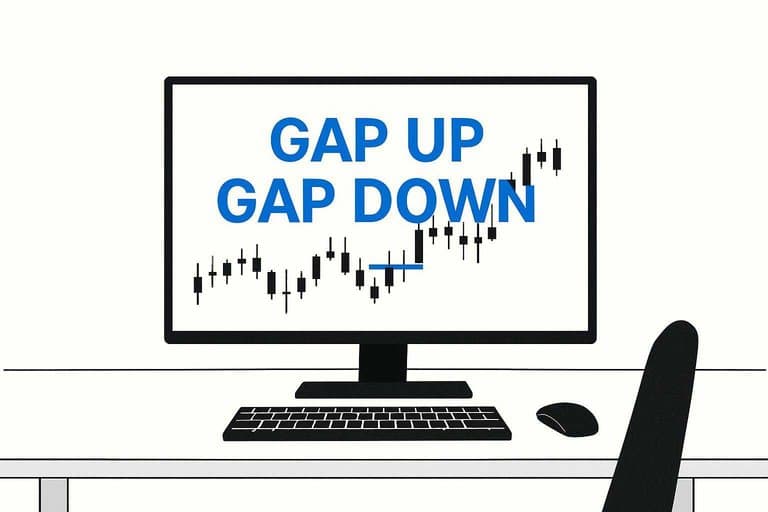
A stock gap is when today’s open prints away from yesterday’s regular-session range. It’s the market repricing while you were off the clock, often on news or thin liquidity.
Gap definitions
A “gap up” opens above the prior day’s high, and a “gap down” opens below the prior day’s low. A true gap clears a meaningful level, while a tiny dislocation is just spread, noise, or a fast auction. The clean reference is prior regular-session close, but after-hours prints can explain the jump.
Common gap causes
Most gaps are catalysts plus positioning, not magic candles. Look for:
- Earnings results or surprises
- Guidance changes and outlook tone
- Macro releases and rate moves
- Analyst upgrades, downgrades, target cuts
- Sector news and peer sympathy moves
Gap taxonomy
Traders call some gaps breakaway, continuation, or exhaustion, but those labels are hindsight-prone. A breakaway gap often leaves a base and starts a new trend, while continuation gaps show momentum mid-trend, and exhaustion gaps show late, crowded chasing. Each label is a probability guess, not a guarantee.
Gap fill logic
Evaluate fill odds with a few context checks, not a single rule.
- Identify the catalyst and rate its staying power.
- Compare gap volume to the stock’s recent average.
- Check the higher-timeframe trend direction and slope.
- Mark nearby support and resistance from prior pivots.
- Watch the first 15–60 minutes for acceptance or rejection.
Opening Range Framework
Define opening range
The opening range (OR) is the price high and low made in the first 5, 15, or 30 minutes. You mark the OR high, OR low, and treat that box like the day’s first real auction, not noise.
Your timeframe choice changes the signal. A 5-minute OR reacts fast but whipsaws more, while a 30-minute OR filters chop but enters later, like waiting for “the market to show its hand.”
Pick one window per market and keep it consistent, or your read will drift.
What OR measures
The OR shows who showed up early and how hard they pushed. It’s your first clue about participation and control.
- Balance of power between buyers and sellers
- Early volatility and urgency into the open
- Trapped traders from failed pushes
- Liquidity pockets near obvious levels
If the OR is clean and decisive, you’re seeing real participation, not random ticks.
Breakout vs fade
OR breakouts tend to work when the day has a reason to trend. Think news catalysts, strong premarket levels, or broad market alignment where dips get bought quickly.
Fades and mean reversion dominate on quiet days with mixed signals. You’ll see early spikes reverse back through the OR, then chop around VWAP as neither side can hold control.
Treat the OR like a regime test: trend day, or range day.
OR checklist
Use a repeatable routine so you don’t improvise under speed.
- Mark OR high and low after your chosen window closes.
- Note volume and spread during the OR versus recent opens.
- Watch for a breakout and a clean retest of the OR edge.
- Set invalidation just inside the OR, not “somewhere below.”
- Size down when whipsaws hit, then re-engage on clarity.
Your edge is the invalidation point, because it tells you when the OR idea is wrong.
Range and Volatility
Range definitions
Daily range is simple: today’s high minus today’s low. It tells you how far price actually traveled, not how it started.
True range fixes a common blind spot: gaps. It’s the max of (high–low), (high–yesterday close), or (low–yesterday close), so an “air pocket” counts. ATR is true range smoothed over N days, like a 14-day average, to reduce one-day noise.
Use range for travel, true range for shock, and ATR for your baseline.
Range signals
Range patterns show whether the open created energy or just motion.
- Range expansion: bigger than recent average
- Inside day: high-low stays within yesterday
- Outside day: breaks both yesterday’s extremes
- Volatility compression: ranges shrink for days
- Regime shift: sustained new range level
When range changes level, your old “normal” stops being normal.
Open-to-close behavior
Intraday volatility usually follows a U-shape: loud at the open, quieter midday, louder into the close. The open is noisy because overnight information hits all at once, liquidity is still forming, and stops get triggered fast.
That’s why early candles often exaggerate both fear and confidence. If you expect midday calm during a news-driven open, you’ll misread random chop as signal.
Match your expectations to the time of day, or you’ll fight the tape.
Sizing with range
Use range to turn “I like this setup” into numbers.
- Pick a volatility unit: ATR(14) or opening range (OR).
- Set stop distance: e.g., 0.8×ATR or 1×OR.
- Set risk per trade: e.g., 0.5% of account.
- Compute size: shares = risk dollars ÷ stop dollars.
- Set target: at least 1.5–2.5× stop, or next level.
If your stop needs to be wider than the day can support, skip it.
Scenarios at Open
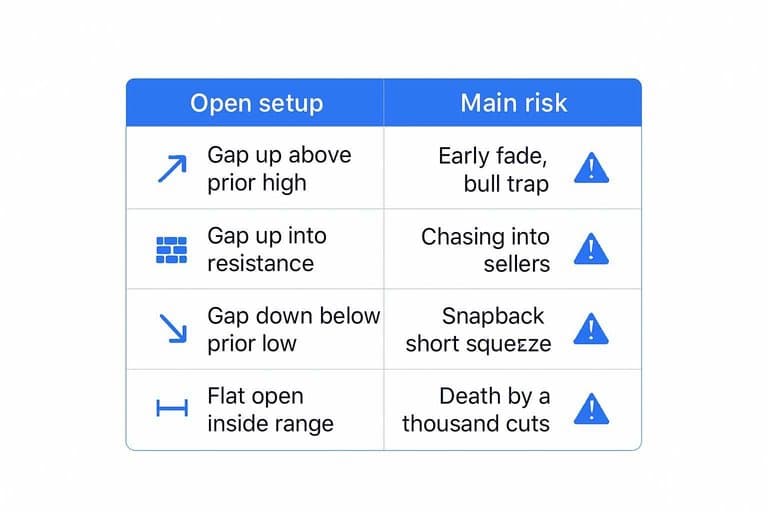
You can’t read the open without context, because the same print can mean trend or trap. Use this cheat sheet to tag the setup, then decide your risk before you click.
| Open setup | Common context | Often implies | Main risk |
|---|---|---|---|
| Gap up above prior high | Strong catalyst, bullish tape | Momentum continuation | Early fade, bull trap |
| Gap up into resistance | Prior supply zone overhead | Quick rejection likely | Chasing into sellers |
| Gap down below prior low | Bad news, weak market | Trend day down possible | Snapback short squeeze |
| Flat open inside range | No new info, balanced | Mean reversion, chop | Death by a thousand cuts |
| Open outside range, then re-enter | Exhaustion after gap | Failed breakout, reversal | Fakeout whipsaw |
Your edge starts when you name the scenario, then size for the risk it attracts.
How to Read Charts
You can read the open cleanly if you mark levels before you judge candles. Think like a referee, not a storyteller. Your job is to separate a real gap from a charting artifact.
Key levels first
Mark levels before you watch price, or your eyes will lie to you.
- Mark the prior regular-session close as your gap anchor.
- Mark premarket high and low to see overnight acceptance.
- Mark the gap midpoint between prior close and today’s open.
- Mark the opening range high and low for your chosen window.
- Mark major HTF support and resistance on daily and weekly.
If you can’t point to these lines, you’re trading vibes, not structure.
Volume and liquidity
The open is an auction, so volume tells you if the move has real sponsorship. A push through the opening range on rising volume often sticks, while the same move on light volume often snaps back.
Thin liquidity at the open also stretches gaps and wicks, especially in small caps and premarket prints. One aggressive order can paint a scary candle that never had depth behind it.
For a closer look at how the opening and closing auctions actually work, it helps to understand how price is formed at a single clearing print.
Treat early candles like headlines, then confirm with volume and follow-through.
Common chart traps
Most “weird gaps” are settings problems or selection bias, not market signals.
- Using adjusted prices that shift past closes
- Mixing extended-hours with regular-session levels
- Running the wrong exchange or session template
- Trusting survivorship-biased watchlists and backtests
- Cherry-picking an opening range window after the fact
Fix the chart first, or you’ll optimize a mistake.
Rules of Thumb
Use these heuristics to read the open without pretending it’s a crystal ball. Think “context and odds,” not “guarantees.”
- Big gap + instant fade often signals weak conviction
- Big gap + early hold suggests real demand
- Small gap, wide range usually means disagreement
- Small gap, tight range often means waiting for news
- Opening range break matters more with volume
Treat them as filters for risk, then let price confirm.
Turn the Open Into a Repeatable Plan
- Start with the context: mark prior day high/low/close, key pre-market levels, and any news catalysts.
- Classify the open: identify whether it’s an in-range open, a gap up/down, or an open near an extreme—then note early volume and liquidity.
- Define the opening range: set your OR window, mark its high/low, and decide in advance whether you’ll trade a breakout, a fade, or stand aside.
- Size with range, not emotion: use the day’s early range/volatility to set stops and position size so one open-driven move doesn’t break your risk limits.
Frequently Asked Questions
What time do U.S. stock markets open, and does “open stocks” include pre-market and after-hours trading?
NYSE and Nasdaq open at 9:30 a.m. ET; pre-market usually runs 4:00–9:30 a.m. ET and after-hours 4:00–8:00 p.m. ET. “Open stocks” typically refers to the regular-session open print, not extended-hours quotes.
Which is more reliable for open stocks analysis: the opening print or the first 5–15 minutes of trading?
The first 5–15 minutes is usually more informative because it shows whether early moves hold once more liquidity arrives. Many traders use 5- or 15-minute candles to reduce noise from the initial auction and immediate order imbalances.
How can I quickly check whether a stock is gapping up or down before the market open?
Compare the pre-market last price (or indicative open) to the prior day’s close in your broker, TradingView, or Nasdaq/NYSE quote pages. A move of ~1–2% or more is often treated as a meaningful gap for liquid large-caps, while small-caps commonly gap more.
What catalysts most often drive big moves in open stocks?
Earnings releases, guidance changes, analyst upgrades/downgrades, macro data (CPI, jobs), and major news (M&A, lawsuits, FDA decisions) most often cause outsized open volatility. These events concentrate new information outside regular hours, so price adjusts rapidly at the open.
How do I manage risk when trading open stocks during the most volatile first minutes?
Use smaller position sizes, define a hard stop based on a price level (not a dollar amount), and consider limit orders to control slippage. Many traders also wait for spreads to tighten—often 1–5 minutes on liquid names—before entering.
Find Leaders Before the Open
Understanding open price mechanics, gaps, and the opening range is powerful—but applying it daily requires a dependable way to spot real leadership and market regime shifts.
Open Swing Trading streamlines stock selection with daily RS rankings, breadth, and sector/theme rotation context across ~5,000 names—no buy/sell signals. Get 7-day free access with no credit card.
Sources
- StockCharts ChartSchool – Average True Range (ATR) and ATR% — referenced in Range definitions
- NYSE Opening and Closing Auctions – Fact Sheet (PDF) — referenced in Volume and liquidity