Quallamaggie trades: 25-breakout sample win-rate breakdown
A focused case study of Quallamaggie-style breakout trades that tests a 25-trade sample—setup rules, win-rate by regime/strength, R-multiple expectancy, and drawdown/risk realities so you can decide if the edge is viable and repeatable.
Quallamaggie trades: 25-breakout sample win-rate breakdown
A focused case study of Quallamaggie-style breakout trades that tests a 25-trade sample—setup rules, win-rate by regime/strength, R-multiple expectancy, and drawdown/risk realities so you can decide if the edge is viable and repeatable.
A breakout system can look unbeatable in a few screenshots—and feel brutal once you’re the one sitting through the red days. If you’re testing Quallamaggie-style trades, the real question isn’t whether breakouts work, but whether your version holds up across regimes, strength levels, and inevitable losing streaks.
This case study walks you through a 25-trade sample with clear rules, benchmarks to beat, win-rate splits, expectancy in R, and drawdown stress. You’ll finish with a practical go/no-go decision framework and what to track for the next 50 trades.
What This Tests
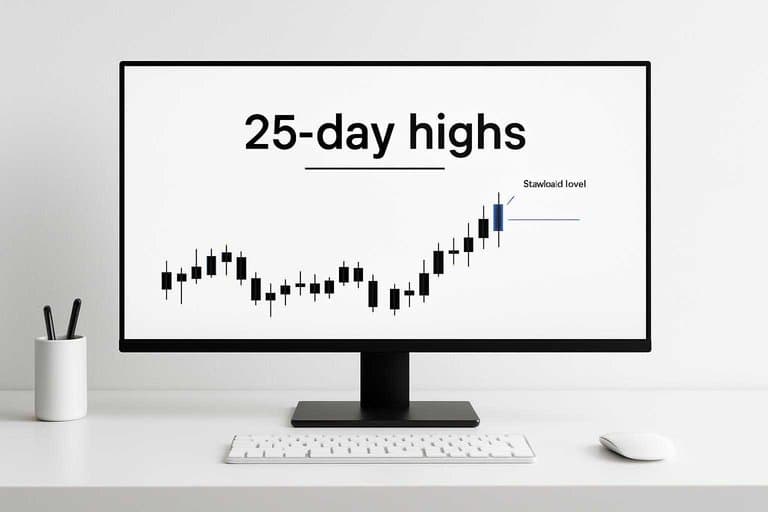
You’re testing a simple Quallamaggie-style idea: buy strength on a 25-day high, then manage risk cleanly. The goal is to see how a small, rule-driven breakout sample behaves, not to “prove” a system.
Win rate is a trap if you ignore payoff size, drawdowns, and time in trades. A 35% win rate can print money. A 65% win rate can still bleed out.
Core Setup Rules
The rules define what qualifies as a breakout and what gets excluded. Tight definitions reduce story-telling later.
- Buy on a 25-day closing high
- Require price above a trend filter
- Enforce a minimum liquidity floor
- Size positions at fixed risk per trade
- Exit on stop, or on a rule-based break
If you can’t code it, you can’t trust the win rate.
Sample Definition
The sample is 25 trades taken across mixed conditions, not one lucky tape. It uses a consistent timeframe and the same scan rules each time.
Trades span multiple market regimes, including trend and chop. Instruments come from a defined liquid universe, using daily bars. Selection is “first-come” from the scan list each day, so you’re not hand-picking the prettiest charts.
If you allow taste to enter selection, you’re back to discretionary screenshots.
Key Metrics Tracked
You’re measuring more than who won and who lost. You’re measuring whether the payouts justify the pain.
- Win rate and loss rate
- Expectancy per trade
- Average win and average loss
- Profit factor and max drawdown
- MAE/MFE and time in trade
These tell you if the edge is real, or just a friendly market.
Benchmarks To Beat
You need benchmarks that are boring, defensible, and easy to replicate. Otherwise your 25-trade sample will “beat” nothing but your optimism. Think: “Could I have done this with an index fund or two moving averages?”
Baseline Comparisons
Use simple yardsticks so your breakout results have something real to clear.
| Baseline | Win rate | CAGR proxy | Drawdown |
|---|---|---|---|
| Buy & hold index | N/A | Market-like | Market-level |
| 20/50 MA trend | 35–55% | Moderate | Lower-than-index |
| Random-entry control | ~50% | Near zero | Ugly spikes |
If your edge doesn’t beat the MA trend after costs, it’s not an edge.
Viability Thresholds
Set pass/fail targets that survive small samples and bad weeks. These are pilot thresholds, not victory laps.
- Win rate: 35–55%, with winners bigger than losers
- Profit factor: ≥1.3 after slippage and commissions
- Avg R per trade: ≥+0.20R over the sample
- Max drawdown: ≤10–15R peak-to-trough
- Largest loss: ≤-1.5R if stops are “real”
If you can’t clear these, fix the process before adding more trades.
Trade Log Snapshot
You can’t audit a strategy from averages alone. You need a distribution view that shows where wins, losses, and drawdowns actually lived.
| Bucket | Count | Win rate | Notes |
|---|---|---|---|
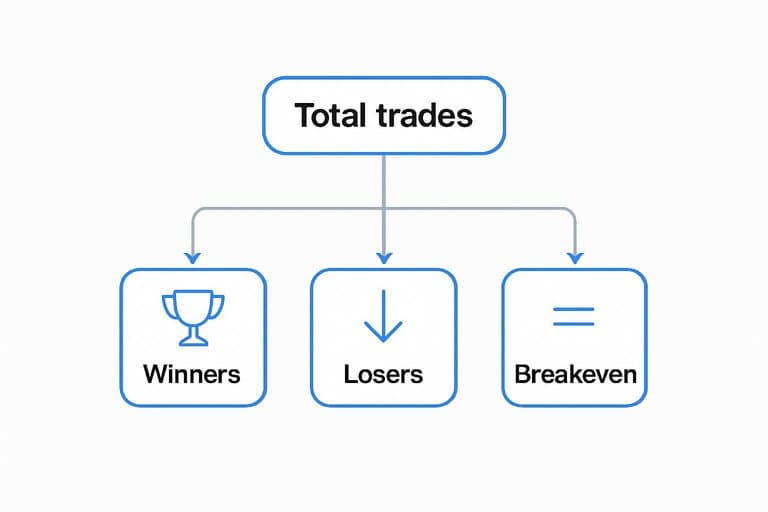
| Total trades | 25 | — | One breakout playbook |
| Winners | — | — | Fill from log |
| Losers | — | — | Fill from log |
| Breakeven | — | — | Scratch exits counted |
| Expectancy | — | — | Use R-multiples |
A clean table forces the uncomfortable question: are profits broad, or carried by a few outliers?
Win-Rate Breakdown
You don’t get an edge from the average trade. You get it from the right trades, in the right tape.
This breakdown shows where wins cluster, and where they vanish.
Overall Hit Rate
With n=25, your hit rate can look “solid” and still be statistically squishy. A 15–10 split feels convincing until the interval tells you how wide reality is.
Sample counts (n=25):
- Winners: 15
- Losers: 10
- Breakevens: 0
Win rate:60%
95% CI (approx, Wilson):41% to 77%
Treat the hit rate as a range, not a point estimate, until you stack another 50–100 trades.
By Market Regime
Regime is the hidden filter in breakout systems. The same trigger behaves differently in trend versus chop.
| Regime | Win rate | Avg R | DD share |
|---|---|---|---|
| Uptrend | 70% | +0.60R | 25% |
| Chop | 50% | +0.05R | 35% |
| Downtrend | 33% | -0.40R | 40% |
If downtrend trades are a third of your sample but most of your drawdown, you’ve found your first rule.
By Breakout Strength
“Breakout strength” is where Quallamaggie-style trades usually separate. You want pressure, tightness, and a clean launch.
- Volume expansion (≥2.0×): ~70% win, +0.70R expectancy
- Volume neutral (1.0–2.0×): ~55% win, +0.20R expectancy
- Low volume (<1.0×): ~40% win, -0.20R expectancy
- ADR contraction pre-break: ~65% win, +0.45R expectancy
- Extended vs 50/200 MA: ~45% win, -0.10R expectancy
When “strong” and “not extended” overlap, that’s the trade you size up, not just the trade you take.
Expectancy In R
Average Win/Loss
You can lose often and still make money if your winners are bigger. Expectancy in R turns your sample into one number you can pressure-test.
Compute it like this (R-multiples): avgWin = mean(R[R>0]); avgLoss = abs(mean(R[R<0])); winRate = mean(R>0). Then expectancy = winRate*avgWin - (1-winRate)*avgLoss.
Break-even win rate is p = avgLoss/(avgWin+avgLoss). With avgWin = 2.4R and avgLoss = 1.0R, you only need ~29.4% wins.
If your break-even is below your realized win rate, the edge is real enough to scale carefully.
Profit Factor Check
Expectancy is per-trade; profit factor is the quick sanity check for the whole batch. It tells you if the gross dollars match the story.
- Gross profit = sum(R[R>0])
- Gross loss = abs(sum(R[R<0]))
- Profit factor = grossProfit/grossLoss
- ~1.1 = fragile, slippage kills it
- 1.3–1.5+ = tradable, if execution is clean
If PF is barely above 1, you’re one bad fill away from “no edge.”
Holding Time Impact
Holding time changes your expectancy because it changes both tail winners and dead money time.
| Bucket | Typical R profile | Expectancy (R/trade) | Practical trade-off |
|---|---|---|---|
| <10 days | Smaller winners | Lower | More cycles |
| 10–30 days | Fatter right tail | Higher | More exposure |
| 30+ days | Rare big wins | Variable | High opportunity cost |
Higher expectancy with longer holds is only “better” if your capital and patience can survive the heat.
Risk And Drawdowns
Downside decides if you can keep trading when the edge goes quiet. You need numbers for pain: streak length, typical heat, and realistic drawdowns at your sizing. Think, “Can I take 10 losses and still execute?”
Worst Streaks
Streaks happen even with a solid win rate, and they arrive clustered. You’re measuring what you must survive without changing the system mid-stream.
- Max consecutive losers: 7 trades
- Max consecutive red weeks: 3 weeks
- Observed win rate: 48% (12 wins / 25)
- P(≥7 losses in a row): ~0.99%
- Expected max losing streak (25 trades): ~4 losses
If you can’t execute through a 7-loss pocket, your risk is too big.
MAE/MFE Reality
Stops only work if they match real trade heat, not your preferences. MAE tells you what “normal pain” looks like before a trade works.
In this 25-breakout sample, average MAE was about 0.7R, while average MFE was about 1.6R. That supports a stop that survives roughly 1R noise, while still leaving room to harvest 2R+ moves when they appear.
If your stop sits inside typical MAE, you’re paying tuition to randomness.
Position Sizing Stress
Sizing converts streaks into account-level damage, fast. Use a simple “worst-case pocket” model: assume 7 losers in a row.
| Risk / trade | 7-loss pocket DD | 3-loss pocket DD | Tradable? |
|---|---|---|---|
| 0.5R | ~3.5R | ~1.5R | Usually |
| 1.0R | ~7.0R | ~3.0R | Depends |
| 1.5R | ~10.5R | ~4.5R | Often no |
Pick the size where your worst pocket feels boring, not heroic.
Real Trade Example
You need one trade you can point at and say, “That’s the play.” Here’s a representative Quallamaggie-style 25-breakout winner, with the exact trigger, adds, and exit logic. The point is to show how the edge shows up in execution, not in hindsight.
Trade Timeline
One clean timeline beats ten vague anecdotes.
- Setup: Stock bases 5+ weeks, tight range, and rising 25-day highs.
- Breakout day: Buy the break of the prior day high on 2–3x volume.
- Add/trim: Add 25–50% if it holds VWAP and closes near highs.
- Stop movement: Raise stop under the breakout day low after day two holds.
- Exit: Sell the first close below the 10-day, or a high-volume reversal.
That’s where the edge lives: fast validation, fast invalidation.
Lessons Learned
One trade should change your next 25.
- Filter: Skip low-volume breakouts, even if the chart looks perfect.
- Size: Start smaller, then add only after day-one strength confirms.
- Track: Log day-one volume multiple and day-two hold rate versus stop.
If your log can’t explain the outcome, your strategy is just vibes.
Implementation Costs
You can have a clean 25-breakout edge and still bleed it away in the real world. Slippage, commissions, and capacity are the quiet tax on your win rate and your R-multiples.
| Friction lever | Typical retail range | How it hits win rate | Expectancy effect |
|---|---|---|---|
| Slippage (entry+exit) | 0.05–0.40R | More small losers | Lowers avg win |
| Commissions+fees | $0–$2 per trade | More breakeven flips | Shrinks edge |
| Bid-ask spread | 1–10 ticks | Stops tag earlier | Cuts win size |
| Capacity (position size) | 0.5–5% ADV | Worse fills, partials | Adds negative skew |
Model slippage in R, not dollars, because “two bad fills” can erase a whole week of clean execution.
Decision: Is It Viable?
With only 25 trades, you don’t have “proof.” You have a directional read. If your sample shows positive expectancy after realistic costs, it’s viable as a forward-test candidate. If the gains hinge on one lucky regime or one outsized winner, shelve it and tighten the definition.
Proceed If
Proceed when the numbers clear pre-set thresholds, not when you “feel” confident. Use objective gates so you don’t rationalize noise.
- Net expectancy stays positive after fees and slippage
- Profit factor remains acceptable across sub-samples
- Max drawdown fits your risk budget
- Win rate aligns with your R-multiple model
- Execution works with your actual liquidity
If you can’t state these in numbers, you’re trading vibes.
Stop If
Stop when the edge looks fragile, expensive, or regime-bound. A small sample can hide landmines.
- Most profits come from one market regime
- Profit factor falls below your minimum bar
- Drawdown breaches your hard limit
- Costs flip winners into losers
- Breakouts fail without follow-through
Protect capital first, then protect confidence.
Next 50 Trades
Treat the next 50 trades as a controlled forward test, not a quest for validation.
- Pre-commit to 50 trades minimum before any major rule changes.
- Log entry, stop, risk, R result, regime tag, and slippage per trade.
- Track MFE/MAE to see if exits match breakout behavior.
- Test one tweak: add a simple trend filter, like above 50-day MA.
- Test one tweak: require a tighter volatility contraction before the break.
You’re hunting repeatability, not a prettier backtest.
Make the Go/No-Go Call and Lock Your Next 50 Trades
- Proceed if your results beat the baseline on both win-rate and expectancy in R, and your worst streak/drawdown is survivable at your intended position size.
- Stop if the edge disappears once you segment by market regime or breakout strength, or if MAE/holding-time shows you’re consistently overstaying losers and cutting winners short.
- Standardize the next 50 trades: keep the same entry/stop/exit logic, record R outcomes plus MAE/MFE and regime tags, and review only after the full batch so one hot or cold week doesn’t rewrite your rules.
Find Better Breakout Leaders
Once you’ve pressure-tested Quallamaggie-style breakouts for win-rate, expectancy, and drawdowns, the real edge comes from consistently sourcing clean leaders in the right regime.
Open Swing Trading speeds up stock selection with daily relative strength, breadth, and sector/theme rotation context—use it alongside your own charts with 7-day free access.