Relative Strength (RS) in Stocks: Everything Traders Use
A pillar guide to Relative Strength (RS) in stocks and how traders apply it—RS vs RSI, calculation and benchmark selection, RS-line reading across timeframes and regimes, plus RS-based setups and tool combinations for better decisions.
Relative Strength (RS) in Stocks: Everything Traders Use
A pillar guide to Relative Strength (RS) in stocks and how traders apply it—RS vs RSI, calculation and benchmark selection, RS-line reading across timeframes and regimes, plus RS-based setups and tool combinations for better decisions.
If your stock is “going up” but still lagging the market, are you really in a winner—or just riding the tide? That’s the blind spot RS exposes: performance in context.
In this guide, you’ll learn exactly what Relative Strength is (and isn’t), how traders calculate it, and how to read the RS line like a leadership dashboard. You’ll also see how benchmark choice changes the story, how RS behaves across timeframes and market regimes, and how to turn RS into actionable setups alongside trend, volume, and breadth tools.
RS, Defined Clearly
Relative Strength (RS) is a comparison: your stock versus a benchmark like the S&P 500. It measures who is winning the race, not how fast either runner is moving. If Stock A is flat while the index drops 5%, RS improves even with “boring” price action.
RS vs RSI
Both names sound similar, but they answer different trading questions.
| Concept | What it compares | Output type | Typical use |
|---|---|---|---|
| RS (price) | Stock vs benchmark | Ratio or line | Find leaders |
| RS rank | Stock vs universe | Percentile score | Screen candidates |
| RSI | Stock vs itself | Oscillator 0–100 | Spot mean reversion |
| RSI divergence | Price vs RSI | Signal pattern | Time entries |
Mixing them up creates bad signals fast.
What RS Measures
RS measures outperformance versus a benchmark, with clear directionality. Rising RS means the stock is beating the benchmark, even if both are falling. In a bear week, a stock down 1% can show rising RS while the index is down 6%.
Why Traders Care
RS is a shortcut to where institutional money is leaning.
- Confirm trends with relative leadership
- Select leaders within strong groups
- Avoid laggards during market stress
- Add timing tailwinds to setups
You can be wrong on direction and still be right on selection.
The Core Mental Model
Use a simple stack: price trend, RS trend, and market regime. An uptrending stock with rising RS in a risk-on market gets a higher probability label. A downtrending stock with falling RS in a risk-off market is a short watch, not a “value buy.”
How RS Is Calculated
RS is just a comparison engine: your stock versus a benchmark over time. The calculation is simple, but your scaling and lookback choices decide what the signal “sounds” like.
Basic Ratio Method
Compute RS as a ratio: RS(t) = Price_stock(t) ÷ Price_benchmark(t). If the RS line trends up, the stock is outperforming; if it trends down, it is lagging.
Example: if AAPL is 200 and SPY is 500, RS = 0.40, and you watch the slope. The absolute number matters less than whether that line is rising or breaking down.
Percent Performance Method
Use percent returns when you want a clean “who won the period” comparison. Pick a lookback like 20, 63, or 252 trading days, then compare stock return to benchmark return.
- Choose a lookback window L (example: 63 days).
- Compute stock return: R_s = (P_s(t)/P_s(t-L)) − 1.
- Compute benchmark return: R_b = (P_b(t)/P_b(t-L)) − 1.
- Compute relative return: RR = R_s − R_b.
- Repeat daily to form a time series.
Short windows react fast and whip around. Long windows smooth noise but can miss fresh leadership.
Normalization Choices
Normalization makes RS comparable across symbols, regimes, and time ranges. Without it, one chart may “look bigger” simply because of starting levels.
Common choices: rebase to 100 at a start date, use log scaling to compare proportional moves, or convert to z-scores to spot extreme deviations. Z-scores help when you want “unusual” outperformance, not just steady drift.
Normalize when you need apples-to-apples across many tickers. Skip it when you only care about trend direction.
Common Benchmarks
Your benchmark defines what “strong” even means for this trade. Match it to the decision you are making.
- Broad index (S&P 500, NASDAQ 100)
- Sector ETF (XLK, XLE, XLF)
- Industry group index (software, semis)
- Custom basket (top competitors)
- Equal-weight index (RSP-style)
Pick the benchmark that matches your risk. Otherwise, your RS signal answers the wrong question.
Selecting the Benchmark
Your benchmark decides what “strong” even means. A stock can beat SPY while lagging its sector, and that changes the trade.
Pick the benchmark that matches your thesis. If your edge is “AI is hot,” your benchmark is different than “this company is best-in-class.”
Market vs Sector RS
Compare to SPY or QQQ when your bet is about risk-on versus risk-off. Compare to a sector ETF when your bet is about rotation inside the market.
A utility stock beating SPY can still be weak if XLU is ripping faster. That’s a false leadership signal.
Use the market benchmark to time exposure. Use the sector benchmark to pick the winner.
Industry Group RS
Industry-level RS beats sector-level RS when the real fight is inside the sector.
- Riding a single theme inside a broad sector
- Tracking a supply-chain cluster moving together
- Comparing true peers with similar margins
- Avoiding sector ETF dilution from unrelated giants
- Spotting leadership before sector rotation appears
If the sector is the ocean, industry RS shows the current.
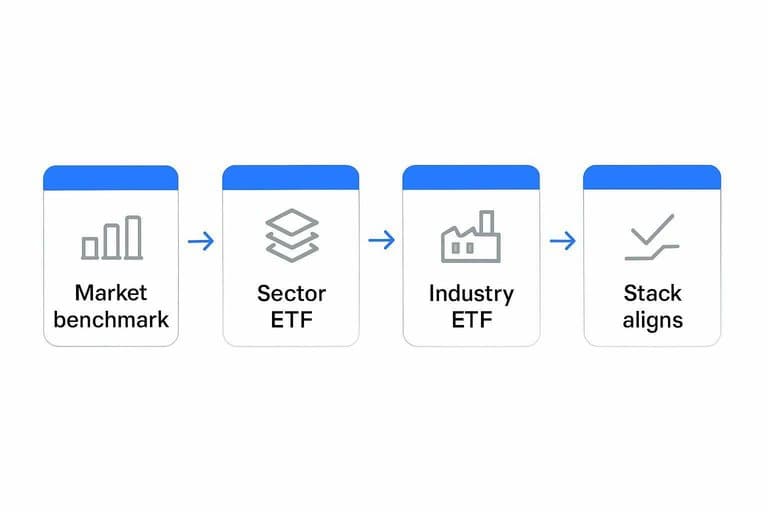
Multi-Benchmark View
Layer benchmarks when you want conviction, not vibes.
- Compare the stock to SPY or QQQ for market-relative strength.
- Compare the stock to its sector ETF for rotation-relative strength.
- Compare the stock to an industry ETF or peer basket for true leadership.
- Check if all three slopes agree on your timeframe.
- Only size up when the stack aligns.
When all three agree, you’re seeing demand, not noise.
Benchmark Pitfalls
Benchmarks drift over time, and the drift changes your “RS” without your stock moving. Sector and index composition updates can flip results overnight, especially when one mega-cap dominates.
Leveraged ETFs distort RS because daily compounding changes the path. ADRs add currency, so “strength” might just be USD weakness.
Treat the benchmark like an instrument, not a label. If it’s warped, your conclusion is too.
Reading the RS Line
PROSE The RS line is your quick read on leadership. It answers one question: “Is your stock outperforming the benchmark?” For example, if price chops sideways but the RS line climbs, money is quietly rotating into it.
Trend and Slope
PROSE A rising RS line means your stock is outperforming, even if price looks boring. A falling RS line means it’s lagging, even during a market rally. Slope is the tell on intensity. A steep RS uptrend often signals sustained institutional demand, while a gentle slope can be retail noise or a one-off catalyst. When the slope accelerates after a base, you’re seeing urgency, not just strength.
Highs and Lows
LIST RS highs and lows show whether leadership is expanding or failing. Watch how the line behaves at decision points, not mid-chop.
- New RS highs before price breaks out
- Higher RS lows during market pullbacks
- Failed RS highs near prior peaks
- Lower RS lows while price holds
If the RS line leads, price often follows on the next clean setup.
Divergences That Matter
STEPS Use divergence as a trigger to investigate, not to predict.
- Mark the last two price swing highs or lows.
- Compare the RS line at those same swing points.
- Require confirmation from price action, like a break of trend.
- Check the market trend, because down markets fake divergences.
- Reject “tiny” divergences inside tight ranges, since they often vanish.
The only divergence that pays is the one that survives a real price decision.
Support and Resistance
PROSE You can draw trendlines on the RS line the same way you do on price. Connect two or more RS lows for support, or two or more RS highs for resistance. A clean break of RS support often shows distribution before price cracks. A break above RS resistance can front-run a price breakout, especially after a long base. Treat RS levels like an early-warning system, not a standalone entry signal.
For a clear definition of RS as a ratio vs a benchmark, see StockCharts’ guide to Price Relative / Relative Strength.
RS Across Timeframes
RS changes character when your holding period changes. Your job is to match the RS lens to your clock, not argue with it.
A day trader cares about today’s relative bid. A position trader cares about who leads for months.
Intraday RS Use
Intraday RS is about pressing advantage while liquidity is highest. You want names that stay strong even when the tape wobbles.
- Trade strongest names in strongest groups
- Buy strength near VWAP, sell below VWAP
- Favor higher lows versus the index
- Avoid weak stocks on strong market days
- Trim when RS fades after noon
You’re not predicting strength. You’re renting it while it persists.
Swing Trading RS
Swing RS is about the daily trend, not the five-minute battle. You use RS to filter candidates, then you use setups to control risk.
For example, you might only trade stocks with rising 20–50 day RS, then take entries on breakouts, pullbacks to support, or tight consolidations. When a breakout works but RS flattens, you tighten stops instead of “giving it room.”
RS is your quality gate. Setups are your timing tool.
Position Trading RS
Position RS is leadership, measured in weeks and months. You’re trying to sit in the market’s winners while everyone else rotates.
- Start with weekly RS versus your benchmark.
- Confirm monthly RS is rising, not just bouncing.
- Enter on daily breakouts or first pullbacks.
- Pyramid on fresh highs with improving RS.
- Hold until weekly RS breaks down.
Your edge is staying power. Most traders sell the leaders right before they lead again.
Timeframe Alignment
Top-down RS keeps you from fighting the bigger move. If weekly RS is falling, your “great” daily setup is often a trap.
Set bias with the higher timeframe, then use the lower timeframe to time entries and manage risk. Think: weekly RS says “long only,” daily chart says “buy the pullback,” intraday chart says “use VWAP for execution.”
When your timeframes agree, trades feel boring. That’s usually the point.
RS and Market Regimes
Relative Strength (RS) behaves differently depending on the market’s trend and risk appetite. If you treat every tape the same, you’ll misread leaders and overtrade noise.
Bull Market Leadership
In bull markets, RS tends to persist because institutions keep adding to winners. You’ll often hear, “Strong gets stronger,” and in this regime it’s usually true.
RS rising into a breakout matters because it signals demand before the price clears resistance. Common patterns include RS making new highs first, RS staying above its moving average, and pullbacks that hold the prior RS peak. When price breaks out with RS already trending up, there’s less “catch-up buying” needed after the fact.
Treat rising RS as a timing edge, not a guarantee, and press when the market is helping.
Bear Market Defensives
In bear markets, RS leadership often means “down less,” not “up.” You can still trade it, but you must respect the tape.
- Utilities and staples
- Healthcare and pharma
- Gold and miners
- High-quality defensives
- Low-volatility factor
Your job is to find what institutions are hiding in, then trade tight and take profits faster.
Choppy Market Filters
Sideways markets punish default RS settings because leadership flips fast. You need tighter filters and clearer invalidation.
- Shorten RS lookbacks to match the range duration.
- Require RS to confirm price breaks, not lag them.
- Trade only at range edges, not mid-range.
- Use hard stops beyond the opposite side of the range.
- Skip trades when RS slope is flat.
In chop, your best edge is saying no until structure returns.
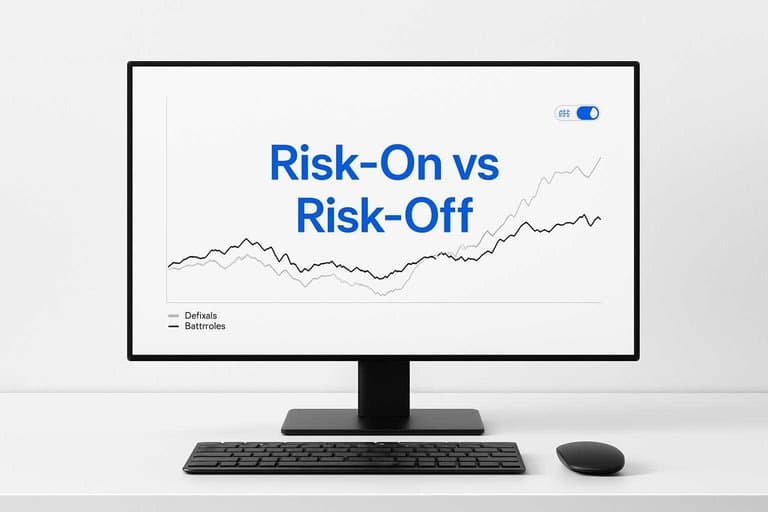
Risk-On vs Risk-Off
RS between groups can act like a regime dashboard. When cyclicals and small caps lead, risk-on is usually in control.
Watch cyclicals versus defensives, and small caps versus large caps, as simple tell pairs. If XLI or XLY outpaces XLP and IWM outpaces SPY, the market is paying for growth and breadth. If the opposite holds, leaders may still exist, but they’ll be fewer and more fragile.
Use these pair-RS reads to size up or down before you pick single-name trades.
For a broader view of sector rotation using benchmarked relative performance, see StockCharts’ overview of Relative Rotation Graphs (RRG).
RS-Based Trade Setups
Relative strength is only useful if it changes what you buy, when you buy, and where you get out. You want triggers you can repeat, plus an invalidation line that ends the debate when you’re wrong.
Breakout With RS High
A breakout works best when price strength and relative strength agree, not when one drags the other. You’re looking for a clean base and an RS line pressing highs before price does.
- Verify a tight base with orderly pullbacks and no wild gaps.
- Confirm the RS line is at or within 1–2% of highs.
- Require above-average volume on the breakout day.
- Enter on a break above the pivot, or on a retest that holds.
- Place the stop below the pivot or last tight low, and add only after a tight pause.
Your edge is the RS line front-running the breakout, so sell fast if that edge disappears.
Pullback in Leaders
Leaders often give you a second chance when they pull back without losing RS. You’re buying the “controlled dip” while relative momentum improves, like RS rising even as price drifts sideways.
The clean version looks like this: price pulls into the 10/20-day moving average on lighter volume, RS holds near highs, and the stock snaps back with a strong close. Your invalidation is simple and unemotional: if RS breaks down versus the prior swing, you’re not buying a leader anymore.
Treat these as continuation entries, not bargain hunts, and your hit rate improves.
Relative Weak Shorting
Short setups get cleaner when a stock is losing on an absolute basis and vs its benchmark. You’re pressing when weakness is persistent, not when it’s a one-day wobble.
- See RS line in a clear downtrend.
- Target stocks in a weak industry group.
- Short breaks of support or failed retests.
- Prefer heavy volume on down days.
- Align with market risk-off tailwinds.
If the group turns up, your “great short” becomes a crowded trade fast.
Pair Trades Concept
Pairs let you trade relative edge while muting market direction. You go long the stronger name and short the weaker one, like long MSFT and short a weaker software peer when software leadership is splitting.
The key is matching exposures: same sector, similar size, and a clear RS spread that’s widening. Your trigger is the spread breaking out or bouncing from support, and your invalidation is the spread closing back through that level.
If you can’t define the spread level, you’re not doing a pair trade, you’re doing two opinions.
Combining RS With Tools
RS tells you who is winning. Your other tools should explain why, and when to act.
The rule is simple: don’t count the same idea twice. If RS is already trend strength, don’t “confirm” it with another trend-only metric.
Moving Averages
Use moving averages to separate “strong” from “strong and tradable.” A clean RS line and a clean price trend are different signals.
On price, traders use the 20/50/200-day MAs to frame trend and risk. On the RS line, they use a 10–30 week MA to spot leadership shifts earlier. Example: price above the 50-day, RS line above its MA, then you buy the first pullback that holds the 20-day.
If price is trending but the RS line is flat, you’re buying a market move, not a leader.
Volume and Accumulation
Volume tells you whether institutions are behind the RS move. You’re looking for demand, not just relative outperformance.
- Volume expands on breakout days
- Breakout closes tight near highs
- Accumulation days outnumber distribution
- Pullbacks happen on lighter volume
- Support holds on high volume
If RS is strong but volume is dead, you may be early or just wrong.
Breadth and Groups
Breadth prevents “one-stock stories.” It helps you confirm the leader is leading something real.
- Check sector breadth for the stock’s group.
- Confirm advance/decline supports the market trend.
- Scan new highs versus new lows for risk-on.
- Verify multiple group peers have rising RS lines.
If the leader is alone, treat it like a trade, not a theme.
Fundamental Tailwinds
Fundamentals help you avoid the strongest-looking trap. They also keep you from selling a real leader too early.
Earnings strength matters when it changes expectations. Look for accelerating revenue, expanding margins, and raised guidance after results. Ignore fundamentals when they are stale, already priced, or purely narrative, like “AI exposure” without numbers.
When the tape and the numbers agree, you can size up and hold longer.
Turn RS into a repeatable trading filter
- Pick the right benchmark first (market, sector, and/or industry) and keep it consistent so your RS read isn’t distorted.
- Define your trading horizon (intraday/swing/position) and only trust RS signals that agree on your key timeframes.
- Look for leadership characteristics in the RS line—rising slope, fresh RS highs, and clean reactions at prior RS support/resistance.
- Execute with confirmation (trend structure, volume/accumulation, group strength, and risk controls) so RS guides selection while your tools handle timing and exits.
Frequently Asked Questions
Is RS in stocks the same as RSI?
No—RS in stocks compares a stock’s performance to a benchmark (like the S&P 500), while RSI (Relative Strength Index) measures a stock’s internal momentum on a 0–100 scale.
How do I screen for stocks with strong RS in stocks using common tools?
Use screeners like TradingView, Finviz, or MarketSmith to filter for relative strength vs a benchmark and then confirm with a rising RS line or top percentile rank (often top 20% or top 10%).
What RS in stocks level is “good” and what results should I expect?
Most traders treat “good” as consistently outperforming the benchmark over the last 3–12 months or ranking in the top 20% of the market; it usually improves your odds of finding leaders but doesn’t prevent drawdowns or failed breakouts.
How long does it take for RS in stocks to become reliable after a stock bottoms or breaks out?
Expect the RS line to stabilize over 4–8 weeks for swing signals and 3–6 months for cleaner leadership trends, because shorter windows are more sensitive to one-off spikes and news moves.
Can I use RS in stocks for ETFs and crypto, or is it only for individual stocks?
Yes—RS works well for ETFs, sectors, and even crypto as long as you choose a relevant benchmark (e.g., QQQ for growth ETFs, BTC for altcoins) and keep the lookback window consistent across comparisons.
Find Breakout Leaders Faster
Once you understand how RS works across benchmarks, timeframes, and market regimes, the bottleneck becomes scanning thousands of charts consistently every day.
Open Swing Trading ranks ~5,000 stocks by daily relative strength and adds breadth, sector/theme rotation, and volatility-adjusted context so you can build a focused watchlist in minutes—get 7-day free access with no credit card.
Sources
- StockCharts ChartSchool: Price Relative / Relative Strength (ratio vs benchmark) — referenced in Support and Resistance
- StockCharts ChartSchool: Relative Rotation Graphs (RRG) overview (benchmarking sectors, RS-ratio/RS-momentum concepts) — referenced in Risk-On vs Risk-Off