
Relative strength stock screener vs momentum: which first
A clear comparison to decide whether to start with a relative strength stock screener or a momentum filter—definitions and “which first” framing, speed vs stability tradeoffs, scorecards on fit/cost, and a practical workflow plus settings you can apply immediately.
Relative strength stock screener vs momentum: which first
A clear comparison to decide whether to start with a relative strength stock screener or a momentum filter—definitions and “which first” framing, speed vs stability tradeoffs, scorecards on fit/cost, and a practical workflow plus settings you can apply immediately.
If your watchlist is huge, “momentum” can feel like a firehose—new names every day, whipsaws everywhere, and no clear way to narrow it down.
Relative strength screening promises order, but it can also feel slow when breakouts are happening right now. This comparison helps you choose what to run first based on your universe, time horizon, and constraints. You’ll see where each signal shines, how they fail, and the exact pipelines and settings that keep your process repeatable instead of reactive.
Decision snapshot
Relative strength screening narrows your universe to “leaders,” while momentum decides when to buy. The tradeoff is speed versus cleanliness: momentum-first reacts earlier, RS-first reduces false starts. Think “only top 20% sectors” versus “buy when 12-month return turns positive.”
Two definitions
Relative strength (RS) screening is a cross-sectional filter. It keeps the stocks outperforming peers over a lookback, like “top decile vs the S&P 500.”
Momentum selection is usually time-series. It buys a stock when its own trend is strong, like “price above the 200-day.”
Cross-sectional asks “who’s winning now,” while time-series asks “is this winning now.”
What “which first” means
You’re choosing the order of your decision gates.
- Filter the universe (RS-first or broad-universe).
- Rank candidates (RS rank or momentum rank).
- Trigger entries (momentum signal or RS threshold).
- Build the portfolio (position sizing and constraints).
Put the noisiest gate first and you’ll churn; put the strictest gate first and you’ll miss early turns.
Quick winner map
Different goals pick different defaults.
- Trend-following with fewer whipsaws: RS filter first.
- Catching early breakouts: momentum trigger first.
- Avoiding mean-reversion traps: RS filter first.
- Keeping rules simple: momentum trigger first.
- Rotating into current leaders: RS filter first.
Pick the order that matches your biggest regret: missing moves or buying fakes.
How each works
Relative strength (RS) screening and momentum investing rhyme, but they start from different reference points. RS compares a stock to something else, like the S&P 500 or its sector. Momentum mostly compares a stock to its own past path, then ranks or triggers entries.
RS screener mechanics
An RS screener needs a benchmark because “strong” is always relative to something. You pick the yardstick, the lookback, and the ranking method because those choices decide who looks like a leader.
Common mechanics:
- Benchmark: S&P 500, Russell 2000, or a sector ETF
- Lookback windows: 3M, 6M, 12M, or blended windows
- Percentile ranks: top 10%, top quartile, or z-scores
- Sector-relative variants: rank within sector, then across sectors
- Rebalancing frequency: weekly scans, monthly refresh, or quarterly rotations
If you don’t name the benchmark and rebalance cadence, you don’t have a strategy. You have a screenshot.
Momentum mechanics
Momentum starts with return measurement, then decides how to translate it into a position. Your lookback, any “skip-month” rule, and your risk scaling do most of the work.
Typical mechanics:
- Return lookbacks: 3–12 months, often multiple horizons
- Skip-month idea: ignore the most recent month to reduce reversals
- Volatility scaling: smaller positions in higher-volatility names
- Breakout variant: buy on new highs, sell on failed breakouts
- Ranking variant: buy top decile, sell bottom decile
If your momentum rules don’t specify exits, you’re just renting beta. In choppy markets, rent comes due fast.
Common failure modes
These approaches fail in predictable ways, usually when the market’s “story” changes. You want failure modes on your checklist before you want a backtest.
- Getting whipsawed in range-bound markets
- Entering crowded trades near peaks
- Missing regime shifts after macro shocks
- Drifting into sector concentration unknowingly
- Using survivorship-biased universes or data
When one of these shows up, don’t “optimize the factor.” Tighten your universe, rules, and risk controls.
Speed vs stability
Relative strength screeners and momentum both chase what’s working, but they optimize different things. Relative strength favors steadier leadership versus a benchmark, while momentum favors quicker acceleration in price. For most traders, stability wins because whipsaws cost more than a slightly later entry.
Signal timeliness
Momentum reacts faster to reversals and breakouts because it keys off recent price thrust. A 20-day rate-of-change will flip bullish days before a 3–6 month relative strength rank climbs the leaderboard.
Momentum wins for early entries.
Noise resistance
Relative strength filters randomness better because it compares you to a benchmark and usually uses longer windows. That dampens one-off spikes, earnings gaps, and “two green days” that fade by Friday.
Relative strength wins for fewer false positives.
Practical takeaway
Use speed when you trade short and accept churn. Use stability when you want fewer decisions and cleaner trends.
- Choose momentum for 2–20 day holds
- Choose relative strength for 4–26 week holds
- Choose momentum if you can tolerate high turnover
- Choose relative strength if you hate whipsaws
- Blend both when signals conflict often
Pick the tool that matches your patience, not your opinion.
For the academic backbone behind momentum-style winner selection, see Returns to Buying Winners and Selling Losers.
Comparison scorecard
Use this scorecard when you’re deciding what to screen first: relative strength (RS) or momentum.
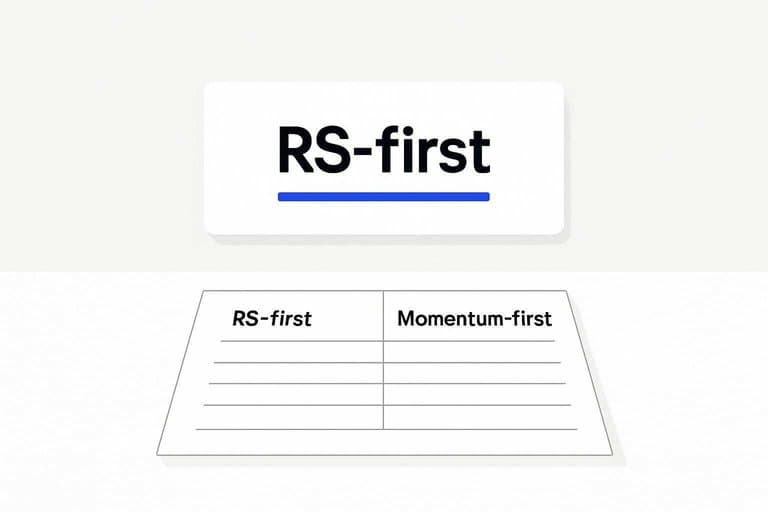
| Criteria | RS-first score | Momentum-first score | Winner |
|---|---|---|---|
| Early trend detection | 5 | 3 | RS-first |
| Breakout timing | 3 | 5 | Momentum-first |
| Whipsaw resistance | 4 | 2 | RS-first |
| Bear-market behavior | 4 | 2 | RS-first |
| Rebalancing effort | 4 | 3 | RS-first |
If you’re trading short swings, lead with momentum; if you’re building a watchlist, lead with RS.
When RS first wins
Relative strength (RS) screening wins when you need a leadership filter before you chase speed. Momentum can look great in the wrong neighborhood, like a weak sector bouncing hard. Start with RS when regime and crowding matter more than raw acceleration.
Wide universe
RS-first works best when you’re staring at 3,000–10,000 tickers and need a fast, stable funnel. It strips out “interesting but irrelevant” names, like a +20% one-month pop inside a lagging industry. In practice, you rank RS versus a benchmark, then run momentum only on the top slice.
The move is simple: shrink the search space before you optimize the entry.
If you want the original framing of relative strength as an investment filter, see Relative Strength as a Criterion for Investment Selection.
Sector rotation
RS-first shines when leadership is shifting and trends are uneven. You’re likely in a relative leadership regime if you see:
- New highs clustering in one sector
- Defensive groups quietly outperforming
- Prior leaders breaking RS lines
- Index flat, winners strong
- Breadth weak, leaders tight
In that tape, momentum-first just buys the loudest move, not the right theme.
Concentration control
RS-first can accidentally overbuy one hot sector, so you need a cap. Use this flow:
- Rank all stocks by RS versus your benchmark.
- Filter to the top 10–20% RS names.
- Apply sector and industry max weights, like 25% and 10%.
- Within each bucket, rank by momentum for entry timing.
- If a bucket is full, skip to the next RS name.
That’s how you keep leadership exposure without turning your portfolio into a single macro bet.
When momentum first wins
Momentum-first wins when timing matters more than ranking. You’re trying to catch the move, not debate the leaderboard.
Breakout trading
Breakouts are time-sensitive, and momentum signals fire at the moment of change. A momentum-first scan catches the “new high on volume” before RS rankings fully reflect it.
Example: a stock clears a 52-week high today, but its 3-month RS still lags after a choppy base. Momentum gets you the entry window.
If you wait for RS to catch up, you often buy the same breakout higher.
Small universe
When your symbol set is already constrained, RS filtering stops adding signal and starts adding delay.
- You trade a 20-name watchlist you know well
- You only rotate among 11 sector ETFs
- You run a “top 50 liquid names” universe
- You focus on one theme basket
- You trade a single country index
In a tiny universe, momentum is the filter and the trigger.
Event-driven trends
Use momentum first when news creates a fresh regime shift and you need entries fast.
- Trigger on price and volume expansion after the event.
- Define the momentum level that invalidates the move.
- Enter on the first clean continuation setup.
- Check RS versus peers for confirmation, not permission.
- Add only if RS improves while price holds.
Momentum gets you in; RS tells you whether to press.
Data and settings
Your “which first” call depends on what data you feed each filter and how often you act on it. Pick defaults that match your holding period, then only customize when you have a clear edge.
Lookback windows
Different windows answer different questions: “who’s been winning lately?” versus “who keeps winning?” Match the window to your trade length, not your conviction.
| Setting | Typical use | Strength | Default winner |
|---|---|---|---|
| RS 3-month | Swing | Fast regime read | Swing: RS 3–6m |
| RS 6-month | Swing/position | Smoother trend | Swing: RS 3–6m |
| RS 12-month | Position | Durable leadership | Position: RS 12m |
| Mom 20/50/200d | Timing | Entry/exit trigger | Use after RS |
If your window is short, lead with momentum for timing; otherwise, RS should pick the universe first.
Benchmark choice
Relative strength is only “relative” to what you compare against, so the benchmark quietly controls your signal. A stock can look strong versus its sector while still lagging the market.
Use a broad index like the S&P 500 for most screens, because it answers the only question that matters: “Would I rather own this than the market?” Use a sector index only when you intentionally want intra-sector leaders, like “best semis,” not “best stocks.”
Refresh cadence
Refresh rate decides your turnover, which decides your real-world results. More refresh usually means more trades, more spread, and more taxes.
- Daily refresh: highest turnover, fastest reaction, most slippage.
- Weekly refresh: balanced turnover, fewer whipsaws, manageable slippage.
- Monthly refresh: lowest turnover, slow adaptation, bigger drawdown lag.
Weekly refresh wins for most setups, because it’s reactive without becoming a transaction-cost machine.
Implementation workflow
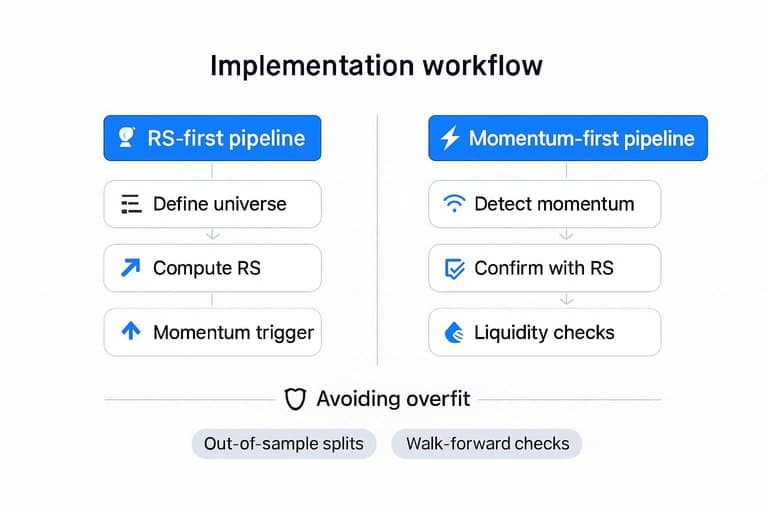
You don’t have to pick a religion here. You need a pipeline you can run weekly, with clear tie-breakers.
Default to RS-first for swing and trend systems, then use momentum for timing. Use momentum-first when you trade catalysts and need speed.
RS-first pipeline
Start with RS when you want structural leadership, then use momentum to avoid early entries. It keeps you out of “almost breaking out” charts.
- Define your universe and remove illiquid names.
- Compute relative strength versus a benchmark over a fixed lookback.
- Filter to the top X% RS names, then sector-cap if needed.
- Apply a momentum entry trigger, like breakout or MA cross.
- Enforce risk rules, then rebalance on a fixed schedule.
If you can’t decide, make RS your gate and momentum your trigger.
Momentum-first pipeline
Start with momentum when you need fast detection, then use RS as your “quality check.” This helps when signals are frequent and noisy.
- Detect a momentum signal, like 20-day high or 1–3 month surge.
- Confirm with RS versus benchmark, requiring above-threshold rank.
- Run liquidity checks, including spread and average dollar volume.
- Set position sizing from volatility, then place the trade.
- Execute exits using stops, time-outs, or momentum failure rules.
Momentum finds candidates; RS decides who deserves your capital.
Avoiding overfit
Overfit happens when your backtest loves a number that the market won’t repeat. Your guardrails are boring rules and ruthless testing.
Use out-of-sample splits and walk-forward checks, not one “perfect” period. Keep parameters coarse, like “top 20% RS,” not “top 17%.”
If small tweaks flip results, you don’t have an edge. You have a coincidence.
Costs and constraints
You don’t pick “relative strength first” or “momentum first” in a vacuum. Your real constraint is what makes trading expensive: turnover, taxes, slippage, and liquidity.
| Constraint | What breaks first | Best first step | Why it wins |
|---|---|---|---|
| High turnover limits | Too many trades | Relative strength screener | Fewer names, fewer flips |
| Tax-sensitive account | Short-term gains | Relative strength screener | Longer holds, cleaner taxes |
| Slippage dominates | Edge leaks in fills | Liquidity filter first | Cheap execution beats theory |
| Low liquidity universe | You move the price | Liquidity filter first | Tradable list before signals |
| Tight rebalance window | Missed entries/exits | Momentum timing first | Clear triggers, faster action |
Treat liquidity like a gate, not a preference. If you can’t trade it, you can’t “screen” it.
Final recommendation
Start with a relative strength screener, then apply momentum as the second filter. Relative strength gets you into the right neighborhood; momentum times the entry.
- Screen for top 20% relative strength vs your benchmark
- Require price above 200-day moving average
- Add 12-1 momentum filter, exclude last month
- Confirm 20-day high or clean breakout
- Cap position size to your risk budget
Do RS first, because momentum without context often buys late-stage heat.
Exceptions: If you trade short-term breakouts, run momentum first and tighten stops. If you run deep value or mean reversion, skip momentum and use RS only as a tie-breaker.
Default settings: RS lookback 6–12 months versus SPY or your sector ETF. Momentum 12-1 (skip the most recent month), rebalance monthly, and demand a simple trend filter like “above the 200-day.”
Keep the defaults boring until you have 50 trades of evidence.
Pick your first filter, then standardize the second
- Start RS first if you need to tame a wide universe, capture sector rotation, and control concentration—then use momentum as the entry/trigger.
- Start momentum first if you trade breakouts, run a small universe, or follow event-driven trends—then use RS to confirm quality and avoid chasing weak leaders.
- Lock in your defaults: choose a lookback window, a benchmark, and a refresh cadence, and keep them consistent long enough to evaluate.
- Run the workflow for a full cycle, log misses and whipsaws, and only then tweak one parameter at a time to avoid overfitting.
Frequently Asked Questions
Is a relative strength stock screener the same as RSI or relative strength index?
No. A relative strength stock screener typically ranks stocks versus a benchmark or peers (relative performance), while RSI is an oscillator measuring a stock’s internal momentum on a 0–100 scale.
What benchmark should I use in a relative strength stock screener (SPY, QQQ, sector ETFs)?
Most traders use SPY for broad U.S. stocks, QQQ for growth/tech-heavy universes, and sector ETFs (like XLK, XLF) when comparing within a sector to avoid mixing different regimes.
How often should I refresh a relative strength stock screener—daily, weekly, or monthly?
Weekly refresh works best for most swing traders because it reduces noise without going stale; daily is common for short-term systems, and monthly fits position traders with lower turnover.
How do I measure whether my relative strength stock screener is actually adding value?
Track out-of-sample results versus a simple benchmark (e.g., SPY) using win rate, average return per trade, max drawdown, and turnover; tools like Portfolio Visualizer or a basic Python backtest can quantify the edge.
Can I use relative strength screening for ETFs or crypto, not just stocks?
Yes. Relative strength screening works well for ETFs (sector/industry rotation) and can be applied to liquid crypto pairs, as long as you use consistent data, a clear benchmark, and liquidity/fee filters.
Build Your RS-First Watchlist
Choosing whether relative strength or momentum comes first is only useful if you can apply it consistently with clean data, settings, and a repeatable workflow.
Open Swing Trading gives you daily RS rankings, breadth and sector/theme context, plus volatility-adjusted and ATR extension tools to surface actionable leaders—start with 7-day free access, no credit card.