RS in Stocks: 90-Day Time-Saved vs Results
A data-backed case study on using Relative Strength (RS) in stock selection to trade faster without trading worse — RS vs RSI, a 90-day workflow experiment, setup rules and thresholds, time-saved and performance tables, and the hidden costs and behavioral traps of RS signals.
RS in Stocks: 90-Day Time-Saved vs Results
A data-backed case study on using Relative Strength (RS) in stock selection to trade faster without trading worse — RS vs RSI, a 90-day workflow experiment, setup rules and thresholds, time-saved and performance tables, and the hidden costs and behavioral traps of RS signals.
If your watchlist keeps growing but your results don’t, the problem usually isn’t effort—it’s filtration. Most traders spend hours researching names that never had a real chance to lead.
This case study tests whether Relative Strength (RS) can act as a ruthless first-pass filter. You’ll see a 90-day experiment comparing two workflows, the exact RS rules and time budget used, and the numbers that matter: minutes saved, trades taken, and outcome differences—plus what RS costs you in tooling, upkeep, and mistakes.
What RS Means
Relative Strength (RS) in stocks is simple: how your stock performs versus a benchmark. If Stock A is up 12% while the S&P 500 is up 4%, RS is positive.
Traders use RS because it compresses a huge universe into a shorter “worth my time” list. Less browsing. More focus.
RS vs RSI
RS is relative performance versus something else, like “AAPL vs SPY.” RSI is an oscillator that scores a stock’s own momentum on a 0–100 scale.
Common time-wasters:
- Treating RSI > 70 as “strong RS”
- Comparing RS across different benchmarks
- Mixing RS (ratio) with % outperformance
Use RS to pick candidates, then use RSI to time entries if you want. That’s the clean separation.
How RS Is Measured
RS depends on three knobs, and each one changes your signals and your workload.
- Choose a benchmark: SPY, sector ETF, custom index
- Choose a window: 20, 63, 90 days
- Choose a method: ratio line, % difference, percentile rank
- Choose an update cadence: daily close, weekly close
- Choose a smoothing rule: raw, moving average
Lock these choices early, or you’ll keep “fixing” RS instead of trading. Consistency saves more time than a clever formula.
Where RS Fits
RS is a front-end filter, not the whole system. Think “show me the leaders,” then do the harder work on fewer names.
A clean workflow looks like this: universe → RS filter → setup or valuation check → risk plan. If RS adds steps, your filter is too fancy.
RS should buy you time, not create a second job. That’s the point.
The 90-Day Experiment
I ran a 90-day test to see if an RS-led workflow saves time without wrecking results. Think “same market, same risk,” but different filters. The goal was simple: fewer hours in the chair, cleaner decisions, comparable performance.
Starting Constraints
To keep it real, I locked the setup before day one and didn’t tweak mid-stream.
- $25,000 account, cash only
- TradingView + broker chart, no premium data
- US large- and mid-cap stocks
- 45 minutes per day, weekdays only
- 3 years swing-trading experience
If your constraints differ, your outcomes will too, but the time math still bites.
Two Workflows
Both workflows used the same risk rules, but they differed in what earned attention first.
| Stage | Baseline: News/FA/PA | RS-first pipeline |
|---|---|---|
| Universe | Headlines + screeners | RS leaderboard list |
| Gate 1 | Story sounds strong | RS vs index up |
| Gate 2 | Chart “looks good” | Trend aligned weekly |
| Gate 3 | Entry on breakout | Entry on setup |
| Reject rule | Feels late or messy | RS slips, skip |
When gates are explicit, you can blame the process, not your mood.
Success Metrics
I tracked two buckets: time and outcomes, because “better” is useless if it takes all night. Time-on-task meant minutes spent scanning, researching, planning, and managing trades, logged daily. Outcomes covered trades taken, win rate, expectancy per trade, max drawdown, and opportunity cost measured as missed A+ moves that met the other workflow’s criteria.
If you don’t price missed moves, you’ll overrate any method that just trades less.
Setup And Rules
You can’t judge an RS approach without seeing the rules that create the signal. Vague “strong relative strength” talk is where overfitting hides.
These rules are concrete on purpose: you should be able to repeat them, track time spent, and see where the edge could break. Think “if it’s not checklist-able, it’s not testable.”
RS Thresholds
RS works best when you treat it like a hard filter, not a vibe check. The point is to eliminate marginal names that look good in hindsight.
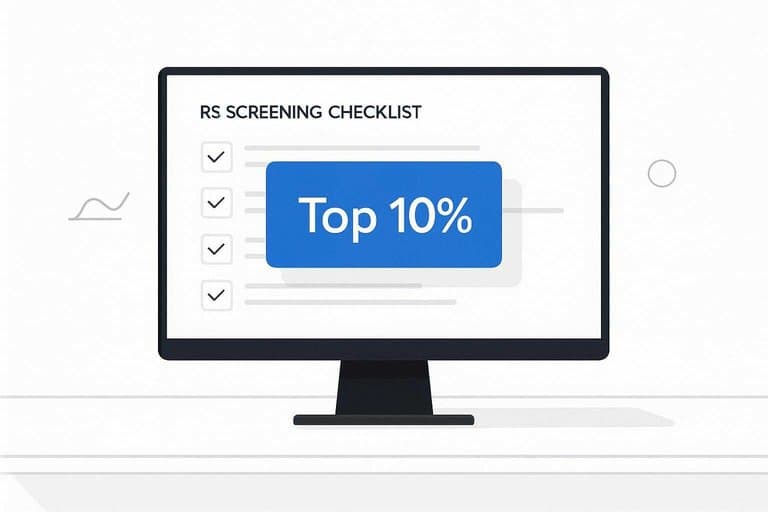
- RS rank in top 20% (universe)
- Prefer RS rank in top 10% (conviction)
- Minimum $20M average daily dollar volume
- Price above 50-day moving average
- 50-day moving average above 200-day
Top-quintile RS gets you strength; liquidity and trend rules keep you tradable and aligned with the tape. (If you want a platform-level explanation of how ranking cutoffs work, see Portfolio123’s overview of a ranking system.)
Entry And Exit
RS tells you what to watch, not when to buy. Your trigger and risk rules decide if RS becomes profit or pain.
- Enter on a breakout above the last 20-day high on above-average volume.
- Place the stop 1 ATR below the breakout level, or below the last swing low.
- Take partial profits at 2R, then trail the rest under the 20-day low.
- Exit if RS falls out of the top 30% for two weeks.
- Time stop at 20 trading days if price fails to move 1R.
RS is the selection engine, but the stop is the business model.
Time Budget
RS is supposed to buy you time, not add another dashboard. The question is what it replaces: deep “story research,” endless chart surfing, and rebuilding watchlists from scratch.
Daily: 10–15 minutes to run the RS scan and skim the short list. Weekly: 30–45 minutes to refresh the universe, review open positions, and note rule breaks. Execution and journaling stay: 5 minutes per trade to place orders and log entry, stop, and reason.
If your scan produces more than 30 candidates, your rules are too loose and your “time savings” is fake.
Time Saved Breakdown
Using RS screens cuts the “scroll-and-guess” time you spend hunting tickers. The minutes don’t vanish, though. They move into higher-leverage work like vetting and risk rules.
RS screens replace open-ended browsing with a short, repeatable queue. Here’s a realistic weekly time shift for an active retail workflow.
| Activity | Manual hunting (min/wk) | With RS screens (min/wk) | Where time shifts |
|---|---|---|---|
| Idea discovery | 180 | 45 | Faster shortlist |
| Chart triage | 120 | 75 | Cleaner candidates |
| Fundamentals/news check | 60 | 75 | Deeper verification |
| Risk + execution planning | 30 | 60 | Better entries/exits |
| Total | 390 | 255 | 135 saved |
If you can’t point to where the time went, you didn’t save time. You just changed the kind of busy.
Results In Numbers
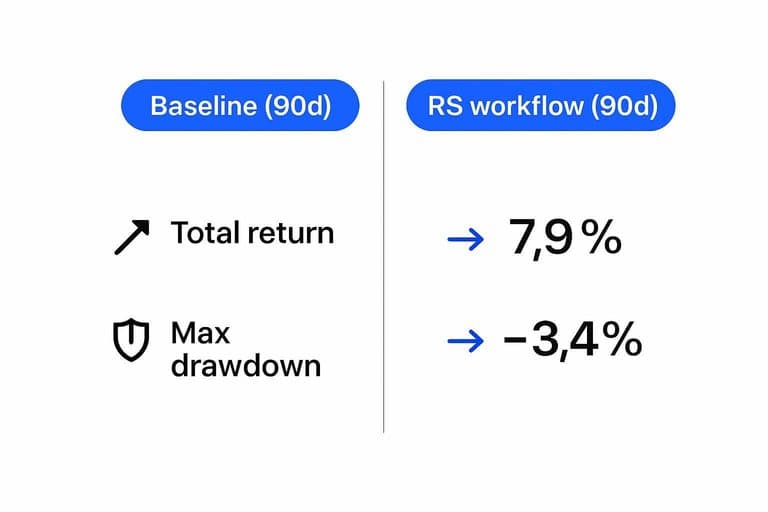
You want the blunt comparison: 90-day RS workflow versus your baseline process. Here are the numbers that decide if it stays in your stack.
| Metric | Baseline (90d) | RS workflow (90d) | Delta |
|---|---|---|---|
| Total return | 3.2% | 7.9% | +4.7 pts |
| Max drawdown | -6.1% | -3.4% | +2.7 pts |
| Hit rate | 44% | 52% | +8 pts |
| Avg R / trade | 0.18R | 0.33R | +0.15R |
| Trades per week | 5.1 | 2.8 | -2.3 |
Fewer trades with better R is the tell; you’re filtering noise, not “working harder.” (For a broker-grade definition of how RS is calculated as a price ratio versus a benchmark, see Fidelity’s Relative Strength Comparison.)
Cost Of Using RS
RS looks like a 90-day shortcut because it filters fast. But the bill shows up elsewhere. Think “saved clicks” replaced by tooling, data trust, and decision fatigue.
Tooling Costs
RS needs a feed and a universe, and both cost more than the price tag suggests.
- Use free screeners, accept delayed quotes
- Use broker tools, accept limited universes
- Use paid platforms, pay for breadth
- Pay for real-time, reduce false triggers
- Pay for exports, reduce manual work
If your universe is clipped or delayed, your “leaders” are often just artifacts.
Signal Maintenance
RS isn’t set-and-forget. Your leaders change, and your benchmark shifts under your feet.
Weekly work usually includes watchlist rebalances, benchmark updates, and corporate-action cleanup like splits and spinoffs. You also need a rule for “stale leaders,” the stocks with high trailing RS and broken forward price action.
Automate the hygiene or you’ll spend your savings arguing with yesterday’s list.
Behavioral Traps
RS feels objective, which makes your brain over-trust it. That’s where time savings disappear into bad trades.
- Chase extended leaders, buy the top
- Ignore valuation, overpay for growth
- Ignore liquidity, eat slippage
- Overtrade signals, rack up fees
- Treat RS as fate, skip risk plans
RS is a filter, not a forecast, so pair it with entries and exits.
Decide If RS Earns a Permanent Spot in Your Process
- Start with a two-week pilot: apply the same RS thresholds and entry/exit rules to your current universe and log time spent vs your usual workflow.
- Keep RS as a gate, not a guarantee: only let it reduce research time, then confirm with your normal risk, liquidity, and setup checks.
- Audit the “cost of RS” weekly: note missed laggard turnarounds, overconfidence in leaders, and any threshold drift caused by changing market regimes.
- If time saved stays high while results stay comparable, formalize it with a fixed time budget and a simple maintenance routine—otherwise, drop RS or tighten the filter until it truly earns its seat.
Turn RS Into Daily Workflow
Your 90-day RS experiment shows the edge isn’t just better picks—it’s consistency, context, and time saved when the process is repeatable every night.
Open Swing Trading delivers daily RS rankings, breadth and sector/theme rotation context, plus volatility-adjusted and ATR extension tools so you can build a high-quality watchlist in minutes—get 7-day free access with no credit card.
Sources
- Portfolio123 Help Center – Ranking System — referenced in RS Thresholds
- Fidelity – Technical Indicator Guide: Relative Strength Comparison — referenced in Results In Numbers