RS in Stocks Looks Strong—but Breakouts Fail
A step-by-step troubleshooter for when a stock’s Relative Strength looks great but breakouts keep failing—verify RS definitions and data, spot repeatable failure patterns, judge base quality and pivots, pressure-test volume/liquidity and catalysts, and tighten entries, stops, and execution rules.
RS in Stocks Looks Strong—but Breakouts Fail
A step-by-step troubleshooter for when a stock’s Relative Strength looks great but breakouts keep failing—verify RS definitions and data, spot repeatable failure patterns, judge base quality and pivots, pressure-test volume/liquidity and catalysts, and tighten entries, stops, and execution rules.
If your charts keep showing “strong RS” but every breakout fizzles, the problem usually isn’t bad luck—it’s a mismatch between what RS is measuring and what the market is rewarding right now.
This troubleshooter helps you pinpoint why leadership isn’t translating into follow-through. You’ll learn how to validate your RS inputs, recognize the most common breakout failure signatures, assess whether the base is actually buildable, and run quick volume, liquidity, and benchmark checks. Then you’ll translate the diagnosis into cleaner entries, tighter risk, and a clear failure protocol.
Triage the Setup
Strong RS can be real and still be useless for your breakout. You want quick checks that separate “signal” from “chart artifact.”
Define RS precisely
RS is price performance versus a benchmark, not the Relative Strength Index oscillator. On your chart, “strong RS” means the RS line trends up while the stock builds, and ideally hits new highs before price breaks out.
Confirm data integrity
Bad inputs can manufacture strong RS, especially around splits and dividends.
- Confirm the correct symbol and share class
- Match the timeframe to your trading plan
- Use adjusted prices for splits and dividends
- Choose the right benchmark for the group
- Verify your platform’s corporate action handling
If RS flips when you change one setting, you found the “strength.”
Timeframe alignment
RS must be measured on the same clock as your breakout thesis. A stock can show strong daily RS from a three-day squeeze, yet be dead weight on the weekly chart.
RS trend quality
A clean RS trend is harder to fake than a single spike.
- Look for a steady upward slope into the base
- Prefer multiple RS higher highs, not one jump
- Reject RS driven by a single gap day
- Check RS holds up on pullbacks
- Compare RS highs versus prior base highs
You’re buying persistent demand, not a one-day headline.
Market regime check
In a risk-off tape, strong RS often just means “down less than others.” If the indexes show distribution and failed breakouts, your “leader” may still fail because capital is leaving equities.
Common Failure Patterns
RS can look great while price refuses to follow through. The usual culprit is supply, timing, or a false “leadership” read.
Here are the most common patterns traders confuse with durable strength.
| Pattern | What RS shows | What price does | What to watch |
|---|---|---|---|
| RS high, base sloppy | Holds near highs | Breaks, then fades | Wide range days |
| RS strong, volume weak | Stays elevated | Breakout on light volume | No demand surge |
| RS strong, market weak | Outperforms peers | Breakout fails fast | Index undercut |
| RS strong, overhead supply | Stays top decile | Stalls at old highs | Prior bagholders |
| RS strong, earnings risk | Rises into event | Gaps down, breaks base | Post-earnings drift |
Treat repeated breakout failure as information, not bad luck. Tighten criteria or wait for a cleaner market tailwind. For more context on why breakouts still need price/volume confirmation, see this breakdown of Using Breakouts in the William O’Neil Methodology.
Diagnose the Base
Strong RS can hide a weak base. You want structure that absorbs supply, not a pattern that only looks tidy on a relative line.
Base legitimacy
A base should wear sellers out, not just pause after a spike.
- Measure depth from peak to low; flag drops beyond your normal tolerance.
- Check duration; ignore bases that form in a handful of sessions.
- Judge symmetry; prefer rounded repair over one sharp V-rebound.
- Compare width to progress; avoid wide, choppy ranges with no tight closes.
- Label the failure types: too deep, too short, too wide.
If the base didn’t force time and pain, it won’t demand higher prices.
Overhead supply
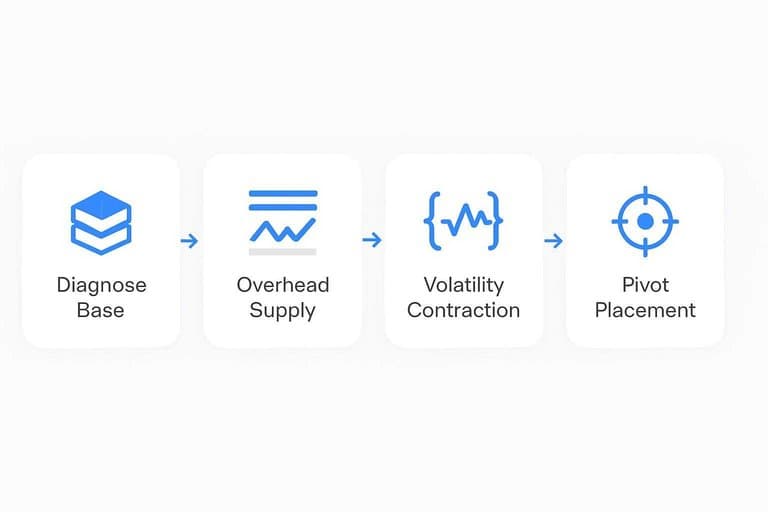
Breakouts fail when a base forms under a ceiling of trapped sellers. Strong RS can still be “stronger on paper” than in the order book.
Look for prior highs that rejected price twice, then scan volume-at-price for heavy bands above the pivot. Those zones are where holders say, “Just get me out even,” and they hit bids on your breakout.
Treat overhead supply like gravity: you need real demand, not hope.
Volatility contraction
A clean base tightens as it approaches the pivot because weak hands already sold.
- Weekly ranges compress into the right side.
- Down days show lighter volume.
- Closes land in the upper half.
- Pullbacks shorten in duration.
- Intraday wicks shrink near the pivot.
If ranges stay fat, you’re not seeing contraction. You’re seeing unresolved supply.
Handle and shakeouts
A handle should form high in the base, with quiet drift and limited damage. If it forms low, it’s not a handle. It’s a warning.
A constructive shakeout undercuts a prior low and snaps back fast on supportive volume. A breakdown lingers below support, then rallies weakly into resistance.
The difference is sponsorship: shakeouts get bought, breakdowns get “allowed.”
Pivot placement
A pivot should sit where supply is proven absorbed, not where everyone drew the same line.
- Mark the highest point in the base or handle, depending on the pattern rules.
- Validate the pivot with tight closes and fewer reversals near that area.
- Define an early entry off a trendline break or tight shelf, below the main pivot.
- Avoid the most obvious horizontal level if it aligns with repeated stop sweeps.
- Place invalidation where the pattern is broken, not where you feel pain.
Obvious pivots invite games. Better pivots force buyers to show up.
Volume and Liquidity Tests
Strong RS can hide a simple truth: nobody is actually buying your breakout. You’re testing for real demand versus thin liquidity, distribution, or flow-driven noise.
Breakout volume quality
Breakouts need relative volume expansion because price alone lies.
- Clear 1.5–2.5x relative volume by midday
- Tight spread, closes near highs
- Volume builds into the close
- Flat or fading volume after early pop
- Wide spread, closes mid-range
If volume doesn’t expand, you’re watching a quote move, not demand.
Up/down volume balance
RS can stay strong while institutions sell in a controlled way. You want to spot “quiet distribution” weeks that cap every breakout.
Look for these telltales on weekly and daily views:
- Two or more high-volume down weeks in a month
- Down days with bigger volume than up days
- Rallies on average volume, selloffs on spikes
- Breakout attempts that reverse on the heaviest day
When sell volume keeps winning, the breakout is a liquidity exit, not a new leg.
Float and liquidity
Illiquid names can print perfect RS, then fail on execution reality. Thin float and low dollar volume create wick-outs, slippage, and fake follow-through.
Check three basics before trusting the breakout:
- Float size: smaller floats move easier, and reverse faster
- Spread: wide spreads signal weak two-sided interest
- Average dollar volume: low ADV can’t absorb real buying
If the spread is wide and ADV is small, the chart is a trap with good marketing.
Options and gamma effects
Options flows can pin price near strikes and create “breakouts” that evaporate. Dealer hedging can also force short-term moves that look like leadership.
- Price stalls near big round strikes
- Breakouts fail exactly at strike walls
- Intraday reversals intensify into Friday close
- Call volume spikes without spot follow-through
- Sudden moves fade after OI resets
If options are steering the tape, your breakout is timing-dependent, not trend-dependent.
Earnings and catalysts
Map catalysts because breakouts before binary events often get sold.
- Mark the next earnings date and the prior two reactions.
- Note guidance history: beats, misses, and “raise but sell” patterns.
- Track news sensitivity: how far price moves on minor headlines.
- Define your no-trade window, like 5–10 sessions pre-earnings.
- Only take pre-event breakouts with clear, sustained volume support.
If the calendar can override the chart, wait for the event to clear first.
Benchmark and Pair Lens
Strong RS can be real leadership, or it can be a mirror held up to the wrong comparison. A stock can look “elite” vs SPY while simply riding a hot sector, a factor wave, or a macro tailwind. Your job is to isolate what’s actually doing the lifting before you trust the next breakout.
Choose the right benchmark
Test RS against multiple baselines before you label it leadership.
- Plot stock/SPY, then mark major RS inflections.
- Plot stock/sector ETF, then compare the same dates.
- Plot stock/industry ETF, then check if RS still trends up.
- Re-run on equal-weight ETFs to reduce mega-cap distortion.
- Keep the benchmark that best matches your capital alternative.
If RS only works vs SPY, you’re probably trading sector beta, not stock edge. (Here’s Fidelity’s definition of relative strength comparison ratio lines if you want the formal framework.)
Sector rotation context
Sector strength can make your stock look like a leader even when its own trend is thin. You’ll see RS rising while price chops below a key moving average, or breaks out and snaps back in days.
When the sector cools, “strong RS” often vanishes first and price follows.
Pairs confirmation
Use ratio charts to separate true leadership from a crowded trade.
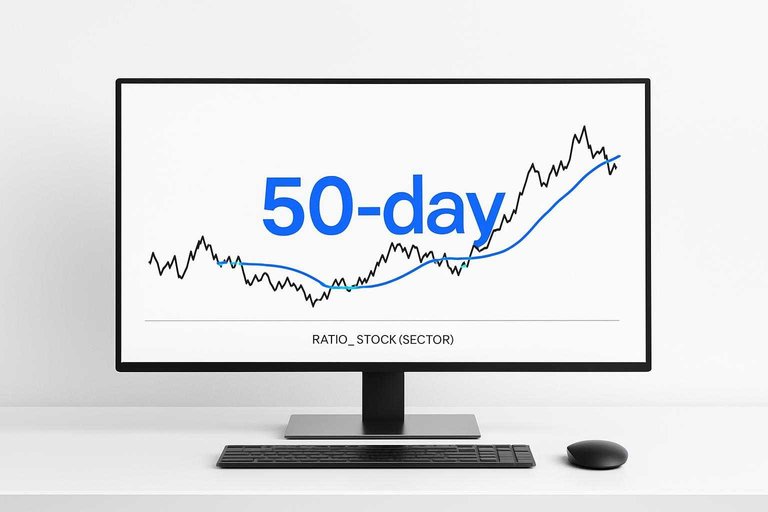
- Confirm: stock/sector ratio makes higher highs.
- Confirm: stock/index ratio holds above rising 50-day.
- Warn: ratio spikes vertical, then stalls.
- Warn: ratio breaks trendline before price breaks.
- Warn: ratio mean-reverts on volume.
If the ratio breaks first, the breakout is usually last to know.
Factor exposure check
RS often hides a factor bet you didn’t mean to make, like momentum, size, or value. A “great” RS stock can simply be high-momentum in a momentum tape, or small-cap in a small-cap squeeze, until the factor rolls over.
When factors reverse, your stock can fail breakouts even with clean charts.
Risk parity reality
Macro crosswinds can quietly veto technical setups, especially in crowded portfolios.
- Watch rates: higher yields hit duration equities.
- Watch dollar: strong USD pressures multinationals and commodities.
- Watch oil: spikes tax consumers and margins.
- Watch credit spreads: widening kills risk appetite.
- Watch gold: rallies can flag risk-off.
If your stock is a macro proxy, the chart answers to the macro first.
Entry, Risk, and Execution
Strong relative strength can still produce weak trades if your mechanics invite churn. Think of it as having the right stock, but the wrong contract with volatility. Fix entries, stops, sizing, and management so breakouts stop “working” only in hindsight.
Entry selection
You’re choosing where you pay for uncertainty: at the pivot, before it, or after it. Match the entry style to the stock’s volatility and how cleanly it trades.
Pivot breakout entries work when liquidity is deep and the base is tight, like a clean cup-with-handle above the 50-day. Early entries work when the stock is coiling and you can define risk tightly, like a reclaim of a key moving average on volume. Pullback entries work when the breakout is real but the stock is jumpy, like a first pullback to the pivot with drying volume.
Your edge often comes from paying the “volatility tax” once, not three times.
Stop placement
Stops should be placed where the trade thesis is invalid, not where the crowd feels safe. Use structure first, then sanity-check with ATR.
- Just below the pivot low
- Under the prior day low
- A round number level
- The base midpoint
- Exactly 1 ATR down
If your stop is obvious, assume it gets harvested.
Position sizing
Size trades so a normal wiggle can’t wreck your week. Use risk per trade and volatility, then adjust for gap risk.
- Set R, your risk per trade, like 0.5% of equity.
- Set stop distance S in dollars, using structure plus ATR.
- Shares = R ÷ S, then round down for liquidity.
- Cap size for gap risk by reducing shares 25–50% into earnings or news.
- If S is huge, skip the trade or wait for a tighter setup.
You’re not sizing for the best-case move, you’re sizing for the worst-case surprise.
Add-on rules
Adding works only when the trade is proving you right and staying tight. You add after confirmation, not to “help” a lagging entry.
Pyramid on tight flags, constructive inside days, or a clean breakout from a mini-base above your first buy. Avoid adding after a wide-range day, after a gap-up spike, or when volume is erratic and spreads widen.
Add-ons should feel boring, because chaos is not confirmation.
Failure protocol
Failed breakouts punish hesitation more than they punish being wrong. You need a script that sells fast and blocks revenge trades.
- If price closes back in the base, exit the next open.
- If the pivot breaks intraday with heavy volume, exit immediately.
- If you’re stopped, wait one full session before any re-entry.
- Re-enter only on a fresh setup with tighter risk than the first.
- After two fails in the same name, blacklist it for two weeks.
Fast exits keep your confidence intact, which keeps your next entry clean.
Turn “Strong RS” Into a Tradable Plan
- Re-check the premise: confirm your RS definition, data integrity, and timeframe alignment, then validate the RS trend quality against the current market regime.
- Grade the structure: ensure the base is legitimate, overhead supply is manageable, volatility is contracting, and the pivot is placed where real demand must prove itself.
- Stress-test participation: demand clean breakout volume, acceptable liquidity/float conditions, and awareness of options/earnings effects that can distort price action.
- Anchor to context: compare against the right benchmark, verify sector/rotation tailwinds, and use a pair or factor lens to spot “RS mirages.”
- Execute like a system: choose an entry that matches the pattern, place a stop where the thesis is invalid, size for the stop distance, and follow a pre-written failure protocol if the breakout stalls.
Frequently Asked Questions
Does strong RS in stocks still matter in 2026 if the stock keeps failing breakouts?
Yes—RS in stocks is still a valuable filter, but repeated failed breakouts often signal supply overhead or weak participation. Treat RS as a “what to watch” signal and require a clean trigger (tightness + confirmation volume) before committing size.
How do I measure RS in stocks the same way pros do?
Most traders use a relative strength line versus a benchmark (e.g., S&P 500) plus an RS Rating-style percentile metric (like IBD RS Rating) to rank leaders. A simple pro workflow is: RS line trending up + stock in the top 20–30% of its universe over 3–12 months.
What’s the difference between a rising RS line and a stock that’s actually breaking out?
A rising RS line only means the stock is outperforming its benchmark; it can happen even while price is flat or drifting down. A true breakout requires price clearing a defined resistance level with follow-through (often within 1–3 sessions) and supportive volume/participation.
Can I use sector RS or industry group RS instead of RS in stocks when picking breakouts?
Yes—sector and industry RS often improves hit rate because many breakouts succeed in “risk-on” groups with broad sponsorship. Use it as a second filter: prioritize stocks with strong individual RS inside the top-ranked groups rather than isolated RS strength.
How long should I wait after a failed breakout before trying the same RS in stocks setup again?
Usually wait for a fresh, clearly defined setup to form—often 2 to 6 weeks—so the stock can rebuild a tighter range and shake out supply. Re-enter only after a new pivot/high is reclaimed with renewed demand rather than “hoping” the old level works.
Turn RS Into Real Breakouts
If your RS screens keep surfacing “leaders” that stall, the edge comes from filtering for base quality, liquidity, and market regime—not just strength alone.
Open Swing Trading helps you rank RS across ~5,000 stocks with breadth, sector/theme rotation, and volatility-adjusted context so your watchlist focuses on actionable setups—get 7-day free access.
Sources
- Forbes — Using Breakouts in the William O’Neil Methodology (bases, pivots, RS confirmation) — referenced in Common Failure Patterns
- Fidelity — Relative Strength Comparison (ratio of security vs. index) — referenced in Choose the right benchmark