RS in Stocks: Percent Change vs RS Rank
A clear comparison of Relative Strength in stocks—understand what percent-change RS and RS Rank actually measure, how each is calculated, where traders get misled, and when to use each for screening, validation, and sector rotation.
RS in Stocks: Percent Change vs RS Rank
A clear comparison of Relative Strength in stocks—understand what percent-change RS and RS Rank actually measure, how each is calculated, where traders get misled, and when to use each for screening, validation, and sector rotation.
Ever buy a “strong” stock because it was up more than the market—only to watch it lag as soon as the next rotation hits? That confusion usually comes from mixing two different ideas that both get called Relative Strength.
This comparison breaks down percent-change RS versus RS Rank so you can interpret each correctly. You’ll learn what each metric captures, the most common pitfalls, and how to use RS lines, rank-based filters, and simple chart context to pick better candidates and avoid false leaders.
What RS Measures
Relative Strength (RS) tells you how well a stock is performing versus something else. Usually a benchmark, like the S&P 500, or a peer group, like “other semis.” Traders use it to spot momentum and leadership, not “cheap” or “expensive.”
Core RS concept
RS is a comparison, not a standalone return number. You pick a lookback window and ask, “Did this stock beat the benchmark over that period?”
Example: if Stock A is up 12% in 3 months and the index is up 5%, RS is positive.
Two common formats
You’ll see RS expressed as a simple performance gap or as a rank inside a universe. Both answer “who’s leading,” but they speak different languages.
- Percent-change RS line: stock return versus benchmark return
- Ratio RS line: stock price divided by benchmark price
- RS Rank: percentile score versus all stocks
- Industry RS Rank: percentile versus a peer group
- Composite momentum score: blended rank across periods
Percent change tells the story; rank tells your position in the crowd.
Where confusion happens
A big percent gain can still earn a mediocre RS Rank if many other stocks gained even more. A modest gain can rank highly if the rest of the market fell.
Example: +20% sounds strong, until your peer group is +35% to +60%. Flip it: +2% looks weak, until the index is -10%.
Your decision changes depending on the question: “Did it rise?” versus “Did it lead?”
Percent Change RS
Percent-change RS is the simplest “relative strength” you can compute: a return over a fixed lookback window. Traders use it to answer a practical question: “Has this stock actually gone up more than my alternatives?” Think of it as the plain-English scoreboard before you add ranks, percentiles, or fancy factors.
Basic calculation
You compute it with one return formula, then choose a window that matches your holding period. Most traders default to 3, 6, or 12 months because those horizons map to swing, position, and trend-following rhythms.
Formula: (Price now / Price then − 1) × 100 Common windows: 3 months, 6 months, 12 months
Pick the window first; otherwise you’re just backfitting a story to a chart.
What it captures
Percent change is blunt, and that’s why it’s useful in trading decisions. It tells you what moved, by how much, over the same span.
- Rewards larger moves, not just direction
- Reflects trend persistence over the window
- Compares cleanly across the same dates
- Translates directly into P&L intuition
If two names have equal “RS,” the bigger, smoother mover is usually the easier hold.
Common pitfalls
Percent change can lie by omission, especially when the path matters more than the endpoint. A stock that whipsaws 20% and finishes flat looks “weak,” even if it offered tradable swings.
Base effects matter: a drop from 10 to 5 is −50%, but 5 to 10 is +100%. Volatility also distorts comparisons, since two stocks can end at the same return with very different drawdowns. Different start dates change the story, because one earnings gap can dominate a 3‑month window.
Treat percent-change RS as a filter, then check the path before you commit capital.
RS Rank Explained
RS Rank is a cross-sectional score, not a return series. It tells you where a stock sits versus peers, like “top 10%,” even if the stock is down. Ranking changes the question from “how much did it move?” to “did it beat most alternatives?”
Ranking mechanics
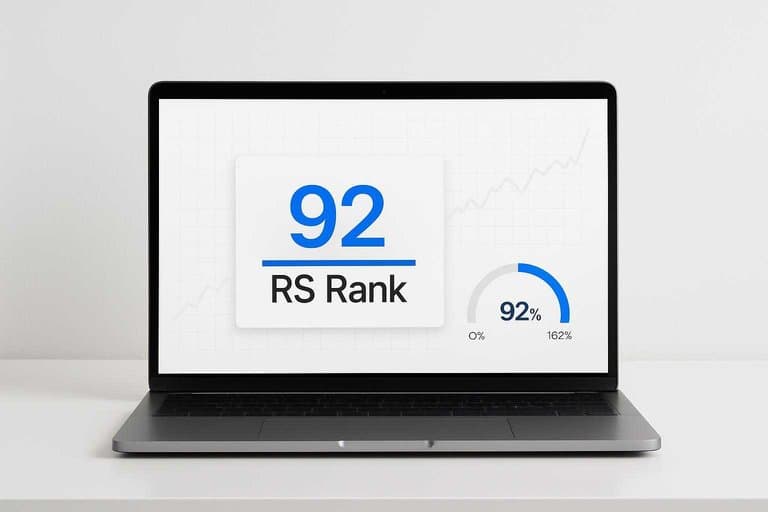
RS Rank works like a percentile inside a defined universe. If your stock has a 92 RS Rank, it outperformed about 92% of stocks in that universe over the lookback window.
Unlike raw percent change, the number is relative. A +8% stock can rank higher than a +20% stock if the whole market ripped.
That’s the line that gets crossed: performance becomes a position in a field, not a standalone score.
What it captures
RS Rank helps you spot leadership, not just movement. You use it to find who’s winning when the tape changes.
- Identify leaders early
- Flag regime shifts fast
- Measure breadth of outperformance
- Reduce absolute-return noise
- Compare across sectors cleanly
When ranks stay high while prices chop, leadership is hiding in plain sight.
Common pitfalls
RS Rank depends on the universe you choose. Compare a small-cap to mega-caps and you can get a misleading “strength” signal.
Rebalance timing matters too. Weekly vs daily ranking can flip “leaders” into “laggards” from one print.
In strong or weak markets, ranks compress because everything moves together. Then small return differences create big rank swings.
If the whole pond rises or falls, the fish still get ranked—just with thinner separation.
Side-by-Side Comparison
You can treat percent change as a raw speedometer, and RS Rank as a race position. They often move together, but they answer different questions.
| Dimension | Percent Change | RS Rank | Best use when |
|---|---|---|---|
| Meaning | Raw price return | Relative performance score | You need clarity fast |
| Inputs | Start and end price | Stock vs peer set | You compare many names |
| Output | % up or down | 1–99 style rank | You want sortable strength |
| Sensitivity | Time-window dependent | Universe dependent | You define rules upfront |
| Typical use | Single-stock check | Screening and rotation | You manage watchlists |
If you can’t name your universe, your RS Rank is just a number.
When Percent Change Wins
Percent change beats RS Rank when you need a clean signal and a clean sentence. Saying “up 18% in six weeks” lands faster than “RS 92,” especially outside your usual universe. Use it when magnitude matters more than placement.
Trend validation
Use percent change to confirm a real move, not a one-day wonder.
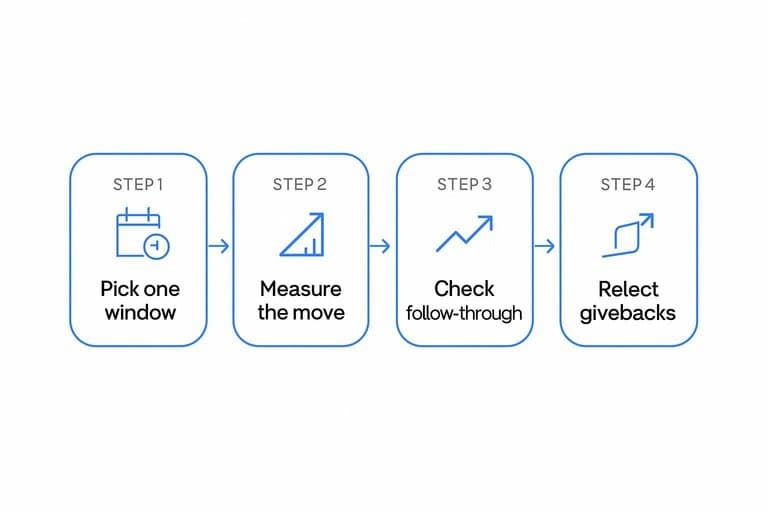
- Pick one window and stick with it, like 20 or 50 days.
- Measure the move from the pivot or breakout level.
- Check for follow-through: higher highs and shallow pullbacks.
- Compare the gain to prior swings in the same chart.
- Reject breakouts with big gains but instant givebacks.
Percent change answers the only question that matters here: did price actually travel?
Single-stock research
When you’re deep in one ticker, rank adds a hidden dependency. Percent change shows magnitude with no extra assumptions.
- Quantify the last thrust, like “+12% in 10 sessions”.
- Compare drawdowns, like “-6% pullback from highs”.
- Gauge volatility, like “3% average daily range”.
- Size gaps, like “+7% earnings jump”.
- Track reclaim levels, like “back above the 50-day”.
If you can’t define the universe, you can’t trust the rank.
Timeframe matching
Your lookback should match your holding period, or you’ll chase the wrong signal. A swing trader might care about 10–30 trading days, while an investor may care about 6–12 months.
If your window and your patience don’t match, your “signal” becomes noise.
When RS Rank Wins
Percent change is loud. RS Rank is selective.
When you are choosing leaders, building baskets, or controlling risk, ranking often beats raw returns because it is relative, not absolute.
Candidate screening
You need a fast way to cut 5,000 stocks into a real watchlist. Rank thresholds do it without guessing which returns are “good enough.”
- Choose your universe, like U.S. stocks over $500M market cap.
- Pick a lookback, like 6 or 12 months, then compute RS Rank.
- Filter to a threshold, like RS Rank ≥ 80.
- Tighten with liquidity, like $5M average daily dollar volume.
- Track the survivors weekly, not daily.
Your edge starts when you stop scanning everything.
Sector rotation
Absolute gainers can hide the real story. Ranking inside sectors shows where strength is clustering.
- Rank stocks within each sector.
- Count names above RS Rank 80.
- Track the top-decile median rank.
- Watch for rank breadth expanding.
- Rotate toward rising rank density.
When the whole group lifts, you are seeing rotation, not random winners.
Avoiding false leaders
One stock can jump 25% on a headline and look like a “leader.” If its peers are trending stronger, its rank stays mediocre.
RS Rank forces the comparison. It asks, “Did you beat the field?” not “Did you move a lot?”
Spikes impress humans. Rank punishes them.
Charting and Tools
Most traders use two views of relative strength: an RS line on charts and an RS Rank in tables. One is a picture, the other is a score. Treat them like a “check engine” light, not a single source of truth.
RS line usage
You’re comparing a stock’s performance versus an index, then reading the line like trend evidence. It helps you spot leadership early, before the crowd agrees.
- Plot the stock divided by your benchmark index.
- Mark RS line new highs, even if price lags.
- Watch divergences: RS up while price stalls, or vice versa.
- Confirm with price action: breakouts, support holds, clean closes.
- Re-check after pullbacks: RS should resist breaking down. When RS makes highs and price follows, you’re seeing real demand.
Rank-based filters
RS Rank is how you sort a universe fast, then decide what deserves a chart. Use it as a gate, not a guarantee.
- Filter RS Rank > 80 for broad leadership.
- Require rising rank over 4–8 weeks.
- Pair rank with 52-week price highs.
- Add “new RS high” as confirmation.
- Drop names with falling rank in uptrends. A screener finds candidates; your eyes find mistakes.
Combining indicators
RS alone can reward thin liquidity, news spikes, or sector fads. You want RS to agree with other evidence, so one metric can’t hijack your decision. For a practical stack, use RS with trend structure, volume behavior, and at least one fundamental anchor. For example: RS improving, price above the 50-day, accumulation volume rising, and earnings revisions not collapsing. When indicators disagree, trade smaller or wait for alignment.
Pick the RS View That Matches Your Decision
Use percent-change RS when you’re validating a specific setup and need to match the exact timeframe of your trade—then confirm it on the chart with an RS line versus the index. Use RS Rank when you’re screening large universes, comparing across sectors, or trying to avoid “leaders” that only look strong because the benchmark was weak. The most reliable workflow is to rank first (find candidates), then validate with percent-change and price/volume context before you commit capital.
Frequently Asked Questions
Is RS in stocks the same as relative strength index (RSI)?
No—RS in stocks usually means relative strength versus a benchmark (like S&P 500), while RSI is a 0–100 momentum oscillator based on a stock’s own price changes.
What’s a good RS Rank number to look for when screening stocks?
Many traders start with RS Rank 80+ to find above-average leaders and use 90–95+ to narrow to the strongest names in the market.
What benchmark should I use to calculate RS in stocks?
Use a benchmark that matches your universe: S&P 500 for large caps, Russell 2000 for small caps, and a sector ETF (like XLK) when you care about industry-relative leadership.
How often should I update RS Rank or percent-change RS in my trading process?
Weekly updates work well for swing and position trading, while active traders often refresh daily; intraday updates usually add noise without improving decisions.
Can a stock have strong percent change but a weak RS Rank (or the other way around)?
Yes—percent change can look strong in absolute terms while the broader market is stronger (lower rank), and a stock can rank well in a weak tape even if its raw return is modest.
Spot True Market Leaders
Understanding percent-change RS versus RS Rank is useful—but applying it across thousands of stocks every day is where most traders lose time and consistency.
Open Swing Trading delivers daily RS rankings, breadth, and sector/theme rotation context across ~5,000 stocks so you can build actionable watchlists faster—get 7-day free access with no credit card.