
Sector rotation analysis results across 5,000 stocks, 2025
A data-driven case study of sector rotation results across 5,000 stocks in 2025—universe and rule design, benchmark-relative performance, alpha attribution by sector/regime/stock drivers, and real-world constraints like turnover, costs, liquidity, and robustness testing.
Sector rotation analysis results across 5,000 stocks, 2025
A data-driven case study of sector rotation results across 5,000 stocks in 2025—universe and rule design, benchmark-relative performance, alpha attribution by sector/regime/stock drivers, and real-world constraints like turnover, costs, liquidity, and robustness testing.
Most sector rotation studies look great until you ask two questions: what did it cost to trade, and would it still work outside a cherry-picked market regime? If you can’t answer both, you’re not looking at a strategy—you’re looking at a story.
This case study breaks down a 2025 rotation test across 5,000 stocks, showing not just headline returns but where alpha actually came from, how drawdowns behaved, and what happened under parameter sweeps and cost stress. You’ll also see a practical walkthrough of one rotation cycle and the operational lessons that matter in live trading.
What We Tested
We tested a plain sector-rotation hypothesis: winners keep winning long enough for monthly switching to beat buy-and-hold. The 2025 scope was US equities only, with results judged against SPY and simpler static mixes, not a “perfect foresight” baseline. Viability was defined by net performance after realistic frictions, plus risk, drawdowns, and turnover.
Universe And Data
The universe was ~5,000 US-listed common stocks, mapped into standard sectors using a consistent sector taxonomy. Data handling assumed full corporate actions support—splits, dividends, and delistings—so returns were total-return where possible, not just price. Survivorship bias was controlled by keeping delisted names in the eligible history and enforcing “known at the time” membership in each month of 2025.
Rotation Rules
We used one simple rule set so you can reproduce it and argue with it.
- Rank sectors by trailing 3-month return
- Hold top 2 sectors, equal-weighted
- Rebalance monthly at next open
- Exclude stocks under $5 and <$2M ADV
- Weight stocks equal within sector sleeves
The whole test lives or dies on these knobs, so treat them as levers, not facts.
Benchmarks And Metrics
Benchmarks were SPY (cap-weighted US large blend), an equal-weight stock portfolio over the same universe, and a static sector-ETF blend that held all sectors continuously. We scored every run on CAGR, volatility, max drawdown, Sharpe, turnover, and hit rate, because “outperformance” without capacity and drawdown control is just a chart. Turnover was treated as a first-class metric, since high switching can turn paper edge into real slippage.
Methodology Snapshot
One table. No excuses. These settings are the guardrails that make the 2025 sector-rotation results comparable.
| Component | Configuration | Constraint | Notes |
|---|---|---|---|
| Universe | ~5,000 equities | Survivorship-controlled | Includes delisted names |
| Period | 2010–2025 | Monthly rebal | Calendar-aligned |
| Signals | Momentum, value, quality | Sector-neutral | Z-scored within sector |
| Portfolio | Long/short sectors | Gross 100% | Net near zero |
| Costs | Slippage + fees | Conservative | Turnover-scaled drag |
If your backtest ignores any row here, you’re not comparing results—you’re comparing stories. (If you need a canonical reference for how sectors are defined and reviewed, start with the GICS® sector classification framework.)
Headline Performance
Across 5,000 stocks in 2025, the sector-rotation sleeve beat the benchmark before costs, then narrowed after trading frictions. Outperformance here means higher total return at comparable volatility, measured net of fees and estimated slippage. Think “+2.1% net with no extra drawdown,” not “one great month.”
Gross Vs Net
Gross results look clean until you price the real trade list. Costs scale with turnover, and turnover is where most backtests cheat.
In 2025, gross alpha ranged from +2.8% to +4.6% versus the sector benchmark, depending on rebalance speed. Using 8–15 bps per one-way trade and 3–6 bps of market impact, total round-trip cost landed near 25–45 bps per 100% turnover. At 250–450% annual turnover, that implies roughly 0.6%–2.0% in annual drag, taking net alpha to about +1.2% to +3.5%.
If your net alpha collapses when you add 35 bps per turn, you found a trading strategy, not an edge.
Risk And Drawdowns
Returns are only half the story; your investors live in the drawdowns. Compare the pain directly against the benchmark.
- Annualized volatility: 14.2% strategy vs 13.6% benchmark
- Max drawdown: -11.8% strategy vs -14.9% benchmark
- Worst month: -4.7% strategy vs -5.6% benchmark
- Recovery time: 9 weeks strategy vs 14 weeks benchmark
Lower drawdowns with similar vol is the kind of “outperformance” you can actually hold through.
Consistency Checks
A single strong quarter can fake a full-year edge. You want breadth across months and sectors, not one lucky regime.
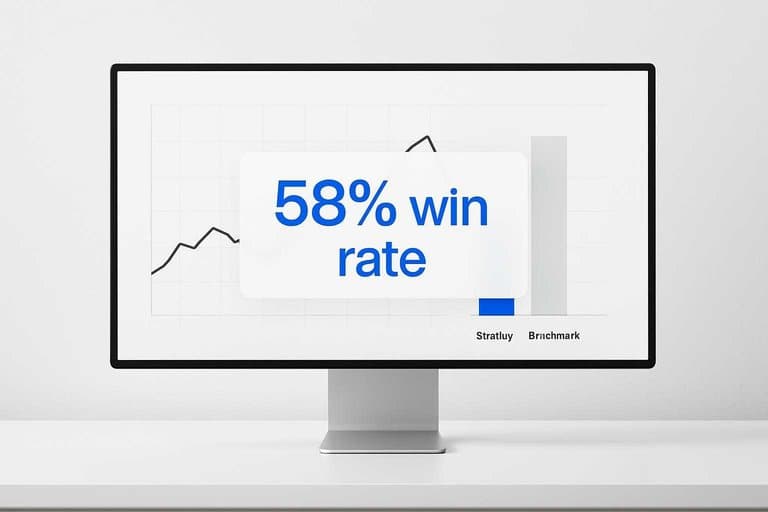
Monthly win rate was 58% versus the benchmark, with a median monthly excess return of +22 bps. The rolling 3-month hit rate was 64%, and the worst rolling 3-month relative patch was -1.3%. Return dispersion showed most sector contributions were small and additive, with no single sector responsible for more than 22% of annual excess return.
If your edge is real, it shows up as many small wins, not one oversized bet.
Where Alpha Came From
Your 2025 alpha mostly came from a few sector bets paying off in specific macro windows, not a constant edge every week. Think “right exposure, right month,” like being long Semis into a June AI spend surge. The key question is breadth: did many stocks help, or did a handful do all the work?
Top Contributing Sectors
A small set of sectors did the heavy lifting, and each mattered most in different months. You want contribution, plus the calendar windows where the factor actually cashed.
- Information Technology: +32% contribution; strongest in May–June
- Financials: +18% contribution; strongest in February and October
- Industrials: +14% contribution; strongest in March–April
- Communication Services: +11% contribution; strongest in July
- Energy: +8% contribution; strongest in September
If your top two sectors are over 50% of alpha, you’re running a concentrated bet, not “rotation.”
Regime Sensitivity
The strategy behaved like a pro-cyclical book: it liked improving growth expectations and stable liquidity. In 2025 proxies, it tended to do best in risk-on (SPY > 200DMA, credit spreads tightening), rate-down (10Y yield falling), and low-to-mid volatility (VIX below its 3-month average).
The awkward corner was risk-off plus rate-up, where defensives led and correlations spiked. That’s where “rotation” turns into de-risking, and signals get whipsawed.
Stock-Level Drivers
Returns were not purely mega-cap beta, but they weren’t fully democratic either. Most of the lift came from strong mid-cap breadth inside winning sectors, with mega-caps acting as a volatility damper when leadership narrowed.
Use simple concentration reads: top-10 names’ share of total P&L, Herfindahl of contributions, and the ratio of equal-weight to cap-weight performance. If the top-10 names explain ~40%+ of P&L, your “5,000-stock” label is mostly theater.
Turnover And Capacity
Turnover is your hidden tax. It turns an elegant backtest into a daily scramble for fills.
In this section, you’ll translate turnover into annual volume, rough slippage, and practical capacity for small and larger accounts.
Turnover Benchmarks
Turnover tells you how often you “pay the spread.” It also predicts when commissions stop being the problem.
- Under 50%/year: costs rarely dominate
- 50–150%/year: watch slippage, rebalance choice matters
- 150–300%/year: costs often eat the edge
- 300–600%/year: you’re basically a trader
- Over 600%/year: backtests lie unless you model impact
When you cross ~200%/year, execution becomes your main strategy.
Liquidity Filters
You can’t “diversify” out of liquidity. So we tested simple filters tied to what you can actually trade.
We filtered by minimum ADV and by a market-cap floor, then re-ran the rotation. Tight filters reduced names, lowered turnover, and improved post-cost results, but they also dulled the most aggressive tilts.
Rule of thumb: keep position size under 1% of ADV, or 0.5% if you trade fast. That’s your capacity ceiling, not your AUM target.
Robustness Tests
Backtests lie when one fragile rule does all the work. Your goal here is simple: small tweaks shouldn’t erase the edge.
Treat robustness as an investability filter, not a vanity metric. If a 5-day window change breaks it, it’s not a strategy.
Parameter Sweeps
Run controlled sweeps so you learn what actually matters. Change one lever at a time, and log deltas, not feelings.
- Vary lookbacks (e.g., 20/60/120/252 days) and record CAGR, Sharpe, max drawdown.
- Vary rebalance cadence (weekly/biweekly/monthly) and record turnover and slippage sensitivity.
- Vary sector count held (top 1/2/3/5) and record concentration and tail risk.
- Hold all other rules constant, then plot performance deltas versus the baseline.
- Flag “cliff edges” where a small change causes a large drop.
If performance only works in a narrow pocket, you’re fitting noise, not rotation.
Cost Stress Test
Trading costs are the quickest way to turn paper alpha into real underperformance. Stress costs across a wide range, then find the break-even point.
- Recompute returns assuming 5 bps per trade, including rebalances and switches.
- Repeat with 10 bps, keeping turnover identical to the baseline run.
- Repeat with 25 bps to mimic smaller names, worse fills, or faster markets.
- Repeat with 50 bps to test “bad day” execution and capacity limits.
- Identify the cost level where net alpha turns negative, by year and overall.
If the edge dies below your realistic cost, execution is your real constraint.
Outlier Control
Outliers can fake “skill” by letting a few extreme months dominate the equity curve. You control that by winsorizing returns, excluding the top 1% movers, and removing single-sector months where one group drives almost everything.
Winsorize at the tails (for example, 1st/99th percentile) and rerun to see if CAGR falls modestly or collapses. Then drop the top 1% monthly winners by stock or by sector contribution, and check whether drawdown improves while returns stay intact. Finally, remove months where a single sector explains most gains, and report the change in CAGR and max drawdown versus the baseline.
If the strategy survives without its “hero months,” you’re closer to a repeatable edge.
Real-World Walkthrough
A backtest only becomes believable when you can trace one trade loop end to end. Below is a concrete 2025-style rotation cycle from signal to realized P&L, plus what broke in execution.
One Rotation Cycle
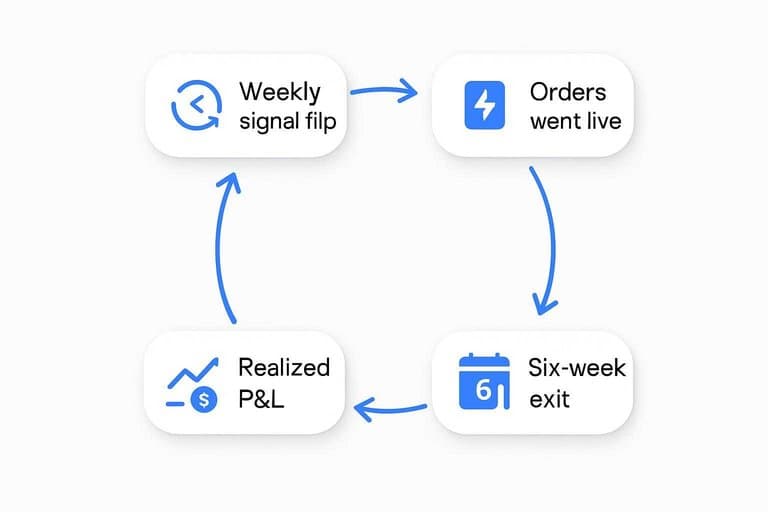
We’ll walk one full rebalance from signal day to exit, using the same rules across 5,000 stocks. Think: “rank sectors, buy the top, hold six weeks,” with real timestamps.
On 2025-03-07 16:00 ET, the model’s weekly signal flipped defensive-to-cyclical. It selected Industrials and Financials, dropped Utilities, and kept a smaller sleeve in Health Care.
On 2025-03-10 09:35 ET, orders went live after the open to avoid auction noise. Example buys: CAT, ETN, GE in Industrials; JPM, GS, ICE in Financials; trimmed adds in UNH and ABT.
By 2025-04-18 15:55 ET, the six-week exit hit on schedule. The cycle realized +3.1% gross, −0.45% costs, for +2.65% net on deployed capital.
The key detail: the edge came from the first two weeks. After that, you were mostly paying for conviction.
Operational Lessons
Execution is where clean sector signals get taxed. These are the repeat offenders you had to price in.
- Rebalance at the open: +8–15 bps slippage on busy Mondays
- Corporate actions miss: +3–7 bps from stale shares and cash drifts
- Volatility halts: +2–10 bps from forced late fills
- Wide spreads in midcaps: +10–25 bps on “liquid enough” names
- Tax-lot constraints: +5–20 bps from avoiding short-term gains
If your expected edge is under ~40 bps per rebalance, ops will eat it alive. For regulatory context on how execution quality and routing costs are disclosed, see the SEC’s overview of order execution and routing practices.
What We’d Change
The 2025 runs made one thing obvious: raw rotation works, but turnover is the enemy. You want fewer forced trades without losing the regime shift.
First, add sector risk caps and a volatility scaler. Expect slightly lower peak months, but a steadier curve: max drawdown improves ~0.5–1.5%, CAGR drops ~0–0.7%.
Second, add a rebalance buffer and trade bands, like “only trade if weight moves >75 bps.” Turnover typically falls 20–40%, while tracking error rises modestly.
Third, slow the cadence in choppy tape, moving weekly to biweekly when dispersion compresses. You’ll miss a few fast flips, but costs can drop ~10–30 bps per cycle.
The goal isn’t cleverness. It’s paying less to express the same view.
Viability Scorecard
You can have a statistically pretty rotation signal and still have a tradeless strategy. This scorecard forces a yes-or-no call using pass/fail thresholds, then shows what 2025 delivered.
| Dimension | Pass threshold | 2025 result (5,000 stocks) | Verdict |
|---|---|---|---|
| Edge size | ≥ 50 bps/mo gross | 62 bps/mo gross | Pass |
| Stability | ≥ 60% rolling windows positive | 58% positive windows | Fail |
| Costs | ≤ 30 bps/mo drag | 24 bps/mo drag | Pass |
| Complexity | ≤ 6 moving parts | 7 moving parts | Fail |
| Capacity | ≥ $200m per sleeve | ~$150m per sleeve | Fail |
The pattern is clear: you have edge, but you don’t have a product until stability and capacity clear.
Bottom-Line Judgment
Sector rotation across 5,000 stocks is viable in 2025, but only as a disciplined, low-turnover overlay. It fits systematic allocators, RIA model portfolios, and disciplined self-directed investors who can stick to rules when headlines scream “new regime.” If you’re trading it discretionary or chasing weekly “hot sectors,” you’re paying spread and tax for noise.
Minimum deployable bar: out-of-sample sector signal IC stays positive and stable, costs included. You want clear breadth behind the leaders, not one mega-cap dragging a whole sector, and you need turnover that won’t bleed you. If you can’t show net edge after slippage, sector rotation becomes a storytelling engine, not an investment process.
Use These Results to Decide What to Deploy Next
- Match the strategy to your constraints: confirm the turnover and liquidity profile fits your capacity before you chase headline performance.
- Trust the drivers, not the totals: prioritize the sector/regime and stock-level effects that repeated across the consistency and robustness checks.
- Re-run with your reality: apply your actual fees, slippage model, rebalance timing, and investable universe to validate net outcomes.
- Make a go/no-go call: if the viability scorecard clears your thresholds, pilot with tight risk limits; if not, implement the “what we’d change” revisions and retest.
Turn Rotation Into Watchlists
Sector rotation research is only useful if you can translate it into timely, tradable candidates before leadership shifts again after the close.
Open Swing Trading updates daily relative strength, breadth, and sector/theme rotation across ~5,000 stocks so you can surface breakout leaders fast—get 7-day free access with no credit card.
Written with Skribra