
Sector theme strength: how it works for breakouts
An explainer on sector theme strength and why it powers breakouts—how cross-stock pressure and breakout fuel form, the breakout mechanics from accumulation to failure, and practical ways to measure breadth/relative strength/flows and apply them in trade selection, entries, and exits.
Sector theme strength: how it works for breakouts
An explainer on sector theme strength and why it powers breakouts—how cross-stock pressure and breakout fuel form, the breakout mechanics from accumulation to failure, and practical ways to measure breadth/relative strength/flows and apply them in trade selection, entries, and exits.
Ever watch a sector break out and wonder why the same few names keep ripping while the rest of the market chops? It’s rarely “just news.” It’s theme strength: the shared pressure that makes multiple charts move together and gives leaders repeat buyers.
This explainer shows you how theme strength builds, how breakouts actually trigger and continue (or fail), and how to quantify it with breadth, relative strength, dispersion, and flows. You’ll also get a simple composite and a clean way to translate it into entries, invalidation, and exits.
What “theme strength” is
Theme strength is when sector-level demand shows up across many stocks at once. That aggregation matters because it turns a single breakout into a group push, and follow-through gets easier.
Think “the whole group is being bid,” not “one ticker got lucky.”
Cross-stock pressure
Theme strength often looks like simultaneous bids across constituents, minute after minute. That creates persistent order-flow, so your breakout depends less on one-name noise like a single seller.
Example: five semis hold their highs together, even as one prints a weak tape. That’s the line that gets crossed.
Breakout fuel sources
Theme strength comes from stacked demand sources that don’t need the same story. When they align, the bid keeps showing up.
- Passive index and ETF inflows
- Active manager rotation into the group
- Dealer hedging from call buying
- CTA trend models adding exposure
- Corporate buybacks and retail momentum
When you can name two or three at once, you’re not watching coincidence.
Why it lifts leaders
In a strong theme, the cleanest breakouts usually come from the most liquid, “ownable” leaders. Big flows need capacity, so they concentrate in names with tight spreads, heavy volume, and simple sizing.
You’ll see it when the leader grinds up on steady bids while laggards chop. Trade the stock institutions can actually buy.
Theme vs news
Theme moves and news pops can look identical on one candle. The difference shows up in how long buying repeats, and how many names participate.
| Feature | Theme-driven move | News-driven move | What you watch |
|---|---|---|---|
| Duration | Days to weeks | Minutes to days | Higher lows held |
| Breadth | Many constituents | One or two names | Advance/decline |
| Repeatability | Buys keep returning | Fades after reaction | Dip-buy response |
| Driver | Flow plus positioning | New information | Volume pattern |
If breadth stays wide after the headline fades, you’re dealing with a theme.
Mechanics of sector breakouts
Sector breakouts usually start with coordinated buying, not a single stock sprinting alone. You see it when multiple names “act right” together, then price expands as supply runs out.
The sequence is repeatable: accumulation creates tight ranges, compression builds pressure, a trigger clears supply, and continuation feeds on positioning. When the sector loses internal support, the whole move can unwind fast.
Accumulation phase
Institutions build exposure over days or weeks because size can’t fit in one candle. They buy on weakness, defend levels, and keep price from running away.
That process often prints a tight base with repeated support, while relative strength quietly grinds higher versus the index. You’ll hear it described as “it won’t go down,” even before it goes up.
The tell is time: the longer the base holds while RS rises, the more fuel you’re storing.
Compression signals
You want proof that sellers are getting absorbed while volatility contracts. Watch for these signals to stack, not appear once.
- Higher lows into resistance
- Narrowing daily ranges
- Declining ATR over weeks
- Volume drying up on dips
- Steady or rising RS line
When three or more show up together, you’re looking at pressure building, not “chop.”
Trigger and release
The breakout starts when price clears a supply shelf and there’s not much resting liquidity above it. Stops from shorts, momentum entries, and systematic flows hit at the same time.
If the order book is thin, price jumps to find sellers, creating a gap-like expansion even without a literal gap. That’s why the first push can feel “too far, too fast,” yet still be healthy.
Your job is simple: distinguish a clean air pocket from a head fake into heavy supply.
Continuation mechanics
Follow-through happens because positioning and incentives lag the price move. A sector breakout forces participants to react, not predict.
- Underpositioning turns dips into buys
- Benchmark chasing accelerates late demand
- Short covering adds forced market orders
- Options gamma pulls price toward strikes
If the sector is leading, dips become invitations, not warnings. For a plain-English explainer on this, see how gamma in options works.
Failure mechanics
Breakouts fail when the sector stops acting like a sector and starts acting like a few tickers. Breadth fades, leaders diverge, and the move loses its bid underneath.
Macro can flip the tape too, especially when rates or FX changes break the prior correlations that supported the theme. Suddenly the “same trade” isn’t the same trade.
If leaders can’t hold their breakout levels, assume the sector move is on borrowed time.
Measuring theme strength
You need a way to tell “real theme” from “one stock got hot.” Quantify participation, performance, coherence, and money-in-motion so you can size breakouts with intent.
Breadth score
Breadth tells you if the sector is being pulled by a few names or pushed by many. When participation expands first, leaders tend to follow.
Track simple participation gauges:
- % of constituents above 50DMA and 200DMA
- % making 20-day or 52-week highs
- % with rising 50DMA (slope > 0)
- Advance/decline line for the sector basket
If breadth won’t confirm, your “theme” is usually just a headline leader.
Relative strength
Relative strength answers one question: are you getting paid to own this theme versus the alternative. Use measures that separate drift from true outperformance.
- Sector/market ratio (XLK/SPY style)
- Rolling alpha vs benchmark
- RS line slope over 20–60 days
- Hit rate of up days vs market
When RS turns up while price bases, breakouts get cleaner and faster.
Dispersion and leadership
Dispersion shows whether the theme is coherent or chaotic. A “real” theme often looks boring: many names acting similarly while leaders grind higher.
Low dispersion with rising leaders suggests a shared driver, like “AI capex” lifting chips and networking together. High dispersion, where one name rips and peers chop, is a stock-picking regime with weaker follow-through.
If dispersion is high, trade the leader. Don’t pretend it’s a sector move.

Flow and positioning
Flows and positioning tell you if marginal buyers are showing up, or if everyone is already in. You’re looking for pressure, not perfect data.
- ETF flows into sector funds
- Volume surge in sector ETFs
- Futures COT positioning (where available)
- Dealer gamma exposure near key strikes
- Borrow rates and short interest trends
If flows confirm breadth and RS, breakouts tend to stick instead of spike.
A simple composite
A composite keeps you from overreacting to one loud signal. Build it from a few inputs you can update weekly.
- Normalize each input to 0–100 using a 1–3 year percentile rank.
- Use three components: breadth (% above 50DMA), RS slope (20–60D), and a flow proxy (ETF flows or ETF volume z-score).
- Weight them 40/40/20, unless flows are your edge.
- Smooth with a 3–5 period average to reduce one-week noise.
- Rebalance and refresh weekly; review weights quarterly.
Once your score holds above 70 for several weeks, you can treat pullbacks as entries, not warnings.
Why breakouts follow through
Breakouts persist because institutions aren’t free agents. Benchmarks, mandates, and systematic rules turn relative strength into forced demand.
Once price starts moving, flows follow price. That feedback is the engine behind “it keeps going” moves.
Benchmark gravity
Most active managers are judged against an index, not cash. When a sector rips and you’re underweight, your tracking error grows and your career risk rises.
That creates a quiet, mechanical chase: as the performance gap widens, managers add exposure to stop bleeding versus the benchmark. You’ll hear it as “we can’t be zero in that.”
Breakouts don’t need universal belief. They just need enough benchmarked money falling behind.
Constraint cascades
Buying often comes from rules, not opinions. When a theme strengthens, multiple constraints can flip from brake to accelerator.
- Increase risk-parity leverage as realized vol drops
- Add exposure under vol-targeting when volatility compresses
- Trigger stop-loss buys on hedges after upside breaks
- Rebalance mandates when sector weights exceed limits
- Free margin as winners reduce portfolio drawdown
If three constraints flip together, you’re looking at forced persistence.
Reflexivity loop
Higher prices improve charts, then charts attract attention. That attention turns into flows from ETFs, model portfolios, and “momentum” sleeves.
As demand rises, borrow tightens and shorts cover. The theme looks even cleaner, so more allocators buy the “obvious leader.”
Price becomes the fundamental. That’s the reflexive loop.
When the loop ends
Feedback loops end when incremental buyers run out. The tape gives you clues before the headline narrative changes.
- Shrinking breadth as fewer names advance
- Blow-off volume with fast reversals
- Leader lag versus the sector ETF
- Failed retests after clean breakouts
- Crowding signs in positioning and borrow
When leadership narrows, stop treating strength as safety.
Two breakout scenarios
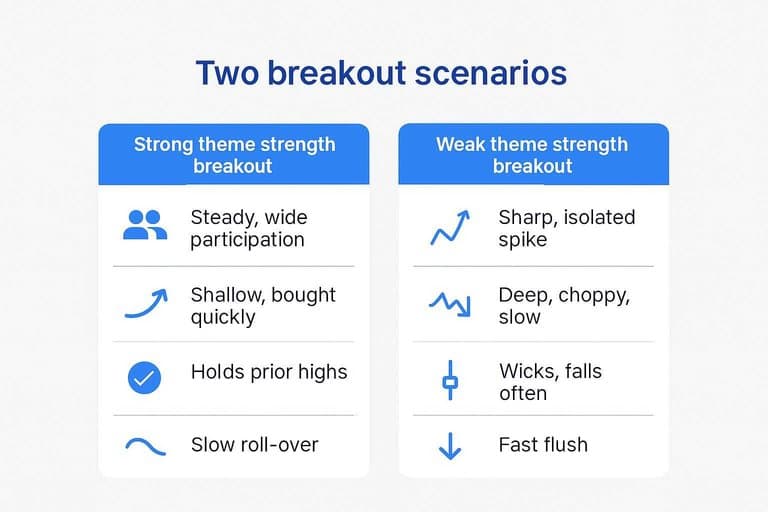
Theme strength changes how a breakout behaves after the first push. You’re comparing a breakout with a tailwind versus one that’s mostly on its own.
Theme strength often shows up as “every peer is green” versus “only this ticker is moving.” That single detail changes both path and risk.
Use this table to spot what you’re dealing with fast.
| Feature | Strong theme strength breakout | Weak theme strength breakout | What to watch |
|---|---|---|---|
| Early move | Steady, wide participation | Sharp, isolated spike | Peer breadth |
| Pullbacks | Shallow, bought quickly | Deep, choppy, slow | VWAP holds |
| Retest behavior | Holds prior highs | Wicks, fails often | Level reclaim |
| News sensitivity | Less headline-dependent | Needs constant catalysts | Calendar risk |
| Failure mode | Slow roll-over | Fast flush | Stop distance |
Trade the strong-theme breakout like a trend with guardrails. Trade the weak-theme breakout like a headline with a fuse.
Using it in trades
You’re using sector theme strength to stack probabilities, not to predict headlines. Think of it as a “wind at your back” filter that keeps your breakout list from turning into random singles.
Selection filter
Start with a hard gate so your watchlist stays small and biased toward momentum. You want breakouts where the group is pulling the stock, not the other way around.
- Sector score above your threshold
- Leader RS at highs
- Liquidity supports clean fills
- Tight base with compression
- Clean supply level nearby
A catalyst is optional, but a strong tape isn’t.
Entry and add-ons
Treat the first entry like a test and the add-on like confirmation.
- Enter on the breakout close, not the intraday spike.
- Add on the first orderly retest that holds the level.
- Size by volatility so risk stays constant.
- Skip add-ons if price is extended.
Your edge comes from structure, not speed.
Risk and invalidation
Invalidate on group deterioration, not every wiggle in your name. If sector breadth decays for several sessions, breakouts lose sponsorship and pullbacks stop being “normal.”
Watch the leaders too. When the top RS names start breaking key levels, your breakout becomes a solo act in a weakening genre, and that’s where clean setups turn into chop.
Exit logic
Plan exits around the theme rolling over, not just your entry price. You’re trading sponsorship, and sponsorship leaves footprints.
- Sector score rolls over
- Breakout level fails on retest
- RS line breaks trend
- Price breaks trendline
- Time stop triggers
If you’re exiting into resistance, you’re selling to the next buyer’s doubt. If you’re expressing the theme via ETFs, it also helps to understand ETF trading and liquidity when flows reverse.
Common misreads
You can misread “theme strength” as random sector noise, then size up positions with fake confidence. The fix is knowing which signals are context, and which are just coincidence.
Theme-strength mistakes show up as repeatable patterns.
| Misread | What you see | Why it fools you | Better read |
|---|---|---|---|
| One-day sector spike | “Everything green today” | Macro headline whipsaw | Require 3+ sessions |
| Leader = whole sector | “NVDA up, sector strong” | Single-name beta | Check breadth leaders |
| ETF flow = breakout fuel | “Big inflows, must run” | Rebalancing, hedging | Confirm price expansion |
| High RVOL = conviction | “Volume confirms theme” | Short-cover, news churn | Match with tight closes |
| Tight chart = strength | “No pullbacks, bullish” | Illiquidity, pinning | Look for controlled tests |
If you can’t name the mechanism, you’re trading a vibe.
Turn Theme Strength Into a Repeatable Breakout Plan
- Confirm the theme is real: look for improving breadth, rising sector-relative strength, and tightening leadership (winners separating from laggards without the group falling apart).
- Map the breakout phase: accumulation → compression → trigger; only press size when the trigger happens with supportive participation.
- Trade leaders, not headlines: pick the cleanest RS + best liquidity names, use add-ons on continuation setups, and cut quickly on failed triggers/rotation.
- Define exits before entry: trail into the reflexivity loop while breadth holds; get defensive when leadership disperses, momentum stalls, or the sector loses RS versus the benchmark.
Frequently Asked Questions
Is sector theme strength the same as sector rotation?
No. Sector theme strength is persistent, broad-based demand that supports multiple breakouts in the same theme, while sector rotation is capital shifting between sectors that can happen without strong breakout follow-through.
Do I need strong sector theme strength to trade a breakout successfully?
Not always, but strong theme strength usually improves odds and reduces whipsaws because multiple stocks attract bids at the same time. Without it, you typically need tighter risk controls and faster invalidation rules.
How long does sector theme strength usually last for breakout trades?
Most themes persist for weeks to a few months, with the best breakout windows often occurring during a 2–6 week momentum phase. When strength fades, breakouts tend to stall sooner and require quicker profit-taking.
What should I watch to confirm sector theme strength is still intact after I enter?
Look for continued leadership (top names holding relative strength), improving breadth within the theme, and pullbacks that get bought quickly rather than breaking prior bases. If leaders start failing on breakouts while laggards can’t lift, the theme is often weakening.
Can I use sector theme strength in crypto or forex, or is it only for stocks?
Yes, you can apply it anywhere there are “groups” that move together, like crypto narratives (L2s, AI tokens) or FX blocs (risk-on vs defensive). Use the same idea—broad participation and sustained relative strength across the group—rather than single-asset signals.
Spot Breakout Leaders Faster
Reading sector theme strength well is one thing; tracking it daily across thousands of stocks without misreads is where most breakout plans break down.
Open Swing Trading surfaces theme/sector rotation, breadth, and RS leadership so you can build a tighter breakout watchlist in minutes—get 7-day free access with no credit card.
Sources
- Gamma in Options: Learn How It Works (Charles Schwab) — referenced in Continuation mechanics
- ETF Liquidity: Understanding ETF Trading and Liquidity (Fidelity) — referenced in Exit logic