
Sector vs theme strength for swing traders
A side-by-side comparison of sector strength vs theme strength for swing traders — clarify definitions, evaluate signal reliability, time entries with catalysts, manage liquidity/slippage, and fit the approach to risk and stock selection.
Sector vs theme strength for swing traders
A side-by-side comparison of sector strength vs theme strength for swing traders — clarify definitions, evaluate signal reliability, time entries with catalysts, manage liquidity/slippage, and fit the approach to risk and stock selection.
You spot a breakout, but the move fades the moment your stock gaps up—was it actually a “strong sector,” or just a headline-driven theme that ran out of buyers?
This comparison helps you decide what to trust for your next swing: sector strength or theme strength. You’ll learn which signals hold up, how each behaves around catalysts, where liquidity and slippage bite, and how to build entries, stops, and a stock-selection workflow that matches the regime you’re trading.
Decision Snapshot
Sector strength is broad, steady rotation across an industry group, like “semiconductors leading the tape.” Theme strength is narrower, catalyst-led demand for a narrative, like “AI infrastructure” or “GLP-1 weight loss.” For swing trades, you usually hold 3–20 trading days, and you care about what can move now, not what sounds good.
Key Definitions
Sector strength is persistent relative strength across a formal sector or industry group, measured versus the index. Theme strength is relative strength concentrated in a narrative basket, often cross-sector and catalyst-driven. Swing-trade horizon is days to a few weeks, commonly 1–4 weeks, with exits triggered by trend breaks or catalyst fade.
Quick Winner Matrix
You’re choosing between a slow, liquid current and a sharp, headline wave. Pick the tool that matches how you enter, scale, and exit.
- Reliability: Sector
- Signal clarity: Sector
- Catalyst power: Theme
- Diversification: Sector
- Timing precision: Theme
- Risk control: Sector
If you can’t name the catalyst date, prefer sectors; themes rot faster than charts show.
When Each Applies
In risk-on, sectors tend to trend cleanly as managers add beta in size. In risk-off, sector defense works better than themes, because liquidity and correlations dominate. Early-cycle usually rewards sector rotation, while late-cycle can favor themes tied to capex, energy, or policy. News-driven tapes favor themes, because a single headline can reprice the whole basket in hours.
Trade themes when the tape is event-led; trade sectors when the tape is flow-led.
What Traders Measure
Swing traders chase strength because it front-runs attention, liquidity, and follow-through. But your “strength” read can be a mirage, like a sector ETF rising on two mega-caps.
Sector Strength Signals
Sector strength looks clean on a chart, which is why it’s easy to overtrust. You’re usually measuring the sector wrapper, not the internals.
- Track relative strength vs SPY
- Monitor sector rotation rank changes
- Check breadth: advancers vs decliners
- Read sector ETF trend structure
If breadth diverges from RS, you’re trading a mask, not a move.
Theme Strength Signals
Themes move on narrative velocity, so traders measure who’s getting paid first. The risk is confusing noise for traction.
- Compare basket RS vs SPY
- Count catalyst and headline frequency
- Watch options flow concentration (see Cboe’s options volume stats)
- Map leader-follower price behavior
If the leaders stop leading, the theme is already exiting.
Metric Failure Modes
Sector metrics fail when rebalancing or a few heavyweights drag the ETF, even as most names weaken. Theme metrics fail when headline churn boosts a basket briefly, then mean-reverts once the “story” fades.
The fix is simple: validate strength at the constituent level before you size up.
Reliability Scorecard
You need a quick way to judge whether a “hot narrative” can actually carry a 5–20 day swing. Grade sectors and themes on what usually breaks swings: churn, one-off headlines, and messy correlations.
| Lens | Stability | Repeatability | Signal-to-noise |
|---|---|---|---|
| Sector strength | A | A- | B+ |
| Theme strength | B- | B | C+ |
| Best use | Base trend filter | Trade catalyst | Position sizing |
| Common failure | Slow rotation | Headline whipsaw | Correlation drift |
If the theme scores lower, don’t ignore it—shrink size and demand cleaner triggers.
Timing And Entries
For 3–20 day swings, your entry quality is mostly about structure and invalidation. A clean trigger looks like “break, retest, go,” with a stop level the market respects.
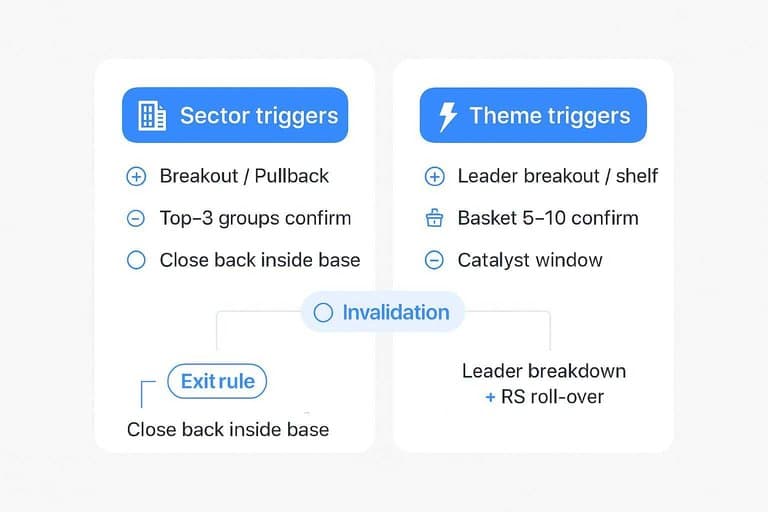
Sector Entry Triggers
You want the sector ETF to do the obvious thing, while the strongest industry groups stop lagging. That alignment cuts chop and gives you a nearby “I’m wrong” level.
- Mark the sector ETF base and the last pivot high.
- Buy the breakout, or the first pullback to the breakout level.
- Confirm top-3 industry groups are also above their pivots.
- Set invalidation below the breakout level, or below the pullback low.
- Exit on a sector ETF close back inside the base.
If the sector can’t hold the breakout, don’t debate the theme. You’re early or wrong.
Theme Entry Triggers
Themes move fast when the story hits, and sloppy when the story fades. Your trigger has to respect the leader and the basket, or you’ll chase noise.
- Identify the theme leader with clean RS and strong liquidity.
- Enter on a leader breakout, or a pullback to the breakout shelf.
- Confirm a basket of 5–10 names is breaking out within 1–3 days.
- Require a catalyst window: earnings, policy, product, or data release.
- Invalidate on leader breakdown plus basket RS roll-over.
If the basket won’t confirm, you’re trading a headline, not a move.
Cleaner Winner
Sector triggers usually give cleaner entries and tighter invalidation for swing trades. The chart structure is more consistent, liquidity is steadier, and false breaks happen less often than in theme-led bursts.
Themes can pay more when you’re right, but they whipsaw more because leadership rotates and catalysts expire. Cleaner entries win more often. That’s the whole edge.
Catalysts And Follow-Through
Swing trades need a catalyst that travels, then keeps traveling. Sectors usually move on “rates up” or “oil down” type inputs, while themes often move on “AI rollout” or “ban headlines.” Your job is judging whether the story stays tradable for days, not hours.
Sector Catalysts
Sector catalysts come from shared economics, so the first move often spreads fast. Think “CPI hot, banks catch a bid” or “crude spikes, energy gaps up.”
Macro prints, rate shifts, commodity shocks, and earnings season guidance changes hit many constituents at once. That creates spillover: leaders pop, laggards get dragged, and ETFs amplify the flow.
When the driver is persistent, the follow-through tends to last long enough for clean multi-day swings.
Theme Catalysts
Theme catalysts are narrative-first, so the trigger can be narrower but more explosive. Think “new model launch” or “regulator comment” that instantly re-prices anything adjacent.
Product releases, regulation, geopolitics, viral narratives, and a single mega-cap headline can lift an entire basket. The catch is durability: themes often fade when the news cycle rotates.
If the theme starts attracting new participants each day, it stops being a pop and becomes a campaign.
Winner By Regime
The edge flips with volatility and correlation, not with your preference. Watch whether money wants broad exposure or specific stories.
- Themes win in high vol, low correlation, headline-driven tape.
- Themes win when dispersion is high and leadership is narrow.
- Sectors win in moderate vol, high correlation, macro-led tape.
- Sectors win when curves, spreads, or commodities trend cleanly.
- Sectors win during earnings season rotation across industries.
Trade what the market is rewarding this month, not what worked last quarter. (For research context on persistent industry effects, see industry momentum evidence.)
Liquidity And Slippage
Liquidity decides whether your edge survives contact with the market. Sector ETFs and large-cap baskets usually trade clean; theme names can punish you at the open.
| Universe | Avg spread | Borrow availability | Gap risk | Position sizing capacity |
|---|---|---|---|---|
| Sector ETFs | Tight | Easy | Moderate | Large |
| Sector leaders | Tight | Usually easy | Moderate | Medium-large |
| Theme ETFs | Medium | Mixed | Medium-high | Medium |
| Theme singles | Wide | Often hard | High | Small |
If the spread looks like a tax, size down or trade the ETF instead.
Risk Management Fit
Sector strength gives you cleaner risk rails. You can size, stop, and hedge off one liquid benchmark like XLF or XLK. Theme strength can pay bigger, but your risk often rides on a few “leaders” that gap hard.
Stop Placement
Sector-based stops anchor to ETF structure, not a single headline-prone name. Theme-based stops often sit under a leader’s pivot, which can fail on one ugly open.
With sectors, you can place stops under ETF support, VWAP bands, or the prior swing low. Your stop triggers on broad distribution, not one earnings candle. In a gap-down, the ETF usually gaps less than the top constituents, so your fill is less hostile.
With themes, the stop is usually under the leader’s base or a key moving average. That works until the leader gaps 8–15% on guidance, a downgrade, or a regulatory tweet. Your “planned” stop becomes a market order into air.
If your stop depends on one ticker behaving, it isn’t a stop. It’s a hope.
Hedging Options
Sectors give you hedge instruments that trade like tools, not like opinions. Themes can be hedged, but you often hedge the neighborhood, not the house.
- Buy sector ETF puts for defined downside
- Run collars on the sector ETF to fund protection
- Pair long leader vs short sector laggard
- Hedge beta with SPY or QQQ puts
If you can’t name the hedge in one symbol, your hedge will lag your risk.
Risk Winner
Sector strength is the safer default for swing traders. You get tighter correlation to your hedge, more diversification inside the position, and fewer single-name tail events.
Themes concentrate exposure in a few names that often move together in panics. Correlations jump when stress hits, and the whole theme can gap on one shared narrative. That’s tail-risk behavior you can’t spreadsheet away.
Trade themes when you have edge, not when you need safety.
Stock Selection Process
Your edge starts with candidate quality, not entries. The real decision is whether you let sector strength lead, or let a theme pull you in. One path cuts noise. The other finds breakouts earlier, but invites more traps.
Sector-First Filter
Start here when you want fewer surprises and cleaner follow-through. You’re aligning with the biggest source of sustained flows: group money.
- Pick the leading sector using relative strength and trend.
- Pick the leading industry inside that sector.
- Select liquid leaders with tight spreads and clean ranges.
- Validate with the earnings calendar and RS versus the sector.
When your stock, industry, and sector all agree, chop has less room to win.
Theme-First Filter
Use this when the tape is rotating fast and narratives are driving attention. You’re trading a catalyst, so you must prove it’s real demand, not a single-name mirage.
- Define a theme basket with 8–20 relevant tickers.
- Identify true leaders by RS and breakout quality.
- Verify liquidity and float to avoid “one headline” spikes.
- Confirm multi-stock participation across the basket.
- Time the catalyst window and key dates.
If only one stock is working, you’re probably trading a story, not a theme.
Selection Winner
Default to sector-first for swing trades, then use themes as a secondary lens. Sector-first reduces false positives because it forces broad participation before you risk capital, instead of “one chart looked good.” Theme-first still has a place, but treat it like a setup type that requires confirmation, not a starting assumption.
Common Trader Mistakes
Trading “strength” sounds clean until you mix definitions. Sector strength, theme strength, and single-stock momentum are different signals with different failure modes.
- Chasing a theme headline, not theme breadth → Track leaders, secondaries, and new highs.
- Buying the strongest stock in a weak sector → Confirm sector RSI and relative strength first.
- Treating sector ETFs and theme baskets as identical → Use ETF flow for sectors, dispersion for themes.
- Ignoring rotation timing → Wait for strength to persist three sessions.
- Using one stop style for everything → Use tighter stops for themes, wider for sectors.
Fix the definition before you fix the entry; most “bad trades” were bad classifications.
Final Recommendation
For most swing traders, prioritize sector strength first, then use themes as a catalyst filter. Sectors give you cleaner breadth, steadier flows, and fewer “story spikes” that fade by Friday. If you can’t say “financials are leading” or “semis are leading,” you’re trading headlines, not a regime.
Exception one: prioritize themes when the move is event-driven and time-boxed, like “AI capex,” “GLP-1,” or “uranium supply.” In that case, treat sector data as a risk check, not the entry trigger. Your job is to ride the narrative while the tape still rewards it.
Exception two: prioritize themes when leadership is cross-sector and concentrated in a small group, like “mega-cap cloud” or “data-center power.” Sectors will look mixed, yet the theme basket trends with tight correlation. If your winners all share the same story, you’re in a theme trade—manage it like one.
Pick Your Primary Lens, Then Trade the Confirmation
- Start with sector strength when you want consistency: broad participation, cleaner relative strength, easier hedging, and better follow-through in normal/slow news regimes.
- Start with theme strength when a catalyst dominates: earnings cycles, regulatory/geo headlines, AI/biotech narratives—then demand proof via expanding volume, repeated green closes, and leadership holding VWAP.
- For any setup, require alignment: the stock leads, the sector/theme confirms, and liquidity supports your position size; if one leg breaks (breadth fades, leaders roll, spreads widen), downshift size or skip.
- Keep the workflow simple: use one as the primary filter and the other as the trigger—it reduces overtrading and makes your entries, stops, and expectations mechanically repeatable.
Frequently Asked Questions
Is sector theme strength still useful for swing trading in 2026 with AI-driven news cycles?
Yes—relative strength still works because it measures where capital is actually flowing, not just headlines. Most swing traders just need faster filters (e.g., RS vs SPY + ATR) to avoid getting whipped by short-lived AI/news spikes.
What’s the best way to scan for sector theme strength without paying for expensive data?
Use Finviz or TradingView to rank sector/industry performance, then confirm with ETFs (e.g., XLK/XLF/XLE) and a simple RS line vs SPY. For themes, track a few liquid proxy ETFs (ARKK, ICLN, TAN, SMH) and compare 1M/3M performance plus volume trends.
How do I backtest sector theme strength for 3–20 day swings in a simple, repeatable way?
Define a rule like “top quartile RS over 20 trading days + price above 20-EMA,” then test next-5/10/15-day returns and max drawdown using TradingView strategy scripts or Python (pandas + yfinance). Judge it on win rate, average R-multiple, and worst 95th-percentile drawdown, not just total return.
What results should I expect when trading sector theme strength—how much edge is realistic?
Most traders should expect small but consistent improvements, like a few percentage points higher win rate or better average R per trade, not a dramatic equity curve overnight. If your “strong” lists aren’t beating a SPY baseline over 50–100 trades, the filter is not adding edge.
Can I trade sector theme strength using options instead of stock, and what changes?
Yes—use liquid options on the sector/theme ETF or the most liquid leaders, and keep expirations 30–60 DTE to reduce gamma whipsaws on 3–20 day holds. Expect wider spreads and volatility shifts to matter more, so position size off premium-at-risk and implied volatility, not share-based stops.
Turn Rotation Into Watchlists
Measuring sector vs theme strength is only half the edge—the real challenge is tracking rotation daily and translating it into timely, low-slippage entries.
Open Swing Trading surfaces breakout leaders with daily RS rankings, breadth, and sector/theme rotation context so you can shortlist actionable names in minutes. Get 7-day free access with no credit card.
Sources
- Cboe press release: 2023 U.S. options volume exceeded 11 billion contracts; 2024 ADVs through Q3 (Cboe, 2024) — referenced in Theme Strength Signals
- Do Industries Explain Momentum? (Moskowitz & Grinblatt, 1999) – AQR summary/link — referenced in Winner By Regime