Set 9 Checks for Market-Open Readiness Daily
A daily checklist for market-open readiness that helps you decide when to trade and how aggressively—run a 10-minute scorecard, interpret overnight context and calendar catalysts, classify volatility and liquidity regimes, and turn key levels into clear if-then triggers with pass/fail thresholds.
Set 9 Checks for Market-Open Readiness Daily
A daily checklist for market-open readiness that helps you decide when to trade and how aggressively—run a 10-minute scorecard, interpret overnight context and calendar catalysts, classify volatility and liquidity regimes, and turn key levels into clear if-then triggers with pass/fail thresholds.
If you’ve ever opened your platform and felt “late” before the bell even rings, you’re not alone—most bad trades start with missing context, not bad charts.
This checklist gives you a repeatable 10-minute pre-open routine: score your readiness, scan overnight drivers and scheduled catalysts, identify the volatility and liquidity regime, and map the key levels that actually matter. You’ll finish with a simple pass/fail decision and a sizing plan that matches today’s conditions.
Daily readiness scorecard
Readiness definition
Market-open readiness is your ability to execute your first trade without improvising, hesitation, or hidden risk.
You’re “ready” when you have a written plan, hard risk limits, one primary focus, and zero unresolved alerts. Think: “levels marked, size decided, platform clean,” before the bell.
10-minute workflow
Start 15 minutes before the open so you’re calm, not catching up.
- Check overnight news and today’s calendar; write the one catalyst that matters.
- Identify the regime (trend, range, high-vol) using your primary index and ATR.
- Mark three levels: prior day high/low and the nearest volume or VWAP level.
- Set risk numbers in writing: per-trade risk, max daily loss, and max trades.
- Record your readiness verdict, then stop checking at T-minus 5 minutes.
If you’re still “researching” at T-minus 5, you’re already trading from stress.
Pass/fail thresholds
Decide these before you see the first big candle.
- Risk per trade: ≤ 0.5% of account, or a fixed $ amount.
- Max daily loss: ≤ 1.5% of account, then stop trading.
- Volatility limit: stand down if ATR is > 150% of 20-day average.
- Alert status: fail if any platform, data, or order-routing alert is unresolved.
- Focus rule: fail if you can’t name one primary setup.
Your best trade is often the one you don’t take when the thresholds say “no.”
Tracking template
Log only what changes decisions, not what looks impressive.
| Date | Regime | Catalysts | Levels | Risk | Bias | Execution notes | Ready? |
|---|---|---|---|---|---|---|---|
| YYYY-MM-DD | Trend/Range | CPI, earnings | PDH/PDL/VWAP | 0.5% / 1.5% | Long/Short/Flat | “Late, chased” | Pass/Fail |
| YYYY-MM-DD | High-vol | Fed, oil | Key swing | $ risk set | Neutral | “Clean entries” | Pass/Fail |
| YYYY-MM-DD | Range | None | Value edges | Reduced size | Flat | “No trade” | Pass/Fail |
After two weeks, patterns in your “Fail” reasons become your real edge.
Check 1: Overnight context
You need a fast read on what moved while you slept and whether it still matters. Overnight action can pre-load your open with momentum, gaps, or traps.
- Scan Asia and Europe index direction
- Note S&P/Nasdaq futures vs prior close
- Mark overnight high, low, and midpoint
- Flag major reversal after a news spike
- Check USD, yields, and crude alignment
If futures reclaimed the midpoint after a spike, expect a fade fight at the open.
Check 2: calendar catalysts
Scheduled events can turn a clean setup into a coin flip. You list them early so your risk rules are set before the first headline hits.
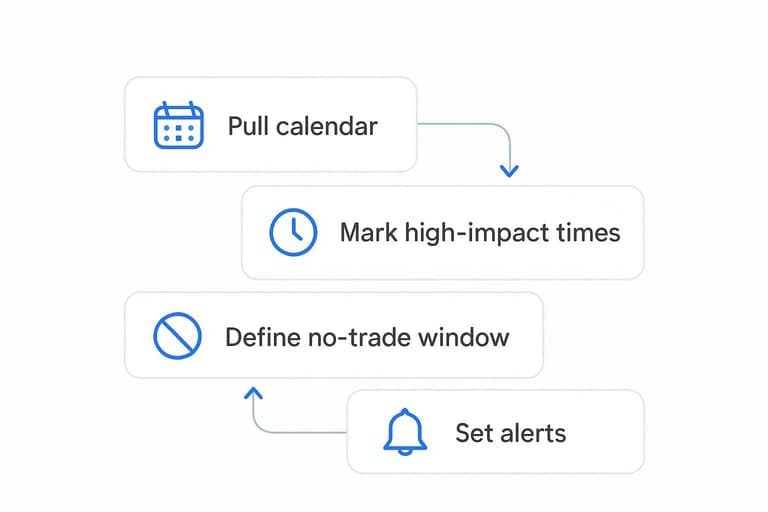
- Pull today’s calendar for your traded markets, plus key global releases.
- Mark high-impact times and write the exact release minute in your timezone.
- Define a no-trade window per event, like “15 minutes before to 10 after.”
- Tag instruments most exposed, like USD pairs for CPI or NQ for FOMC.
- Set alerts and note the first post-event level you’ll reassess.
If you can’t explain your no-trade window in one line, you’re still trading hope.
Check 3: volatility regime
Volatility decides what gets paid today and what gets punished. You read the regime first, then choose a strategy, size, and setup that fits. Think: “high vol = paid for patience, punished for tight stops.”
Key volatility reads
Get a small set of reads you can check in under two minutes. You want direction, expansion, and what the market already priced in.
- Check VIX level and IV rank
- Measure ATR expansion versus 20-day
- Mark premarket high–low range
- Note expected move for today
If two reads scream “expansion,” treat your tight-stop plays as invalid.
Strategy mapping
Map the regime to a default play, then write down what you will not trade. The goal is fewer decisions after the open.
| Volatility regime | Best-fit play | Position size | Avoid |
|---|---|---|---|
| Low, compressing | Breakout prep | Larger | Chasing wicks |
| Low, expanding | Breakout | Normal | Fading highs |
| High, trending | Trend | Smaller | Tight stops |
| High, choppy | Mean reversion | Smallest | Breakouts |
Your edge isn’t the play; it’s refusing the wrong one fast.
Sizing adjustment rule
Pick one rule you can run every day without debate. Use volatility and liquidity to set a hard bracket, then stop tinkering.
Set size = base size × (target ATR% ÷ current ATR%), then cap it between 0.25× and 1.25×. If spread is wide or depth is thin, cut one more notch.
Most blowups come from sizing like it’s Tuesday when it’s actually earnings week.
Check 4: liquidity conditions
Liquidity is your ability to enter and exit without paying a surprise tax. Before the open, you’re really checking one thing: can you trade your size near your price.
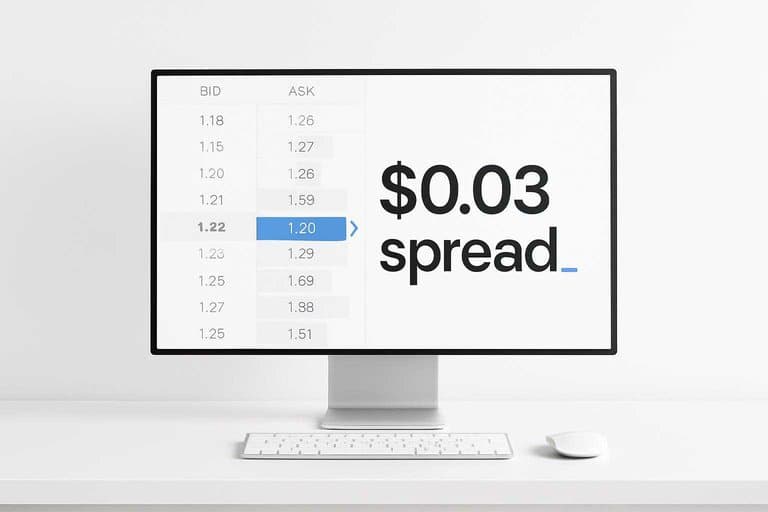
Example: a “$0.03 spread” on a $10 stock is fine, but not if the book is empty behind it.
Liquidity red flags
Liquidity breaks in obvious ways, and you can reject the day fast. Treat this as a pre-open kill switch, not a debate.
- Spread widens and stays wide
- Premarket volume stays thin
- Prints look erratic or stale
- Symbol is halted or pending halt
- Gap is news-driven and violent
If you see two or more, skip the trade and scan elsewhere.
If you want the official mechanics behind pauses, review the Limit Up/Limit Down plan.
Brokerage constraints
Your broker can turn a liquid chart into an untradeable position. Check constraints while you still have time to switch symbols.
- Confirm margin and buying power updates.
- Verify borrow availability for shorts.
- Check locate fees and rate changes.
- Confirm allowed order types for the session.
- Check platform status and data feed health.
If any one fails, your “plan” is fiction until it’s fixed.
Go/no-go criteria
Use a simple rule you can execute under pressure: trade only if spreads are stable, volume is building, and the top-of-book has real size on both sides.
If any of those are false, it’s a no-go, even if the setup looks perfect.
Your edge can’t survive paying the spread plus the panic premium.
Check 5: key levels map
Your level map is your decision grid for the open. It separates “watch” levels from “act” levels, so you don’t improvise at 9:31.
Example language helps: “Above premarket high, I’m active; inside the range, I’m observing.”
Must-mark levels
Mark the same core levels every day, even when they feel obvious. Consistency makes your reads comparable across sessions.
- Prior day high, low, close
- Premarket high and low
- Weekly high and low
- Session VWAP and bands
- Major gaps and gap fills
If you can’t point to these in seconds, you’re trading vibes.
Level validation
Not every line deserves attention. Validate levels so your “act” zones are scarce and meaningful.
Look for:
- Confluence with another level
- Two or more clean touches
- Volume profile node or POC
- Nearness to a catalyst window
A level without a reason is decoration, and decoration steals focus at the open.
If-then triggers
Write triggers before the bell, when you’re calm. Keep them binary, so you can execute without debate.
- If price breaks premarket high and holds 1 minute, then enter; stop below the hold.
- If price rejects prior day high twice, then fade; stop above the wick high.
- If price reclaims VWAP after a flush, then go long; invalidate on VWAP loss.
- If price fills the gap and stalls, then take profits; exit on next lower low.
When your “if” is clear, your “then” becomes routine.
Run the Checklist, Then Commit to the Decision
Treat this as a daily gate, not a suggestion: complete the scorecard, then decide “trade” or “stand down” before the open. If you pass, lock in your volatility-based sizing and your liquidity go/no-go rule so you don’t renegotiate risk mid-session. Keep your key levels and if-then triggers visible, and only take setups that match today’s regime and calendar. Finally, log the outcome so tomorrow’s readiness score is based on evidence, not vibes.
Turn Checks Into Watchlists
Running a market-open readiness scorecard is powerful, but it’s hard to keep overnight context, breadth, and leadership lists fresh every single day.
Open Swing Trading updates relative strength, breadth, and sector/theme rotation nightly so you can build a tight breakout watchlist in 5–15 minutes—get 7-day free access with no credit card.