Set Up a 20-Minute Daily Stocks Trading Routine
A step-by-step guide to building a repeatable 20-minute daily stock trading routine—set tight constraints, prep your tools, enforce risk rules, and run a minute-by-minute script with a checklist and two-minute trade log for consistent execution.
Set Up a 20-Minute Daily Stocks Trading Routine
A step-by-step guide to building a repeatable 20-minute daily stock trading routine—set tight constraints, prep your tools, enforce risk rules, and run a minute-by-minute script with a checklist and two-minute trade log for consistent execution.
If your “quick trade” turns into 90 minutes of chart-hopping and second-guessing, you don’t have a strategy—you have a stress habit. Most trading mistakes happen before you ever click buy: unclear goals, too many tickers, and no hard stop on risk.
This guide helps you turn 20 minutes into a disciplined routine. You’ll define constraints, set up fast tools, lock in risk rules, follow a minute-by-minute script, use a simple checklist, and log trades in two minutes so you can improve without living on your screen.
Define Routine Constraints
Your 20 minutes is a hard container, not a suggestion. Decide the window, what you trade, and how you score it, before you touch a chart. Otherwise you’ll “just check one more thing” and your routine will sprawl.
Pick time slot
Choose one fixed 20-minute block that matches your energy and the market’s behavior.
- Pick open, lunch, or close based on your availability.
- Convert that block to your local time zone.
- Add a daily calendar event with a one-minute alert.
- Block the time as “do not book” in your calendar.
The calendar is your risk control before the first trade.
Choose trade universe
Limit your watchlist so scanning and execution stay fast inside the time box.
- Track 10–30 tickers total
- Prefer high average volume
- Require tight typical spreads
- Exclude frequent halt names
- Record rules in one note
If your universe needs constant debate, your routine will fail on busy days.
Set routine goals
Pick one primary objective, because mixed goals create mixed decisions. For example: “I’m practicing pullback entries,” or “I’m adding $200–$500/week,” or “I’m reducing portfolio drawdowns.”
Choose 1–2 weekly metrics you can’t argue with, like “followed my entry rules 8/10 times” and “max loss per day stayed under X.”
If you can’t measure it weekly, you’ll manage it emotionally.
Decide strategy type
Choose one approach and one timeframe so every check is predictable.
- Trade trend pullbacks
- Trade breakouts
- Trade mean reversion
- Use 1–5 minute charts
- Or use end-of-day
One strategy beats five half-used ones, especially in 20 minutes.
Prepare Tools Fast
You’re building a setup that lets you scan, decide, and execute without hunting through menus. Think “two clicks to enter” and “one glance to validate,” like having a saved bracket order named “Daily Risk 0.5R.”
Broker essentials
Your broker settings decide your speed and your surprises. Lock them down once so every morning feels identical.
- Enable real-time quotes and confirm the data package is active.
- Set margin permissions only if you’ll actually use margin.
- Create default order types you’ll trade daily (market, limit, stop).
- Set time-in-force defaults (DAY, GTC) and after-hours rules.
- Verify buying power, short availability, and locate rules.
If any of this is “maybe,” you’ll hesitate at the exact wrong second.
Chart workspace
One chart template beats ten custom charts. You want the same signals drawn the same way, every time.
- Add candlesticks with your preferred color scheme.
- Add VWAP, plus 20 EMA and 50 EMA.
- Add volume with a clear average-volume line.
- Save as a template and name it something obvious.
- Apply the template to every ticker window by default.
Consistency is your edge here, not creativity.
Scanner setup
Two scanners cover most daily opportunities without turning your routine into a research project. One finds speed, the other finds cleaner entries.
- Momentum: percent change up, high relative volume, tight spread.
- Momentum: minimum price and float filters you can actually trade.
- Pullbacks: trend up, price near VWAP or 20 EMA.
- Pullbacks: ATR minimum for room to move.
- Both: alert on new highs or reclaim levels.
Save them once, then stop tweaking filters mid-session.
Execution shortcuts
Execution is where good ideas go to die. Presets keep you from doing math with adrenaline.
Set hotkeys or order presets for buy, sell, stop, and bracket orders. Prefill position sizing with your default risk, like “$50 risk per trade.”
If you can’t place a bracket in two seconds, your system is still theoretical.
Create Risk Rules
Your 20-minute routine only works if risk decisions are pre-made. Write rules that are boring, specific, and enforced without debate.
Use language you can execute fast, like “two strikes, done” or “-1R and I’m out.”
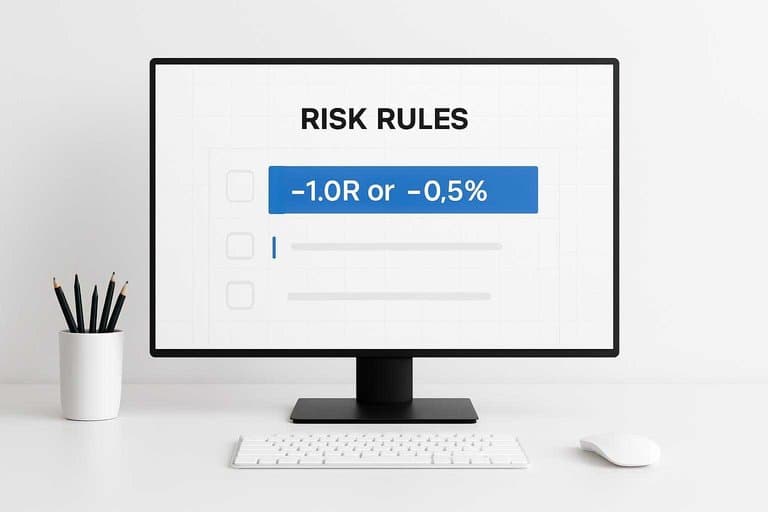
Daily loss limit
Pick a max daily loss and a max number of losing trades, so you stop before tilt starts.
- Stop for the day at -1.0R or -0.5% account
- Stop after 2 losing trades, even if small
- Stop after 3 trades total, win or lose
- Stop immediately after a rule violation
- No “one more to get it back”
Your trigger is the routine’s kill switch, not a suggestion.
Position sizing
Size from risk first, not from conviction.
- Set risk per trade to 0.25R–0.5R, or 0.10%–0.25% account.
- Define stop distance in dollars from entry to invalidation.
- Calculate shares: Shares = Risk $ ÷ Stop $.
- Round down to a clean lot and confirm liquidity.
- Save a tiny sizing table or calculator link in your notes.
If sizing is instant, entries stay disciplined under time pressure.
Stop and exit plan
You need one stop rule and two exit rules, so every trade ends the same way. Keep it mechanical, like “stop below the setup low,” “take profit at 2R,” and “exit at 10:10 if it stalls.”
Place the initial stop at the point your thesis is wrong, not where it feels comfortable. Use a target exit (like 1.5R–2R or prior day high) and a time-based exit (like “close after 8–12 minutes if no follow-through”).
Consistency beats creativity when you only have 20 minutes.
Allowed order types
Decide order types now, so you don’t improvise under stress.
- Use limit for entries near levels
- Use market only for liquid breakouts
- Use bracket orders on every trade
- Adjust stops only once, at +1R
- Ban revenge trades after a loss
If you can’t describe the order, you can’t place the trade.
Build the 20-Minute Script
You’re not building a “routine.” You’re building a script you can run half-asleep and still trust. Think of it like a pre-flight checklist: it ends with a trade plan, and sometimes a trade, not vibes.
Minute 0–3: scan
Run the same saved scanners every day, then extract only what you’ll trade. Speed matters because the goal is a clean shortlist, not a market tour.
- Open your saved premarket and momentum scanners.
- Shortlist three tickers with clean liquidity and tight spreads.
- Mark premarket high and premarket low on each chart.
- Add VWAP and mark prior close as a line.
- Screenshot or jot levels in one place.
If you can’t mark levels fast, you’ll hesitate later and pay for it.
Minute 3–8: evaluate
You’re filtering for one A-quality setup, not debating five “maybes.” Use one checklist and treat any miss as a hard no.
- Confirm trend aligns with your setup.
- Verify a clean level is nearby.
- Check volume is expanding, not fading.
- Identify a real catalyst, not “Twitter said.”
- Demand acceptable risk-to-reward on the chart.
Rejection is the edge here; your account grows when you skip the junk.
Minute 8–15: plan
Turn the best candidate into numbers you can execute without improvising. Your plan should survive a fast candle and a distracted brain.
- Define the entry trigger at a specific price and condition.
- Place the stop where your thesis is invalidated.
- Set a target at the next logical level.
- Calculate share size from max dollars at risk.
- Set alerts or stage orders at entry and invalidation.
If you can’t size it, you don’t understand the risk yet.
Minute 15–20: execute
If your trigger hits, place a bracket order with your pre-written entry, stop, and target. If it doesn’t, set the alerts and log “no trade” like it’s a win, because it is.
Your job is to execute your script, not to manufacture action. For a clear primer on leverage and day-trading buying power, see the SEC’s margin rules for day trading.
Use a Trade Checklist
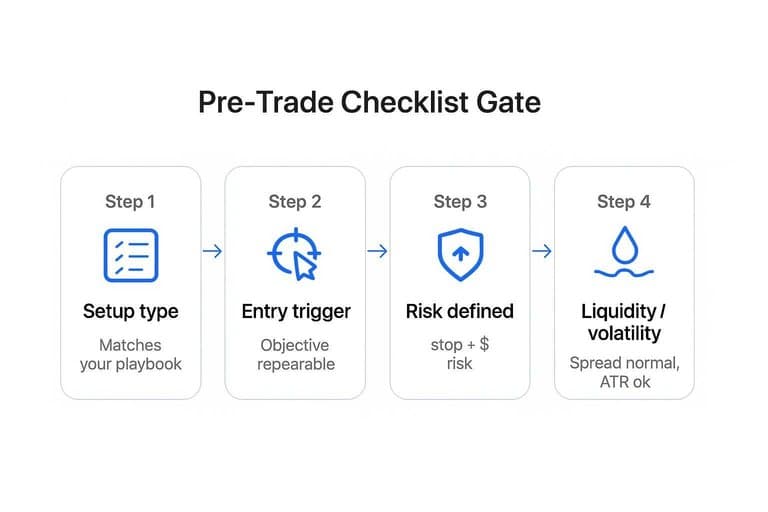
Your session is short, so your checklist becomes your decision engine. Keep it on one page and treat any blank line as a no-trade signal.
Use this table as your pre-trade gate before you click anything.
| Checklist item | Pass criteria | If no | Notes |
|---|---|---|---|
| Setup type | Matches your playbook | Skip trade | Name it |
| Trend + level | Clear bias at level | Reduce size | Mark level |
| Entry trigger | Objective, repeatable | Wait | No guessing |
| Risk defined | Stop + $ risk set | No entry | R multiple |
| Liquidity/volatility | Spread normal, ATR ok | Avoid | Check time |
If you can’t pass it in 60 seconds, you’re not prepared to trade it.
Log in Two Minutes
Your journal should earn its spot by improving tomorrow’s decisions. Keep it brutally small, like a “flight log,” not a memoir.
Minimum fields
Record only what you’ll actually use mid-session when you’re tempted to improvise.
- Ticker and date
- Setup name and timeframe
- Entry, exit, and stop
- R multiple and size
- Screenshot link and rule sentence
If it doesn’t change your next trade, it doesn’t belong in your log.
Screenshot process
Screenshots are evidence, not decoration, so make them repeatable.
- Capture the chart one minute before entry.
- Capture the chart right after exit.
- Save both in one “Trades” folder.
- Name files: date_ticker_setup.
- Paste both links into your journal row.
When your naming is consistent, reviewing patterns becomes fast and unarguable.
Daily reflection
Write one note you can act on tomorrow, even if today was messy.
Use a simple line: “Keep X, do Y, change Z,” and keep it process-only. Example: “Keep waiting for confirmation, do alerts earlier, change chasing late breakouts.”
Pick one micro-improvement for tomorrow, then stop thinking about it.
Run It for 10 Sessions, Then Tighten the Screws
- Commit to the same time slot and trade universe for the next 10 sessions so your results reflect the routine—not randomness.
- Follow the 20-minute script exactly, using the checklist to prevent “one-off” rule breaks and impulsive entries.
- Log every trade in two minutes, then review your daily notes to find one bottleneck (scan noise, sizing errors, late entries) to fix next.
- After 10 sessions, adjust only one variable at a time—scanner filters, risk per trade, or strategy type—so improvements are measurable.
Frequently Asked Questions
Can a 20-minute daily stocks trading routine actually be profitable?
Yes—many traders can be profitable with 20 minutes if they focus on a narrow, repeatable setup and strict risk limits, because execution quality matters more than screen time. Expect small, consistent edges rather than big daily wins.
What type of stocks trading works best in a 20-minute window: day trading or swing trading?
Swing trading usually fits best because decisions can be made quickly and managed with alerts and bracket orders. Pure day trading often requires more monitoring than a 20-minute session allows.
How many trades should I place per day with a 20-minute stocks trading routine?
Most traders should aim for 0 to 1 trade per day, only taking the highest-quality setup that meets all criteria. Forcing multiple trades in a short window typically increases mistakes and fees/slippage.
How do I measure whether my stocks trading routine is improving over time?
Track a small set of stats weekly: win rate, average win/average loss, expectancy per trade, and maximum drawdown, using a journal or a spreadsheet. If expectancy stays positive over 30–50 trades, the routine is usually working.
What can I do if I can’t trade during market hours but still want a daily stocks trading routine?
Use pre-market or after-hours planning plus next-day limit orders, and manage risk with stop-loss and take-profit brackets. You can also shift to swing trading with end-of-day charts and alerts so execution doesn’t require live monitoring.
Streamline Your Daily Stock Selection
A 20-minute routine only works if your prep, risk rules, and checklist are fed by reliable daily context—without turning into a second job.
Open Swing Trading delivers daily relative strength ranks, breadth, and sector/theme rotation so you can build a focused watchlist fast—get 7-day free access with no credit card.
Sources
- Charles Schwab: How to Use Volume-Weighted Indicators in Trading (VWAP) — referenced in Chart workspace
- SEC Investor Bulletin: Margin Rules for Day Trading (PDF) — referenced in Minute 15–20: execute