Stock and market cycles explained for breakout traders
A clear explainer for breakout traders on how stock and market cycles shape win rates—understand the two-layer cycle lens, the liquidity/volatility engine, stock-level absorption and distribution, phase-aligned breakout rules, and a practical toolkit for identifying cycle conditions in real time.
Stock and market cycles explained for breakout traders
A clear explainer for breakout traders on how stock and market cycles shape win rates—understand the two-layer cycle lens, the liquidity/volatility engine, stock-level absorption and distribution, phase-aligned breakout rules, and a practical toolkit for identifying cycle conditions in real time.
Ever nailed a textbook breakout—tight base, clean level, strong volume—only to watch it fail within hours? Most breakouts don’t fail because your charting is wrong; they fail because the cycle you’re trading is.
This explainer shows you how to read the market’s “engine” (liquidity, positioning, volatility) and a stock’s internal cycle (absorption, repricing, distribution) so you can pick setups with a tailwind. You’ll also get a simple toolkit to classify the phase before you risk capital.
Cycle Lens First
Breakout trading isn’t just pattern recognition. It’s timing your pattern against the current that can carry it or crush it.
A stock cycle is the push-pull inside one ticker, like $AAPL compressing for weeks before a range breaks. A market cycle is the broader risk regime, like the S&P shifting from steady markup to choppy distribution. The promise is simple: align your breakout with the cycle’s tailwind, not its headwind.
Two cycle layers
You’re trading two clocks at once. One is the stock’s own cycle; the other is the index or sector cycle feeding liquidity.
A stock can be coiling while the market is ripping, or breaking out while the market is rolling over. Think “NVDA looks clean,” but semis are fading and the Nasdaq is rejecting highs. That divergence is where good breakouts turn into work.
When the cycles disagree, your chart is not lying. It’s just missing context.
Why breakouts fail
Most failed breakouts aren’t bad patterns. They’re good patterns launched into the wrong regime.
- No sponsorship from institutions
- Liquidity pulls back across the tape
- Mean-reversion regime dominates trends
- Volatility expands after your entry
Fix the environment first. Your setup usually follows.
Tailwind mental model
You want expansion on two levels. The stock exits contraction as the market enters expansion.
Picture a tight base with shrinking ranges, then a clean range break. Now add a market that’s in markup, with higher highs and improving breadth. That’s when the same breakout goes from “maybe” to “it should work.”
Your edge is the overlap. Contraction ending, expansion beginning.
Market Cycle Engine
Market cycles aren’t mystical. They’re mechanical outcomes of liquidity, risk appetite, positioning, and volatility regimes interacting.
When those levers align, trends persist and breakouts follow through. When they fight, moves fade fast.
Liquidity and rates
Easing lowers the discount rate and makes leverage feel safe, so bids get thicker and pullbacks get bought. Tightening does the opposite: higher funding costs, thinner depth, wider spreads, and more “sell the rip” behavior.
Watch how rate shifts change what participants can hold, not what they can predict. That’s what decides if your breakout gets a second day.
Positioning feedback
Under-positioned markets chase because managers and shorts must buy strength to reduce regret. Over-positioned markets clip upside because every rally becomes a chance to de-risk, rebalance, or take profit.
Positioning turns price into a reflex loop. If you can spot the forced buyer, you can trade the trend’s fuel.
Volatility regimes
Realized and implied volatility change how breakouts behave and how you should size them.
Index-to-stock transmission
Benchmarks move capital in bulk, and that flow can overpower any single stock’s setup. When correlations spike, a clean breakout can fail because the index rolls over and drags everything with it.
Tape first, stock second. If the index is in distribution, your “perfect” breakout is just beta in disguise.
Stock Cycle Internals
A single stock cycles because supply and demand never stay balanced for long. Float, positioning, and fresh information keep forcing repricing, even when the chart looks “quiet.”
Supply absorption
Accumulation is repeated selling getting absorbed by patient buyers who don’t chase. Price can go nowhere while volume stays heavy because every dip is met with limit bids and hidden demand.
You’ll often see “big red candles” that don’t go anywhere over weeks. That’s supply being transferred, not a breakdown.
When the last motivated seller is done, the same volume starts moving price fast.
Volatility contraction
Volatility contracts when buyers and sellers agree on a temporary price, so the order book thickens on both sides. The range tightens because market orders get filled quickly without pushing through stacked liquidity.
You’ll see smaller daily ranges, fewer gap attempts, and quicker mean reversion inside the box. It’s “boring” because imbalance is getting engineered out.
The tighter the coil, the less fuel it takes to move it once imbalance returns.
Catalyst and repricing
Catalysts reset perceived value, so traders stop defending the old range. A new narrative changes what buyers will pay and what sellers will accept.
- Earnings surprise and margins
- Guidance change or outlook cut
- Macro print and rate path
- Sector leader news or regulation
Your job is spotting when the catalyst forces new positioning, not just headlines.
Distribution mechanics
Distribution is strong hands selling into strength while demand still looks confident. The chart prints choppy highs, weak closes, and “breakouts” that don’t follow through because supply is hitting every push.
You get higher volume near the highs, more intraday reversals, and more trapped breakout buyers creating overhead supply. Each rally has less air.
Once buyers need fresh demand to keep going, the exit doors suddenly matter.
Breakouts Through Cycles
Breakouts are not pattern recognition games. They are regime bets, even when the chart looks identical.
A clean base breakout in a markup market often follows through. The same breakout in markdown becomes a liquidity event.
Best phase alignment
Breakout odds are highest when your stock and its environment are aligned. You want pressure building in the name, with the bigger tape already paying you for risk.
Look for a stock emerging from a base, a sector in markup, and volatility that supports orderly expansion. Think: “tight range, higher lows, then a clean push” with the market not fighting it.
When the cycle lines up, the breakout is the market’s easiest trade, not your bravest one.
Common failure modes
Most failed breakouts are phase mismatches. The setup is fine, but the regime is wrong.
- Buying late-stage markup after distribution started
- Breaking out into visible supply and prior resistance
- Taking longs while the market is in markdown
- Trading single names during correlation spikes
Fix the alignment first, because price patterns don’t override the cycle.
Continuation vs reversal
Continuation breakouts work when trends persist. You’re betting that institutions keep adding, and dips keep getting bought.
Reversal breakouts need a different engine: forced re-rating plus a supply vacuum. The move comes when sellers are exhausted and new buyers must pay up fast.
Treat them the same and you’ll confuse a slow grind with a snapback.
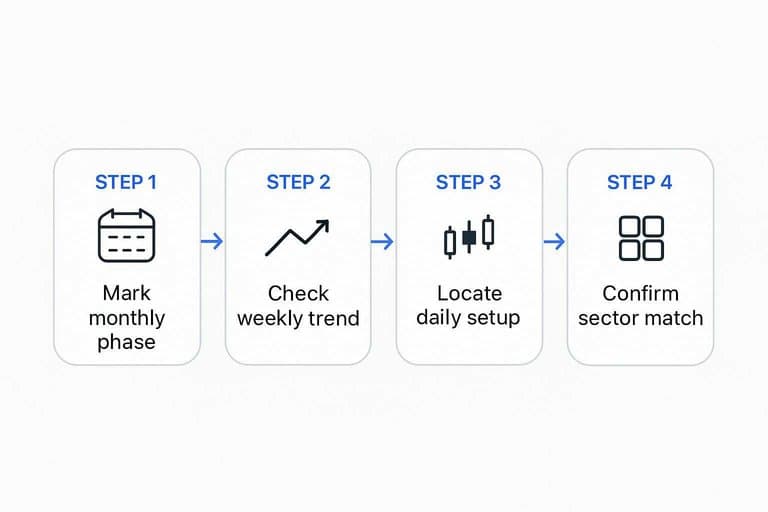
Timeframe nesting
Before you act on a daily breakout, anchor it in the bigger cycle. It prevents you from buying “strength” that is just a weekly bounce.
- Mark the monthly phase: accumulation, markup, distribution, or markdown.
- Check the weekly trend: higher highs, lower highs, or range.
- Locate daily setup inside that context: early, middle, or late.
- Confirm sector and index phase match your direction.
- Decide the play type: continuation add-on or reversal ignition.
If the monthly and weekly disagree, size down or pass.
Cycle Identification Toolkit
You don’t need to predict the cycle. You need observable tells that keep you on the right side of risk. Watch four buckets: price structure, volume and volatility, breadth, and relative strength. Think “What is happening?” not “What will happen?”
Structure cues
Price leaves footprints. Your job is to label them, then trade the phase you see.
- Print higher highs and higher lows
- Build one base, then a second
- Fail breakdowns, then snap back
- Expand range on upside days
- Reclaim key moving averages
If you see failed breakdowns plus MA reclaims, the character just changed.
Volume and range
Volume tells you who is in control. It also tells you when supply is getting absorbed, or when distribution is leaking. A wide-range day near a pivot matters more than “above average volume” in the middle of a range. You want intent, like a hard push through resistance or a sharp rejection from it. That’s where breakouts either get sponsored or get swatted.
Breadth and leaders
Indexes can hide a lot. Breadth shows whether participation is expanding or narrowing.
- Track advance/decline line slope
- Watch new 52-week highs versus lows
- Check percent above 20/50/200-day MAs
- Note leadership rotation by sector
When breadth diverges from price, your “market cycle” is usually thinner than it looks.
Relative strength filter
Relative strength trending up is a cheat code for cycle phase. It flags names in stronger internal uptrends, even during market chop. That usually comes from sponsorship and capital flow, not luck. Funds defend leaders, and leaders keep acting right. If RS is rising, you can size up earlier and cut less often.
Trade With the Tailwind, Not the Pattern
- Classify the backdrop: risk-on or risk-off (rates/liquidity), volatility regime, and whether indexes are helping or hurting stock breakouts.
- Confirm stock internals: evidence of supply absorption, volatility contraction, and clean repricing potential—not late-stage churn or distribution.
- Align the setup with the phase: press continuation breakouts when conditions are expanding, and treat reversal-style breakouts as smaller, faster, and more conditional.
- Run the toolkit before entry: structure cues + volume/range + breadth/leaders + relative strength filter; if two or more disagree, size down or pass.
Frequently Asked Questions
Do stock cycles lead market cycles, or does the market lead individual stocks?
Most often the market cycle sets the risk backdrop first, and stock cycles accelerate when the market provides liquidity and trend support. Leaders can turn early and hint at a market turn, but they usually follow through only when the broader market confirms.
Does understanding the stock and market cycle still matter in 2026 with AI-driven trading and passive flows?
Yes—liquidity, volatility regimes, and crowd positioning still create repeatable cycle behavior even with more automation. Passive and systematic flows often make rotations faster, so cycle awareness becomes more important for timing breakouts and managing risk.
How do I measure whether the stock and market environment is “breakout-friendly” right now?
Track 3 numbers weekly: index trend persistence (e.g., 20/50-day trend), market breadth (advance/decline line or % above 200-day), and realized volatility (e.g., VIX/ATR). When trend is up, breadth is expanding, and volatility is stable-to-falling, breakouts usually follow through more reliably.
What should I do if the market cycle looks bullish but my stock breakouts keep failing?
Usually that’s a stock-specific cycle issue (overhead supply, weak relative strength, or no fresh catalyst) rather than a market problem. Filter harder for relative strength vs the index/sector and require tighter risk (smaller size, closer stops, fewer add-ons) until your win rate normalizes.
How long should I give a breakout trade to prove itself in different stock and market regimes?
In healthy uptrends, most successful breakouts show progress within 3–10 trading days; if they stall quickly, they often fail. In choppy or high-volatility regimes, demand faster confirmation (1–5 days) or reduce holding time because reversals happen sooner.
Trade Breakouts With Context
Reading stock and market cycles is only useful if you can spot leadership and regime shifts fast enough to act before the breakout is crowded.
Open Swing Trading organizes daily RS rankings, breadth, and sector/theme rotation so you can build tighter breakout watchlists in minutes—get 7-day free access with no credit card.