
Stocks Trading: Breakouts vs Pullbacks in Choppy Markets
A clear comparison of breakout vs pullback stock trades in choppy markets—define both setups, score signal reliability and stop logic, weigh win rate vs payoff math, and match each approach to the market conditions and trader profile where it performs best.
Stocks Trading: Breakouts vs Pullbacks in Choppy Markets
A clear comparison of breakout vs pullback stock trades in choppy markets—define both setups, score signal reliability and stop logic, weigh win rate vs payoff math, and match each approach to the market conditions and trader profile where it performs best.
Choppy markets punish impatience: you buy a “clean” breakout, it pops for five minutes, then snaps back into the range and tags your stop. Do that a few times and you’re not just down money—you’re down confidence.
This comparison shows you how to choose between breakouts and pullbacks when price action is noisy. You’ll learn where each signal fails, how to place invalidation that actually makes sense, what the win-rate/payoff tradeoff looks like, and which conditions favor each setup—ending with a quick rules cheatsheet you can execute.
Decision Snapshot
Choppy markets punish certainty. Your job is to choose the entry style that survives sideways price and frequent fakeouts.
Breakouts and pullbacks both work, but for different reasons. You’ll judge them against the same criteria, like signal quality and risk control, before you commit.
Choppy Market Reality
Chop is a range with attitude. Price whips above “resistance,” snaps back, then tags the other side.
Mean reversion dominates because liquidity sits at the edges. Trend signals degrade because follow-through disappears after the first push.
If your breakout needs a clean second leg, chop removes it.
Two Setup Definitions
Two entries. Two different bets on what happens next.
- Breakout entry: buy above range high; bet continuation after the squeeze.
- Pullback entry: buy near support; bet the range holds again.
- Breakout example: “above yesterday’s high, go.”
- Pullback example: “first touch of VWAP, buy.”
You’re choosing between chasing expansion and renting the range.
Scoring Criteria
You’re not picking a setup by vibes. You’re scoring it on repeatable constraints.
Use these lenses: signal quality, risk control, win rate, expectancy, time-in-trade, and psychological load. Think “can I take this 50 times?” not “can this work once?”
The best setup is the one you can execute cleanly when the tape gets rude.
Who This Fits
Match the method to your temperament before you match it to a chart.
- Breakouts: active, fast decision-making, thrives on momentum.
- Breakouts: rules-based triggers, minimal discretion at entry.
- Pullbacks: patient, comfortable waiting for price to come to you.
- Pullbacks: discretionary reads, better with context and levels.
- Time availability: breakouts need screen time; pullbacks allow alerts.
Style-fit beats “best strategy” every week.
Signal Reliability
In choppy markets, your real enemy is the false signal that looks clean at the moment it triggers. In practice, pullbacks throw fewer false positives than breakouts because they cooperate with the range instead of fighting it.
Breakout Failure Modes
Chop makes breakouts easy to trigger and hard to hold. You need to spot the traps before your stop becomes liquidity.
- Fade at the range edge
- Stop-run above resistance
- Low follow-through after trigger
- News spike that reverts
If two of these show up together, assume the breakout is bait.
Pullback Edge Sources
Pullbacks work because chop is mostly mean reversion, and you enter from better location. Buying near support after a dip, or shorting near resistance after a pop, fits how ranges actually trade.
That alignment matters because liquidity sits at the edges and midrange is where moves stall.
Winner: Pullbacks
Pullbacks win on reliability in chop because you’re trading into the range’s dominant force, not trying to escape it. Market structure favors them since order flow often hunts breakout stops, then rotates back to value.
Trade the rotation, not the headline move.
Risk and Stops
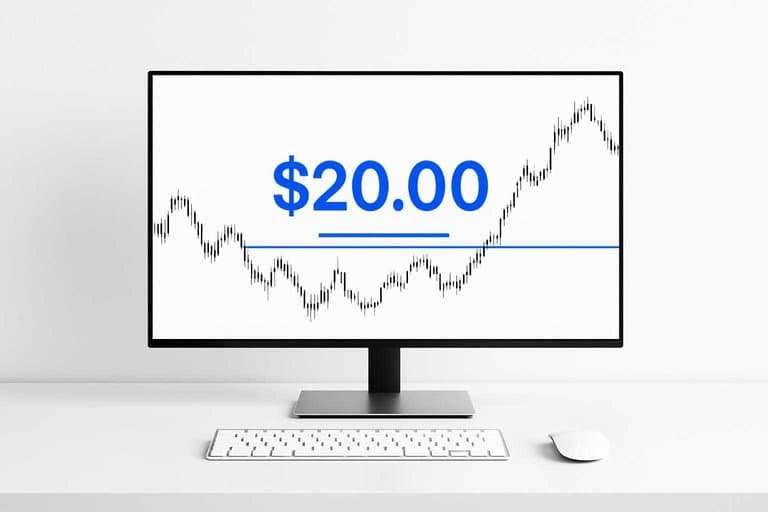
In choppy markets, your edge often comes from risk definition, not prediction. A clean stop turns “maybe” into a measured bet, like “I’m out if it loses $20.00.” Better entries shrink stops. Smaller stops let you size up without blowing up.
Breakout Stop Placement
Pick a stop location before you click buy, because breakouts fail fast.
- Place the stop just below the breakout level to define the line.
- Place the stop below the last swing low to avoid small noise.
- Set an ATR-based stop to match current volatility.
- Reduce size if the stop is wide and your dollar risk is fixed. Chop turns “clean” breakouts into whipsaws, so your stop gets hunted more often.
Pullback Invalidation
With pullbacks, your entry and invalidation can sit on the same obvious structure.
- Buy near support and invalidate below the prior swing low.
- Use the reclaimed level as the stop line after a retest.
- Tighten the stop if the pullback holds on low volume.
- Cut size only when the structure forces a wide stop. A good pullback gives you a specific “if this breaks, I’m wrong” level.
Winner: Pullbacks
Pullbacks usually win on risk because the stop belongs to the setup, not to hope. Your invalidation is clearer, and the average stop distance is smaller, which improves position sizing without increasing stress.
Win Rate vs Payoff
In choppy markets, your edge usually lives in the math, not the story you tell yourself. Breakouts often pay big but rarely, while pullbacks pay smaller but more often.
Breakout Math
Breakouts in chop typically have a low win rate because range edges fade fast. You keep buying “the move,” then watching it snap back.
A common profile looks like this: you risk 1R, lose -1R repeatedly, then occasionally hit +3R to +6R when a real trend finally sticks. Example: 8 losses (-8R) plus one +5R win still leaves you at -3R.
You need monster outliers to survive, and chop starves you of them.
Pullback Math
Pullbacks in chop tend to win more because you’re entering near range extremes, not the middle. You’re betting on mean reversion, not “escape velocity.”
The typical profile is a higher win rate with modest targets, like +0.5R to +1.5R, and tight invalidation. Example: win +1R six times (+6R) and lose -1R four times (-4R), net +2R.
Your profits come from repetition, not a single heroic candle.
Winner: Pullbacks
In ranges, pullbacks usually have the better expectancy because your outcome distribution is tighter. You avoid the “many small cuts, one miracle” pattern.
- Higher win rate in noisy ranges
- Smaller drawdowns from fewer streak losses
- More consistent R distribution
- Less reliance on rare trends
- Cleaner invalidation at range edges
Steadier distributions beat lottery tickets when the market keeps snapping back.
Execution Difficulty
In choppy markets, execution is the real edge, not your thesis. A “perfect” setup can die on the fill, like buying a breakout that jumps 30 cents on your click.
Breakout Execution Issues
Breakouts force you to act fast because the move is already happening.
- Eat slippage on rapid prints
- Chase price after hesitation
- Pay wider spreads at the trigger
- Get partial fills on size
- Second-guess instantly under speed
If you need three confirmations, you’re already late.
Pullback Execution Issues
Pullbacks test patience because the trade isn’t “on” yet.
- Miss entries by a few cents
- Wait too early, then watch it run
- Buy “cheap” into real weakness
- Get faked out below support
- Over-tinker levels mid-pullback
If your level is vague, your fill will be worse.
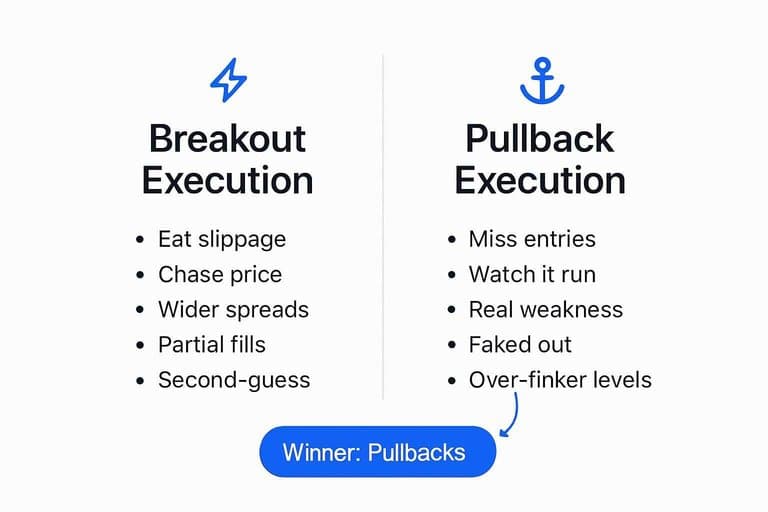
Winner: Pullbacks
Pullbacks are easier to execute consistently because you can standardize them with pre-defined levels, limit orders, and alerts. You’ll still need patience, but you won’t need split-second decisions when spreads widen and price teleports.
Best Market Conditions
Choppy markets punish the wrong trigger, not the wrong ticker. Use this table to match the approach to the regime you’re actually in.
| Market condition signal | Breakouts perform best when | Pullbacks perform best when | What to watch |
|---|---|---|---|
| Range structure | Tight, clean box | Wide, noisy range | Range width vs ATR |
| Volatility | Expanding from low | Elevated but stable | ATR trend |
| Participation | Broad, rising volume | Selective, fading volume | Up vs down volume |
| Catalyst flow | Clear, scheduled news | No headlines, drift | Calendar risk |
| Level quality | Obvious, well-tested | Multiple prior reactions | Wick density |
If you can’t describe the range in one sentence, treat it as mean reversion territory.
Setup Rules Cheatsheet
Choppy markets punish vague rules, so you need two playbooks that don’t mix. Use this table to decide your entry, proof, risk, and management before you click buy.
| Setup | Entry trigger | Confirmation | Stop | Target | Trade management |
|---|---|---|---|---|---|
| Breakout | Close above range high | Volume uptick; hold retest | Below breakout level | 1R then trail | Cut fast if re-enters |
| Pullback | Touch support in uptrend | Reversal candle; higher low | Below swing low | Prior high; 1.5R | Scale out into strength |
| Breakout (short) | Close below range low | Volume uptick; failed bounce | Above breakdown level | 1R then trail | Cover if snaps back inside |
| Pullback (short) | Tag resistance in downtrend | Rejection wick; lower high | Above swing high | Prior low; 1.5R | Add only after retest fails |
If you can’t point to the row you’re trading, you’re not trading a setup.
Choose Your Default Playbook (and a Simple Fallback)
In choppy markets, make pullbacks your default: they lean on mean reversion, offer clearer invalidation, and typically deliver a higher hit rate when breakouts keep failing. Use breakouts only when the tape proves it—tight consolidation, expanding volume/volatility in your favor, and clean acceptance above a level rather than a quick spike. If conditions are mixed, wait for the first pullback after a breakout attempt and trade the retest; it’s often the cleaner, lower-risk entry that tells you whether the move is real.
Frequently Asked Questions
Does stocks trading breakouts still work in 2026 with algorithmic trading and headline-driven volatility?
Yes, but it usually works best when you filter for real catalysts and above-average volume/volatility. In choppy markets, breakout signals without those filters tend to fail more often.
Do I need level 2 data or order flow tools for stocks trading breakouts or pullbacks?
No—most traders can execute both using price, volume, and basic indicators on a 5–60 minute chart. Level 2/Time & Sales can help with entries and avoiding thin liquidity, but it isn’t required.
How do I measure whether my stocks trading strategy handles choppy markets well?
Track your results separately for “chop” periods using metrics like profit factor, max drawdown, and average R per trade in a journal or spreadsheet. Most traders also use an ATR-based volatility filter or a trend filter (like 50/200 MA slope) to label regimes consistently.
Can I combine breakouts and pullbacks in the same stocks trading plan without overtrading?
Yes—use a simple priority rule like “pullbacks only unless price breaks and holds above a key level with volume,” and cap trades per day/week. Keeping one risk model and one time window prevents strategy drift.
How long should I forward-test a stocks trading breakout vs pullback approach before going live?
Aim for at least 30–50 trades per setup or about 6–12 weeks of consistent execution, whichever comes later. Go live only after you can follow rules with stable risk and your stats aren’t dominated by one or two outliers.
Find Leaders in Choppy Markets
In chop, the hardest part isn’t knowing breakout vs pullback rules—it’s consistently finding the right names and reading the market regime each day.
Open Swing Trading surfaces potential breakout leaders with daily relative strength rankings, breadth, and sector/theme rotation context—so your setups start with better candidates. Get 7-day free access with no credit card.
Sources
- Breakout Trading Strategy (stop placement incl. ATR-based stops) — Tradewink (2026 guide) — referenced in Breakout Stop Placement
- Empirical investigation of state-of-the-art mean reversion strategies for equity markets (PAMR, OLMAR, TCO) — arXiv:1909.04327 — referenced in Best Market Conditions