Swing Trading: 2-Day vs 2-Week Holds
A clear comparison of 2-day vs 2-week swing trades—understand noise vs signal, setup and entry filters, risk and exit management, time/tool demands, and how costs/taxes shape realistic performance expectations.
Swing Trading: 2-Day vs 2-Week Holds
A clear comparison of 2-day vs 2-week swing trades—understand noise vs signal, setup and entry filters, risk and exit management, time/tool demands, and how costs/taxes shape realistic performance expectations.
If your swing trades keep failing for “no reason,” the reason is often the clock. A setup that works over two weeks can get chopped up in two days, while a quick momentum play can bleed out if you try to babysit it into a longer hold.
This comparison helps you choose the holding period that matches your market, your temperament, and your schedule. You’ll see how behavior changes across regimes, what entry filters fit each horizon, how stops and exits differ, and where costs, spreads, and taxes quietly swing your edge.
Decision in Context
Picking a 2-day hold versus a 2-week hold is a trade between edge, time, costs, and stress. You’re choosing a workflow as much as a timeframe, like “trade the reaction” versus “ride the move.” This decision hits active swing traders, part-time traders with day jobs, and anyone scaling position size without blowing up their sleep.
Two Hold Profiles
A 2-day hold usually targets the first burst after a breakout, reversal, or news reaction. A 2-week hold leans on trend continuation, mean reversion over multiple sessions, and slower catalysts like earnings cycles or sector rotation.
Two-day holds typically look like:
- Setup length: 1–5 days forming
- Catalysts: gap, headline, technical break
- Exit timing: fast follow-through or quick failure
Two-week holds typically look like:
- Setup length: 2–6 weeks forming
- Catalysts: earnings drift, macro, rotation
- Exit timing: trend break or time stop
Pick the profile that matches your signal’s half-life, not your patience.
Why Holding Period Matters
Holding period changes what “works” because it changes what can hurt you. It also changes what you even notice on the chart.
- Signal quality shifts from microstructure to regime.
- Noise rises as you zoom in.
- Slippage matters more with frequent exits.
- Overnight risk compounds with more nights held.
- Opportunity cost grows when capital sits.
If your edge is real, it should survive the costs your timeframe forces you to pay.
Common Misfits
Most traders fail here because their life and their strategy disagree. They say “2-week trader” but trade like a nervous scalper, or say “2-day trader” but can’t watch the tape.
Watch for these mismatches:
- Schedule: you can’t manage intraday exits.
- Risk tolerance: you dread overnight gaps.
- Account size: fees and spread eat you alive.
- Strategy drift: you move stops to avoid being wrong.
The wrong horizon doesn’t just lose money, it trains bad habits that look like “discipline.”
Market Behavior Differences
Two-day and two-week holds operate on different parts of the market’s “timeframe stack.” One is dominated by microstructure and headlines, while the other is shaped by positioning, flows, and trend persistence.
Noise vs Signal
Two-day trades often ride intraday impulses and overnight gaps, where a single headline can rewrite the chart. Two-week holds more often catch moves that survive multiple sessions, like a breakout that keeps making higher closes.
In 2-day windows, price action is frequently driven by opening auctions, stop runs, and gap-and-fade behavior. In 2-week windows, you see cleaner sequences: consolidation, expansion, then follow-through as late money piles in.
If your “edge” disappears after one bad open, you’re trading noise, not swing structure.
Regime Sensitivity
Different regimes reward different holding periods because volatility clusters and trends persist unevenly. Match your horizon to the market’s current mood, not your calendar.
- Chop ranges favor 2-day fades and quick rotations.
- News-driven volatility favors 2-day reactions and gap management.
- Steady trends favor 2-week holds and add-on pullbacks.
- Sector rotations favor 2-week relative strength and pairs.
- Index drift favors 2-week holds with wide stops.
When regime shifts, your “strategy” didn’t break; your timeframe did.
Catalyst Timing
Catalysts land on calendars, and your hold length decides if you’re trading the reaction or the digestion. A 2-day trade often targets the first repricing, while a 2-week trade targets the second-order move.
Earnings gaps, CPI prints, and Fed days can dominate a 48-hour window, especially when implied volatility collapses after the event. Over two weeks, the market has time to reassess guidance, adjust analyst targets, and rotate capital across peers.
Trade the window that fits the catalyst’s half-life, not the headline’s impact.
Liquidity and Spreads
Execution frictions matter more when your target is small and your timing is tight. Longer holds can absorb worse fills, but only if the trend pays you back.
- Wider spreads punish 2-day entries and exits.
- Thin depth increases slippage on 2-day stops.
- Volatility bands widen, forcing smaller 2-day size.
- Mean-reverting names reward 2-day limit orders.
- Trending names tolerate 2-week marketable entries.
If costs eat your expected move, you don’t have a trade, you have a donation.
Setup and Entry Filters
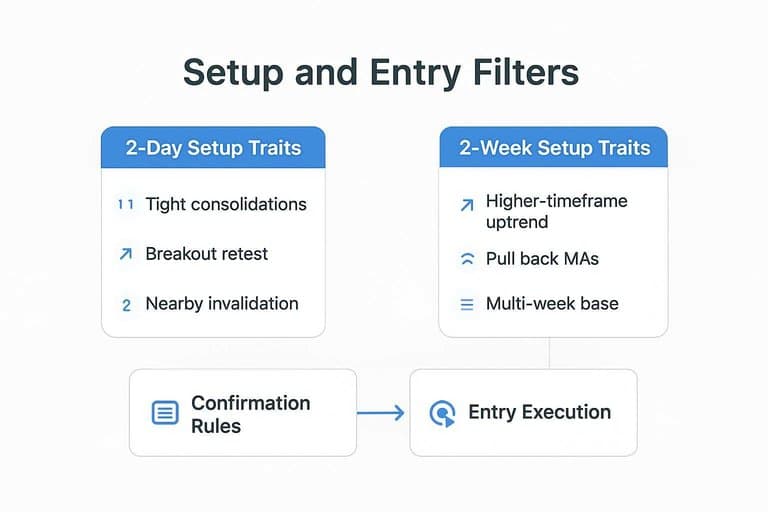
Your hold time dictates your setup. A 2-day trade needs fast structure and a nearby “I’m wrong” level. A 2-week trade needs trend alignment and room to work without constant babysitting.
2-Day Setup Traits
You’re hunting quick repricing, not a thesis. Pick patterns that move in 1–2 sessions and invalidate fast.
- Form tight consolidations near highs
- Break out, then retest cleanly
- Use gap plays with follow-through
- Show strong relative volume early
- Keep invalidation level nearby
If your stop can’t be obvious within a few percent, it’s not a 2-day setup.
2-Week Setup Traits
You’re paying for persistence, not speed. Choose structures that can grind higher even on boring days.
- Align with higher-timeframe uptrend
- Pull back into key moving averages
- Break out from multi-week base
- Show multi-day relative strength
If it only works on a perfect day-one pop, it’s not a 2-week trade.
Confirmation Rules
Confirmations should reduce dumb entries, not optimize a backtest. Use a small set of checks you can apply the same way.
Start with timeframe alignment: daily structure for 2-day, weekly bias for 2-week. Add a simple activity filter like “volume above recent average” or “ATR not collapsing,” then skip entries that are already extended from the level. The edge is arriving early enough to manage risk, not finding a magical indicator mix.
Entry Execution
Your entry should match how the setup resolves. Plan the order type before the open, not during the candle.
- Place stop entries above trigger levels
- Use limit pullbacks into retests
- Scale in after first confirmation
- Avoid illiquid opens and closes
Clean entries beat clever ones, because they keep your risk math real.
Risk and Trade Management
Your hold time sets your risk unit. A 2-day trade lives and dies by short-term volatility and open-to-open gaps. A 2-week trade absorbs more noise, but it faces more regime shifts and event risk.
Stop Placement Logic
Stops answer one question: “What price proves me wrong?” The trick is that “wrong” looks different over two days versus two weeks.
A technical invalidation stop sits beyond a level that breaks your setup. For 2-day holds, that’s often yesterday’s low, a micro-swing, or the VWAP failure line. For 2-week holds, it’s usually a higher-timeframe level like the weekly pivot, the 20-day low, or the base low.
A volatility-based stop scales to movement, not lines. For 2-day holds, use something like 1–1.5× ATR(14) on the daily, or even ATR on the hourly. For 2-week holds, 1.5–3× daily ATR is common, because the trade needs room to survive “normal” pullbacks.
If your stop is inside the instrument’s routine wiggle, you’re not managing risk. You’re donating it.
Sizing Framework
Size comes from your stop, not your conviction.
- Set a fixed risk per trade in dollars or percent.
- Compute stop distance in dollars, including spread and slippage.
- Size shares or contracts: risk ÷ stop distance.
- Cap exposure across correlated names and the same sector theme.
- Recheck size after any stop widen or volatility spike.
Your edge shows up when your sizing stays boring under pressure.
Exit Playbooks
Exits should match your horizon, not your emotions.
- Take partials into the first impulse move.
- Trail a stop behind structure or ATR.
- Sell at pre-marked target levels.
- Use a time stop if price stalls.
- Apply a post-gap rule before reacting.
Write the rules before entry. That’s how you stop negotiating with yourself.
Overnight and Gap Risk
Overnight is where 2-day trades get punished fast. You can be right on direction and still lose on a bad open.
Mitigate it with fewer shares, not more analysis. Reduce size ahead of binary events like earnings, CPI, FDA decisions, or court rulings. Diversify across uncorrelated names so one gap doesn’t dominate your week.
Predefine your gap-down response in one sentence. Example: “If it gaps below my stop, I exit on the first liquid bounce.”
Gap risk isn’t a chart problem. It’s a planning problem.
Time, Tools, and Attention
Your holding period sets your operating system. It decides when you scan, how often you react, and how tired your brain gets. Think “quick check” versus “managed campaign.”
Daily Routine Fit
Two-day holds reward tight loops and fast exits, because your edge expires quickly. Two-week holds reward scheduled reviews, because noise is constant.
- Premarket scan: 2-day daily; 2-week only when setting entries
- End-of-day review: 2-day mandatory; 2-week standard, not urgent
- Weekend planning: 2-day light; 2-week heavy, map catalysts
- Position monitoring: 2-day intraday checks; 2-week set times
- Adjustment frequency: 2-day frequent trims; 2-week fewer, larger decisions
Your calendar is the strategy, and missed check-ins become hidden risk.
Tooling Needs
You need different tools because you’re solving different timing problems. The shorter the hold, the more you lean on alerts and volatility.
- Screeners: 2-day momentum; 2-week trend plus liquidity
- Alerts: 2-day price levels; 2-week structure breaks
- Journal templates: 2-day quick tags; 2-week thesis plus invalidation
- Earnings calendars: 2-day avoid surprises; 2-week plan around events
- Volatility measures: 2-day ATR focus; 2-week ATR plus weekly ranges
Build for your horizon, or you’ll trade the wrong signals with confidence.
Stress and Psychology
Two-day holds tempt you into “just one more trade,” because feedback is instant and seductive. Two-week holds test patience, because you’ll sit through chop and doubt your thesis.
Your fix is rule design, not willpower. Hard limits on trades per day, and scheduled reviews, keep you from negotiating with yourself.
Costs and Taxes
You can trade the same setup and still lose to friction. The hold length changes which costs dominate, and how often they hit.
| Cost / Tax item | 2-day holds (frequent) | 2-week holds (less frequent) | What to watch |
|---|---|---|---|
| Commissions | Hits often | Hits less | Round-trips per month |
| Spread + slippage | Bigger share per trade | Smaller share per trade | Avg fill vs mid |
| Borrow fees (shorts) | Usually minor | Can accumulate | HTB rate, days held |
| Funding / margin interest | Short exposure window | Longer exposure window | Rate, leverage used |
| Tax treatment | Mostly short-term | Still short-term | Turnover, wash sales |
If costs feel “small,” measure them in basis points per round-trip, not dollars.
Performance Expectations
You’re choosing between faster feedback and deeper moves. The trade-offs show up in hit rate, payoff ratio, frequency, and how ugly the equity curve feels.
A realistic comparison looks like this:
| Metric | 2-Day Holds | 2-Week Holds | What drives it |
|---|---|---|---|
| Realistic hit rate | 45–55% | 40–52% | Noise vs trend |
| Avg win / avg loss | 1.0–1.4R | 1.3–2.2R | Room to run |
| Trades per month | 8–20 | 2–8 | Signal turnover |
| Typical drawdowns | 6–15R | 10–25R | Fewer samples |
| Variance of results | Higher, smoother | Lower, lumpier | Clustering swings |
Pick the holding period your psychology can survive, then size down until drawdowns feel boring.
Pick Your Hold, Then Build the Whole Trade Around It
Decide whether you’re trading a 2-day move or a 2-week swing before you pick indicators, stops, or targets—your holding period determines what “signal” even looks like. Build one playbook per horizon with matching entry confirmation, sizing, and exit rules so you aren’t mixing fast-trade entries with slow-trade risk. Then pressure-test it against the real constraints: spreads and liquidity for short holds, overnight/gap exposure for longer holds, and the attention/time you can consistently give. When the horizon, process, and expectations line up, execution gets simpler—and results get more repeatable.
Frequently Asked Questions
Is swing trading the same as day trading if I only hold positions for 2 days?
No. Swing trading typically holds overnight and targets multi-session moves, while day trading closes positions the same day and relies more on intraday catalysts and execution speed.
How do I measure whether my swing trading edge is better for 2-day holds or 2-week holds?
Track R-multiples and expectancy (Avg Win × Win Rate − Avg Loss × Loss Rate) separately for 2-day vs 2-week trades, and compare results over at least 50–100 trades per bucket to reduce noise.
Can I swing trade 2-day and 2-week setups at the same time in one account?
Yes, most traders run both horizons by tagging trades by “timeframe” and capping total portfolio risk (e.g., 1–2% across all open positions) so shorter-term trades don’t crowd out longer swings.
What’s a good way to backtest 2-day vs 2-week swing trading without overfitting?
Use simple, rules-based exits (time-based or ATR-based), include realistic slippage/fees, and validate with out-of-sample testing (walk-forward or a separate date range) before trusting the results.
How often should I review positions when swing trading a 2-week hold?
Most 2-week swing traders review once daily after the close and set alerts for key levels; checking more frequently usually adds noise without improving decisions unless earnings/news risk is imminent.
Sharpen Your Swing Selection
Whether you hold for two days or two weeks, consistent results come down to picking true leaders and staying aligned with the market regime.
Open Swing Trading surfaces breakout candidates with daily relative strength, breadth, and sector/theme rotation context—so you can filter faster without automated signals. Get 7-day free access with no credit card.