Swing Trading Explained for Beginners: Core Concepts
An explainer of swing trading for beginners—learn the definition and time horizon, the trend/range mental model, core chart tools (price action, support/resistance, volume, minimal indicators), plus a practical trade plan template and risk/position sizing basics.
Swing Trading Explained for Beginners: Core Concepts
An explainer of swing trading for beginners—learn the definition and time horizon, the trend/range mental model, core chart tools (price action, support/resistance, volume, minimal indicators), plus a practical trade plan template and risk/position sizing basics.
If you’ve ever watched a stock move for a few days and wondered how traders profit without staring at charts all day, you’re already thinking like a swing trader. The challenge is that “buy low, sell high” isn’t a strategy—without a plan, risk rules, and a clear setup, swings turn into guesses.
This explainer breaks swing trading into simple, usable parts: what it is (and isn’t), how to read market conditions, which tools matter most, and how to plan entries, exits, and position size so one trade can’t derail your account.
What Swing Trading Is
Swing trading is a way to trade where you aim to capture a “swing” in price over days or weeks. You plan the entry, the exit, and the risk before you click buy. Think “catch the middle of a move,” not “call the exact top.”
The basic idea
Swing trading means taking trades designed to profit from multi-day price moves. You use a planned entry, a planned exit, and a hard risk limit, like “I’m out if it breaks X.” Beginners learn one job: build repeatable trades instead of chasing candles.
Typical time horizon
Most swing trades sit between day trades and long-term investing.
| Style | Typical hold | Typical goal | Screen time |
|---|---|---|---|
| Day trading | Minutes to hours | Intraday move | High |
| Swing trading | 2 days to weeks | Multi-day swing | Medium |
| Investing | Months to years | Long-term growth | Low |
Pick the timeframe that fits your life, then match your strategy to it.
What you are not doing
Swing trading is boring on purpose. You’re not trying to do these things.
- Predict exact tops and bottoms
- Watch every tick all day
- Use huge leverage to “make it worth it”
- Trade on insider information
If you need constant action, you’re choosing adrenaline, not an edge.
A simple example
Here’s one clean, hypothetical swing trade from start to finish.
- Spot a stock trending up and pulling back to support.
- Enter on a breakout above the pullback high.
- Place a stop-loss below the recent swing low.
- Set a target near the next resistance zone.
- Exit after three days when price hits the target.
Your stop-loss defines the trade, not your opinion.
The Swing Trading Mental Model
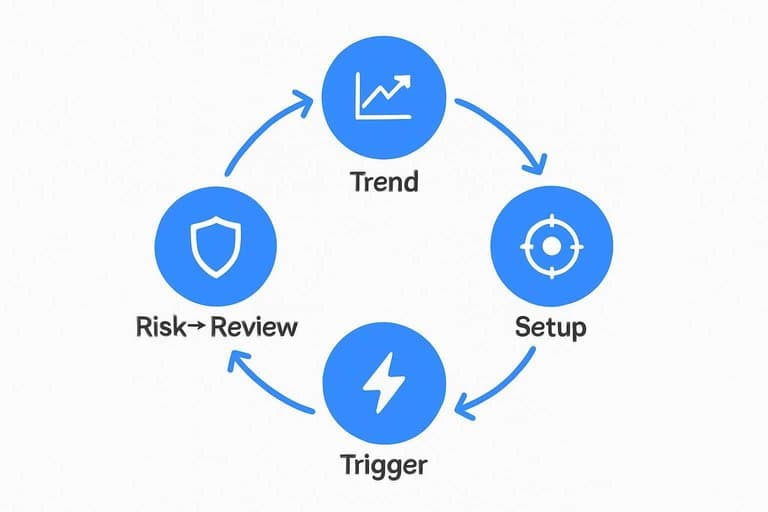
Swing trading works best as a loop you can repeat under stress. You read the market, find a setup, wait for a trigger, define risk, then review. Think of it as “trend → setup → trigger → risk → review,” like a pilot checklist.
Trend vs range
Most charts live in two states: trending or ranging. Swings often ride trends with pullbacks, or bounce between range edges like “support to resistance.”
A trend makes higher highs and higher lows, or the opposite in a downtrend. A range chops sideways, rejecting similar highs and lows repeatedly. Your job is to stop forcing trend trades in ranges, and stop fading strong trends.
Trade the state you’re in, not the one you want.
Setup and trigger
A setup is the “interesting situation,” and a trigger is the “go” signal. Beginners mix them up, then enter early because the chart looks good.
A setup could be a pullback to a moving average, a range retest, or a breakout forming. A trigger is the specific event that proves buyers or sellers showed up, like a breakout candle close, a reclaim of a level, or a trendline break. Setup answers “what could happen,” trigger answers “it’s starting.”
If you can’t name the trigger, you’re guessing.
Risk-first thinking
Define loss before you daydream about profit. Position size and stop placement come first.
- Place the stop where the idea breaks
- Size the trade to the stop distance
- Define your target after risk
- Keep risk constant across trades
- Use “R” to compare outcomes
“R” is your risk per trade, like $100, and +2R means you made $200. Trade your risk plan, not your emotions.
Review loop
A tiny journal keeps you honest, even with a busy schedule.
- Write the thesis in one line.
- Record entry, stop, and target.
- Log position size and planned R.
- Note exit, outcome in R, and screenshots.
- Write one lesson you’ll reuse.
Your edge lives in repeatable decisions, not one lucky trade.
Core Tools Beginners Use
You don’t need a dozen screens to swing trade. You need a clean read on price, a few levels, and one or two sanity checks.
Think of it like driving. The windshield is price, not the dashboard lights.
Price action basics
Candles are just a picture of the fight: open, high, low, close. A candle’s wick shows rejection, while the body shows acceptance.
Your job is to track structure with swing highs and swing lows, like “higher highs” in an uptrend. Price is primary because it reflects every participant, including the ones with size.
Support and resistance
Mark levels that other traders will also see.
- Zoom out and find recent swing highs and lows.
- Draw horizontal lines at the most “touched” prices.
- Treat zones, not single pennies, as the real level.
- Plan entries near support and exits near resistance.
- Put stops beyond the level, not on it.
Levels turn random movement into planned risk.
Volume as context
Volume tells you how much participation sits behind a move. A breakout on a volume spike can signal real interest, while a breakout on low volume can be a trap.
Watch for volume dry-ups near support or resistance too. Quiet trading can mean nobody cares, or it can mean sellers are exhausted.
Indicators (minimal)
Use indicators to answer one question each, then stop.
- Moving averages: “Is the trend up?”
- RSI: “Is momentum stretched?”
- ATR: “How big should my stop be?”
If an indicator changes your mind daily, it’s noise, not help.
Trade Planning Template
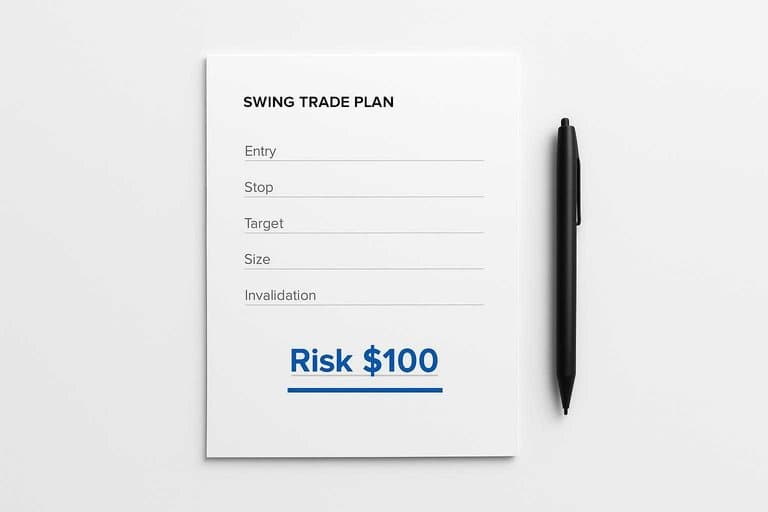
Use this one-page template to plan every swing trade before you click buy or sell. It forces clarity on entry, stop, target, size, and the exact condition that proves you wrong.
- Define your setup and entry trigger in one line, like “Buy on daily close above $52.”
- Place your stop where the idea breaks, like “Stop at $48.90 below the last swing low.”
- Set a target based on structure, like “Target $60 at prior resistance.”
- Calculate position size from risk, like “Risk $100; size = $100 ÷ (entry − stop).”
- Write invalidation criteria, like “Exit early if it closes back below $51.”
If you can’t write Step 5 clearly, you don’t have a trade yet. For a plain-language overview of timeframes and expectations, see this guide to what swing trading is.
Risk and Position Sizing
You control swing-trade risk with two knobs: dollars you’re willing to lose and where your stop sits. Position size is the output, not the starting point.
Use this relationship: Position size (shares) = Risk per trade ($) ÷ Stop distance ($ per share).
| Risk per trade ($) | Stop distance ($) | Position size (shares) | Example outcome |
|---|---|---|---|
| 50 | 1.00 | 50 | Lose $50 at stop |
| 50 | 2.00 | 25 | Smaller size, same risk |
| 100 | 1.00 | 100 | Bigger size, same stop |
| 100 | 2.50 | 40 | Wider stop, fewer shares |
Example: You buy at $50 with a stop at $48, so the stop distance is $2. If you risk $100, you take 50 shares ($100 ÷ $2).
If the size feels “too small,” don’t move the stop closer to force it. Find a better setup or skip the trade.
Build Your First Swing-Trade Playbook
- Pick one market and one timeframe (daily + 4H is enough) and define whether price is trending or ranging.
- Mark key support/resistance, then wait for a clear setup and a specific trigger (the “if X happens, I enter” rule).
- Set the trade before you place it: entry, stop-loss, target, and the invalidation point.
- Size the position from risk: choose a fixed % you’re willing to lose per trade, calculate shares/contracts from stop distance, and place the stop.
- Review after exit: screenshot the chart, note what matched your plan, and adjust one rule at a time.
Frequently Asked Questions
Is swing trading the same as day trading or investing?
No. Swing trading typically holds positions for days to a few weeks, while day trading closes the same day and investing often holds for months to years.
How much money do you need to start swing trading?
Most beginners can start with $500 to $2,000 in a cash account, but $2,000+ usually makes risk management and diversification easier. If you’re trading U.S. stocks with margin, pattern day trading rules can affect accounts under $25,000.
How do you measure swing trading performance beyond win rate?
Track expectancy (average win × win rate minus average loss × loss rate) and maximum drawdown to see if your edge is real. A simple spreadsheet or tools like TraderSync/Edgewonk can calculate this from your trade log.
How long does it take to get consistent results with swing trading?
Most beginners need 3 to 6 months of focused practice to become consistent with execution and risk control, and 6 to 12 months to validate results across different market conditions. Logging at least 50 to 100 trades helps you judge whether performance is repeatable.
Can you swing trade without indicators, using price action only?
Yes. Many swing traders rely primarily on price, volume, and key levels, using indicators only as a secondary confirmation or to standardize entries.
Find Better Breakout Leaders
Once you understand the swing trading mental model, tools, planning template, and risk sizing, the hard part becomes consistent stock selection and market-regime awareness.
Open Swing Trading streamlines that research with daily RS rankings, breadth, and sector/theme rotation context—use the 7-day free access to build a tighter watchlist in 5–15 minutes a day.
Sources
- What Is Support and Resistance? — Fidelity Learning Center — referenced in Trend vs range
- What Is Swing Trading and How Does It Work? (vs. day trading) — NerdWallet — referenced in Trade Planning Template