Trade Open Stocks Now vs After 30 Minutes
A clear comparison of trading at the market open versus waiting 30 minutes — understand overnight information gaps, spread/slippage and liquidity changes, volatility/whipsaw tradeoffs, strategy fit (ORB, breakouts, pullbacks), and the risk-management rules that should change with your timing choice.
Trade Open Stocks Now vs After 30 Minutes
A clear comparison of trading at the market open versus waiting 30 minutes — understand overnight information gaps, spread/slippage and liquidity changes, volatility/whipsaw tradeoffs, strategy fit (ORB, breakouts, pullbacks), and the risk-management rules that should change with your timing choice.
Should you hit the buy button at 9:30—or sit on your hands until 10:00? That first half hour can be the best window for fast gains and the easiest place to get chopped up, slipped, or stopped out.
This comparison breaks down what’s actually different at the open versus after 30 minutes: how liquidity and spreads evolve, when volatility is opportunity versus noise, which strategies match each window, and how to adjust sizing, stops, and daily loss limits so your timing isn’t guesswork.
Decision Snapshot
Trading the open is a bet on immediate price discovery. Waiting 30 minutes is a bet on clarity after the first shakeout. Think “catch the impulse” versus “trade the confirmed direction.”
What “open” means
The market “open” is 9:30 a.m. ET for U.S. stocks, with the first 30 minutes often behaving like a different instrument. Overnight news, earnings, and premarket positioning collide, so volatility spikes and volume surges.
You’ll often see wider spreads, faster tape, and abrupt reversals as orders get matched and levels get tested. Midday usually has steadier liquidity and fewer surprise orders, so price moves can be cleaner.
If your edge needs speed and disorder, the open is where it lives.
What “wait 30” means
“Wait 30” means you skip the 9:30–10:00 a.m. ET window and start trading after the initial imbalance resolves. You’re letting the market show its hand: the real direction, key levels, and whether the opening move holds.
In that window, spreads often tighten, early whipsaws calm down, and you get more reliable signals like a break-and-retest. You also see which gap attempts fail, and which trends attract sustained volume.
You’re not late; you’re buying information.
Two trader profiles
Different windows fit different constraints and personalities. Pick the one that matches how you actually execute, not how you wish you did.
- Trades fast, accepts slippage, uses hotkeys and Level II
- Has strict stops, tolerates noise, decides in seconds
- Trades fewer names, watches catalysts, reads the tape
- Waits for levels, prefers confirmation, uses alerts
- Trades calmer setups, sizes larger, journals decisions
If your process breaks under speed, waiting isn’t cautious; it’s accurate.
Market Microstructure
The open is an auction, not a normal two-sided market. Everyone is reacting to the same overnight puzzle with different urgency.
Thirty minutes later, the puzzle is mostly priced. Your fills get cleaner, but the easy mispricings are gone.
Overnight information
Overnight news creates gaps because price discovery pauses, then restarts in one jump. Earnings, guidance, or a “downgrade to Sell” can reset fair value before 9:30.
Premarket highs, lows, and the opening print act like visible anchors in the first minutes. If price reclaims the premarket high and holds, early buyers look right; if it rejects fast, the gap can fade hard.
Treat the open like a negotiation over new information, not a continuation of yesterday.
Spreads and slippage
Spreads blow out at the open because uncertainty is highest and quotes must move fast.
Liquidity evolution
After the first imbalance clears, more participants show up and depth usually thickens. Passive orders get hit less randomly, and stops trigger on cleaner structure.
Limit orders start behaving like price, not lottery tickets. Stops also become more meaningful because fewer prints are pure noise.
Wait 30 minutes when your edge depends on execution quality, not being first. (NYSE has research on opening-auction fill behavior that aligns with this early-window execution reality.)
Volatility and Opportunity
The open offers the biggest price swings, and that can pay fast. It can also punish you with a clean-looking move that snaps back in minutes. Think of a 2% gap that either trends all morning or fades by 9:45.
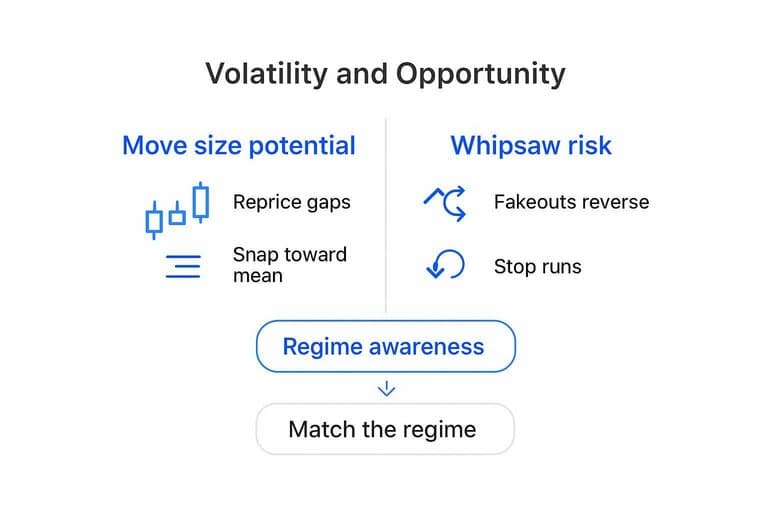
Move size potential
Early candles are often larger because the market is digesting overnight information and queued orders.
- Reprice gaps from overnight earnings or macro headlines
- Snap toward mean after premarket overreaction
- Absorb institutional rebalancing at the bell
- React to retail surge and social chatter
Bigger range gives you more room, but it also raises your error cost.
Whipsaw risk
The same volatility that creates opportunity also creates traps, especially in the first few minutes.
- Chase opening range fakeouts that reverse instantly
- Buy news-headline spikes after the real move ends
- Get tagged by stop runs through obvious levels
- Overpay with ill-timed market orders
If you can’t define the invalidation level, you’re donating liquidity.
Regime awareness
Some days stay volatile past the first 30 minutes because new information keeps getting priced in. Trend days after major earnings surprises, CPI, or a broad risk-on rotation often keep expanding range. Other days collapse quickly because the opening rush was just order matching, and liquidity normalizes once the imbalance clears.
Your edge comes from matching the regime. If volatility is compressing, shift to mean-reversion and tighter targets. If it’s persisting, give trades room and stop fighting the tape.
Strategy Fit Guide
The open gives you speed, emotion, and huge spreads. Waiting 30 minutes buys you structure, cleaner levels, and fewer fake moves.
Think “need immediacy” versus “need confirmation.” That choice changes both signal quality and how tight your execution must be.
Breakouts vs mean reversion
Breakouts often fit “open-now” because the edge is urgency. Mean reversion usually fits “wait-30” because the edge is location and confirmation.
Open-now breakout cues: strong premarket levels, fast tape, and a clean “go” through VWAP or prior high. Wait-30 mean-reversion cues: first impulse exhausts, price reclaims VWAP, and you can say “this is the day’s range” with evidence.
If you can’t define invalidation in one line, you’re early for mean reversion.
Opening Range Breakout
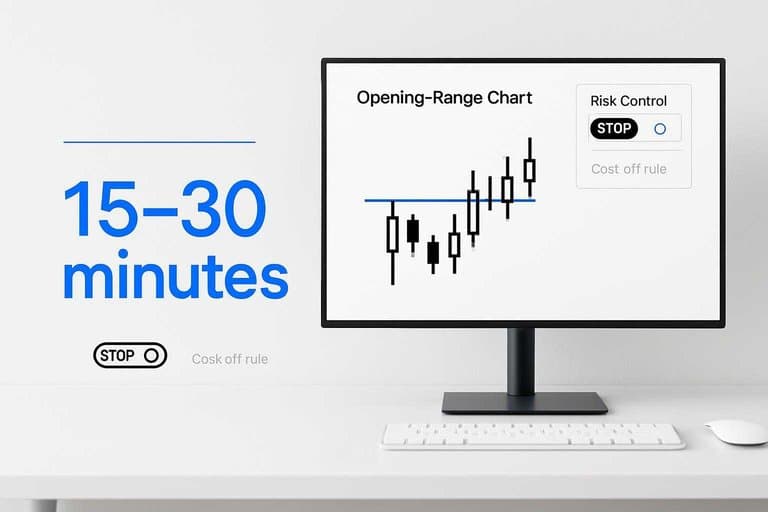
ORB works when you let the first 5–30 minutes define the battlefield.
- Define the opening range high and low for your chosen window.
- Enter on a break and hold, not the first tick through.
- Invalidate on a close back inside, or a hard reclaim against you.
- Target measured moves, prior day levels, or 1–2R into liquidity.
- Skip if spreads are wide, range is huge, or news is chaotic.
Your job is to trade the range break, not argue with the range size.
Pullback after open
Waiting 30 minutes pays when you want the day’s direction and a better entry price.
- Identify trend using VWAP slope, higher highs, and market alignment.
- Mark key levels: premarket high/low, prior day close, and VWAP.
- Wait for the first pullback to a level, not the first green candle.
- Trigger on reclaim, higher low, or break of pullback trendline.
- Place the stop beyond the pullback low, then scale out into prior highs.
You’re trading the second move, where the crowd is already committed.
Risk Management Differences
The open is a volatility event, not just an earlier timestamp. If you trade it like 10:30, your risk math lies to you.
Sizing rules
Sizing has to flex with volatility because the first minutes print wider ranges. Equal share size at 9:31 and 10:15 creates uneven dollar risk, like risking $50 on one trade and $200 on the next.
Use volatility-based sizing:
- Base risk on dollars per trade, not shares
- Size from ATR or opening range width
- Cut size when spreads widen
- Add size only after ranges compress
Your edge can survive noise, but your position size can’t.
Stops and limits
Your orders should match the microstructure of the moment. The open rewards patience and punishes sloppy execution.
- Use wider stops at the open, based on opening range
- Prefer limit entries early, accept missed fills
- Avoid market orders during spread spikes
- Use hard stops early, not “I’ll watch it”
- Tighten stops later as liquidity normalizes
At 9:30, execution is part of the strategy, not a detail. FINRA’s notes on stop orders in volatile markets are a good reminder of how fills can differ from expectations when the tape is fast.
Daily loss limits
Losses at the open snowball because volatility tempts you into fast re-entries and bigger size. One bad fill becomes two revenge trades, then you’re trading emotionally inside the noisiest window.
Set open-specific guardrails:
- Max daily loss: a hard dollar number you stop at
- Max trades: cap retries when the tape is chaotic
- Cool-off rule: step away for 15–30 minutes after a stop-out
If you can’t stop trading, the market will do it for you.
Pros and Cons
Trading at the open gives you first access to price discovery, but it also throws you into peak chaos. Waiting 30 minutes trades some opportunity for cleaner signals and tighter execution.
| Approach | Pros | Cons | Best for |
|---|---|---|---|
| Trade the open | Early breakouts | Wide spreads | News catalysts |
| Trade the open | Fast fills | Slippage risk | High liquidity names |
| Wait 30 minutes | Tighter spreads | Miss first move | Trend traders |
| Wait 30 minutes | Clearer levels | Fewer setups | Risk-averse plans |
If your edge needs precision, pay the “wait tax” and collect better entries.
Which Should You Choose
Your best choice depends on who you are at 9:30, not what the chart “usually” does. Use a simple decision matrix: experience, tools, temperament, and schedule. When one side clearly wins, follow it and stop second-guessing.
Choose open now if
You trade the open for edge, not excitement, because the first minutes punish hesitation. You need criteria that are true on your worst day, not your best day.
- Execute entries and exits fast, with low slippage
- Trade a tested gap plan, with defined triggers
- Maintain high focus for the first 10 minutes
- Stay calm during wide, fast candles
- Enforce strict risk caps, no exceptions
If even one of these is shaky, the open will find it and charge you for it.
Choose wait 30 if
Waiting is a strategy when you want information to replace adrenaline. You’re buying clarity with time, and it’s usually worth it.
- Prefer confirmation over prediction
- Take fewer, higher-conviction trades
- Want tighter spreads and cleaner fills
- Make calmer decisions after early noise fades
- Have limited screen time in the morning
If you can’t watch every tick, waiting turns trading into a process instead of a reflex.
Practical recommendation
Default to waiting 30 minutes for most traders, especially if you’re still building consistency. Use the open only when you run specialized, backtested open setups and you can execute them with tight risk.
Treat “trade the open” like a power tool: great in trained hands, expensive everywhere else.
Pick Your Window, Then Trade It Like a System
Choose the open if you have a defined playbook for high volatility (like an Opening Range Breakout), can accept wider spreads/slippage, and can execute fast with hard risk limits. Choose the 30-minute mark if you want cleaner structure, tighter fills, and more reliable pullbacks or mean-reversion setups after the initial price discovery. Whichever you pick, lock it into your plan: set window-specific position sizing, predefine stop logic, and cap your daily loss so one chaotic open—or one slow grind—doesn’t dictate your month.
Frequently Asked Questions
Is it better to trade open stocks with market orders or limit orders?
Limit orders are usually safer for open stocks because spreads and slippage are widest right after the bell. If you must use a market order, consider waiting until liquidity stabilizes (often 5–15 minutes) and keep size smaller.
What time is considered “the open” for US stocks, and does the first 30 minutes include premarket?
For US exchanges, the regular-session open is 9:30 a.m. ET, and “the first 30 minutes” means 9:30–10:00 a.m. ET. Premarket (typically 4:00–9:30 a.m. ET) is separate and has different liquidity and spread behavior.
How can I screen for the best open stocks to trade right after the bell?
Filter for high relative volume, tight spreads, and clear catalysts (earnings, guidance, upgrades/downgrades, news) using tools like Trade Ideas, Finviz Elite, or your broker’s scanners. Prioritize names with strong premarket liquidity and clean levels from the prior day’s high/low and premarket range.
Do open stocks behave differently on earnings days or during major economic news?
Yes—earnings and scheduled macro releases often amplify opening imbalances, gap size, and reversal risk in open stocks. Expect wider spreads and faster level breaks, and plan for more frequent halts in highly volatile names.
What results should I expect if I wait 30 minutes before trading open stocks?
Most traders see fewer whipsaws and more reliable trend/level confirmation after 10:00 a.m. ET, but they often miss the largest first-leg move. Your edge shifts from capturing the initial gap/momentum to trading continuation or reversal setups with cleaner fills.
Trade the Open With Context
Whether you trade right at the bell or wait 30 minutes, your edge comes from knowing which stocks and sectors are truly leading in the current regime.
Open Swing Trading gives you daily relative strength rankings, breadth, and sector/theme rotation so you can build smarter opening watchlists in minutes—get 7-day free access with no credit card.
Sources
- NYSE Data Insights (Dec 2, 2021): Opening Auction Filling Behaviors—Opportunities Early in the Day — referenced in Liquidity evolution
- FINRA Investor Insights: Stop Orders—Factors to Consider During Volatile Markets — referenced in Stops and limits