Trade Stocks Open or Wait? 7 Scenarios
A scenario-based collection to decide whether to trade the market open or wait—use a horizon-first framework, identify catalysts (earnings/news/macro), set risk guardrails, and adapt to volatility regimes across seven common setups.
Trade Stocks Open or Wait? 7 Scenarios
A scenario-based collection to decide whether to trade the market open or wait—use a horizon-first framework, identify catalysts (earnings/news/macro), set risk guardrails, and adapt to volatility regimes across seven common setups.
The open is where many traders make their best and worst decisions—spreads are wider, emotions run hotter, and price can move farther in minutes than it does the rest of the day. So should you participate immediately or let the noise pass?
This collection gives you a simple framework and seven real-world scenarios—earnings gaps, breaking news, macro releases, trend days, ranges, illiquid names, and your own time/risk constraints—so you can choose the right timing, trigger, and risk control instead of guessing.
Decision framework
You’re deciding between speed and information. Trading the open pays when the catalyst is clear and liquidity is strong. Waiting pays when spreads, emotions, and fake-outs are highest.
Pick your horizon
Your horizon sets your patience, and your patience sets your entry. A day trade needs a clean opening range, while a swing can wait for a pullback. A position trade can scale in over days on a thesis, not a candle.
Example: if you’re swinging earnings, you can wait for the first 30–60 minutes to stabilize. If you’re day trading it, you’re betting the first move is the real move.
Know today’s catalyst
Trade the open when you can name the driver in one line. If you can’t, you’re trading vibes.
- Earnings beat or miss
- Guidance raise or cut
- Macro print surprise
- Breaking company news
- Analyst upgrade or downgrade
If you can’t tie price to a headline, waiting is your edge.
Set risk guardrails
Decide your risk before the bell, not after the first red candle. Set a max loss per trade, size from that number, then place stops where your thesis breaks. Use structure, not pain, like “below premarket low” or “under VWAP after a reclaim fails.”
When your limits are preset, the open can’t bully you into oversized mistakes.
Map volatility regime
Check volatility fast, then choose open or wait.
- Compare today’s ATR to its 20-day average.
- Measure premarket range versus yesterday’s full range.
- Check implied volatility versus the last month’s percentile.
- Read the broad trend using index futures and market breadth.
High vol is tradable only with wider stops and smaller size.
Scenario 1: Earnings gap
Earnings gaps create instant opportunity and instant traps. The open can be perfect when liquidity is thick and your levels are mapped. But extreme or messy gaps deserve patience, even if the chart looks “obvious.”
Trade open when
You trade the open when the gap is tradable, not just exciting.
- Hold a tight premarket range
- Mark clear premarket levels
- Show heavy opening volume
- Get strong index support
- Define a stop before entry
If you can’t point to your stop in one second, you’re gambling.
Wait when
You wait when price discovery will likely be chaotic and expensive.
- Print a huge gap percent
- Show wide opening spreads
- Give conflicting guidance
- Whipsaw in premarket
- Threaten multiple halts
If halts are on the table, your “strategy” becomes your broker’s fill.
Best entry trigger
Use a trigger that forces structure before commitment. Opening Range Break and retest works when the stock respects levels. The first pullback to VWAP works when volume stays strong and clean.
Confirmation earns size, not conviction.
Risk control move
Control risk by assuming the first move can be wrong.
- Start with reduced size.
- Use a wider stop only if risk dollars shrink.
- Set a hard time stop if it stalls.
- Take partials quickly into the first impulse.
Your edge is surviving the open, not winning it.
Scenario 2: Major news
Major news can make the open either a gift or a trap. Use it when the reaction is fast and confirmed, like “FDA approval” or “earnings beat plus raised guide.” Step aside when the story keeps changing and the tape can’t settle.
Trade open when
Trade the open when the headline is clean and the market agrees fast.
- See one clear headline, no qualifiers
- Watch immediate sector sympathy bid
- Check stable spreads and depth
- Notice no follow-up “but” risk
You’re trading information, not interpretation.
Wait when
Wait when the headline is still becoming a story. The first minutes can be price discovery, not direction.
- Spot a developing story with updates
- Face unclear regulatory or legal scope
- See rumor-driven surges and fades
- Get multiple reversals in minutes
When the narrative moves, your edge disappears.
Confirmation checklist
You want confirmation that real money is involved and the move has structure. Think “volume plus levels,” not “fast prints.”
Confirm with a volume spike versus the recent open, a key level reclaim or clean lose, alignment from the sector leader, and market breadth pointing the same way. If two of those disagree, treat the move as noise and wait for the next setup.
Execution steps
Once confirmed, execute like you expect volatility. Your job is to get filled without getting dragged.
- Use limit orders at defined levels.
- Avoid chasing extensions after the first impulse.
- Scale entries in two or three pieces.
- Place the stop beyond a clear structure level.
- Set alerts for headline updates and halts.
Clean execution is your edge when everyone else is reacting.
Scenario 3: Macro data
Macro prints can make the open either clean or chaotic. You trade it when the reaction stays consistent across futures, rates, and FX, like a CPI beat that lifts ES while yields rise steadily. You wait when correlations flip mid-candle and ranges balloon, because that’s when the tape lies.
Trade open when
You want a readable chain reaction. The open is tradable when the first move keeps its friends.
- Futures reaction holds after 5–10 minutes
- Rates and FX confirm the direction
- Sector response stays coherent, not mixed
- Key premarket levels hold on retest
If three markets agree, you’re trading information, not noise.
Wait when
Macro opens punish impatience. You stand down when the market can’t keep a story straight.
- Futures breaks out, then snaps back fast
- Yields whipsaw through prior ranges
- Breadth flips from green to red quickly
- Big overnight gap shows no follow-through
When the signal keeps changing, your edge becomes slippage.
Best playbook
Start with structure, not opinions. Use the opening range plus internals like $TICK, advance/decline, and volume pace, then trade the index or sector ETF first. Only then rotate into the cleanest relative strength names, like the one holding VWAP while the index chops.
If the ETF won’t trend, your single-stock “setup” is probably just beta in disguise.
Timing steps
Treat the first minutes as data collection.
- Wait 15–30 minutes after the open.
- Mark the opening range high and low.
- Note VWAP and the prior day’s high/low.
- Trade only after a level retests with volume confirmation.
- Cut quickly if it re-enters the range.
The retest is the filter that turns a headline spike into a tradable move.
Scenario 4: Trend day
A clean trend day can pay you for acting early. But a suspected trend can punish you for guessing.
Your job at the open is simple. Decide if you’re joining strength or waiting for proof.
Trade open when
You trade the open when the trend is already obvious and broadly supported.
- Follow a strong overnight trend
- Prefer aligned sector leaders
- Demand rising volume early
- Buy higher lows only
- Ensure pullbacks hold VWAP
When you see four or more, you’re trading structure, not hope.
Wait when
You wait when price action says “uncertain” and the open is likely noise.
- Avoid choppy index action
- Skip mixed sector leadership
- Reject repeated VWAP crosses
- Watch for thin liquidity
- Respect wide, sloppy candles
If VWAP keeps flipping, you don’t have a trend. You have a trap.
Hold vs scalp
Hold runners when the trend stays intact and pullbacks look like pauses, not reversals. Think “three small red bars, then push.”
Scalp when the move feels borrowed, like sharp spikes and instant give-backs near VWAP. In that tape, taking the first clean push is a feature, not a flaw.
The giveaway is follow-through. If highs keep getting paid, you can let winners breathe.
Add-on rules
Adding works on trend days because the market rewards confirmation.
- Start small to buy information.
- Add on the break and clean retest.
- Trail your stop under the last structure low.
- Reduce size if candles widen and momentum fades.
Add only when the chart makes your risk smaller. Never when your ego gets louder.
Scenario 5: Range-bound
Range-bound days pay you for patience. You’re trading mean reversion, not momentum, so you need defined edges.
Think “ping-pong,” not “breakout.” If the open prints right into support or resistance, you can fade it. If it opens in the middle, you’re flipping coins.
Trade open when
You trade the open in a range only when price is already at an edge. That’s where your stop is small and your thesis is clean.
- Open at prior support
- Open at prior resistance
- Tag a clear fade level
- Hold a tight, obvious stop
- Get predictable opening liquidity
If you can’t point to the edge, you don’t have a trade.
Wait when
You wait when the open has no location. The middle of the range is where good traders donate money.
- Open inside the middle
- Lack a clear edge level
- Print random wicks
- Show conflicting market internals
When structure is blurry, the market is pricing noise.
Mean reversion cues
Mean reversion shows up when price keeps snapping back to “fair value.” VWAP acts like a magnet, and repeated taps with weak follow-through are the tell.
Prior day high/low and the overnight midpoint often become hard range walls. Add declining volume on pushes, and you usually get failed extensions. That’s when the fade works.
Entry steps
Use a simple playbook so you don’t invent reasons in real time.
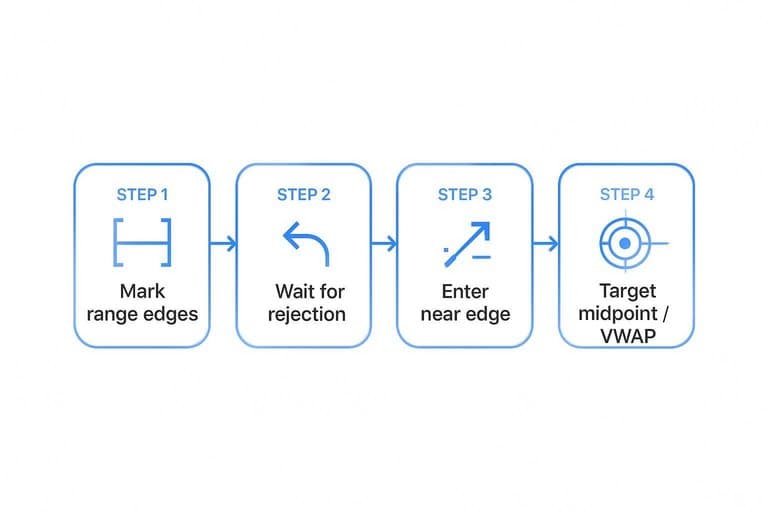
- Mark the range edges from prior day and overnight levels.
- Wait for rejection at an edge, not a first touch.
- Enter near the edge with a stop beyond the level.
- Target the midpoint first, then VWAP if it’s inside.
- Exit fast if a break holds on retest.
Your job is to fade extremes, then stop trading when the range breaks.
Scenario 6: Illiquid stock
Illiquid names punish impatience, especially at the open. One wide spread can turn a “quick trade” into a forced hold.
Treat the open like a liquidity test. If it fails, you wait.
Trade open when
You trade the open only when liquidity is already proven. You need clean execution, not hope.
- Keep spreads tight and stable
- See consistent prints at the tape
- Verify real volume, not one-lot noise
- Trade a clear, timed catalyst
- Confirm fast exits are available
If one of these breaks, you’re trading a trap, not a setup.
Wait when
You wait when the order book looks like air. Illiquidity turns small mistakes into large losses.
- See wide spreads that don’t tighten
- Find sparse bids and thin depth
- Watch erratic jumps between prints
- Notice small-float “push” behavior
- Expect frequent halts or near-halts
If you can’t get out cleanly, you don’t have a trade.
Order choice
In illiquid stocks, your order type is your edge. A market order at the open is basically saying, “Fill me anywhere.”
Use limit orders so you control the worst price you’ll accept. If you must participate, place limits before the bell or wait 1–5 minutes for spreads to normalize.
Your job is simple: pay your price, or don’t play.
Safety steps
You can’t “manage” bad fills in illiquid names. You prevent them.
- Cap size to what you can exit in one print.
- Pre-place limit orders with a firm max price.
- Use hard stops, not mental promises.
- Avoid margin when spreads are wide.
- Stop trading after one bad fill.
One ugly fill is a warning shot, not a challenge. For more context on how the bid–ask spread measures liquidity cost, review the basics before trading thin names.
Scenario 7: Your constraints
Trade the open only when your execution is sharp and your head is clear. Wait when your attention, tools, or emotions raise the odds of dumb mistakes.
Trade open when
You’re “ready” when you can watch the first 15–30 minutes without interruptions and act fast. Think: one screen, one platform, one plan, and the calm to follow it.
Ready looks like this: you already mapped key levels, you know your first entry and your stop, and your order route is tested. You can say, “If it loses $0.30 from entry, I’m out,” and mean it.
Wait when
Constraints don’t just slow you down. They change your decision quality.
- Sitting in back-to-back meetings
- Getting slow fills or lagging data
- Skipping premarket prep entirely
- Feeling revenge-trading pressure
- Running on sleep debt
If two or more are true, waiting is a risk reduction trade.
Prep routine
Use a short routine so “trade open” is a decision, not a mood.
- Scan for liquidity and clean structure.
- Mark premarket high/low and VWAP zone.
- Define invalidation for your main idea.
- Set alerts at trigger and stop levels.
- Write the plan, then choose open or wait.
When the routine feels rushed, that’s your signal to wait.
If you must trade
Sometimes you trade anyway, like when you’re testing a system or managing an existing position. Make your defaults conservative, even if your opinion is strong.
Cut size, cap trades, and take only A+ setups with obvious stops. Hit a max loss and you’re done for the day, no debates.
Choose Your Default, Then Earn the Right to Break It
- Set a default: if you don’t have a clear catalyst + plan, you wait for the first 15–30 minutes and trade only after structure forms.
- Match the scenario: identify what’s driving today (earnings, news, macro, trend, range, liquidity, or your schedule) and use that section’s “trade open vs wait” rules.
- Define the trigger and the exit first: pick one entry trigger, pre-place a stop/invalid level, and size for the wider-open volatility.
- Review after the close: note whether the open offered clean follow-through or just noise, and adjust your “trade-open eligibility” checklist for next time.
Frequently Asked Questions
What time do stocks open and does premarket activity affect the opening price?
U.S. stocks open at 9:30 a.m. ET, and premarket orders (4:00–9:30 a.m. ET) often shape the opening print through the opening auction. Heavy premarket volume and large imbalances can increase slippage and widen spreads right at the open.
Is trading at the stocks open riskier than trading later in the day?
Usually yes—spreads are wider and volatility is higher in the first 5–30 minutes as price discovery happens. If you want lower noise, many traders wait for the first range to form and then trade a break or fade with a defined stop.
How can I measure whether the stocks open is “tradeable” on a given day?
Check opening range size, bid-ask spread, and volume versus normal using tools like VWAP, ATR, and relative volume (RVOL). A tradeable open often shows tight spreads, clean levels, and consistent fills rather than whipsaws and rapid reversals.
Can I use limit orders to trade the stocks open without getting bad fills?
Yes—limit orders control price, but you may miss the trade if the market gaps past your limit in the opening auction. For many setups, placing limits at predefined levels (not “at market”) reduces slippage when volatility spikes at the open.
How long should I wait after stocks open before making my first trade?
A common approach is waiting 5–15 minutes for spreads to tighten and a clear opening range to develop. In very volatile sessions, waiting 30–60 minutes can produce cleaner levels and more reliable signals.
Plan the Open With Data
These seven scenarios make the open feel less random—but executing the framework still depends on having fresh leadership, breadth, and rotation context each day.
Open Swing Trading surfaces breakout candidates with daily relative strength rankings, market breadth, and sector/theme rotation so you can decide whether to trade the open or wait. Get 7-day free access with no credit card.
Sources
- Wikipedia — Bid–ask spread (liquidity cost concept) — referenced in Safety steps